All posts by James Humphreys

Wish – Review

This is what 100 years of artistry has led to.  The Walt Disney Company is a multi-faceted machine that has many branches into different aspects of our pop culture; from movies to theme parks and so much more.  But the core of Disney still remains their now century old animation studio.  Started out of a back room of a law office, Disney quickly grew into the juggernaut of the still maturing animation medium of filmmaking.  They were the industry leaders and the trend setters, and to this day, Disney Animation is still regarded as the gold standard of the art form.  Though the studio has been responsible for many beloved animated projects, what most fans hold the most dear is what is called the Disney Feature Canon.  The canon of animated features dates back to the groundbreaking first, Snow White and the Seven Dwarves (1937), which was at the time thought to be an impossible achievement.  But, the success of Snow White proved that animation could indeed hold peoples’ attention for the length of a full feature film, and Walt Disney and his team wasted no time in repeating that achievement.  Before Snow White was even out of theaters, the Disney animators were already at work on two more projects, Pinocchio (1940) and Fantasia (1940), with a couple more also in the early pipeline.  Disney has continued to build upon this canon of films, through both good times and bad.  The tools over time have changed as well, with computers replacing the traditional hand drawn method.  With the release of last year’s Strange World (2022), the total number of Animated Features in the Disney canon reached 61.  But, there was a milestone coming up in 2023 as the Animation Studio was about to hit it’s century mark.  And with a huge milestone like 100 years, the Disney animation team needed to figure out a special way to mark the occasion.

Sadly, the 100th anniversary has fallen on a hard time for the Disney company.  The studio has seen a lot of their projects over the last year fall short of expectations, which has led to a significant priority shift.  At the same time, the industry itself is not what it used to be, as the streaming market has put every previous metric of success into flux.  The last couple of years has been a bit of a perfect storm of confusion and bad fortune to fall upon every aspect of Hollywood, but especially at Disney.  The pandemic caused significant disruption across the spectrum of the business, with Disney seeing not just a hit to their box office performance with theater closures, but also lengthy closures of their theme parks as well.  Once the world began to re-open, the problems didn’t go away.  Budgets that ballooned over the course of filming during a pandemic made it harder for them to re-coup at the box office once theaters were re-opened, and a significant shift towards streaming viewership also made it hard for studios to generate excitement for theatrical releases.  This was particularly evident with Disney, as their corporate mandate went aggressively into the streaming market.  Though all animation at Disney was affected, the brunt of this shift was particularly felt at Disney’s sister studio in Emeryville, California; Pixar Animation.  Their movies for over 2 years weren’t even granted a theatrical exhibition, including Soul (2020), Luca (2021) and Turning Red (2022).  Meanwhile, the main animation studio still was able to get theatrical releases, though they didn’t fare much better in the post-pandemic box office.  Since Covid, no Disney Animation film has crossed the $100 million mark at the box office, which is troubling given that before the outbreak in 2019, Frozen II (2019) managed to gross over a billion worldwide.  With the 100th anniversary looming, and pressure mounting to deliver a movie that could reverse the sagging fortunes of Disney Animation, the studio heads decided the right thing to do was to return to basics with their newest animated film called Wish (2023); a traditional fairy tale adventure musical with all the hallmarks of what made Disney the dream machine that it has become over the last 100 years.  The only question is did their wish come true or is a dream too far to reach?

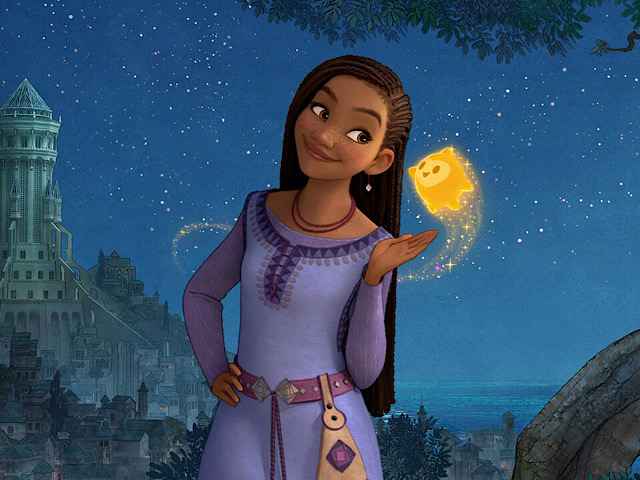
The story of Wish takes place in the mythical kingdom known as Rosas.  The island kingdom has become a place of refuge where residents have come from all over the world to have their greatest dreams come true.  They all come to Rosas because the kingdom is ruled over by a sorcerer turned monarch named King Magnifico (Chris Pine) who has the power to grant wishes, though on a limited basis.  Everyone desires to serve the king and his Queen Amaya (Angelique Cabral) fatihfully in order to have their wish selected and fulfilled.  Chief among them is an eager young woman named Asha (Ariana DeBose), who has been granted an interview to become Magnifico’s apprentice.  Asha has no wish to give herself, but instead she wants to fulfill the wish of her 100 year old grandfather Sabino (Victor Garber).  Upon meeting Magnifico in his palace, she learns that the King is not really granting wishes, but rather hoarding them, picking and choosing a select few to grant each year.  Asha challenges his assertion of what to do with the wishes and it causes her to lose her candidacy for the job.  Distraught, Asha looks for hope in her own wishes, and seeks guidance in the stars above.  To her surprise, a star comes down from the sky towards her.  The Star has a mind of it’s own and begins to spread it’s magic around the forest where Asha has found herself in.  To her surprise, all the creatures touched by the star dust begin to speak, including her pet goat Valentino (Alan Tudyk).  The arrival of the star alarms King Magnifico, who believes it to be a threat to his hold on power over the people of Rosas.  He declares Asha to be a traitor for sheltering the Star, and he promises a wish granted to anyone who rats her out.  Asha seeks the help of her seven friends in the palace, including Dahlia (Jennifer Kumiyama), Gabo (Harvey Guillen), Hal (Niko Vargas), Simon (Evan Peters), Safi (Ramy Youssef), Dario (Jon Rudnitsky), and Bazeema (Della Saba) to assist her in getting Star to the wishes so he can grant them all.  But, they’ll have to act fast once Magnifico has started to delve deeper into his dark, forbidden magic.

As described before, the movie Wish has a lot of heavy lifting to do.  It’s got to help restore Disney’s waning success at the box office while at the same time mark the 100th anniversary of the studio as a whole.  Either is no easy task, but on paper this movie does have the ingredients to make a valiant attempt at the job.  It’s got a charismatic princess type heroine at the heart of its story, vibrant animation, ambitious musical numbers, an unambiguous villainous threat, and plenty of funny talking animals.  It pretty much is every Disney movie you can think of rolled into one.  Unfortunately, the pieces don’t all come together like they should.  Disney’s Wish sadly feels more like a parody of a Disney movie rather than the fleshed out stand alone feature that it aspires to be.  As a life long Disney fan, this movie is especially disheartening in its disappointment because of all those factors that weigh on its shoulder that I described earlier.  It’s the movie that was “100 years in the making” according to the marketing for this film, and this is what we ended up with?  The characters are all shallow imitations of characters we’ve already seen in other, better Disney movies; quite literally in seven specific cases.  The songs are bland and will in no way climb the charts the same way that classics from “When You Wish Upon a Star” to “We Don’t Talk About Bruno” have done in the past.  Even the animation feels woefully generic, especially in contrast to more ambitious films in the last year like Dreamworks’ Puss in Boots: The Last Wish (2022) and Spider-Man: Across the Spiderverse (2023).  Now, to be fair, I have seen worse from Disney; the abysmal Frozen II comes to mind, as well as the basement dweller Chicken Little (2005).  But the way that Wish squanders all of it’s opportunities just makes the end result feel so frustrating and pretty much a punctuation mark on the lackluster year that Disney gave us to mark their 100 years.  Of course, the studio is aware of it’s shortcomings right now and are taking steps to right the ship, but sadly the occasion of a one hundred year anniversary is one they should have gone the extra length to make particularly special and it’s ultimately a wasted effort.

The first and foremost problem with Wish is the story, or more appropriately the lack of one.  Again, the ingredients are there for something special, but it just feels like the filmmakers want to speed run us through them.  This was really apparent to me at a point watching the film where I thought the movie was actually beginning to find some dramatic footing but then I realized that it was already heading into its climax.  I was shocked to to see that almost nothing of substance was happening in the lead up to the climax; it’s just a collection of cat and mouse chases and then on to the final battle.  The movie is 95 minutes long, a full 11 minutes longer than Beauty and the Beast (1991) for example at it’s 84 minute length, and yet in the Beauty and the Beast’s case those 84 minutes developed a richly textured love story that grows organically without feeling rushed and even finds time for seven original songs.  Wish never gives the story enough time to breath and allow us to get to know the characters and the world they inhabit.  One obvious problem is that there are simply too many characters.  Not only do you have Asha and King Magnifico, the two characters who we should be learning the most about in the story, but their time on screen has to be shared with Asha’s seven friends, her pet goat, as well as Asha’s grandfather and mother, and also the Queen as well.  The movie has a big problem with balancing all of these characters into the story as a whole, and as a result character development suffers.  This is especially a problem when it comes to Asha, as she should stand out as a more interesting heroine.  We don’t understand her motivations other than standing up to King Magnifico.  Her wants and desires are ultimately surface level and she never exhibits any aspirational qualities.  More useful time used to develop her as a character could have helped, but I guess the filmmakers were desperate to have a song and dance scene with chickens.

Not every aspect of the film fails though.  If there is a silver lining to the film, it would be the voice cast.  While her character development suffers greatly in the movie, Asha still is able to be endearing enough thanks to the soulful performance of Oscar-winner Ariana DeBose in the part.  You can tell she is trying her hardest in the performance to make Asha an appealing character, and it does translate in the film.  There’s a wonderful earnestness in her vocal performance that helps to cut through the lackluster writing.  You can probably tell from Ariana’s performance that voicing a Disney heroine was a dream come true for her, so she definitely seized her moment and made the most of it, especially in the songs that she performs.  Of all the songs in the movie, the one that comes closest to working is the big ballad “This Wish;” your standard Disney “I Want” song.  The song itself is no “Part of Your World,” by a long shot, but Ariana DeBose still crushes it with her angelic, Broadway trained voice.  The other noteworthy vocal performance is from Chris Pine, playing the villainous Magnifico.  You can definitely see that Pine understood the assignment and goes full maniacal Disney villain with his performance.  It’s a little cartoonishly over the top at times, but given the blandness of most of the rest of the movie, his performance is the one thing about the movie that stands out, and as a result he ends up stealing every scene he’s in.  Alan Tudyk has over the years become Disney Animation’s good luck charm, having had a role in every film from the studio since Wreck-It Ralph (2012); much like the role John Ratzenberger has played over at Pixar Animation.  Tudyk’s performance as Valentino the Goat is fine, though not as funny as his past roles, and he’s mainly here just to get a chuckle out of the little kids in the audience, which I guess he does a fine job with.  The rest of the cast don’t stand out much at all, but they aren’t terrible either.  Again, the cast is let down by a poorly written story, and it’s only through the efforts of a talented vocal cast that they movie escapes becoming a complete disaster.

There’s a lot to say about the animation as well.  Wish continues the recent trend of textured animation being applied to 3D computer generated models.  It’s basically CGI trying to emulate the look and feel of something that was hand drawn.  In some cases, we’ve seen a brilliant utilization of this animation style, like with Sony Animation’s  Spiderverse movies.  It’s a trend that is definitely catching on, and Wish is Disney’s first attempt at adopting this style.  While the Spiderverse movies emulated the look of comic books for its art style, Disney delved into its own history to find the right kind of texture to build their palette around.  The art style of Wish is a mixture of the kind watercolor richness of Snow White and the Seven Dwarves, but with the angular composition and high detail of Sleeping Beauty (1959).  While the end result does look pleasing to the eye, it also makes the movie feel derivative.  The movie tries too hard to look like a Disney movie, and as a result it lacks its own iconic elements to help it stand out.  All the classic Disney animated features stood out from the pack because they didn’t just copy what had been done before.  That’s why each kingdom is unique in the Disney canon, and why they work with so many diverse cultural influences.  When Disney movies are your cultural inspiration, it just feels like animation cannibalizing itself.  Also, Disney doesn’t fully commit to the textured animation either.  The distinctiveness of the Spiderverse movies is attributable to the way the characters are animated as well, with the animators using choppier frame rates for the characters to make their movements seem more dynamic and hand drawn.  The characters in Wish have the skin and clothing texture of that classic Disney hand drawn style, but they still move with the same fluidity of a computer animated character, making the characters feel a little too plastic.  Perhaps it may have worked better if, you know, Disney actually tried to make this movie the traditional hand drawn way like they used to.  I feel like Disney has been spooked ever since the post-Renaissance decline and the fact that the big hand drawn come back in the late 2000’s, led by The Princess and the Frog (2009) never lit up the box office the way they would’ve liked.  Since then, it’s been all CGI for better and worse.  I know it’s out of their comfort zone now, but I feel Wish would’ve been better served as a return to the traditional hand drawn art style that built the company in the first place, rather than this compromised half-and-half approach that ultimately doesn’t work the way it’s supposed to.

I don’t think that Wish is the end of Disney Animation as we know it as some more doomerist critics have deemed it to be.  It definitely feels like a good idea that unfortunately was squandered by a lot of bad creative decision.  How far up the problems go at Disney Animation I am not sure, but the movie definitely feels like it was the victim of corporate interference as the studio was desperate to have a product out by the end of the year to commemorate an anniversary.  It doesn’t surprise me at all that this was a late Chapek era project, as it has all the hallmarks of a movie made by a committee rather than artists.  The screenplay was co-written by Disney Animation head Jennifer Lee, but her success in the pass with working on classics like Frozen (2013) and more recently Encanto (2021) should say that she’s got enough good creative good sense to see these features through.  Considering that this movie was produced during the turbulent transition from Bob Chapek back to Bob Iger tells me that the film needed more time to fully cook, but it unfortunately had to still hold it’s anniversary release date which meant not giving it enough time to work out all it’s issues.  I just hope that Bob Iger and the top Disney brass takes the disappointment of this movie as a sign that they need to invest less in their animation output.  If anything, this movie shows that the Animation Department at Disney has been neglected these last couple years, and should really be focused on more.  You can still tell that the animators poured their heart and soul into their work.  It’s just that all that great animation ultimately doesn’t stand out with a story that is insultingly flimsy.  Sadly, this is what we ended up with as a touchstone to mark Disney’s 100th anniversary.  We as fans wanted a love letter and all we got was a greeting card.  But, if you are looking for a more rewarding experience to mark Disney’s 100th, check out the short Once Upon a Studio (2023), playing right now on Disney+.  The short is a wonderful celebration of the studio’s history, as all of the animated characters from every film, from Mickey Mouse to Asha, assembles outside the Burbank Studio office to take the ultimate family photo.  It’s a wonderful short that both works as a well crafted piece of animation as well as the love letter to Walt Disney’s legacy that this 100th anniversary deserves.  As for Wish, it sadly will be looked at as a lost opportunity.  Younger audiences unaware of the 100 year legacy may not care as much and will probably enjoy the movie a lot more.  But for adult fans who wanted something more than this, you’re better off wishing for something else.

Rating: 6.5/10
The Director’s Chair – William Friedkin

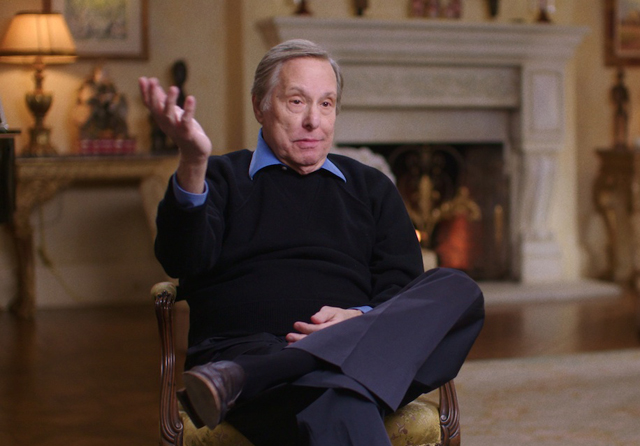
There are very few filmmakers out there who left quite the impression that the late William Friedkin had made, both behind the camera and in front.  Part of the young crop of filmmakers that rose up in the late 60’s and early 70’s as part of the “New Hollywood” movement, Friedkin was a maverick in every sense of the word.  His unglamorous, documentarian style was so unlike what the rest of the industry was making, and it grabbed a hold of audiences in a way that took many industry insiders by surprise.  He was also a brash, opinionated auteur who was not afraid of speaking his mind, even when it would burn a bridge or two with other creative collaborators.  But there was no one in all of Hollywood, even among his detractors, who denied Friedkin’s talents as a filmmaker.  He has gone on to become one of the most influential filmmakers of the last half century, with directors like John Singleton singling him out as a particular inspiration in their work.  And though the New Hollywood era came to an end with the dawn of the age of blockbusters in the 1980’s, Friedkin would continually still find work both inside and outside of Hollywood.  In addition to being a part-time film school instructor (including at my own film school Chapman University, though sadly before my time there), Friedkin would continue to direct small films for the big screen as well as for television, and remarkably enough was also a director of operas both in his home base of Los Angeles and for the National Opera in Washington.  Even in his final year, he was still working on what would be his final film, Showtime Network’s The Caine Mutiny Court Martial (2023), showing that even at the age of 87 he remained a tireless storyteller.

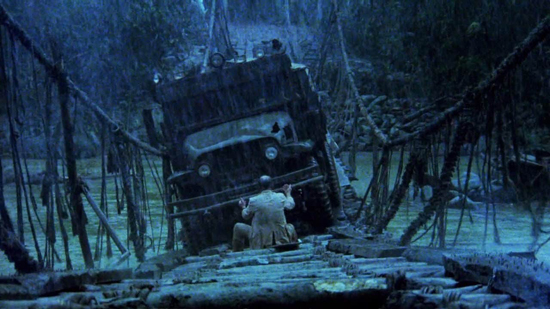
Friedkin was born in 1935 in Chicago, Illinois to a family of Jewish Ukrainian emigrants.  Given the person he would become one day, it may be surprising to know that he didn’t see his first film until he was 16.  But the movie that introduced him to the art of cinema would be a profound one and it would shape the course of the rest of his life.  That film was Citizen Kane (1941) by Orson Welles, and anyone familiar with Friedkin’s filmography will undoubtedly find the aura of Kane looming large over Friedkin’s particular style.  Friedkin became a true cineaste afterwards and he spent much of his young adulthood indulging in the masterworks of that time period, both domestic and foreign.  Eventually, upon graduating high school, he gained a position working for the local Chicago WGN television station.  After working his way up from the mail room, he was granted the chance to direct programming for the station.  Friedkin would excel as a documentarian in those years, winning accolades and awards for documentaries like The People vs. Paul Crump (1962) and Mayhem on a Sunday Afternoon (1965).  Eventually, he grabbed the attention of movie studios who were looking to make use of his talents as a director.  He initially started out with a Sonny and Cher movie called Good Times (1965) which he later described as “unwatchable.”  But, this experience did lead him towards directing an adaptation of the Mart Crowley play The Boys in the Band (1970).  Though Friedkin is not gay himself, he is lauded by the LGBTQ community for directing the first mainstream film to contain positive portrayals of queer identity, and Freidkin over the years did consider it one of his own personal favorites.  But, what came after may be one of the best back to back triumphs of any filmmaker in Hollywood ever.  He would go on to direct the crime drama The French Connection (1971), which would be an astounding hit that ended up sweeping the Academy Awards, including a win for Willaim who at the time was the youngest Best Director winner ever at the age of 35.  To follow that up, he directed the horror themed The Exorcist (1973) which even to this day is still one of the highest grossing films in history adjusted for inflation.  Of course, astounding heights soon lead to depressing lows, and Friedkin’s follow-up, Sorcerer (1977), despite being an impressive cinematic achievement was also plagued by production problems and was unable to make-up it’s colossal budget at the box office.  Friedkin’s remaining career would experience ups and downs, but it never quite returned to the height it had in the early 70’s.  But, it never got Freidkin down as he remained active all the way up to his passing earlier this year.  In this article, I will be taking a look at all of the important factors that made a William Friedkin film stand out in the cinematic crowd.

1.

DOCUMENTARIAN STYLE

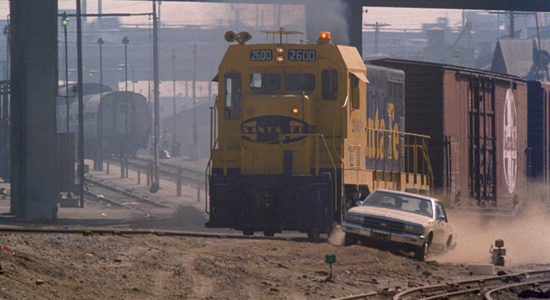
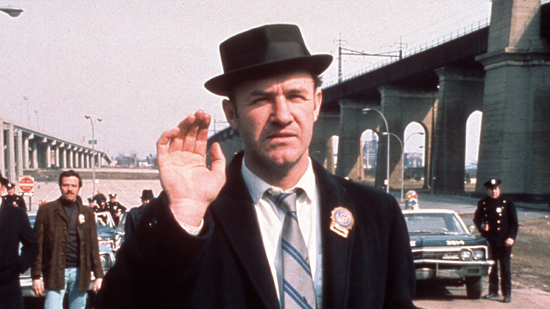
A lot of filmmakers carry the tricks of the trade that they started out with along with them as they create their body of work over time, and William Friedkin is no different.  From a filmmakers style, you can tell if they started off as a commercial director, a television director, or a documentarian before they got into narrative film.  Friedkin was definitely the latter, and it’s that documentarian spirit in his film-making that really makes his style stand out.  Every movie he made has a very voyeuristic feel to them, like the camera has unexpectedly captured a moment.  Friedkin’s films make particularly heavy use of hand held photography, which are especially present in his action scenes.  While Friedkin didn’t invent the first person car chase sequence on film (Bullit had done that back in 1968), his team did take it to the next level.  The car chase in The French Connection is one of the most wild and visceral action sequences ever put on screen, with Friedkin upping the ante by having Gene Hackman’s Popeye Doyle chasing an commuter train.  The whole sequence has a chaotic feel and that’s because Friedkin is shooting the sequence with any artificiality involved.  Real cars on real roads, with the camera right there in the passenger seat.  For Friedkin, cinema was about getting as close to reality as possible, even if the story was something supernatural like The Exorcist.  And the documentarian in Friedkin’s style can even be found in the quieter dialogue moments, as he often shots his subjects from far away with shallow depths of field, again like he’s catching a moment rather than staging one.  Though the scales of his movies changed over time, Friedkin still would use his documentarian instincts in most of the films he made over the years.  His groundbreaking French Connection car chase scene would inspire similarly impressive action scenes in his later films like To Live and Die in L.A. (1985) and Jade (1995).  Friedkin would also continue to create the occasional documentary, including 2007’s The Painter’s Voice and 2017’s The Devil and Father Amorth.  Documentaries was the language of cinema where he found his voice, and it’s something that he carried with him all the way through his career.

2.

CONTROLLED CHAOS

One other thing that comes from a documentary background is the sense of letting the unexpected happen in order to create a magical moment on film.  This is something that certainly has it’s rewards, but also it’s consequences as well on a movie set.  Ever the maverick filmmaker, Friedkin would often make his movies with a sort of reckless abandon, hoping to create very naturalistic results for his film.  In many cases, this would bring his cast and crews dangerously close to the edge.  There are many stories from the sets of his movies of near death experiences and on set injuries.  That previously mentioned car chase from the French Connection was notoriously shot in some instances without a permit, making it illegal and dangerously hazardous to unsuspecting pedestrians that may have gotten a little too close to the shooting location.  There is one shot that made it into the movie where the stunt car has to quickly swerve out of the way of a pedestrian, and you see the car jump a curb, hit a trash can and nearly miss the camera by just a couple feet.  This is a chaotic way to make a film, but the end result is one of the most famous chase sequences in movie history.  Friedkin likewise used some extreme tactics on the set of The Exorcist.  Young Linda Blair experienced minor injuries from the ropes used to flail her around on the bed during her exorcism scene, and actor Jason Miller also violently confronted the director after he fired a gun near his ear in order to get the right startled reaction from him.  These were pretty extreme measures taken in order to create the amount of authenticity that Friedkin desired for his films.  No one would argue with him, as long as the results panned out.  This mode of filmmaking eventually came to a head with the filming of Sorcerer, William Friedkin’s big budget remake of Henri Georges-Clouzot’s The Wages of Fear (1953).  The film is celebrated today as a colossal achievement in filmmaking, but Friedkin’s chaotic instincts got the best of him as the movie’s production turned into an over-budget mess that couldn’t recoup at the box office, showing his limits for the first time in Hollywood.  Most of the movies he made since then would try to replicate the action dynamics of his early years, but he would do so without the same amount of chaos, keeping things smaller and more controlled.

3.

FLAWED, AMORAL PROTAGONISTS

Apart from his attraction to darker themed movies, Friedkin also was drawn to stories centered around imperfect characters.  While a lot of Hollywood dramas wanted to leave the viewer with a good sense of good triumphing over evil, Friedkin liked to view the deeds of people who operate within shades of gray.  The main characters in his movies are often people just skirting on the edge of the right side of the law and are not so easy to root for from the start.  No character better exemplifies this than Jimmy “Popeye” Doyle from The French Connection, brilliantly portrayed by Gene Hackman in an Oscar-winning performance.  Hackman plays Doyle as a brash, unorthodox cop with violent tendencies and often a very racist attitude.  At the same time, we also see that he is the best person for the job in hunting down the villainous French drug kingpins that are plaguing his city.  Most of Friedkin’s movies would follow along with main characters that exemplify these moral gray areas, because in Friedkin’s worldview, there is no such thing as a pure hero.  These are real characters and like all real people, they have character flaws that make them far more interesting and individualistic.  The story then becomes how well the characters overcome their flaws in order to succeed in the end.  This is definitely true of all the characters in Sorcerer, where their initial motivation is greed but ultimately by the end it becomes about survival.  Some of Friedkin’s characters in the later part of his career also fall on different sides of that moral gray area.  In The Hunted (2003), the movie comes down to a battle of wits between two battle weary killers played by Tommy Lee Jones and Benicio Del Toro.  Matthew McConaughey plays both sides of the law in Killer Joe (2011), as both a cop and an assassin.  Even the purer characters in his movies carry some kind of baggage with them that keep them from being just purely good and moral.  That’s true of the two priests in The Exorcist, Father Karras and Father Merrin (Jason Miller and Max Von Sydow respectively), as both are experiencing their own crises of faith in their own way as they try to summon the strength to battle an otherworldly evil.  It’s clear that Friedkin was never interested in the traditional standard of characterization from Hollywood, where good and evil was so black and white.  And that’s why he’s so celebrated now as a storyteller as his characters stand out as uniquely amoral.

4.

THE “CITIZEN KANE” SHOT

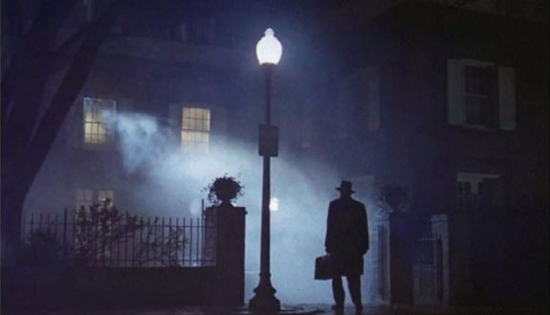
There is something in William Friedkin’s style that very much owes a lot to classic Hollywood, and it’s something that harkens back to the movie that made him from the very beginning.  To his dying day, William Friedkin stated that Citizen Kane was his all time favorite film, and it shows very much in his body of work.  In particular, there’s something within Friedkin’s movies which has become known as a “Citizen Kane” shot.  In Citizen Kane, Orson Welles would accentuate the largeness of his character by shooting many scenes from low angles; so low in fact that special trenches had to be dug on the set for the cameraman to get as low to the floor as possible.  As a result, you see something in Citizen Kane that is often out of view in most movies, which is the ceiling.  William Friedkin loved this kind of camera angle so much that he frequently used in most of his films.  When the camera isn’t handheld in a scene to accentuate the action, Friedkin will often have it still and low to the floor, helping to still maintain that voyeuristic element.  While there is at least one of this kind of shot in the majority of his movies, it’s The Exorcist where you see the “Citizen Kane” shot deployed the most.  He keeps the camera low for most of the movie, which may have been a necessity given the fact that they were shooting in a real home for most of the movie as opposed to a soundstage set so space was likely limited.  At the same time, it gives an extra sense of claustrophobia as the visible ceiling boxes the scene of the exorcism in all that much more.  That confined feeling really elevates the violence on screen too, as the demonic paranormal activity of things flying around the room feel reminiscent of Charles Foster Kane’s violent outburst at the end of Citizen Kane, again with the low angle making the moment feel all the more visceral for the viewer who feels trapped.  It is beautiful to see the full circle of cinema as one cinematic classic is responsible for inspiring another in an unexpected way.

5.

FEROCIOUS VIOELNCE

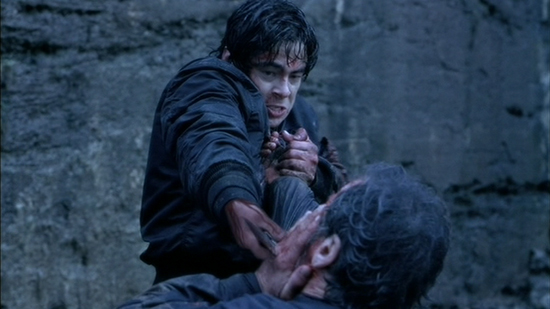
Violence is another crucial ingredient in William Friedkin’s movies.  But, unlike a lot of other action movie directors, he never once glamorizes his violence.  If anything, he wants the viewer to experience how truly ugly violence really is.  In his films, every violent act is shocking and brutal, even if it isn’t always bloody.  This is definitely true of the controlled chaotic movies of his early career, where there is a crazed manic energy to the violence in those films.  The most violent parts of The Exorcist achieve the effect that Friedkin desired, which is to make you feel uneasy and afraid.  It was reported at the time that many people would faint in the theater watching The Exorcist because of the sheer amount of unrelenting shock the viewer would go through in the movie.  As film standards loosened around what was acceptable with on screen violence, Friedkin would continue to push the boundaries to their limit.  His late career films are a great example of how he was trying to go as far as he could with on screen violence.  The Hunted features some very visceral moments of violence, particularly in the climatic riverside brawl between Jones and Del Toro.  Bug (2006) brought in the kind of claustrophobic insanity that you can find him recalling the close quarter violence of scenes from The Exorcist.  And Killer Joe became that rare movie to be slapped with an NC-17 rating for it’s violence.  But never once does Friedkin try to indulge and glamorize in any of that violence.  It’s always treated as an ugly action, and his use of it within his movies is part of his attempt to capture a sense of realism within his scenes.  There really is no other director out there who makes the spilling of blood on screen feel more real and personal than William Friedkin and it’s something that really has made him stand out as an influential filmmaker.

I have talked before on this site many times about my attendance for many years at the annual TCM Classic Film Festival in Hollywood.  While there are many memories that I cherish from my time at the festival, some of my favorite moments are the ones that William Friedkin was a part of.  I feel so fortunate to have seen William Friedkin live in person at the festival not once but twice, for screenings of The French Connection and The Exorcist especially.  The Exorcist screening in particular stands out as one of my all time favorite festival experiences, as Mr. Friedkin shared an hour’s worth of stories and anecdotes from his experience working on the movie.  It was amazing seeing this filmmaker well into his eighties still manage to captivate an audience just through telling his own story on stage.  He was long winded to be sure, but we the audience didn’t care, because his stories were just so fascinating to listen to.  There is no doubt that he lived a wild life, and that is clear from the movies that he left behind.  He certainly was not a perfect human being, given some the controversial ways he made his movies, but at the same time perfection was never something he valued.  He was perhaps the best personification of what we knew as “New Hollywood;” a filmmaker who sought to break all the old rules and turn cinema into something different for a new generation.  At the same time, he was a man that still had a reverence for classic cinema; in particular for the films of Orson Welles and Alfred Hitchcock.  He remained a champion for the movies all his life, and it’s satisfying to see that he did indeed leave an impact.  So many action films today owe a debt to the innovations he made as a filmmaker, especially with the documentarian, in the middle of it style that he applied to the violent moments within his movies.  It’s also worth revisiting a lot of his film analysis from his scholarly years, especially when you see him getting especially salty in some interviews.  The man was just as much of a character in real life as the ones he put up on screen.  I will definitely miss his presence at the festival screenings, and I feel honored to have been there for the ones that I did see him attend.  He was certainly a giant in the history of cinema, and he thankfully never grew out of his reputation of being a maverick filmmaker.

The Marvels – Review

There is no doubt that the 2010’s belonged to Marvel Studios at the box office.  The comic book movie machine dominated the multiplexes, creating the most lucrative franchise in Hollywood history with a connected universe of super hero franchises all contributing to a grander narrative while also working perfectly well on their own.  The Marvel Cinematic Universe reshaped the way stories could be told on the big screen, and suddenly every other studio was looking for their own cinematic universe to mine gold from.  But few if any could do what Marvel had done.  Under the leadership of studio head Kevin Feige, and with the deep pockets of their parent company Disney, they managed to build upon each movie they put out, making each one more profitable than the last.  But of course, all roads must lead somewhere, and the culmination of all of these connected stories in their movie train had to have a satisfying conclusion to justify the audiences’ time and money spent watching them.  The collection of Avengers movies in Marvel’s first three phases made excellent destination points to drive the story towards, creating monumental adventures that loom large over all the other stories told up to that point, but also satisfying our desire to see all threads woven together and having all of our heroes sharing the screen together.  The first decade of Marvel’s master plan culminated in the two part saga of Avengers: Infinity War (2018) and Avengers: Endgame (2019), and given how well Marvel mastered their storytelling craft over those ten years, audiences were overwhelmingly ecstatic with the results.  What became known as the Infinity Saga is a masterclass in franchise building over multiple individual story arcs with many different star characters.  Marvel managed to successfully wrap their colossal story up in a thoroughly satisfying manner, defying all conventional wisdom.  But, once you’ve successfully done the impossible, you are then expected to do it again.

It’s not uncommon on the comic book page to start another chapter after completing a big, universe changing event.  It is however untried territory in cinema.  Kevin Feige and his team did turn to one such crossover event to begin a new phase of their Cinematic Universe; one that involved the concept of the Multiverse.  Much like how all the connecting threads of the Infinity Stones in Marvel’s first three phases led down a road to a confrontation with the fearsome Thanos, the Multiverse would be woven into multiple storylines in the MCU, eventually culminating with the multiverse’s biggest menace from the comic books; Kang the Conqueror.  A sound plan on paper, but harder to achieve in reality as it turns out.  Marvel, more or less, has struggled to keep their post-Endgame momentum going.  Some of it certainly has been due to external forces (Covid, economic uncertainty, the strikes) which have disrupted Marvel’s release plans numerous times.  The inclusion of projects meant exclusively for streaming on Disney+ has also increased the workflow of Marvel to a point where the studio is starting to buckle under the massive burden on their shoulders.  In the span of only 3 years, Marvel has released double the amount of film and television projects that they had in any of the previous phases.  And audiences who loyally kept up with the MCU for the last 15 years are now starting to feel burned out.  Sure, there are still highlights here and there (Spider-Man: No Way Home, Wandavision, Loki, Black Panther: Wakanda Forever, and Guardians of the Galaxy Vol. 3), but a lot more are just okay (Moon Night, Multiverse of Madness, Hawkeye) or a couple that are just downright bad (Black Widow, Ant-Man and the Wasp: Quantumania, Secret Invasion).  For the first time in it’s history, Marvel Studios seems to have lost it’s luster as the good is being outweighed by the bad.  And into this cloud of uncertainty, Marvel is releasing what has reported to be one of their most troubled productions; the big budget sequel to Captain Marvel (2019) titled simply The Marvels (2023).  Is The Marvels another harbinger in Marvel’s collapse, or is it a surprising bright spot in an otherwise bad situation?

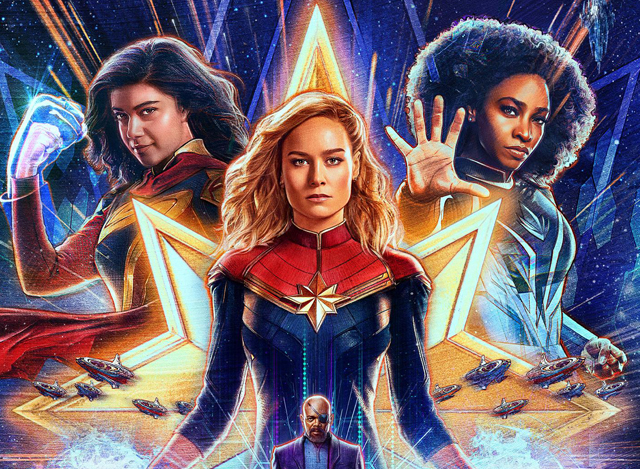
The Marvels has to juggle quite a few story elements that may be hard to follow if you haven’t seen any of the Disney+ shows.  Captain Marvel herself, Carol Danvers (Brie Larson) is out patrolling deep space when she receives a message from her contact on Earth, Nick Fury (Samuel L. Jackson).  Fury is on the Earth orbiting Space Station S.A.B.R.E where another super powered agent named Monica Rambeau (Teyonah Parris) is also stationed.  Fury is concerned over an anomaly found at a intergalactic portal point near Earth.  He asks Carol to investigate the portal’s exit point while Monica checks the other end.  When the two come into contact with the portal, the energy causes a reaction.  Suddenly Carol and Monica are warped into different locations, but they are also not alone.  Someone else has been caught in this entanglement as well; a super-powered teenager from Jersey City named Kamala Khan (Iman Vellani), aka Ms. Marvel.  After the trio have to deal with the dilemma of their displacement, they come together to assess what is happening to them.  There is a lot of baggage coming into the meeting on these heroines; Carol was best friends with Monica’s mother, but her 30 year absence after gaining her super powers has chilled their once affectionate friendship, especially after Monica’s mother Maria (Lashana Lynch) passed away.  On top of this, Kamala is a massive fan girl of Captain Marvel, which makes her extremely overwhelmed in her presence.  They all realize that they’ve been connected together based on their light based super powers and any time they try to use them, they’ll warp into the other’s place, which can be major problem when one of the heroes can’t fly.  Though reluctant at first, given Carol’s preferred isolation, Captain Marvel decides to have the other two follow her along as she unravels the mystery surrounding the broken portals.  She soon learns that the havoc is being caused by a Kree warrior named Dar-Benn (Zawe Ashton) who has gained possession of a powerful weapon, a bangle identical to the one that gave Kamala her powers.  Dar-Benn is hell bent on targeting Captain Marvel personally, calling her the “Destroyer” after Carol had been responsible for the downfall of her home world.  Can the three heroines manage to work around their unfortunate entanglement to save multiple worlds affected by Dar-Benn’s actions, and even more so, can they become better heroes as a team rather than by themselves.

The Marvels unfortunately has to carry a lot of baggage with it into theaters.  It’s coming into theaters at an unfortunate time, with both Marvel and Disney having struggled all year long with multiple disappointing results at the box office and in the streaming ratings.  The discourse around this film has also become unfortunately negative, and in some corners toxic.  It stems back to when the original Captain Marvel released into theaters.  Actress Brie Larson made some comments in the past about diversity mattering in film criticism (not even about her own film, but instead about the reception of the 2018 movie A Wrinkle in Time) and this caused an uproar from people online.  Critics of Brie Larson labeled her (wrongly) as being anti-man and began a crusade online to attack her at every turn no matter what she said or did as a means of putting her back in her place.  Thankfully, Captain Marvel managed to rise above the hatred directed at it’s star and became a billion dollar hit at the box office.  But the trolls didn’t go away and continued to hound Brie Larson for her perceived crimes in their eyes.  There are dozens of channels on YouTube alone that are devoted to solely condemning Brie Larson or any cultural figure that expresses any feminist opinion on their own, and sadly these channels are the ones that the algorithm drives traffic towards because negativity creates more engagement.  With the financial woes of Disney and Marvel, and the unfair “culture war” negativity placed upon it, The Marvels seems to have been put into this no-win situation as it has become a lightning rod for the state of the industry and the culture itself.  With all that going on, the outlook is not a positive one for the movie, but even still I tried my best to leave all that baggage at the door and just judge the movie based on it’s own merits.  And surprisingly I found myself actually having a good time.  The Marvels, despite all the burdens laid on it’s shoulders, actually managed to do what Marvel does at it’s best: entertain.

Of course, The Marvels isn’t perfect either.  It does have a fair share of problems; particularly with it’s story.  The narrative in this movie is pretty scattershot, with what seems like a bunch of ideas thrown at the wall hoping to have something stick.  It becomes even more complicated when the movie has to incorporate back story completely disconnected from what we’ve seen from Carol Danvers story up to now.  Somebody who has watched only this and the previous Captain Marvel will be completely lost.  Not only is there a 30 year gap between the stories in each film, but Monica and Kamala’s backstories require information from the shows Wandavision and Ms. Marvel to understand, especially regarding how each got their powers.  The Marvels doesn’t feel in any way like a sequel to Captain Marvel, and instead just feels like an episode of the ongoing MCU series that now spans several more hours of view time since we last followed Carol’s story.  It’s a lot to unpack, and it doesn’t really give adequate time to newcomers to catch up with the story.  On top of that, the story that we do get is pretty flimsy, especially when it comes to the villain’s plot and how they overcome it.  So, why isn’t the movie any worse for that.  Well, as sloppy as the story is with it’s story, it manages to overcome it by having a good vibe to the flow of the story.  At 105 minutes, this is the shortest MCU film ever, and I think that brisk run time helps the movie out immensely.  It doesn’t try to force any more weight on the story than it needs, which has become more of a problem recently with Marvel’s output, and just lets the vibe of watching these characters interact carry the movie along.  The pacing is on point as a result, and more of the gags land better.  I think a lot of the success of finding that right balance comes from director Nia DaCosta.  She’s not trying to shake-up the MCU as we know it, but instead manages to find the heart of the story that she’s been assigned to tell.

There is little doubt, even from the most ardent critics, that the movie’s best asset is the cast.  In particular, the three leads.  Brie Larson, Teyonah Parris, and Iman Vellani have remarkable chemistry, and it’s their interaction on screen that helps to propel this movie past it’s shortcomings.  For one thing, I actually think this is the best we’ve seen Brie Larson in this role ever.  She didn’t quite have the grasp of the character in Captain Marvel, and she wasn’t given a whole lot of screen time to develop more in Avengers: Endgame.  Here, we actually see her make Carol Danvers much more relatable than before.  She conveys the lonely existence that she’s lived over 30 years (Earth time) as essentially a galactic beat cop, and being forced to work as part of the team opens up new avenues of her character we have yet to see.  Where we see her become disarmed and regretful of the actions of her past are some of the best character moments yet that Brie has displayed in her run as the character.  Teyonah Parris picks right up from her excellent  performance as Monica Rambeau in the Wandavision series and she has some of the best reactions in the movie when the film goes into some of it’s weirder moments.  But the star of the film is undoubtedly Iman Vellani as Kamala Khan.  She steals every scene she is in, and her infectious bubbly personality is a big reason why this movie has such a strong vibe to it.  Given that Iman is a true comic book nerd in real life, it’s especially fun to see her playing Kamala as this hyper fan girl in Captain Marvel’s presence, knowing that it’s not a far cry from who she really is in person.  The movie also does a great job of incorporating the whole Khan family into the story, including Kamala’s mother, father, and brother (played by Zenobia Shroff, Mohan Kapur, and Saagar Shaikh respectively).  There’s a couple great sequences where they are even involved in the action, which leads to some very crowd pleasing moments.  Samuel L. Jackson doesn’t get much to do as Nick Fury, and he’s probably just here as a holdover because of his history with Captain Marvel, but he does manage to make the most of his short time and even gets some of the best one-liners in the movie.  If there was a weak spot in the cast, it’s the villain Dar-Benn.  Zawe Ashton isn’t bad in her performance, it’s just that her character is a bland stock villain overall that she really can’t do much with.

There’s been a lot of discussion regarding the way Marvel has used their visual effects in recent years.  A lot of complaints have arisen over the fact that Marvel had been over-burdening their visual effects teams, leading to a lot of burn out in the industry with artists working long hours for little extra pay.  This has been a industry wide problem for the most part, but Marvel has been one of the worst offenders.  The mismanagement of this situation even led to the firing of longtime Marvel executive Victoria Alonso, who was one of the overseers of the visual effects department.  This has all led to what many people have seen as a downgrade in the quality of visual effects from recent Marvel projects, especially in films like Thor: Love and Thunder (2022) and Ant-Man and the Wasp: Quantumania (2023), which looked like they released in theaters with unpolished effects.  It’s a mess in the ever crucial effects department, and this has led to effects artist beginning to unionize for the first time at the major studios.  With all that going on, how did it affect the visuals in The Marvels.  Well, there are a couple effects that did look rushed and unfinished at times, but they are thankfully not as distracting as the ones found in the other movies.  In one aspect, the lighter vibe of the movie actually makes some of the more cartoonish effects shots feel not too out of place.  This is true about a sequence involving cats that I won’t spoil too much, but I will say that the fact that the visual effects didn’t look completely naturalistic in that scene actually helped to make it a whole lot funnier, and it’s to the movie’s benefit.  When the movie calls for a stand out effects sequence, it does deliver and credit to the visual effects team for doing the best they could under the circumstances.  It probably helped that Nia DaCosta had a clearer sense of the tone she wanted to set, which meant that there was more leeway to be creative in the process.  This movie knows it’s not an Avengers level project and it wants to treat the audience to a more fun romp by comparison.  I don’t know if there was trouble involved behind the scenes when it came to making the movie look the way it does, but you definitely aren’t made aware of it while watching the movie.

Sadly, the discourse surrounding this movie is going to get ugly for the next few weeks.  The trolls are going to make a lot of noise and claim victory for their cause after the movie doesn’t perform well.  Of course, there are other factors contributing to the low box office projections for this movie, including Disney’s cost-cutting affecting it’s marketing as well as the actors not being able to promote the film because of the strike that only just ended days before the premiere, that are completely unrelated to the “culture war” narrative that the trolls are trying to shoehorn this movie’s fortunes into.  I dare say, those factors are more than likely what’s causing The Marvel’s problems right now, and much less what the trolls think of Brie Larson.  I think that it’s unfortunate that all of this baggage has had to fall on the shoulders of this movie.  Too many people are saying that the future of Marvel rests solely on the box office performance of this one movie, and that it’s failure at the box office will mean the end of the MCU.  This of course is ridiculous.  Marvel, and for that matter Disney, are going to come out of this fine.  Marvel already is making adjustments for a post-strike roll out that will likely see them improve in the years to come, especially with their next film in theaters being the highly anticipated Deadpool 3.  What worries me is that the discourse will be hurting the creatives behind the film more.  Nia DaCosta and the three leading ladies did an admirable job here and helped to elevate the film above it’s issues, leading to an overall enjoyable experience.  Same with all the hard working crew.  But all of that is going to get buried under a whole lot of negativity in the coming days and weeks.  My hope is that when the discourse dies down that people actually judge the movie based on it’s own merits and not on how it fits into a cultural and political narrative.  I know it’s not going to be for everyone, and it’s still likely going to be a divisive film no matter what.  But please, if you are going to see this movie (which I heartily recommend) do so with an open mind and with all of the discourse noise filtered out.  Tune out the pundits and the apologists and the trolls, and just let the movie speak for itself.  If you don’t, you may in fact be robbing yourself of a good time in the theater.  I watched this with a semi-full theater, and this movie had the best response I’ve seen to a Marvel film in a long time, with the audience laughing and cheering like they did at the Marvel movies of old.  And that’s certainly something to marvel at after all is said and done.

Rating: 8/10

100 Years of Wonder – The Walt Disney Studios’ First Century and the Highs and Lows of the Magic Kingdom

The name Disney is undeniably a potent one in our culture.  No other media company in the world has risen to the heights that they have while at the same time maintaining it’s independence as a brand.  It is the only one of the “big five” movie studios in Hollywood to have never been owned by a larger conglomerate, and in fact it has grown to a point where they were able to acquire one of their former rivals in the marketplace (the formerly known 20th Century Fox).  That massive growth has also come with it’s own problems, as Disney has become such an omnipresent presence in our culture that it’s drawn scrutiny from critics who say that they are (sometimes rightly or wrongly) a menace to society.  The Disney Company is many things to many people, but the undeniable fact is that it has been a continual presence in most of the lives of the people who live today.  I guarantee that for most people the first movie they ever saw had the Disney name on it.  Most of us probably owned a Disney branded toy at some point in our childhood, and a good many people probably have had happy childhood memories of visiting either Disneyland or Disney World.  Whether you like them or not, the Disney Company has played a part in the shaping our lives, from childhood on.  And the story of how they got to this point in our culture is one that could be indicative of the story of Hollywood as a whole; a convergence of incredible talent, perseverance through adversity, and just a whole lot of good luck.  As they celebrate their 100th year, let’s take a look at the tumultuous journey the Walt Disney Company took from one man’s dream to the Magical Kingdom that we celebrate as a whole today.

Walt Disney was certainly a unique figure to emerge out of the early part of the 20th Century.  He started off as an amateur artist who worked his way into this emerging new artform called animation.  Only a few years removed from the innovations of Windsor McKay and his groundbreaking short Gertie the Dinosaur (1914), the young Walt foresaw the potential of what moving drawings could do, and even more importantly, he had the special ability to sell others on his ideas.  Walt quit the Laugh O’Gram animated shorts studio in Kansas City, Missouri that he had been forging his skills at and took up an offer from his brother Roy to move out to Los Angeles.  Once there, Walt convinced Roy to help him establish a new independent studio out there in the shadow of Hollywood.  But instead of doing the same educational or slice of life shorts that he was working on at Laugh O’Grams, they would be innovating with the artform, creating unique characters and stories that pushed beyond the boundaries of the medium.  Assisting Walt with that mission was a fellow artist that he had befriended back in Kansas City named Ub Iwerks.  Iwerks was a mechanical genius who was interested in experimental camera tricks that he wanted to bring into animation.  The trio set out to start this bold plan and on October 16, 1923, the day we have commemorated this year, Roy and Walt signed the LLC paperwork to officially begin what was then called the Disney Brothers Studio.  The newly formed company consisted of only three employees on day one (Walt, Roy and Ub) and was run out of a back room in a small law office in the Los Feliz neighborhood of Los Angeles.  Not even Walt could have foreseen how these humble beginnings would grow into the giant empire that Disney has become a full century later.  But, the story of Disney Animation began here and immediately the trio of young innovators were ready to shake the world up with what they were dreaming.

Roy of course would run the business end while Walt and Ub took on the creative side.  Over time, Walt realized that he couldn’t match Ub’s ability to animate with incredible speed and artistry, so he evolved more into a producer and story writer role in those early days.  Over time, Walt hired on more artists, as well as a secretary named Lillian, who would in a couple years become the future Ms. Disney.  Though they didn’t have the budget and infrastructure in place that other animation studios at the time had, they managed to stand out due to the fact that they were experimenting with newer techniques.  One of the great innovations that Ub Iwerks had put into practice at the studio was the blending of live action photography with animation.  This breakthrough (one which Disney would revisit many times throughout their history) gained them immediate attention in Hollywood circles, with many people being in awe of how they were able to put live action characters in an animated world.  These Alice shorts (loosely based on the story of Alice in Wonderland) were what initially put Disney on the map, and they were able to secure a new lucrative distribution deal with the Charles Mintz company at Universal Studios.  With the new deal in place, Walt was ready to create a series of shorts centered around a character that he hoped would be as popular as Felix the Cat or Max Fleischer’s Koko the Clown.  That character would be a rabbit named Oswald.  The Disney Brothers Studio completed a number of Oswald the Lucky Rabbit shorts before Walt was called out to New York to meet with Charles Mintz directly.  What Walt didn’t expect going into that meeting was that Mintz had locked away the rights to the Oswald character and hired away all of the Disney artists, cutting him out of the deal, believing that the animators were the sole reason for the studio’s success.  Only Ub refused to sign with Mintz.  Walt was devastated.  He had lost everything he had built over those five short years; his staff, the rights to his own characters, and his reputation.  But, as would be a reoccurring theme throughout the history of the Disney Company, bad fortune would end up leading to a better future.  On the train ride back to California, Walt began to brainstorm his next step.  He no longer had the rights to Oswald, but he was free to create a character from scratch.  That’s when he began to dream up a cartoon mouse who he would later give the name Mickey.  And out of all the moments in Walt Disney’s life that mattered the most, this was the most important of them all.

Walt Disney, no matter how successful he became afterwards, would always return to the same conclusion about how he got to where he was, “It was all started by a mouse.”  Mickey Mouse is above all else the heart of the Walt Disney Company.  While it can be said that there wasn’t much of a shift between Mickey and Oswald (all they did was swap bunny ears with mouse ears), there certainly was a shift in how seriously Walt took the character.  The incident with Charles Mintz was a pivotal lesson for Walt, and from then on he was never going to take anything he made for granted.  Through Mickey Mouse, Walt went from being an animator to a showman.  People would see the name Walt Disney on a Mickey Mouse short and know that this was a different kind of animation from all the rest.  And it was through Mickey Mouse’s debut on the big screen, that Walt Disney would shake the world again with another innovation; sound.  Steamboat Willie (1928) was the first ever short with synchronized sound, which not only gained Walt renewed notoriety, but it turn Mickey Mouse into a household name across the country and the world.  It was around that time that Roy insisted they change the name to the Walt Disney Studios, recognizing that Walt’s showman instincts made him a better public face for the company.  Over the next couple years, the Walt Disney Studios grew exponentially, adding more and more artists to studio roster, though he also lost Ub during this time, as he was set on establishing his own studio.  Along with Mickey Mouse, the company was also adding to even more sidekick characters that themselves grew into stars of their own like Minnie Mouse, Donald Duck and Goofy.  They also created a new line of one-off shorts called the Silly Symphonies, where the artists would try out experimental ideas that wouldn’t fit in the mainline Mickey cartoons.  Only a couple years after Charles Mintz had pulled the rug out from under Walt Disney’s legs, Walt was not only still standing but thriving.  There weren’t even any Oswald shorts being made anymore and Mintz soon lost his contract with Universal.

As the story of the Disney Company evolved over the next few years, we see where the element of luck played a key role in their success.  The Walt Disney Company was one of the few companies to blossom during the height of the Great Depression.  The country was in need of something to bring the spirits of the people up, and Mickey Mouse was that one thing.  Disney was also the beneficiary of having a bunch of hungry and bold-thinking artist who were desperate for work, and the key players who would shape the next few decades of the Disney company came to work for Walt during these pivotal years.  But even despite this success, Walt was still a gambler who was willing to put up a lot at stake in order to see a dream become a reality.  Despite the fact that the Mickey Mouse shorts made them a lot of money, it was also off-set somewhat by the enormous costs of making the increasingly complex projects they were working on.  Disney was innovating at a speed and scale that other animation studios couldn’t match, and that was expensive to maintain.  One thing that certainly tested Roy Disney’s management over the coffers of the company was Walt’s dream of full length animated feature.  Despite misgivings, Walt was able to convince Roy and his team of artists that such a thing could be done, and the next few years were spent seeing this colossal dream come true.  Often dubbed Walt’s Folly by the industry, Walt invested his future on this idea, even putting up his home and studio up as collateral to get the bank loans need to pay for it.  But, Snow White and the Seven Dwarves (1937), like Mickey Mouse nearly a decade before, became an overwhelming success.  Roy was able to pay off all the loans, and the extra profits went into the construction of a new studio campus in Burbank, California, where the Disney Company still calls home to this day.  But, even with all that, Walt still never rested on his laurels, and he continued to bet big.  This often clashed in the face of reality sometimes, like with the onset of World War II, where the European market was cut off and expensive projects like Pinocchio (1940) and Fantasia (1940) failed to make their investment back.  The boom and bust pattern is one that is consistently present throughout Disney’s history, but one other thing that is persistent about the Disney company is that like Walt himself, they learn valuable lessons from their failures.

This was true especially in the later part of Walt Disney’s life.  In 1955, Walt embarked on his most ambitious project yet; opening a theme park named Disneyland.  And while Disneyland has grown to become one of the world’s most cherished vacation destinations, it had it’s struggles right from the beginning.  One of the things that Walt wished he had thought through better when it came to Disneyland was to have more control over the land around it.  Disneyland quickly was surrounded on all sides by businesses that popped up to capitalize on the park, including cheap motels and restaurants.  Walt’s true vision was to create a true place to leave the world behind, which led him to envision something on a more massive scale.  Through a clever use of shell companies, Walt and Roy bought up over 40 square miles of swampland in central Florida.  After it was discovered that the Disney company was behind this land grab, Walt determined that he was ready to tell the world what he was planning.  “The Florida Project” as he called it would be a vast resort destination with it’s own version of Disneyland, plus an urban planning initiative that his team of Imagineers were calling an Experimental Prototype Community of Tomorrow, or EPCOT for short.  Sadly, this would be the last great dream of Walt Disney.  Walt died of lung cancer on December 15, 1966 at the age of 65.  The suddenness of his passing left a huge void at the company that he built.  Ambitious projects that he was personally involved with, like the movie The Jungle Book (1967) and the rides Pirates of the Caribbean and Haunted Mansion (all of which would become legendary in their own right), had to press on without Walt’s guidance.  Roy Disney, having always looked out for his little brother over the years, took over as best he could in the years that followed.  Perhaps his own greatest legacy was seeing Walt’s final dream come true with the opening of Walt Disney World in Florida in 1971.  Roy himself would pass away a mere two months later.

Without the two Disney brothers there to guide the company, the future of Disney was uncertain.  From here on, the history of the company falls into different eras that like Walt’s time represented a pattern of busts and booms.  The 1970’s are considered to be the Dark Ages for Disney.  Walt’s son-in-law Ron Miller eventually rose to the level of CEO during this time, and he tried his best to carve out a positive future for the company, but it was very clear that he didn’t have the same magic touch that Walt had.  The Animation Department, the foundational heart of the company, even faced permanent closure in the early 80’s after the box office failure of The Black Cauldron (1985).  There was a hostile takeover bid conducted by financier Saul Steinberg which threatened to destroy the company as a whole, before a rescue effort was led by Walt’s nephew Roy E. Disney.  The younger Roy, who maintained a seat on the board, convinced the company to hire outside executives who would bring a new vision to the company.  In from Paramount Pictures came Michael Eisner and Frank Wells as CEO and CFO, having overseen a golden age at that studio, including the creation of the Indiana Jones franchise.  Eisner and Wells brought an ambitious vision to the company to help it grow while at the same time honoring the character of the studio that Walt had cultivated during his time.  The best part of this new era was that they were able to salvage the animation department, which led to what is now known as the Disney Renaissance, creating brand new classics like The Little Mermaid (1989), Beauty and the Beast (1991) and The Lion King (1994).  Sadly, the sudden death of Frank Wells in 1994 hit the company hard.  Eisner lost his partner in crime, and he began to drawback most of the ambitious plans that the two had dreamed up for the future of Disney.  Again, the company hit hard times as Eisner began to mismanage the priorities of the company, chasing cheap short term gains instead of building the brand long term.  Threats of another take over, this time by cable giant Comcast, began to emergeEisner, seeing patience growing short with stockholders, decided to step down in 2006.  His successor would be the head of Disney’s ABC division, Bob Iger, who would indeed breath new life into the company.  Iger’s tenure was a period of rapid expansion for the Disney company, with acquisitions of valuable of IP’s like Marvel and Lucasfilm happening on his watch.  He even convinced Universal to give them back the rights to Oswald the Lucky Rabbit, bringing Mickey’s predecessor back home after 80 years.  In the late 2010’s, Disney was at the peak of it’s powers; a media juggernaut unlike anything Hollywood had ever seen.  But, as we’ve learned from Disney’s history, it wasn’t going to last forever.

Ironically, as Disney is celebrating it’s 100 year anniversary, it is also having to contend with one of it’s most tumultuous years ever as well.  Disney has had one unfortunate event after another all falling into their lap this year.  Big box office disappointments from the likes of Ant-Man and the Wasp: Quantumania (2023), Indiana Jones and the Dial of Destiny (2023) and Haunted Mansion (2023) have dented their reputation as a box office champ.  Disney+, their ambitious streaming channel, is also not generating enough money in subscriptions to offset the cost of the money spent on shows and movies premiering on the platform.  And while theme parks are holding up okay, ticket sale are still below what they were at the height pre-pandemic.  All of this has led to Disney’s stock value reaching a decade long low.  A lot of the problems have been attributed to the mismanagement of Iger’s successor Bob Chapek, who was fired from the CEO position after only 2 tumultuous years, leading to the immediate return of Iger.  But, many people are saying that Disney has become a victim of it’s own success as well.  It’s grown too fast and many believe it’s unsustainable in it’s current state as a company.  Rumors are that Iger’s second tenure may include a sell off of different underperforming parts of the company, or perhaps a complete sale of Disney as whole to an even bigger company like Apple (as has been rumored).  One hopes this isn’t the case.  It’s easy to look at this year alone and feel like Disney is cooked and it’s days are numbered.  But, looking at the history of Disney as a whole shows that they have faced adversity before and have come out of it stronger.  At the end of the day, it’s the core of the Disney Company (it’s imagination and the will to see the impossible become a reality) that has always endured, and the example that Walt Disney himself left behind has helped that legacy endure even through the dark times.  Walt never forgot that all important lesson when he lost the rights to Oswald, that failure sparks ingenuity and that you have to keep moving forward.  As much as we dislike some of the directions Disney has taken recently, we all wish to feel that same spark of joy again when they are performing at their best.  We all grew up with a little bit of Disney in our lives, and most of us would like them to bring back a little bit of that wonder into our lives again, even as we get older.  My belief is that this time of adversity will help shape a brighter future for Disney ahead.  Some may be cheering on Disney’s demise and believe they can do their job better.  That’s a mistake that many adversaries have made before, from Charles Mintz to Ron DeSantis, and they have gone on to regret it too.   Walt Disney and the many dreamers that have come through the Disney company over the years have continually been underestimated and as a result they all collectively have made many dreams come true.

Top Ten Most Gruesome Disney Villain Deaths

One thing that has been the hallmark of the success of Disney Animation are the characters.  Over their 100 years, the studio has grown it’s roster to include hundreds of classic characters that have found their place in the hearts of generations of fans, from Mickey Mouse onward.  And while there are groupings of characters that standout more than others, I think that the most surprising fanbase to have popped up over the years has been the ones for the Disney Villains.  The Villains sometimes have even been the main attraction, remembered far more than the rest of the films they inhabit, and that’s perhaps because just by their very nature they are out-sized personalities that command every moment they are on screen.  In addition to being scene-stealing presences in their movies, the Disney Villains also can become more legendary by just how big of an exit they are given.  Because Disney has catered to a family friendly audience for most of it’s existence, they often shy away from violent imagery, and that’s largely the reason why they rarely enact violent ends for their villains.  Most of the time the villain receives their comeuppance through karmic retribution or ending up in prison for their crimes.  But, there are villains whose evil deeds are so great that a violent end does justify itself.  And in some cases, Disney says farewell to their villains in a surprisingly dark and graphic way; by their standards anyway.  With Halloween around the corner, and continuing on my look at Disney during their 100th anniversary, I decided to list what I think are the most gruesome villain death scenes from Disney movies.  I’m excluding their entirely live action films, so no Star Wars or Marvel since they could fill their own lists, but I will include villain deaths from films that have both live action and animation, as well as include films from Pixar Animation as well.  So, here are my picks for the Top Ten Most Gruesome Disney Villain Deaths.

10.

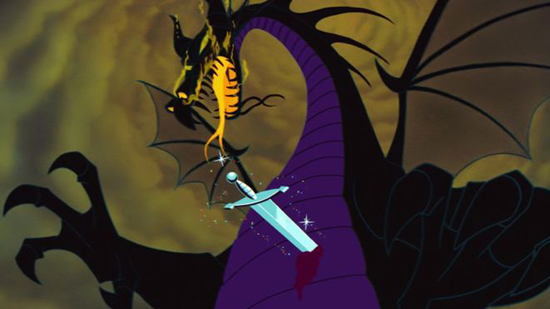
MALEFICENT from SLEEPING BEAUTY (1959)

SLAYED BY AN ENCHANTED SWORD

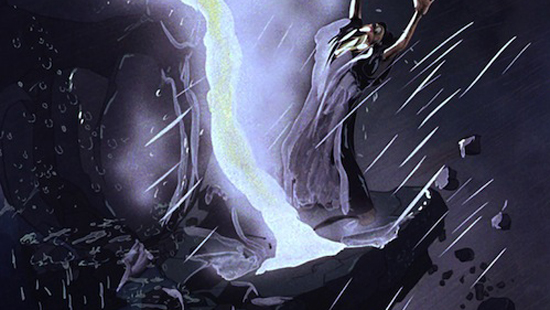
Certainly the “Mistress of All Evil” would have a death scene that was iconic in it’s own way.  The reason I don’t have her higher is because the thing that ultimately dooms her is nothing extraordinary with regard to fantasy storytelling.  The valiant Prince Phillip does exactly what any hero in a fairy tale does; he saves the kingdom by slaying a dragon.  Perhaps what makes the scene so iconic is not the kill shot, as much of a bullseye as it is, but the whole scene that leads up to it.  Maleficent calls upon all of her magical tricks to prevent Phillip from breaking her curse on the kingdom, in a tour de force sequence that shows Disney at it’s absolute best.  However, it is when she transforms into a dragon that the scene reaches another level.  You really feels the odds stacked up against the hero, with the villain seeming to be unstoppable.  And that’s what makes the defeat of Maleficent all the more satisfying by the end, because it all feels like a great evil has been vanquished.  The only downside is that the actual plunge of the sword into Maleficent’s heart comes at us a tad bit anti-climatic, though it is significant in the fact that we see a rare instance of on-screen spilled blood in a Walt era Disney movie.  It is still a strong moment in the movie, with Maleficent’s pained scream, even in her dragon form, feeling like the roar of an otherworldly demon.  Of course, even as the life goes out of her, Maleficent still attempts one final kill as she snaps at Phillip one final time before falling to the ground.  It’s not the most creative way for a Disney villain to go out, but the sequence it’s a part of is still an all-time masterwork of animation, and that certainly earns a place for it on this list.

9.

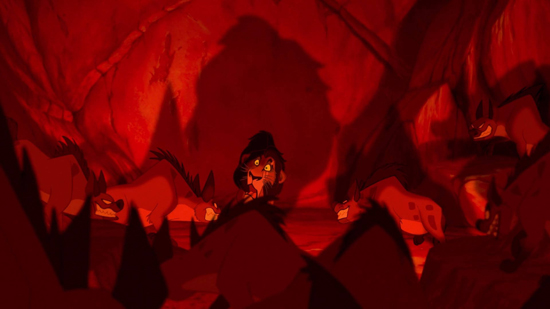
SCAR from THE LION KING (1994)

EATEN ALIVE BY HIS OWN MINIONS

Scar is an interesting case of a villain who succumbed to the consequences of his own misdeeds.  His whole evil scheme was to take power through the regicide of his brother the king and his nephew.  To do so, he made a pact with the hyenas, giving them free reign over the Pridelands, his kingdom, and as a result he disrupted the food chain (or Circle of Life) as they call it that made the kingdom prosper and drove it into ruin.  There’s a Arthurian element to this story, where the return of the good king brings prosperity to the land once the bad king is driven out, and the makers of The Lion King borrow greatly from those kinds of legendary tales, as well as quite a bit of Shakespeare.  Certainly the thing that makes Scar such a great villain to hate is his lack of morals.  He is someone who will do anything to gain power, and that’s what makes his inevitable downfall all the more satisfying.  He is also a petty character as well, willing to throw anything in his way in order to survive.  That’s ultimately what leads to his downfall.  His nephew Simba easily overpowers him to reclaim his throne, but to buy himself an out after being cornered, Scar claims to Simba that he only acted the way he did because of the hyenas, saying it was their idea.  Simba of course doesn’t buy it, but he grants Scar mercy by condemning him to exile.  Scar, ever the petty one, attacks Simba when his defense is down, but ultimately he is no match and Simba sends him off the summit of Pride Rock in a steep fall.  Scar survives, but he finds himself surrounded by his hyena minions, who just happened to overhear him throwing them under the bus.  The hyenas have also been starving because of the shortage of food under Scar’s reign.  So, we see Scar’s evil schemes come full circle as he ultimately is undone by the very thing he empowered.  Of course Disney spares us the graphic details, playing out Scar’s end through shadows, but it’s obvious to us the grisly end that Scar meets, and it’s one that is significantly satisfying for such a weaselly manipulator who only cared about himself.

8.

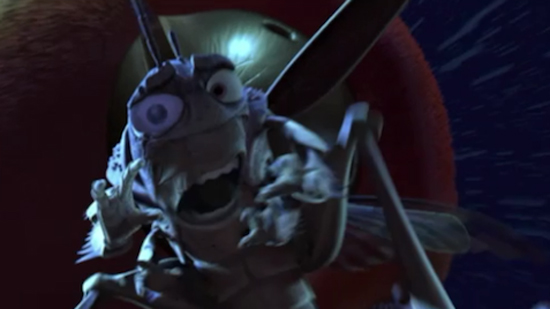
HOPPER from A BUG’S LIFE (1998)

LATE NIGHT SNACK FOR BABY BIRDS

Hopper was an early Pixar movie villain that proved to be surprisingly brutal and dark for a family film.  The leader of a gang of grasshoppers who bully a colony of ants is not above using violent ends to not just get his way, but to also make his point.  One particularly dark moment involves Hopper crushing two of his minions to death under a mountain of food after they challenge his reasoning for demanding tribute from the ant colony.  It also is interesting to note that Hopper is the only Pixar villain voiced by a real life monster named Kevin Spacey.  Which makes it all the more satisfying that Hopper is one of the few Pixar villains who is done in by the end of the movie.  But, of course, the creative minds at Pixar are not going to kill off their dark and sinister bad guy in any ordinary way.  One of the few weaknesses that Hopper has as a character is his crippling fear of birds, which is something that the resourceful hero of the ants, Flik, takes advantage of.  He convinces the colony to build a replica bird as a defense against the grasshoppers, and while it works initially, Hopper eventually gets wise to the artifice.  However, this misconception that the ants have built a bunch of fake birds ends up leading to Hopper’s downfall, because during the final climax of the movie, Flik leads Hopper to a real birds nest and the villain doesn’t realize he’s been tricked until it’s too late.  Hopper’s demise is both hilarious in execution as well as a bit terrifying.  We know he’s about to be eaten alive, horrific as it sounds, but the ones doing the devouring are the cutest little baby chicks Pixar has ever animated; a nice little spin that the animators made to give it that extra bit of satisfying comeuppance.  It’s that mix of cute baby animals and Hopper’s helpless screams of terror put together that makes this villain death scene so memorable, and a brilliant way to make a gruesome death feel consequential but not out of place in a colorful movie like A Bug’s Life.

7.

JUDGE FROLLO from THE HUNCHBACK OF NOTRE DAME (1996)

PLUNGED INTO THE FIERY PIT

There’s a complaint that Disney tends to kill most of their villains off in the same way, which is to have them fall from a great height, making it a bit of a cliché.  The truth is that even though it does show up multiple times in Disney animation, it is an overall effective way to have the villain meet their end in a G-rated film; it’s bloodless and it doesn’t involve the heroes actively dealing a killing blow to the villain, thereby maintaining their purity of character.  A lot of Disney villains meet their end this way; Gaston, Professor Ratigan, Mother Gothel.  But it is perhaps Judge Claude Frollo’s fall from a high place that stands as the most memorable.  Not only is he falling from the balcony of the Notre Dame cathedral, but he is plunged head first while grabbing onto a very heavy stone gargoyle sculpture towards the square down below, which we know from earlier in the film has been covered in a layer of molten iron that the hero Quasimodo poured down to ward off invaders.  You’ve got to believe that it was not a pleasant end for Frollo.  Frollo is far and away one of the most vividly portrayed evil characters in any Disney movie.  His pious hypocrisy makes him an especially hateable presence in the film, and the fact that he’s a bit of a sadist is another layer to his villainy that makes him all the more potent.  That’s why his death scene has this satisfying and ironic karmic sense to it.  He believes he’s got the heroes, Quasimodo and the gypsy Esmeralda, cornered and he triumphantly holds his sword up high, quoting scripture by saying, “He shall smite the wicked and plunge them into the fiery pit.”  But, of course fate has other plans, as Frollo’s footing gives way.  Amping up the symbolism of the moment, the filmmakers had the gargoyle that Frollo is clinging to life to transform into a terrifying hell beast, indicating where Frollo is headed to in the next life.  It’s operatic and perhaps a little too heavy-handed, but still a satisfyingly gruesome end to one of Disney’s most evil human monsters.

6.

THE EVIL QUEEN from SNOW WHITE AND THE SEVEN DWARVES (1937)

STRUCK BY LIGHTNING, FALL OFF A CLIFF, AND CRUSHED BY A BOULDER

You wouldn’t think that Disney would take out their villain in a violent way during it’s early years, let alone in their first feature film ever, and yet they did just that.  Snow White and the Seven Dwarves pushed the boundaries of what could be done with the animated medium, and it’s interesting that Disney did not hold back when it came to creating a terrifying presence in their villainous Evil Queen.  Everything about the character is dark and foreboding, even during her regal scenes in her castle.  Once she transforms into her peddler woman form, she is the stuff of nightmares, with her gnarled fingers and buggy eyes.  As sweet and light as the rest of the film is, the Queen casts a dark shadow whenever she appears.  It’s to Walt Disney and his team’s credit that they remained true to the dark nature of the character, and it’s likely why they also chose to make her comeuppance in the story all the grander once it comes.  The moment Snow White bites the poison apple, it’s almost like nature itself has come apart, as the Queen’s triumphant laughter is punctuated by the sudden flash of a raging storm.  As she makes her way back to her castle, she finds that the Seven Dwarves are hunting her down.  She escapes them by climbing up a mountain slope, only to get cornered on a cliffside.  A precariously balanced boulder nearby gives her one final weapon to stop the Dwarves, and she tries to push it down their way, hoping to crush them.  In a real deus ex machina moment, her evil intent is stopped by a lightning strike right at her feet.  It crumbles her ledge away, causing her to fall to her death (it all started here).  To make the death even more gruesome, the boulder she intended to crush the dwarves with ends up toppling in her direction after she falls off screen with a final helpless scream.  It is amazing that even in their first animated film they managed to make their climax feel this monumental, and the Evil Queen’s over-the-top death scene really set the bar high for Disney afterwards.  It almost seemed like they were afraid to go as big as they did afterwards, because another Disney villain wouldn’t die on screen until Maleficent 22 year later.  Nevertheless, it is one that still remains memorable over 80 years later and is still a somewhat shocking moment for a Disney movie given when it was made.

5.

SYNDROME from THE INCREDIBLES (2004)

DEATH BY CAPE

Keeping in the same tradition of Hopper from A Bug’s Life, the main adversary of the Incredibles family also has a death scene that is both gruesome and hilarious at the same time.  Earlier in the film, the Incredibles’ go-to outfit designer Edna Mode makes it clear that she has one primary rule: No Capes!!  The reason for this is because though capes are an aesthetically pleasing and traditional part of a superhero’s overall presentation, it can also become a hazard depending on the situation.  The movie demonstrates this with a hilarious montage of different super heroes over the years who have had their cape get snagged on something or causes their wearers to get pulled into harm like they were lassoed in by a rope.  The Incredibles creator Brad Bird (who also voiced Edna Mode) brilliantly pays off this gag late in the film’s climax with the villain Syndrome being killed off by what else, his cape.  The great thing about this pay off is how sneakily Brad Bird brings it back into the movie.  Syndrome’s cape is not exactly a prominent feature of his costume, so we forget it’s there most of the time.  But once Syndrome is thwarted after Mr. Incredible throws his car at the villain’s hover plane, he is thrown back towards one of the plane’s jet turbines, and all of a sudden we are acutely aware of the cape.  It’s a hilarious way to finish off this villain, who certainly has earned this karmic death after the years of slaughtering super heroes to build better weaponry, but also at the same time when you think about it, it is also horrific in it’s own way.  What happens to the human body when it gets sucked into a turbine engine is pretty gruesome.  The movie spares us the blood and horror of it, instead showing the fireball aftermath, but we can still imagine what happened.  Given the gruesome nature of it, as well as the perfect punchline to a running joke throughout the movie, this is certainly the best villain death to have come from Pixar Animation.

4.

CLAYTON from TARZAN (1999)

HUNG EXECUTION STYLE IN TREE VINES

Tarzan is definitely one of Disney’s more action oriented films, so more on screen violence is to be expected.  This also leads to one of the more explicitly violent villain deaths in all of Disney Animation.  Clayton is not a particularly original villain.  His kind of trigger happy gentleman explorer type is just basic stock villainy for a lot of films similar to this one, both in animation and live action.  He still works as formidable foe for Tarzan in the movie, and is give a wonderfully boisterous vocal performance by legendary British character actor Brian Blessed.  But during the film’s climatic confrontation, Disney shockingly pushes the limit for what they can get away with in a G-rated film with the way Clayton meets his demise. He chases Tarzan into the treetops with his shotgun fully loaded.  Tarzan and him skirmish for a bit, before Tarzan manages to disarm him.  Tarzan could end the fight by pulling the trigger, but he proves he’s the bigger man by not sinking to Clayton’s brutal level and he smashes the gun to pieces.  Clayton then resorts to using his machete to lunge with murderous intent at Tarzan.  The fight ends up culminating in a tangle of vines, which Tarzan has a natural advantage in.  With his knowledge of the natural barrier that the vines provide, he manages to entangle his foe in the foliage.  But, the still bloodthirsty Clayton tries to hack his way out, not knowing that one of the vines has roped around his neck.  Tarzan tries to intervene, but Clayton cuts one vine to many and begins to fall.   After a quick freefall, we see the last vine attached to Clayton go taut.  We don’t see explicitly what happened, but a quick lightning flash shows the shadow of Clayton’s lifeless dangling body hanging off screen.  This is one moment where Disney gets the closest to not leaving anything to the imagination, and it is a shockingly brutal end for the villain.  It fits with the tone of Tarzan as a whole, which is among the more mature Disney animated movies, but even still compared to all the other Disney villain deaths, the fact that it is so grounded in reality makes the moment feel all the more shocking overall.

3.

URSULA from THE LITTLE MERMAID (1989)

IMPALED BY A SHIPWRECK

One of the most memorable Disney Villain divas should absolutely have a death scene as over-the-top as their personality.  Ursula the Sea Witch gets hers through one of the craziest turn of events seen in any Disney film ever.  After gaining her rival King Triton’s crown and trident, Ursula commands enormous power over the ocean.  She enacts her malice by growing to giant size and creating a chaotic storm.  Ariel the mermaid and the love of her life Prince Eric get swept into the maelstrom of Ursula’s creation, but the swirling water also dredges up ship wrecks from the ocean floor.  Eric manages to climb aboard one of these wrecks that has reached the surface and using his seafaring skills, he manages to steer it in Ursula’s direction.  Ursula is distracted by her focus on killing Ariel, and doesn’t see the ship making it’s way toward her, with the decayed bow having now become a nice pointy end.  She only notices a half second before and the sharpened bow cuts right into her.  The colossal Ursula has been completely impaled from front to back, and she quickly melts away as the life leaves her, leaving a smoky pool behind on the water’s surface.  It’s been told by the filmmakers that Ursula’s confrontation with Ariel and Eric was more low key in early versions of the story, and it was actually Disney Animation chief at the time, Jeffrey Katzenberg, who told them to make the climax a lot bigger, saying in his words, “I need it to be more Die Hard.”  And I guess they took it literally, because they made the climax bigger by making Ursula bigger.  But, given the enormity of her personality to begin with, this climax just fits the character a lot better.  In a strange way, this seems like the way Ursula would have wanted to go out; in spectacular fashion.  And kudos on Disney for once actually not taking the safe route and minimizing the gory details.  It’s a violent end, but one that is appropriate for this kind of classic villain.

2.

THE HORNED KING from THE BLACK CAULDRON (1985)

RIPPED APART BY THE POWER OF THE CAULDRON

Of all of the films made by Disney Animation, the darkest by design was their fantasy epic The Black Cauldron.  Made at a time when Disney was desperately trying to re-invent themselves in what was known as their Dark Age, The Black Cauldron was a far more violent and adult-oriented movie.  It was also the first time Disney received a PG Rating.  The shift in tone didn’t work out, as the movie was a financial flop that almost killed the animation department at the studio.  But, there have been elements about the movie that have helped it to gain a cult fanbase over the years.  One of them is the very memorable villain, The Horned King.  The Skeletal faced adversary is far and away one of the most terrifying characters to ever appear in a Disney animated film, or any animated film for that matter.  And of course, with a villain this terrifying and with so many evil deeds done in his wake, the comeuppance that he faces in the climax has to be as fittingly as gruesome as he is.  Given that The Black Cauldron was made in a moment in time when Disney felt unencumbered by the need to keep things family friendly, they decided that the Horned King’s death had to be a shocking one, and boy did they deliver.  Once the spell he has casted on the Cauldron begins to reverse itself, all of the magic begins to return back to the cauldron in a powerful black hole like vortex.  The Horned King tries to evade the pull of the Cauldron, but it overpowers him.  He makes one final desperate cling to life at the Cauldron’s rim, but the force begins to peel the skin off of the King’s bones.  The Horned King is violently torn apart piece by piece as the Cauldron consumes his essence and he is finally obliterated in one final violent explosion.  I don’t think you’ll find a more visibly gruesome villain death in any other animated Disney movie.  The Black Cauldron wasn’t afraid to take it’s story into violent places and show it all on screen, and that was evident by the visually explicit way that the Horned King meets his end.

1.

JUDGE DOOM from WHO FRAMED ROGER RABBIT? (1988)

MELTED BY DIP

Sure this is not a canonical Disney Animated movie, but the Disney Animation studio did work on this and Judge Doom is technically a cartoon character, so that makes this a Disney Villain death.  And the reason why he has managed to top this list is because I don’t think any other Disney Villain has had their life ended in a more gruesome and violent way than how Judge Doom meets his end.  The main villain of Who Framed Roger Rabbit? is definitely one of the most terrifying characters ever put on screen (played brilliantly by Christopher Lloyd) and that’s true even before we see his final form.  At one point with his climatic battle with the heroic Eddie Valiant, Doom appears to have met his end under the crushing power of a cement roller.  But, we soon learn that he was a cartoon the whole time, wearing a rubber mask disguise to appear human.  When he regains his shape, we see the terrifying red eyes now poking through the mask, creating a sight that drove terror into this writer as a child every time.  But, much like other villains on this list, Judge Doom falls victim to his own hubris, and is killed off by his own invention.  Doom had created a liquid mixture of Turpentine, Acetone and Benzine (all paint removers) to melt cartoon characters out of existence.  His master plan was to destroy all of Toontown (home of all the cartoon characters) with the nasty mixture, but Valiant manages to turn the tables of the maniacal judge and causes a spill of the substance to shoot out in Doom’s direction.  Judge Doom slowly melts down into the green colored pool, all the while screaming “I’m melting” in a nod to the Wicked Witch’s similar fate.  You really get the sense that Judge Doom went out painfully in the end, and it’s fitting given the sadistic way that he put a cute little cartoon shoe through the same fate earlier in the film.  Even as much as he deserved what came to him, there is this incredible sense of grimness in seeing a character just melt away into nothing, especially knowing just how painful each second of it would have been.  That’s why Judge Doom’s death scene is the darkest and most gruesome that Disney has ever put on screen.

Disney certainly doesn’t go dark and violent often, but as we’ve seen in some of the cases above, that when they do they make it memorably visceral and even sometimes graphic.  Of course, some of the most memorably evil baddies get grandiose exits, like Maleficent and Ursula.  But, at times Disney may even throw in a shockingly violent end to even a lesser villain.  The example of Clayton in Tarzan shows how they’re not afraid to give a vividly violent death to a more grounded character who left a lesser impact.  And there are of course the examples of the Horned King and Judge Doom, where Disney made use of the added freedom of a PG rating to show a bit more violence on screen.  Whatever the case, there definitely are rules that Disney still sticks with when it comes to how they give their villains a comeuppance that either leaves them dead or not.  For one thing, I notice that when a villain dies in a Disney movie, it’s mainly because they had already taken a life beforehand, and ending up dead themselves is just karmic retribution.  That’s definitely the case with on screen murders committed, like with Judge Doom, Scar, Frollo, Hopper, Clayton and the Evil Queen, or those implied off screen like with Maleficent, Ursula, the Horned King, and Syndrome.  Another rule that Disney applies is that their heroes can’t kill their villains unless it is a last act necessity.  That’s why so many villains meet their end through their own hubristic mistakes in Disney films, hence why a fall from a high place is so commonly used.  It’s always interesting to see Disney take more creative routes in dealing with their villainous characters, even when it means showing them mercy in the end.  Not every villain needs to meet a terrible fate, and as much as people like to see a big violent end for these characters, the movie doesn’t need it always to have a satisfying conclusion to a story.  For this list, it does offer up some interesting insights into how a company like Disney tends to handle darker moments within their movies, and it shows that they can go surprisingly hard when it comes to giving their Villains a violent and gruesome death.  They were even capable of doing so even in Walt’s time, with the Evil Queen’s three fold comeuppance in Snow White.  For this spooky time of year, I hope this was an interesting look into the different times Disney took a risk and gave their Villains a really hardcore exit out of their movies; even to some very shocking levels.

Killers of the Flower Moon – Review

Few filmmakers have managed to achieve the kind of careers heights that Martin Scorsese has.  Now in his seventh decade of filmmaking, Scorsese remarkably is not slowing down one bit.  In fact, he has found new avenues of getting his visions made.  While some of his peers like Spielberg, Tarantino, and Nolan have scoffed at the streaming market, Scorsese has embraced streaming, with his last two films getting financing from Netflix and Apple respectively.  Some purists may see this as selling out, especially for a filmmaker like Marty who has been a strong champion for cinema and for film preservation.  But, at the same time, Scorsese recognizes that getting the money to produce the kinds of movies that he wants to make is something that he can’t reliably count on the traditional movie studios for.  Martin has notably been critical of the ways that the film studios have abandoned adult themed movies in favor of comic book “rollercoaster rides” as he calls them; basically creatively bankrupt movies solely meant to please the masses rather than challenge them.  So, with studios turning away from the movies that he prefers to make, it doesn’t seem that irrational for him to look to streaming as an alternative, since they have been more friendly to auteur driven cinema.  Scorsese’s big move to streaming was marked with his new crime themed epic The Irishman (2019), which marked a welcome return to the mobster movies that put him on the map from the beginning.  In many ways, it acted as a capper to an unofficial trilogy of mafia movies, reuniting Scorsese with his favorite leading man, Robert DeNiro, but containing many of the same familiar themes and faces of his past films like Goodfellas (1990) and Casino (1995).  Structurally, The Irishman also had the same fourth wall breaks and inner monologues of the those two movies, which is why so many believed together they were a sort of trilogy.  The one thing The Irishman didn’t have in common with the others is that it never had a wide theatrical release; it solely streamed exclusively on Netflix.  So, though Scorsese was given the budget and the creative freedom to make the movie he wanted, he unfortunately had to compromise on the film’s exhibition.

The situation is different with his new film, however, which is also going to be exclusive for a streaming platform, but only after a theatrical run.  Apple Studios, the company behind the new Scorsese film, Killers of the Flower Moon (2023), is approaching the streaming business much differently than Netflix is.  While Netflix has refrained from wide theatrical engagements it’s whole history, with the intent of driving traffic to their platform, Apple has decided that giving their movies a run in theaters works better to boost the profile of their projects.  Some of their films have gone straight to streaming, but others like their Oscar-winner CODA (2021) have made it to theaters on a much wider scale than Netflix gives their own.  This year in particular, Apple is very much flexing their cinematic muscle with two new big epic features from two legendary filmmakers, the aforementioned Scorsese’s Killer of the Flower Moon, and Napoleon (2023) from Ridley Scott.  Apple still doesn’t have a distribution wing for their studio, so they are partnering up on these big budget epics with other studios (Paramount and Sony respectively) to share the financial burden.  Still, Apple is a deep pocketed company with near endless resources, and that’s probably why Scorsese wanted to work with them.  They want to give their brand a prestige reputation, and he’s got the visionary mind to make that happen.  So, why Killers of the Flower Moon.  The 2017 best-selling true crime novel from David Grann is very much a different kind of source material than what Scorsese usually lends his filmmaking style to.  But in many other ways, it is also the kind of story that he is perfectly matched for.  Also, it is far and away one of the most ambitious films he has ever undertaken, as the boundless riches of Apple Studios has put far fewer creative barriers in his way.  The only question is, where does Killers of the Flower Moon rank in the unparalleled filmography of Martin Scorsese’s half-century long career.

Killers of the Flower Moon tells the story of the Osage Nation murders that occurred in the 1920’s.  This moment in time is noteworthy, because it was one of the first cases ever investigated by the newly formed FBI, founded under J. Edgar Hoover.  The Osage Nation was forcibly moved off of their ancestral homes in Missouri and Arkansas during the turn of the century, and were given what was believed to be worthless land in the Indian Territory, which is now the State of Oklahoma.  But, unbeknownst to the white people who forced the move, the land that the Osage Nation owned was rich in oil.  By the 1920’s, the members of the Osage Nation were the richest people per capita in the entire world.  No longer living with what they could off the land, the Osage were now living in luxury, building oppulent mansions and owning multiple cars at a time when most Americans still couldn’t afford one.  And for the first time ever, they were being treated like royalty by the white people who once forced them to resettle.  Among the white population that has ingratiated himself to the Osage people is a cattle rancher named William Hale (Robert DeNiro) who has been affectionately nicknamed “King” by the people in the community.  His nephew, Ernest Burkhart (Leonardo DiCaprio), has returned from serving during the Great War, and Hale propositions him with the plan to ingratiate himself into the life of a wealthy heiress from the Osage Nation.  Mollie Brown (Lily Gladstone) has already lost a sister to illness and her mother Lizzie (Tantoo Cardinal) already has a foot in the grave.  If Mollie’s two other sisters die before her, she is set to inherit a vast fortune.  Ernest turns on the charm very quickly and manages to court and eventually marry Mollie.  Meanwhile, more Osage members turn up dead all over town.  Mollie and the other Osage members suspect there is a conspiracy at play, which prompts them to seek help from the government, since local law enforcement either seems disinterested or complicit in the murders.  Pretty soon, a former Texas ranger turned government agent named Tom White (Jesse Plemons) shows up and starts to shine light on the situation, causing divisions among the white population behind the conspiracy.  Ernest, getting caught up in all this, is pulled into two directions; obey the Machiavellian plans of his powerful uncle, or remain a loving husband to his embattled wife.

There really is no denying Scorsese’s might as a filmmaker after seeing Killers of the Flower Moon.  Even at 80 years old, he has not lost one ounce of his might as a cinematic storyteller.  And it only seems at this point that he is becoming even more ambitious in his old age.  Killers of the Flower Moon, like The Irishman, carries an expansive 3 hour and 26 minute runtime (Irishman was 3 hours and 29 minutes), which is not an easy runtime to fill and remain captivating from beginning to end.  Some filmmakers get lost in the attempt to go epic with their length, and end up floundering to fill that timeframe, but Scorsese has managed to not only do well with making long movies, but he also makes them feel fast paced and lively as well.  The Wolf of Wall Street (2013) is a great example as the whole 3 hours of that film is a feverish adrenaline rush that feels perfectly in tone with the crazed reality of the Wall Street world it is satirizing.  I think a big reason why Scorsese’s movies continue to feel alive in every frame of their long lengths is because of the perfectly attuned creative partnership he has had over 40 years with editor Thelma Schoonmaker.  The legendary creative partnership has managed to withstand the changing standards of the industry, and Thelma at this point is so effortlessly perceptive of the rhythm that Scorsese’s films must take.  They are two confident filmmakers with the same intuitive instincts about how to make a movie on an epic scale and make it sing.  Killers of the Flower Moon shows undoubtedly that their creative talents have not wavered, as the whole film is indeed a monumental achievement.  The one question is, how does it stack up against Scorsese’s own high standards.  Overall, pretty well, but with a few unfortunate shortcomings that holds it back from being an all time masterpiece.

In comparison to it’s recent predecessor, The IrishmanKillers of the Flower Moon is a more grounded and subdued movie, which has it’s benefits as well as it’s faults.  The interesting thing about the movie in the wide breadth of Scorsese’s body of work is that it’s the first movie of his that you could call a Western.  Mostly that has more to do with the aesthetic of the setting rather than the story itself, which actually surprisingly falls more into line with his oeuvre of mafia movies.  Along with the aesthetic of the old west the movie takes a quieter, more methodical approach to the story telling.  There are a lot of mood setting stillness in scenes throughout the film, with Scorsese making great use of sound and sometimes the absence of it to drive the emotion of a scene.  There’s a wonderful moment involving a rainstorm in the background that Scorsese just plays out to great emotional resonance.  I really appreciate that he has the confidence as a filmmaker to have character building moments like that play out in full without having to chop it up in order to tighten the plot.  At the same time, there are a few too many moments like that across the whole of the movie, and a few don’t really add much to the story.  After a while, the film gets repetitive (particularly in the middle) as the story stalls in order for the character interactions to play out in full.  Thankfully, at the 2 hour mark when the FBI arrives in town the movie’s pacing begins to improve, and it leads to a satisfying final hour.  But compared to Scorsese’s other epics, like Wolf of Wall Street, Goodfellas, and The Irishman, all of which never let up in their pacing, the more methodical pacing of Flower Moon makes the movie feel a bit more arduous to sit through for 3 hours.  It doesn’t ruin the movie too much.  I’d compare it to something like Scorsese’s Silence (2016), another beautiful but slower paced film for the director.  They are both movies that require patience on the part of the audience, but still are artistically satisfying in their own right.  Remember, the scale we are working with is solely within Scorsese’s filmography, and Killers of the Flower Moon handles it’s length far better than most epic movies do in general.  But, compared to his own movies, the pacing does knock it down a bit from the very peak of the filmmaker’s best work.

What the movie does exceptionally well, and perhaps at the most impressive level of his entire career, is to immerse the viewer into the setting of the film.  It is clear that Scorsese spent every little bit of the $200 million budget that Apple gave him and didn’t waste a cent.  The 1920’s period detail is exceptional, right down to the smallest prop placement.  Scorsese is no stranger to lavish period epics, but here he really outdoes himself.  What makes the movie impressive is just how well they make this a lived in setting for the characters.  The details of Mollie’s home, from the furniture to the color of the wallpaper just feels 100% authentic and just the way it would’ve been in that time period.  The fact that Scorsese shot the film in wide open prairies of Oklahoma also give the film that authentic flavor, and it makes great uses of the anamorphic widescreen frame as well.  It helps that he’s working with production designer Jack Fisk, whose resume also includes grim Western styled films like The Revenant (2015) and There Will Be Blood (2007).  Fisk just has that eye for recreating the American west with an air of foreboding danger lurking underneath, from the cozy opulence of the Osage manor houses to the roughness of a moonshine distillery camp on the outskirts of town.  It’s all beautifully captured through the lens of Rodrigo Prieto’s camera, whose making quite the bold jump in films this year, working on this immediately after shooting Greta Gerwig’s vibrant Barbie (2023).   It should also be noted that this movie marks the final collaboration between Scorsese and his longtime music producer Robbie Robertson.  One of the members of the legendary rock group The Band, Robertson first met Scorsese during the making of the influential concert documentary, The Last Waltz (1978), and the two have remained good friends since, with Robertson acting as the music supervisor on Scorsese’s films that featured a lot of pop music as part of the soundtrack, from The King of Comedy (1982) all the way up to The Irishman.  For Flower Moon, Robertson provides the omnipresent guitar infused heart beat that underscores most of the movie.  It’s simple but artistically daring choice, and it perfectly matches the melancholy that persist throughout the film.  Sadly Robertson passed away at the age of 80 this August, making Killers of the Flower Moon his final production.  It’s a fitting finale to a legendary musical career, and perhaps a fitting final personal statement given Robertson’s own ancestry with the First Nations tribes of Canada.

Of course, the thing that people are going to talk about the most with this film are the performances of it’s stars.  The most interesting thing about this cast is that it’s the first time that Scorsese is featuring both of his favorite leading men, DeNiro and DiCaprio in the same film.  Marty and Bobby have had perhaps the longest continuous partnership of actor and director that Hollywood has ever seen, going back 50 years to  their breakout film Mean Streets (1973).  Killers of the Flower Moon marks their 10th film together, and it’s clear that they both bring out the best in each other.  Not to be outdone, DiCaprio also seems to do his best work when acting for Scorsese, and Flower Moon is no exception.  In many ways, DiCaprio has the hardest role in the movie, because for most of the film he’s playing a bad person complicit in the conspiracy to kill multiple people throughout the story.  At the same time, he also has to show that there is a conscience underneath all the criminal activity, manifested through his genuine love for his wife and family.  A lot of actors would find it daunting to play a character like that, especially considering that the character could easily become too unlikable, not to mention a bit dim-witted.  But, Leo manages to strike the right balance and makes Ernest Burkhart a compelling character.  DeNiro likewise takes a character that could’ve been easily one dimensional and adds a bunch of complexity to the persona of William Hale, making him a rather interesting villain.  The scenes between him and DiCaprio are especially captivating.  It’s not the first time they’ve shared the screen together (going all the way back to 1993’s This Boy’s Life), but it is interesting to see the balance of power projected through their interactions on screen, showing both actors relishing in the material given to them in this film.  Of course the breakout for this movie is Lily Gladstone in the role of Mollie.  Her role is to ultimately represent the plight of the whole Osage people during this ordeal, and Lily does a magnificent job of creating a character in Mollie that represents quiet grace and power.  She says so much in this movie solely with a look.  It’s not a showy performance, and she more than anyone grounds this movie in it’s realism.  It’s a very brave performance too, given all the things that Mollie has to go through in this movie.  Unfortunately, the movie sort of sidelines her for a large chunk of the run time, which is another nitpick about the film, because you do miss the commanding presence that she brings to the movie.  A lot of the supporting cast is also great, with many of them played by character actors who feel right at home in the rugged setting.  One character actor named Ty Mitchell in particular looks like he was pulled right out of the old west with his distinct rugged features.  Like most of his other movies, Scorsese knows how to use his actors well.

Killers of the Flower Moon, for the most part, succeeds in creating a compelling and vast epic story about a dark time in our nation’s history.  Scorsese, naturally, nails all of the period details of the setting, and he doesn’t shy away from showing us all of the grisly details of what occurred in this true life story.  The violence in the film will still shock many, but it’s on par with what we’ve seen in most of Scorsese’s other films.  I don’t think any other filmmaker out there has made violence on screen feel so visceral and devoid of exploitation as he has.  When someone dies in his movies, you really feel the loss of a life, whether they were good or bad, and Flower Moon continues that tradition.  Comparatively, I feel that the movie falls a bit short of Scorsese at his absolute best, and that is largely due to the repetitiveness of the middle part of this movie.  Some of my favorite Scorsese films, like Goodfellas, The Departed (2006), The Wolf of Wall Street, and The Irishman just had better pacing from beginning to end.  Perhaps a tighter 3 hour cut would’ve made the movie work just a little bit better, but I honestly don’t know what would’ve been better left on the cutting room floor.  Individually, all the scenes are brilliant on their own, and just collectively it feels like a bit much.  Maybe on further re-watches the long length will feel a bit lighter.  Overall, it is still mightily impressive, and I’m happy that there are filmmakers who are not afraid to use 3+ hours to tell a story on the big screen.  It’s hard to know how well Killers of the Flower Moon will do with it’s 206 minute run time.  We are starting to see a bit of a revival of epic length movies recently at the box office, with Avatar: The Way of Water (2022) and Oppenheimer (2023) both banking huge profits in theaters despite 3 hour plus runtimes.  If anyone can achieve that same kind of success, it’s Martin Scorsese.  Killers of the Flower Moon may not be peak Scorsese, but it is nevertheless an impressive artistic achievement that should be seen on the biggest screen possible, and in many ways is a crucial documentation of a dark but pivotal chapter in history of the American West.  For shining a light on the troubled history that America has had with the first nation tribes that have been here long before there was an idea of America, the movie is very much an essential piece of cinematic art that we all need to see and absorb it’s greater meaning.

Rating: 8/10

What’s This? What’s This? – The Odd and Lasting 30 Year Legacy of Tim Burton’s The Nightmare Before Christmas

When we think of Holiday movies, there can be only two holidays that come to mind that fill that definition.  Halloween and Christmas are the two holidays that have formed their own cinematic subgenres, and for the most part you couldn’t find more dissimilar groupings of films within each.  Christmas movies are generally defined by warm and cozy inspirational films, mostly geared towards a family audience, befitting the festivities of the holiday.  Halloween by contrast is the haven of horror and bloody gore, given the holiday’s attraction to the ghoulish and spooky.  There are some crossovers, like family friendly Halloween movies or horror filled Christmas movies, but generally these are holidays that do not mix within the same genre.  But, there is a movie that manages to bridge that gap, and to many is both a quintessential Halloween movie, and and a quintessential Christmas movie.  Released in October of 1993, The Nightmare Before Christmas challenged the labels put on holiday films and set out to a celebration of both worlds.  The film was the brainchild of a young rising star filmmaker at the time named Tim Burton, who took a story idea that he had been formulating for years since his early career and had managed to finally bring it to the big screen.  The Nightmare Before Christmas was very much a risky film to put out at the time, and initially it was treated as an outsider by the company that made it, Disney, who chose to put it on their Touchstone Pictures label so as to not associate it with their own animation output.  But, thanks in part to it’s timely seasonal release, it managed to find an audience and over the years it became not just a hit for Disney, but an essential part of their animation library.  Now 30 years later, Nightmare Before Christmas is as prominent within the Disney identity as much as classics like Beauty and the Beast (1991) and The Lion King (1994), and the story of how it came to be is itself an unexpected journey.  If you want to know where holidays come from, then I say it’s time we begun.

In the early 80’s, Tim Burton had managed to use his artistic training and unique talent to land a gig at the Disney Animation studios.  Unfortunately, this was during what was known as the dark ages of Disney, where Animation was on the decline.  Burton and his fellow young colleagues were tasked with working on cute little animal productions like The Fox and the Hound (1981), which Burton particularly found artistically stifling.  In his off time, he would develop ideas for short films that he would pitch to the higher ups at Disney.  He managed to make a short stop motion animation project inspired by one of his horror movie icons named Vincent  (1982), based on actor Vincent Price of course.  Disney liked what they saw and gave Vincent a small release, and they even got the real Vincent Price to do the narration, which started a lasting friendship with the veteran actor and the fresh-faced filmmaker.  Seeing that Tim Burton had a flair for the macabre, Disney decided to give him a chance to direct an upcoming Halloween special they were working on called Frankenweenie (1984), which was to air on the newly launched Disney Channel.  This would mark Burton’s debut as a live action filmmaker, which of course would lead him down a whole other career path.  But, with the success of Vincent and Frankenweenine, Burton was hoping to have a chance to bring one dream project to reality while he was still at Disney.  During his upbringing in Burbank, California, Burton was always fascinated with the way that store shelves in his area would hold so much Halloween merchandise on one day, and then the very next it would all get replaced with Christmas wares once Halloween was over.  It inspired an idea in his mind of two holidays colliding together, with one struggling to take the place of the other.  During his early years at Disney, he crafted this idea into a three page poem which would in time become the inspiring concept of what would be The Nightmare Before Christmas.

Tim Burton’s original poem consisted of only three central characters; Santa Claus, of course, the Pumpkin King of Halloween named Jack Skellington and his faithful ghost dog Zero.  In the Poem, Jack Skellington stumbles across a gateway door to another holiday world, which just happens to be Christmas.  In Christmastown, he sees the joyful festivities of the yuletide, and wishes to bring that same feeling back to Halloweentown with him.  Jack and his fellow Halloween creatures create their own version of Christmas and in addition they kidnap Santa Clause to bring him to their world to show what they’ve made.  Jack wishes to take Santa’s place for this season, but it’s clear that his version of Christmas is too much like Halloween, which of course turns all the people back on Earth against him.  Santa, being surprisingly forgiving, tells Jack that it’s best that he continues to be the master of Halloween because it’s what he’s the greatest at, and that he should leave Christmas the way it is.  Jack is disheartened but Santa shows a bit of kindness by bringing a Christmas snowfall for the first time to Halloweentown.  Tim Burton believed that his poem could be the basis for another 30 minute holiday special for the Disney Channel.  He pitched the idea as a stop motion animation short, much in the same spirit of the Rankin Bass holiday specials of the 1970’s.  He worked with the same Claymation sculptor who helped him make the short Vincent, Rick Heinrichs,  and they crafted conceptual models of Jack Skellington and Santa Claus based on drawings Burton created himself when he first wrote the poem.  Sadly, the project was just too weird for the Disney executives to get behind, and with a whole new regime coming into the studio with Michael Eisner at the reigns, Burton believed that there was not much a future left for him at Disney.  So, in late 1984, Burton left Disney Animation.

Sadly, because he worked on The Nightmare Before Christmas as a contracted artist at the Disney Company, he couldn’t shop the project anywhere else because Disney still maintained the rights to it.  But, Tim would receive a bit of good luck thanks to the strong reception of his work on Frankenweenie that same year.  The imaginative short grabbed the attention of Los Angeles based comedian Paul Reubens, who was in development for a film based on his character Pee-Wee Herman.  Reubens and his producers believed that Tim Burton had the right kind of vision they were looking for to match the manic persona of the Pee-Wee character, and just like that, Tim Burton was a feature film director.  The movie was a success, and that led to Warner Brothers giving Burton a contract.  From this, Tim developed the imaginative macabre comedy called Beetlejuice (1988), which was the first movie of his where he really got to show off his unique visual style.  The oddball Beetlejuice likewise also clicked with audiences, which gave Warner Brothers the confidence to trust him with one of their biggest projects ever; Batman (1989).  Batman was a box office phenomenon, and it cemented Tim Burton not just as a force within Hollywood, but also a household name.  So, with the sudden meteoric rise of one of their former outcasts, Disney decided it was time to approach Mr. Burton once again about his Nightmare Before Christmas project.  Thankfully for them, Burton had wanted to revisit the project himself, as he was continually thinking about the story over the years.  With Disney’s recent string of hits under it’s belt alongside Tim Burton’s own success, the two sides felt confident they could make this film work now.  Tim Burton signed a special two picture deal to come back to Disney, which would include Nightmare and a biopic based on notorious B-movie director Ed Wood Jr.  But, there was still the obligation that Tim Burton had to fulfill with Warner Brothers, as they were wanting to fast track a sequel to Batman, and Burton was contractually obligated to complete.

Fearing that he would not be able to do double duty on both Nightmare Before Christmas and Batman Returns (1992), Burton made the hard choice to give up directing duties on Nightmare and just stay involved as the producer while working full-time as director on the Batman project.  In his place, Tim turned to another old friend and fellow Disney outcast named Henry Selick, who himself had developed a skill directing stop motion animation.  Burton entrusted Selick with bringing his vision to life, which would prove to be a daunting task.  With Jeffrey Katzenberg now in charge of the Animation department at Disney, the goal was no longer to just make a short Holiday special, but a full length feature instead.  This would be a first for stop motion animation, as the time consuming process had never advanced beyond short subjects before.  Still, Burton and Selick were determined to make it work out.  One big change was to expand the story.  It was no longer possible to do a whole 70-80 minute movie in rhyme, so writers like Michael McDowell and Caroline Thompson were brought in to flesh the story out in a standard screenplay.  Jack Skellington was given a love interest in the sentient rag doll Sally, and a nemesis in the vindictive bag of bugs named Oogie Boogie.  The whole community of Halloweentown was fleshed out to include the double-faced Mayor, the mischievous trick or treaters Lock, Shock and Barrel, and the mad scientist Dr. Finkelstein.  But even with all the story changes, the for lack of a better word “skeletal” structure of the story remained, as well as the unmistakable Burton-esque look of it all.  Jack Skellington’s design never changed in all the years from Burton’s original drawing, and it’s remarkable how well it translated into the articulated figure used in the animation.  With incredibly detailed sets designed by Rick Heinrichs, the production began in earnest in a San Francisco based studio with 120 workers and up to as many as 20 soundstages working simultaneously on this elaborate project.

One of the most key elements of the production, however, would be the music.  The Nightmare Before Christmas, like all of Disney’s other productions at the time, would be a full-fledged musical.  But, unlike Disney’s other films, which was using the talents of Broadway vets like Howard Ashman and Alan Menken, Tim Burton would be relying upon his long time collaborator Danny Elfman to write the musical score for this film.  The one-time front man for the rock band Oingo Boingo had transitioned into a successful film composer thanks to his work with Tim Burton, having written the orchestral music for all of Burton’s films up to this point; from Pee-Wee’s Big Adventure (1985) to Edward Scissorhands (1990).  However, Nightmare Before Christmas would be his first ever attempt at a musical, but it was a task that Elfman was ready for.  He invested himself more into this project than anything he had done before, and the result of his effort shows.  Each song is a show-stopper and immediately catchy.  Not only did he craft the film’s full musical score, with an astounding 10 original songs, but Elfman also provided the singing voice of Jack Skellington himself.  Probably due to the amount of work that Elfman had to do on the score made him unable to voice the character in all of the non-singing moments, but the film did manage to find a good soundalike for Elfman’s Jack with actor Chris Sarandon, who famously played a vampire in the horror film Fright Night (1985).  A lot of Tim Burton’s favorite regulars also got to voice characters in the movie including Catharine O’Hara as Sally, William Hickey as Dr. Finkelstein, Glenn Shadix (Otho from Beetlejuice) as the Mayor, and even Pee-Wee himself Paul Reubens as Lock.  There was also the incredibly inspired choice of casting Broadway vet Ken Page as Oogie Boogie, with boisterous and playful bellow of a voice perfectly matched for the over-the-top villain.  Sadly, one of Tim Burton’s dream casting choices was unable to become a reality.  Originally, Burton wanted his friend and idol Vincent Price to do the voice of Santa Claus.  But, when production began, Price’s health began to take a turn and he would soon pass away mere months before the film was released.  Burton wanted to give the key role of Santa to a worthy second choice, but none could match what Burton envisioned for the character.  In the end, a local voice actor named Edward Ivory provided Santa’s voice in the film.

Initially, when Disney finally saw the completed film, they were unsure what to do with it.  It was too much of a left-turn compared to their other animation output.  It was also being released in between two big productions of theirs; Aladdin (1992) and The Lion King.  The decision was made to release the film under their Touchstone banner, which was a compromise they also made on the film Who Framed Roger Rabbit? (1988), which was the avenue they took if they had a movie that was too dark or adult themed for their typical family audience.  The movie also received a restrictive PG rating due to the scary imagery of the film.  Even with all that, The Nightmare Before Christmas still performed respectfully at the box office, grossing $90 million on a $40 million budget, probably helped by it’s timely Halloween weekend release.  It was on it’s home video release, however, that the movie genuinely began to catch fire.  The video tape release of Nightmare Before Christmas sold as well as any of Disney’s marquee catalog titles, and even more in some cases.  It steadily developed a cult following, with Danny Elfman’s musical score likewise becoming an omnipresent fixture in holiday playlists.  Songs like “This is Halloween” “What’s This?” “Oogie Boogie’s Song” “Kidnapping Sandy Claws” and “Making Christmas” have become some of the most popular in the modern Disney songbook.  Perhaps the biggest benefit for Disney however was the boon of merchandise sales they have made off of this movie over the last couple decades.  The Nightmare Before Christmas has enable Disney to reach a more adult oriented, gothic inclined demographic that typically wouldn’t go for their fairy tale fare, and that has given them a whole other branch of branding that stands well just on it’s own.  It’s not at all surprising to see a Jack Skellington shirt or hoodie being sold at a Hot Topic store near you even today, and that’s a testament to the continuing impact this film still has.  And just as Tim Burton had hoped for, it has become a classic standard of not just one but two holidays, much in the same vein as the classic Rankin Bass specials of old, showing in the end that he had the right story all along.

Tim Burton and Henry Selick would collaborate on one more project together, the 1996 adaptation of Roald Dahl’s James and the Giant Peach (also animated partially in stop motion), but the two parted ways thereafter.  There’s been a bit of contention between the two over the years over who has claim to the film overall.  Selick contends that he was the chief creative force on the film as he was the director and Burton was barely on set.  Tim counters by rightly pointing out that he created the original concept and did much of the early design of both the characters and the worlds they inhabit.  Also, his name was used to market the movie after all, with it still preceding the name of the film to this day as the full title Tim Burton’s The Nightmare Before Christmas.  Regardless, the two have taken separate paths since.  Tim Burton would continue to remain a successful live action filmmaker, and he would again undertake stop motion animation projects from time to time, only now finally in the role of director with 2005’s Corpse Bride and 2012’s Frankenweenie re-make.  Selick would join the Portland, Oregon based Laika Studios and direct their first feature film, Coraline (2009), which became a cult classic in it’s own right.  More recently Selick directed the stop motion film Wendell & Wild (2022) for Netflix.  All of these films (Corpse Bride, Frankenweenie, Coraline, and Wendell & Wild) definitely feel like spiritual successors to Nightmare Before Christmas, though none have managed to have the lasting impact that it has.  Tim Burton has contemplated ideas for a sequel, but nothing has come of it, and that feels like a good thing.  The Nightmare Before Christmas stands well enough on it’s own, and it’s not like we’ve been missing out with these characters.  They have enjoyed a long after life in all sorts of media outside of the film, from appearances in video games like Kingdom Hearts to a full holiday overlay of one of Disneyland’s most popular attractions; The Haunted Mansion.  The fact that Jack Skellington and his crew can occupy a beloved attraction like that for a full 1/3 of the year and no one complains about it but rather looks forward to it every holiday season is really something.  More than anything, the movie’s success all of these years is due to the fact that it feels timeless and just as entertaining today as it was when it first came out.  That’s a testament to the strength of Tim Burton’s original vision and the success of Henry Selick’s flawless execution of the animation.  And what other movie can you say bridges the holiday season better between Halloween and Christmas than it does.  Tim Burton believed that neither holiday was better than the other, but rather could become something special together.  And that’s a beautiful ideal, the macabre and merry co-existing, that has endured 30 years later and will continue to do so in the years ahead.  In this town, we call home, everyone hail to the pumpkin song.

What the Hell Was That? – The Haunted Mansion (2003)

To theme park enthusiasts around the world, the Haunted Mansion ride at Disneyland is considered hallowed ground.  The ride that opened at the Anaheim, California based theme park in the summer of 1969, and subsequently has spawned re-constructions of the same ride at Disney parks in Orlando, Tokyo, and Paris, is to many the pinnacle of ride engineering and theming.  The ride system itself that propels guests through the attraction was cutting edge at the time; taking a conveyer line assembly of ride vehicles called Omnimovers (or Doombuggies in this case) and stringing them together in a continuous loop through the show building.  But what made the Haunted Mansion stand out even more was the incredibly detailed theming throughout.  Haunted house are commonplace in most amusement parks, but Walt Disney wanted to take the concept and do something special with it.  He assembled his best “Imagineers” together to create a ride through attraction that used every trick in the book to immerse his guests in the experience.  The team used old magicians tricks like “peppers ghost” reflections and endless hallway mirror effects and combined them with newer effects like the recently developed Audio-Animatronic technology.  Haunted Mansion was developed as part of the New Orleans Square expansion at Disneyland, along with another landmark attraction called Pirates of the Caribbean.  And while many guests were wowed by the effects and theming of the attraction, they were also intrigued by the mystery of the Mansion itself.  Before it opened, a sign on the outside gate promised that the estate would be home to 999 “happy haunts” but they also have room for one more.  Unlike any theme park attraction built before, even the nearby Pirates, Haunted Mansion had it’s own built in lore.

There was a story to the Haunted Mansion, which made it much more than just a ride.  The 999 happy haunts were not just some random specters; they had names and a backstory.  There’s the foreboding voice of the Ghost Host (performed by the legendary voice actor Paul Frees) that follows visitors throughout the ride; Madame Leota, the fortune teller trapped within her own crystal ball; the Bride who lurks alone in the attic; the Singing Busts that serenade your visit to the cemetery; the Hitchhiking Ghosts who follow you through the finale; and Little Leota who beckons you to “hurry baaack.”  These were original characters that were found solely within the ride itself, and over time, they became just as famous within Disneyland as Mickey Mouse himself.  Haunted Mansion revolutionized the idea of storytelling within a theme park attraction, and it would prove to be a forbearer for many attractions thereafter, both for Disney and elsewhere.  Over the years, the lore of theme park attractions grew to a point where Disney felt confident that they could adapt them into theatrical films.  The idea would be risky, because even though a ride like the Haunted Mansion has a story buried within it, it’s also not a linear narrative that could easily translate into a film.  Disney initially tried to play it safe by giving their first theme park to movie translation project over to an adaptation of the Country Bear Jamboree.  The Country Bears (2002) naturally didn’t light up the box office, but it also wasn’t a huge financial risk either.  The bigger challenge would be in adapting the more ambitious Pirates of the Caribbean to the big screen.  And while many thought Disney was crazy to spend a fortune on a movie based on a ride, Pirates of the Caribbean: The Curse of the Black Pearl (2003) ended up being a massive hit, launching it’s own billion dollar franchise in the process.  With Pirates managing to succeed at bringing the experience of a ride to the big screen, it seemed only natural to select The Haunted Mansion as the next attraction to receive the movie treatment, given it’s already well known lore amongst the fans.  Unfortunately, 2003’s The Haunted Mansion would not be a repeat of that success.

On paper, it all looked like things were perfectly aligned for The Haunted Mansion.  Pirates of the Caribbean had proven the concept of turning a ride into a movie successful, becoming one of the year’s biggest hits at the box office.  There was a lot of crossover appeal for theme park fans, as both Haunted Mansion and Pirates have this shared history within the park and close proximity at Disneyland in particular.  There was all this built in lore that many fans of the ride couldn’t wait to see on the big screen for the first time.  Not only that, but the film was going to be directed by one of the talents behind The Lion King (1994), which was the studio’s biggest it at the time.  And it would star one of the biggest box office names in Hollywood.  However, once we found out who that star was, it likely became the first sign for many of what would ultimately go wrong for the film.  The Haunted Mansion had none of the creative spark that was found in Pirates of the Caribbean.  The Pirates movie made the smart move to become it’s own adventure tied to it’s own lore, with only brief little nods to the ride for fun.  It was less of an adaptation of a ride, and more of an original adventure piggybacking on a familiar name.  The Haunted Mansion, on the other hand, feels nothing like an adaptation, or a salute to the ride.  It just borrows the veneer of the well known ride and lays it over a lazily written, cliched family comedy.  There’s none of the rich lore in the film; it’s just a vehicle to showcase a bunch of ride highlights, without any context to their importance.  Sure, following in the wake of Pirates of the Caribbean was always going to be a challenge, but it is very clear that one film was delivered with a lot of thought and care put into it’s presentation, while the other was just meant to be there as a product.

Fundamentally, the biggest flaw that the movie has is that it doesn’t seem to really care about the ride it’s based on.  Tonally it misses the mark entirely.  Walt Disney envisioned the ride to be a place that felt spooky but never terrifying for the guests.  This is perfectly illustrated through the progression of the ride, where the experience begins with it’s scariest moment.  In an incredible effect that still wows to this day, guests enter a disguised freight elevator that is made to look like a portrait room.  As the elevator descends, the room gives the effect that it is stretching, visualized through the unraveling of the portraits “hanging” on the walls.  Once the room reaches the bottom level, the Ghost Host tells us how he managed to escape the room.  The lights suddenly go out, a flash of lightning draws our eyes up, and a hanging corpse can be seen dangling above us.  This is the scariest the attraction ever gets, and it’s right at the beginning.  Things remain spooky for the first part of the ride, heading down dimly lit hallways, but the Ghost Host says that the spirts are feeling our “sympathetic vibrations” and decide to materialize before us to make us feel more welcome.  From then on, going through a magnificent ballroom and then out to the cemetery, the atmosphere is festive, as the ghosts have their “swingin’ wake.”  Not surprisingly, The Haunted Mansion movie doesn’t have anything remotely scary about it, and any attempt at it just feels forced and clumsy.  The scariest part of the attraction, the Stretching Room, doesn’t even show up at all in the movie, though the opening prologue does show the origin of the hangman.  It’s very apparent that Disney intended this movie to never go beyond PG in terms of scares, which just defeats the whole purpose of translating the experience of the ride into the movie.  That’s why the movie leans far more into the comedy than the scares, because it’s just easy to play safe and within the bounds of the Disney brand that way.  But, as the movie shows, they couldn’t even make the comedy work that well either.

The most apparent problem with the movie is that it just feels like an easy paycheck vehicle for it’s star; Eddie Murphy.  Murphy is just a bad fit for this kind of movie.  I understand why Disney pursued him for the role.  Eddie was coming off of a career high point in the late 1990’s with the mega-successful remake of The Nutty Professor (1996), and he followed that up with well received roles in Dr. Doolittle (1998) and Bowfinger (1999), as well as successful vocal performances as Mushu in Mulan (1998) and as Donkey in Shrek (2001).  Disney certainly believed that having his name on the marquee would be a huge advantage for the film.  But, the style of Haunted Mansion the ride doesn’t fit well with the style of comedy that Eddie Murphy excels at.  Murphy has always been at his best when he’s a wisecracking jokester, like in the Beverly Hills Cop movies, or as a fully immersed, over-the-top character like he did as the entire Klump family in The Nutty ProfessorThe Haunted Mansion gives him neither to work with.  Here he’s just an over-worked Dad whose takes his family to the Mansion as a prospective real estate acquisition.  Eddie Murphy’s trademark wisecracks just butts up against the tone that needs to be set for the movie to be like the ride.  Every time the movie attempts to be spooky, you can always count on Eddie to deflate the moment with a poor attempt at a joke.  It’s this clash that proves to be the most frustrating, because we all know how funny Eddie Murphy can be when he’s in his element, and how atmospheric the Haunted Mansion can be when it’s allowed to build it’s presence.  The movie is trying to shoehorn the aesthetic of the Haunted Mansion, with all of it’s iconography and rich lore, into what is essentially a pale imitation of an Eddie Murphy family comedy.  And you can tell that Eddie’s heart is not in it.  Half of his performance is just going wide-eyed when he sees something scary, or delivering an over-the-top scream.  Not a single funny beat lands, and it’s pretty embarrassing to watch so much talent be wasted.

Eddie Murphy is not the only miscast part of this movie.  There is the completely non-sensical choice of casting actress Jennifer Tilly as Madame Leota.  Like Eddie Murphy, Tilly can be quite good in a role that best fits her talents.  But, she is definitely a bad fit for a role like Madame Leota.  Leota is perhaps the character best remembered from the original ride; the disembodied head within a crystal ball.  Apart from the iconic structure itself, Madame Leota is the most visible element of the ride seen in most of the theme park marketing for the attraction.  Apart from her appearance, it’s her ethereal voice that also makes her stand out, delivered by the legendary Elanor Audley, a voice actress responsible for not one but two of Disney’s most iconic villainesses;  Lady Tremaine in Cinderella (1950) and Maleficent in Sleeping Beauty (1959).  Jennifer Tilly’s high pitched, shrill voice just doesn’t sound right at all, and her appearance also makes Leota feel too young.  Leota should be this seasoned, old veteran and Ms. Tilly just sounds very amateurish and not at all ethereal like the character should be.  The rest of the cast also feels either too wacky or too wooden.  There’s a ghost footman and ghost maid played by Wallace Shawn and Dina Spybey-Waters that again tries to force out comedy in the film that just falls flat.  The movie even forces an “inconceivable” out of Wallace Shawn that just feels desperate.  Nathaniel Parker’s performance as the ghostly owner of the Mansion, Master Gracey, is unremarkable, as are the performances of the members of Eddie Murphy’s character’s family. The only passable performance is from Terrence Stamp as the villainous butler Ramsley.  His performance is almost the right amount of camp spookiness that feels right at home with the tone that the Haunted Mansion is supposed to set.

One of the other big problems from this movie is that it just feels so bland.  Director Rob Minkoff just takes this very flavorless approach to the filming of this movie.  You could argue that he’s a filmmaker more comfortable in the realm of animation, which is where he got his start at the Disney Studio.  But, The Haunted Mansion was not his debut as a live action filmmaker.  Just a few years prior, he had directed Stuart Little (1999) and it’s 2002 sequel.  He had already proven himself as a live action director, but like with Eddie Murphy, he was also a bad fit for this material.  He approached The Haunted Mansion like it was one of the same kids movies he had worked on before.  There is no sense of the foreboding atmosphere that the Haunted Mansion should have in this movie.  The film has this glossy, effects heavy feel to it that makes the film feel more cartoonish than eerie.  Albeit, there’s some interesting production design elements that’s attempting to make this mansion look unique and not just a carbon copy of the ride, and it features some great camera work from Award-winning cinematographer Remi Adefarasin (Elizabeth, Band of Brothers).  But the movie as a whole has no creative drive to make all of those elements come together.  Pirates of the Caribbean worked out because it felt like a lived in world where the characters were interesting and the adventure carried some heavy stakes.  It didn’t have to rely upon a viewers’ familiarity with the ride; though it did reward you with some well placed Easter eggs.  In The Haunted Mansion, the story and the characters lack any identity, which just makes the inclusion of the elements from the ride feel all the more unremarkable.  We see familiar things throughout like the ballroom dancers, or the Hitchhiking Ghosts, or a memorable line here and there, and none of it carries any weight because the movie around it lacks anything worthwhile.  The movie needed a vision behind it that was invested in doing justice to the atmosphere of the ride.  The Pirates films had Gore Verbinski, who had a vision that perfectly matched the assignment.  Rob Minkoff just feels like a hired hand who was just there to get the movie across the finish line.  There was at one time a version of this movie that was put into development with Guillermo Del Toro involved.  Sadly, nothing came of that movie, and it has since become one of those great “what if’s” in cinema history.

Disney did eventually return to the Haunted Mansion 20 years later with a second attempt at bringing the ride and it’s lore to the big screen.  Emboldened by the success of the Jungle Cruise (2021) movie starring Dwayne Johnson and Emily Blunt, which grossed a respectable $100 million in a pandemic affected box office, Disney felt they could do right by the attraction with a new, more focused adaptation.  Director Justin Simien, who once worked as a Disneyland cast member, seemed to be far more invested in getting a Haunted Mansion movie right, and the end result is a marked improvement over the failed Eddie Murphy version.  Unfortunately Disney mishandled it’s release, choosing to put it out in July against tough competition like Barbie (2023), instead of saving it for a more appropriate Fall release in time for the Halloween season.  Unfortunately, the newer Haunted Mansion failed to do any better at the box office than it’s 2003 predecessor, though it is vastly better in pretty much every way.  I’d say that the one good thing about the failure of the Eddie Murphy Haunted Mansion is that it became quickly forgotten after it’s doomed release.  Because the Pirates of the Caribbean movies were so popular, it ended up pushing Disney into making changes to the original ride much to the objections of Disneyland fans.  The Pirates ride now has to reference the movies it inspired, with Johnny Depp’s Captain Jack Sparrow now shoehorned into scenes throughout the ride.  Thankfully, the Haunted Mansion remains untouched.  Can you imagine how bad a change it would be if they had Jennifer Tilly’s face in Madame Leota’s crystal ball (which Disney did seriously consider, before the movie tanked)?  And ultimately that’s the one saving grace about the movie, is that it is so forgettable that it doesn’t reflect poorly on the ride that inspired it.  The Haunted Mansion ride is still a timeless classic that remains just as popular as it has ever been, and the failed Eddie Murphy adaptation is just a footnote in it’s storied history.  Between the two adaptations, you are better off seeing the flawed but still more respectable recent Haunted Mansion (2023), which does a more valiant job of trying to capture the atmosphere of the ride.  It’s a deserving watch in this spooky time when ghosts are present, practicing their terror with ghoulish delight.

Writing an Ending – What Was Won and Lost in the Largest Strike in Hollywood’s History

And now our strike has ended.  The battle was fought long and hard, but like all things do it too came to an end.  After a staggering 146 days of work stoppage and picketing outside in the sweltering California summer heat, the Writer’s Guild of America has finally reached a deal with the AMPTP organization representing the top studios in Hollywood.  The resulting deal represents a monumental shift for the industry.  The Writer’s Guild has managed to get almost everything they were seeking through the deal, which includes much needed protections against AI technology, revised residual compensation to be better reflective of the streaming markets’ value, as well as improvements in minimal staffing for televised series and an increase in overall base pay.  The fact that the studios eventually met all these demands in the end shows that the strike was an unprecedented victory for the WGA, and a masterclass in showing the power of solidarity in labor.  Though while the WGA is celebrating the hard won gains they have achieved in this new deal, it has come at a steep cost for many.  Many writers, especially those who were already living paycheck to paycheck, have had to endure nearly 5 months worth of no income, and many who were signed onto contracts with the studios also saw those deals thrown out during the work stoppage.  With the whole industry at a standstill, no work was being done, which meant a lot of other industries dependent on the Hollywood machine were suddenly feeling the pinch of reduced income.  And yet, even with all that hardship, most of the WGA membership would have voted overwhelmingly to strike still, knowing that the future of their profession was absolutely worth the sacrifice that they endured.  And at the same time, showing the example of a unified front in the face of clear cut corporate greed has led to a renewed faith in organized labor that has transcended beyond just Hollywood.

There were a couple of things that did work out in the WGA’s favor during the whole Summer of striking.  Chief among them was that they were joined on the picket lines by the powerful Screen Actors Guild, who began their own strike in July.  Fighting for pretty much the same demands that the WGA was seeking, SAG-AFTRA injected a fresh amount of energy to the ongoing WGA strike.  While the studios can continue to function for a while with the Actors still going to work on already written projects, having both guilds striking at the same time very much brings the whole studio system to a screeching halt.  Without the star power to help with marketing, movies releasing at the same time while the strikes are going on suffer from reduced visibility.  In the last couple of months, we’ve really seen how much of a difference red carpet premieres, press junket interviews, talk show appearances, and plugging on social media really affects the box office performances of a lot of movies.  If it weren’t for the grass roots grown phenomenon of “Barbenheimer,” the back end of the summer might have been severely depressed at the box office.  It was clear from the dismal performances of Disney’s Haunted Mansion (2023), Warner Brothers’ Blue Beetle (2023), and many other late summer films that lack of star studded publicity came at a steep cost for the studios.  It also motivated a lot of highly anticipated, Oscar-hopeful films to move off of the Fall 2023 calendar, like Dune Part Two (2024)  which now has a Spring release next year.  It’s clear that the movie studios know how much they need their stars to promote their movies, and yet it is insane that it took them this long to be willing to sit down and work out a deal.

One thing that the movie studios seemed to fail to anticipate was the strength of solidarity between not just the striking unions, but from all corners of the industry.  The WGA and SAG-AFTRA received support from two of the nation’s strongest unions, the Teamsters and IATSE, who vowed to not cross any picket lines or accept work from any production company not cleared by the striking unions.  The WGA and SAG-AFTRA also had much more favorable coverage from the press this time around.  Though there are some industry rags that remained neutral throughout the strike, a lot of online media bloggers, content creators, and fan communities stated their solidarity with the striking workers, including many from day one.  One of the positive changes that social media has played in changing the game with labor disputes is that it has allowed striking workers to have better control over the narrative.  In past strikes, the studios have easily painted the picketers as a spoiled, angry mob; defined more by the big names than the average working joe, and thereby more easily to portray as ungrateful.  This time around, the world didn’t see the striking writer’s as an angry mob, but instead as individuals because many of them were using their socials to get their own story out there for people to hear.  We came to learn about people who were getting pennies on the dollar in residuals from streaming, all because the studios were exploiting that loophole in the Guild’s contract.  Striking writers were telling the world that they were not unlike the rest of them, working multiple jobs just to make it in Hollywood with the high cost of living, and that the studios were unfairly taking the lion’s share of the hard work that they were doing.  The striking workers finally had a way to outreach and get their message out there through the studios’ interference, and it very much helped to keep the solidarity within the union strong up to the end.

The studios mistakenly believed that the end result of this strike would mirror how the 2007-08 strike ended, with the union being forced to compromise and grant the studios their leeway.  That strike ended because the Writers Guild had no other choice as they ran out of options while the studios still held most of the cards.  They got a modest increase in compensation, but their inability to define what online media would become eventually led to the impasse that ignited the strike this year.  This time around, the Writer’s Guild managed to have the tides of fortune work out in their favor.  If Hollywood itself wasn’t in more of a precarious position that it is in now post-pandemic, the WGA’s strength against the AMPTP’s tactics may not have been so resilient.  If anything, the studios have done themselves no favors throughout this whole strike ordeal.  Every chance that the studios had to look like the better team in this fight was wasted.  The CEO’s of the studios looked especially out of touch with where the mood of the country was during these strikes.  It doesn’t help when you attack striking workers asking for a better living wage while you are vacationing on your million dollar yacht or going to a closed door meeting with the most elite business men in the world.  Never mind that many of these executives also gave themselves insanely high bonuses at a time when many studios have been forced to reduce their labor force.  If the goal was to appear as the good guys in this fight, the executives very much failed at that during the whole ordeal.  They even believed that delaying many of these movies would cause people in the fan community to turn against the striking worker, positioning them as the reason why the movies were being pushed back.  But that tactic did not work as it became clear from the negotiated deal that the studios could have easily met the demands of the unions from the beginning, and the fan community itself knew that striking workers are not the one’s wasting everyone’s time.

That in the end is what was lost most in this fight; time.  While it won’t be felt for another half year or so, we are going to see the ramifications of nearly 5 months of work stoppage felt both at the box office and on television.  Nearly half a year of what could have been productions moving forward for eventual completions and releases into the next year, all wasted.  The Spring and Summer of 2024 may end up looking a little light next year at the box office, as many of the films slated for release will need to catch up quickly or be pushed back further in order to be in a finished state.  And this comes at a terrible time for the theatrical industry, which was just beginning to pull itself out of the hole created by the Covid-19 pandemic.  Movie theaters are going to have to endure a period of time where fewer big tent-pole films are going to be heading to their screens in the next few months, and it’s going to put them right back into a precarious position financially.  If it weren’t for some intervening on the behalf of Taylor Swift and her concert film, movie theaters would likely be in another round of theater closures.  And the fact that the studios didn’t even offer up another offer for several months to the WGA or even join them at the negotiating table is a sign of inexcusable recklessness on a financial level.  The WGA remained firm on their terms, so it was always in the hands of the studios to bring this strike to a quicker end, and they wasted so much time over misguided slander tactics.  In the end, the studios themselves likely will lose more money from the strike then they would’ve given up if they had met the terms of the WGA’s demands in the first place.

The total cost for Warner Brothers alone has been estimated to be around $500 million in lost revenue due to the strike, which kind of takes the shine out of their Summer victory with Barbie (2023).  They now no longer have a sure fire hit to compensate the loss after moving Dune Part Two to next year, and this is the financial woes of just one company.  The total cost of this strike is said to be in the billions for the local economies dependent on the film industry.  California alone is going to see a devastating financial blow from the strikes.  There is a whole economy surrounding the film industry, from technicians working on building sets and setting up lighting, to caterers who feed the crews, to costume makers and make-up artists, and whole variety of freelancers who sometimes only get a single days pay.  Local businesses that supply film productions with what they need also feel the loss of revenue coming in because of the work stoppage across town.  The same also applies to places outside of Hollywood, such as filmmaking hotspots like New York, Atlanta, Vancouver, and even small towns that lucked out in being selected for a film shoot.  Many of these places that believed they were going to see an increase in business due to movies and shows being prepped suddenly had to adjust their timeframes or see the productions disappear altogether.  It was getting to a point where outside forces were looking to intervene.  California Governor Gavin Newsom suggested acting as a neutral broker to get both sides back to the negotiating table at a time when no progress was made.  There could have been a lot of blame leveled at both sides, but with the WGA going in with clear cut goals from the beginning, and the studios misguided in their belief that they could wait them out, the WGA clearly won over more sympathy throughout this whole ordeal.  The moment an unnamed studio executive made the stupid public statement that he or she would like to see the writers lose their homes or apartments during the strike, that is when this whole thing should have been over and the studios should have returned to the negotiating table to save face.  Everything else is a self inflicted wound on their part.

And the WGA now has the things that they should have been getting over the last decade signed into their hard won contract.  One of the strongest achievements, that will very much be a huge factor in Hollywood contracts moving forward are the protections against AI.  AI can no longer be used as a replacement for a writing staff, or be used to justify a reduction in pay, but writers and productions who chose to use AI as a tool can be granted permission by the union.  This is a change in the contract that helps to prevent the existential threat that AI posed in replacing writers completely, thereby ensuring that Screenplay and Teleplay writing will remain a cornerstone profession within the industry.  The new contract also updates the residual pay that a writer will receive from the amount of play that their work generates on streaming platforms, helping to make it much more fare and on par with residuals earned on network television.  Another crucial change made in the contract are the terms of length of employment and size of writing teams for television shows.  The increasing practice of “mini-rooms” on streaming shows had decreased the number of opportunities for up-and-coming writers to be staffed on a frequent enough basis to earn a fair living wage, and it was also affecting the quality standards of many shows, as too few writers were stretched thin across multiple projects.  Now, shows that run a certain number of episodes, whether they be for streaming or not, must now meet the minimum requirement for a writing staff.  There are special carve outs for showrunners who wish to write a show by themselves, but the new deal allows for shows of all kinds to have the right amount of writers it needs and ensures that they will be compensated fairly based on the work they do.  The WGA did have to compromise on the transparency of the studios streaming numbers, which the studios still wanted to keep out of the public eye for now, but they’ll still get internal accounting to ensure which shows are performing better than others in order for the obligations of the new deal to be met.  What is great about the WGA striking this new deal, and pretty much getting almost everything that they were asking for is that it provides the rest of Hollywood a blueprint for future labor negotiations throughout the industry.

It should be noted that this is still a deal in the early stages, with the two sides in agreement on the terms.  The deal still needs to be put up to a vote with the 11,000 strong WGA membership, but considering that the negotiating team and the union membership have fully endorsed this deal, and it seems to be facing little resistance across the membership based on reactions from social media, it is almost certain to be ratified very soon.  Even still, it will take weeks for the writers to be fully back to work as contracts will need to be updated or completely renewed.  Also, let’s not forget that the SAG-AFTRA strike is still very much actively going on as of this writing.  Thankfully, the WGA were fighting for many of the same things that the Actors are seeking and this deal will hopefully bring a swift end to their strike as well, if the studios meet the same terms.  There is a meeting set for next week, so hopefully this is the case.  There are a lot of lessons to be learned from these crucial few months.  One is that the unions in Hollywood are a lot stronger and more unified than people realized.  If the only “scabs” that the studios pulled off in these last 5 months were Drew Barrymore and Bill Maher (both of whom quickly backtracked after immediate backlash) than its a definitive sign that union solidarity is at it’s strongest point ever in Hollywood, and that extends to nearly all departments.  Despite the personal economic toll, there was no resistance to the WGA or the SAG-AFTRA’s fight amongst the working class of Hollywood, and the fact that the unions have come out victorious gives renewed hope to union workers everywhere that they too can regain their fair share from greedy corporate executives who are growing wealthy off of their labor.  The hope is that the benefits won today bear out in the long run.  The industry is going to take a financial hit because of the days wasted without a deal made, and that will have a trickle down affect on movie theaters and local businesses dependent on production.  There will also be a shake-up in productions going forward, as many studios chose to end long running contracts rather than retain writers and actors under exclusive deals by meeting their terms.  There will be consequences of the work stoppage, but long term the strike helped to ensure that a career in film and television will be one with a future; not replaced with AI technology, but instead one worth pursuing if you’ve got a story to tell and the belief that you see that vision to a reality.  That’s something that is absolutely worth fighting for, and for many, the WGA gave many what they always try to achieve individually; a happy ending.

Down Stream – Why the Hollywood Streaming Wars Have Turned into a Headache for the Studios

In the late 2010’s, it seemed like the next revolution in entertainment was upon us.  Streaming was the way of the future.  The models of distribution for movies and television were seen as primitive in a world that was now more interconnected than ever thanks to the internet.  On demand entertainment was preferable to a whole new audience that wanted to consume their content on their own schedule.  So, the movie industry, seeing the potential for billions of dollars in revenue that was there for the taking, began to dive head on into this new mode of distribution.  Though they weren’t the first to dip their toes into the uncharted waters of streaming online, Netflix did take the platform to the next level.  They shifted from their lucrative business model of by-mail video rental (which had previously killed Blockbuster Video), and began to invest heavily in online streaming as the new primary focus of their business.  Many analysts at the time called them crazy with their plans to invest billions of dollars annually into content creation for their streaming service, which initially caused their market value to plummet.  But, as people began to see the results of this investment, Netflix streaming not only became a success story, it became a juggernaut in the film industry in general.  Netflix shows and original movies became essential viewing, and Netflix made their imprint in Hollywood at a rate that caused the establishment studios to take notice.  With their films and shows becoming international successes within their own insulated platform, and without the need of distributing through theatrical or network television intermediaries, Netflix changed the industry’s idea of what entertainment could be.  Movie studios could bring their films and shows directly to their audience without paying the costs associated with distribution.  It seemed like Hollywood had the answer to a brighter, productive future.  But as time went on, it may have been more of a false hope than a true revolution.

What is it that got Hollywood’s attention in the first place about streaming.  To access Netflix’s library of films and shows, users must set up an account and agree to pay the service a monthly fee.  Those who had signed up for Netflix’s previous by-mail service were automatically signed up for streaming in the early days, until they eventually split that service off into an add-on and then eventually sun-setted it altogether.  Netflix makes it’s money through the subscription fees much in the same way that people use their gym membership; the value remains the same each month no matter how frequently you use it.  As the membership numbers grew into the millions, it provided Netflix with a guaranteed monthly income that over time became billions of dollars in capital.  Even though they had this income in the billions, Netflix still remained a company with significant debt, because they were taking out loans not just to build out their infrastructure (including server capacity and expanding their office footprint in Hollywood) but to also invest an insane amount into original movies and shows.  It was a gamble, but it overall worked out for them as they eventually grew to become a major Hollywood studio on their own, competitive with the Big 5 (Disney/Fox, Warner Brothers, Paramount, Universal, Sony).  Even today Netflix has a market value greater than any of the other movie studios, though they still are not as widely spread out into other divisions as them.  Still, the Netflix model was envied by the other studios, and it was determined industry wide that this was the model for the future.  Though many studios worked initially with Netflix to air their catalog of films and shows on their platform, it was only a matter of time before they got the idea that they should try it themselves.  And thus began the streaming wars.

Each of the Big 5 studios (except Sony) put into action a plan to begin their own streaming platforms.  Paramount would re-brand their fledgling mini-streaming service (CBS All Access) into a company wide platform.  Warner Brothers would piggyback off of their HBO streaming app and expand it into their own legacy streamer.  Disney and Universal meanwhile, who were the most involved with Netflix from the outset, were looking to build up platforms from scratch.  Not only that, but tech giants and start-ups were also looking to cast their sails into the streaming market.  Apple was intent on putting their name into the streaming world.  And there was also the ill-fated Quibi, which was hoping to make a splash with shorter formatted shows.  All the while, Netflix expanded their reach into bigger and more prestigious exclusives for their platform, seeing as they would have to rely upon them in a more competitive market.  They got filmmakers on board like Martin Scorsese, the Coen Brothers and David Fincher, heralding themselves as the more friendly home to celebrated creatives within Hollywood.  In turn, the movie studios promised that their own platforms too would see investment into prestigious and epic exclusives rivaling what Netflix was making.  For a lot of Hollywood creatives, this was an exciting time because it meant a huge surge in new productions, meaning a lot of jobs created within the industry.  At least that was the hope.  Hollywood certainly was thinking this way, as there were plans to increase the number of production facilities across Hollywood and it’s surrounding communities.  Netflix had already bought up space at the old Sunset Bronson Studios, with additional facilities across Los Angeles.  Apple and Amazon both leased out soundstages in nearby Culver City.  Warner Brothers currently is in the process of expanding their production space near their Burbank lot.  And Disney’s entire acquisition of Fox possibly was motivated by the need to have a more robust library for their platform.  Beginning in 2019, the culmination of all this planning was set for it’s premiere.  This was to be the big test for the future of the film industry; seeing if that Netflix model of subscription based streaming would be the cash cow to deliver a new Golden Age for Hollywood.

There were some things that Hollywood unfortunately didn’t factor in with their plans for streaming.  One was of course a global pandemic.  The effects of the Covid-19 pandemic created a shockwave across the industry.  With movie theaters closed across the world, and production brought to a halt, the movie studios only had their newly launched streaming services to rely upon.  Now this may have looked like a fortuitous moment for streaming, as they were now the only game in town.  But, because so many of them were brand new, they were far more reliant upon what they had ready for their launch dates, which in the beginning was not that much.  Unlike Netflix which had the benefit of building up their library of originals over an extended period of time, these newly launched streaming platforms had to knock it out of the park right away.  Considering that the original plan for many of these new streamers was to gradually build up their exclusives over the first few years, their new pandemic effected time table suddenly becoming accelerated put a heavy amount of pressure on each of them to perform more strongly.  Projects that were supposed to be held for later suddenly had their releases moved up.  Movies that were originally meant for theaters now had to shift to streaming, despite promises made to theaters.  It was all a desperate jumble to ensure that investors would be happy with the performance of the streaming platforms and to show that Hollywood was filling in the vacuum of a pandemic stricken market.  Initially it looked like streaming would be the savior of the industry, though it wasn’t a universal result for everyone.  Disney+ benefitted from buzzworthy content on their platform like the Mandalorian series.  Universal’s Peacock and Warner Brothers’ HBO Max inherited the binge worthy shows of The Office and Friends respectively that were huge hits on Netflix.  But, little upstart Quibi failed to launch and quickly fizzled out before the pandemic year of 2020 was even over, complete with a huge shortfall of their billion dollar investment.  Though the shift during the pandemic was beneficial for the time, it would create bigger problems down the road.

Once the world began to re-open again post-pandemic, the theatrical business began to show signs of life again, and as a result, streaming faced renewed competition that it hadn’t dealt with in over a year.  And this led to some not so well thought out plans in order to keep the growth of streaming going.  Perhaps the biggest blunder of this period in time was the plan by Warner Brothers to release their entire 2021 theatrical slate day and date on streaming and in theaters.  This might have been wise for say some of their smaller films that would’ve struggled at the box office anyway during the post-pandemic days, but no, Warner Brothers was doing this with all of their blockbuster films too.  What ended up happening was all of their films in that year underperformed at the box office, including the Oscar-winning Dune (2021), which resulted in Warner Brothers having one of it’s worst financial years ever.  It’s primarily the reason why the executive who came up with the idea, Jason Kilar, is no longer with the company and it probably accelerated the eventual merger with Discovery the following year.  But, they were not the only company to make questionable decisions post pandemic.  Disney themselves continued to move projects to streaming despite them originally being intended for theatrical, which in turn affected the way that their audiences watched their films.  Pixar Animation, one of Disney’s vanguard brands, had three of their films in a row released straight to streaming; Soul (2020), Luca (2021), and Turning Red (2022).  You could make an argument for the first two, but Turning Red was planned for release at a time when movie theaters were fully open.  There was no logical reason for that movie to get short-changed like it did, as movies like The Batman (2022) were doing quite well at the box office at the time.  As a result, Disney Animation in general has failed to light up the box office in the same way it used to, while other studios like Illumination Animation is enjoying record breaking profits from the likes of the Minions and Super Mario.  This is a sign that the need for aggressively building up the streaming market is negatively affecting the industry’s performance in other departments.

The big problem with so many of these studios in the streaming wars is their belief that they have to keep “feeding the beast” as it were to survive in this new streaming based battlefield.  Netflix has grown to the point where they can release a new original film or series every week in the year.  The studios, not to be outdone, want their platforms to have that kind of output as well.  So, the studios have invested billions of dollars into content in order to keep pace with Netflix’s output.  This unfortunately has consequences of it’s own.  One is the loss of quality control.  The movie studios over the last couple years have spread themselves a little thin in order to both satisfy their theatrical output as well as their streaming.  Divisions within the studios are struggling to keep up with that amount of demand.  Take Marvel Studios for example, who have been one of the prestige brands gracing the line-up on Disney+.  Many have pointed out that the shows and movies of the most recent phases of the Marvel Cinematic Universe don’t feel as cohesive as they were before the launch of Disney+.  Some have speculated that because Marvel Studio chief Kevin Feige has had his workload doubled because of streaming that he is unable to have the same quality control over each project like he had before.  Whereas prior to the launch of Disney+, every Marvel project was a big collaboration towards a singular goal.  Now, those communications feel broken and the MCU is now a bit rudderless, despite there still being bright spots (Wandavision, Loki, Wakanda Forever).  The need to continually fuel the fires of the streaming wars is in turn leading to a lessening of an impact for each project.  Nothing feels special like it used to; it’s just another item on the menu.  And that doesn’t bode well for the long term health of these brands that the studios need to keep valuable.

And then of course comes the cost.  In order to keep the output going at that pace, billions of dollars need to be spent.  It takes thousands of creative talent to make these shows and movies happen, and keeping that many people employed is expensive.  One looming problem remains hanging over the heads of the studios that are going so all-in with this streaming revolution.  There are only so many people out there that are willing to pay month after month for streaming content.  Even Netflix found themselves hitting a wall at some point, and their unexpected loss of subscribers a couple years back sent shivers across the whole industry.  Netflix’s exceptional growth in the 2010’s was due to they had a huge head start and were able to dominate a market that was mostly theirs all alone.  With increased competition now, the subscriber base is more discerning about what they are willing to pay for.  Few people can afford to subscribe to every platform, so it becomes about being good enough to be favored above the rest.  Some streaming platforms are not going to get the crossover attention that others do.  So, not only are the streamers in competition for attention from subscribers, but they have to continually reinforce their content in order to justify the need to spend $15 a month on their platform.  This is causing all these streaming platforms to turn into money pits with an unreliable generator of income to offset that investment in spending.  So, the studios are reassessing where their money should be going with regards to supporting their streaming output.  This is the reason why since the beginning of the streaming wars you’ve seen so many shows get cancelled after one season orders.  Even worse, these shows are being pulled off the service altogether in order for the studios to collect tax write-offs for the expense of making them.  And all because they weren’t buzz-worthy enough to increase the count of new subscribers.  This is sadly creating a whole new collection of what is considered “lost media” as none of these deleted movies or shows received physical media releases.  They are just gone forever, because the studios can no longer make any money off of them unless they forfeit that tax credit.

So, the streaming revolution, which looked like the next big thing in the world of entertainment, is not shaping out to be what we all thought it would be.  The studios in Hollywood are now feeling the pinch, as their billions of dollars in investment has only resulted in modest results for their streaming business.  Not only that, but the up-ending of their business model has disrupted all of the other markets that had been the backbone of the industry for decades.  Theatrical and Home Video have suffered with the competition, and it’s uncertain if they may be able to bounce back to what they used to be; though theatrical has seen hopeful signs as post-pandemic audiences seem eager to leave the confines of their home once again.  Also, the uncertain geometrics that the streaming business measure their success by is causing a lot of people out there to question the true benefit that streaming has provided for the industry.  That’s one of the reasons why so many labor unions are pushing back on the studios right now, because they want to ensure that they are being fairly compensated for the extra work that is being done to build up the catalogs for these streaming platforms.  The biggest bone of contention is that residuals have remained at pre-streaming levels, but the unions have no insight into the actual viewership numbers that streaming content generates, which is crucial to determining the fair amount, which leads many to believe that the studios are purposely using streaming as a way to undercut them.  Visual effects workers, many of whom have been overworked and underpaid for a long time due to the glut of projects need to be worked on for streaming, are also pushing back and unionizing as a result.  What seemed like a blue sky promise for a Golden Age of filmmaking has turned into a perfect storm of messy missteps by the studios, an underwhelmed audience base, and a resentful, overworked labor force demanding a change.  Streaming will indeed need to take some time to readjust itself.  One thing the studios need to do is to slow down and emphasize quality over quantity.  Even Netflix is taking things more slowly now.  They also need to be serious about negotiating a fair deal with their creatives, because they are going to be essential for the future of this process.  Streaming may yet prove to be a crucial arm of the industry, but it needs to evolve from the wild, untamed beast that it is now into something that can be a sustainable medium for the industry going forward, and that might mean being something much less than we all thought it was going to be.