There probably is no story in scripture that lends itself more to the cinematic experience than that of the Exodus. Well, that certainly is what Hollywood believes. The story of the Moses and his liberation of the Hebrews from slavery in Egypt has all the hallmarks of a great epic adventure; charismatic lead hero, exotic locales, and the might of God manifesting through grandiose miracles from heaven. While it all has the makings of a great movie plotline, it’s also important to know that the story of the Exodus is a cornerstone text in three of the world’s largest and most important religions. Bringing these kinds of stories to the big screen takes a certain amount of care and consideration. While biblical stories have been a part of filmmaking since the inception of the artform, they particularly became a big deal in the post-war years. With the development of newer technologies like widescreen and stereo sound making it more possible to do large scale epic filmmaking, Hollywood was in search for stories that had the grandiosity to match the expanded limits of the technology, and the ones from the Bible fit the bill. It also came at a time when evangelical religious movements were on the rise in America, and they saw the power of cinema as a useful tool in spreading the teachings of the Bible. While many filmmakers working in Hollywood were for the most part secular in their work, even on adapting stories from the Bible, there were others who made a concerted effort to use their movies to push forward biblical teachings. One of those filmmakers was Cecil B. DeMille, one of the most powerful and respected filmmakers in the business. DeMille’s career went all the way back to the early days of Hollywood, directing his first film in 1914. He would be one of the founding members of the Academy of Motion Picture Arts and Sciences (the ones who created the Oscars) and he directed 81 movies over 50 years. He was also a controversial figure in Hollywood, being an ardent supporter of the blacklist. Even still, no one doubted his skill as a filmmaker, and no other movie displayed that more than his own adaptation of the biblical Exodus story, The Ten Commandments (1956).
DeMille’s 1956 version of The Ten Commandments, would actually be his second attempt at adapting the Exodus story, as he had already made the film before in 1923. While there are some parallels between the two versions, the 1923 Ten Commandments actually only uses the biblical tale as half the film, with the second half devoted to a modern day set morality tale in which the Commandments themselves play a part. In the 30 years between DeMille’s two films of the same name, the director had gained a lot more clout as a filmmaker and he was determined to use that to make the Biblical movie to outshine them all. Unbeknownst to him at the time, the latter Ten Commandments would be his swan song as a director as the then 74 year old filmmaker would see his health decline in the aftermath of making the film, passing away only 3 short years later. Despite the grueling undertaking that went into the making of the film, the results speak for themselves. When people think of biblical epics, this is likely going to be one of the first movies to come to mind. Everything about the movie is grand in scale, with unparalleled production values that still impress today, especially with the exterior and interior sets. And for the next thirty years, it would set a gold standard for how to adapt a biblical story to the big screen, especially for the story of the Exodus. But, in 1998, a newly formed animation studio saw the Exodus story as potential for their first big feature film. Dreamworks Pictures had only just formed in 1994 and they were already aiming to take on Disney as the dominant force in the animation industry, with former Disney executive Jeffrey Katzenberg heading the animation department. He and his studio partners Steven Spielberg and David Geffen picked the story of Moses as their first animated feature, and their aim was to help bring a new modern sensibility to this 3,000 year old tale. Of course, they had to rise out of the shadow of the DeMille classic and that was no easy feat. But The Prince of Egypt became a classic in it’s own right after it first premiere, becoming the first non-Disney animated film to cross the $100 million mark at the box office, and also winning an Oscar for Best Original Song. Both films take very different approaches to telling the same biblical story and it’s interesting seeing how both reflect the different times in which they were made with regards to both filmmaking and religion.
“Tell me this Moses. Why is it that every time you start something, I’m the one who ends up in trouble.”
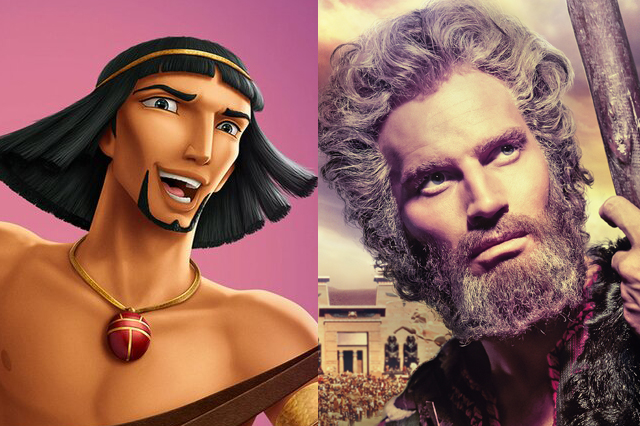
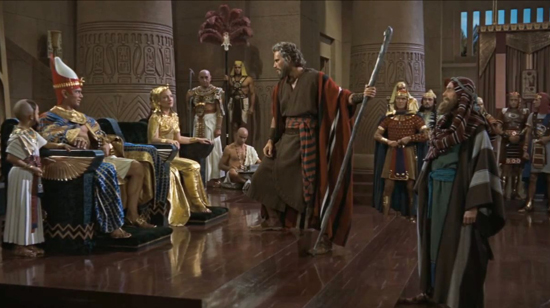
One of the biggest things that the two movies differ on is their approach to the character of Moses. They both take on the character from the same starting point, which in fact differs greatly from the original biblical text. While the Bible does state that Moses was raised as an Egyptian after his Hebrew mother sent him away for his own protection during a purge of newborn children ordered by the Pharoah, it remains vague about who ended up raising him. The movies, however, state that Moses was not only raised in an Egyptian household, but in the royal court of the Pharoah as a Prince. This interpretation mainly comes from the 1949 fictionalized novelization of the biblical story from Dorothy Clarke Wilson titled Moses, The Prince of Egypt. Cecil B. DeMille clearly drew inspiration from this re-telling of the story, along with many other sources, to help flesh out Moses’ backstory. It’s one thing for Moses to be an instrument for God’s liberation of the Hebrews from bondage, but it makes the transformation all the more interesting to see him begin as someone who was so close to the Egyptian throne to begin with. Both Ten Commandments and Prince of Egypt use this as the starting point, but where they differ very much comes down to the casting of the character. Charlton Heston had long been a favorite for the role since DeMille had work with him in the Oscar winning The Greatest Show on Earth (1952). The statuesque actor had all the gravitas and presence to bring this larger than life character faithfully to the big screen, and he also shared DeMille’s sense of religious fervor. For the role, Heston actually had two roles to play; one as Moses the Prince and the other as Moses the Prophet. The latter is the performance that most people are familiar with, showing Heston at his most theatrical. Indeed, one of the things that unfortunately has not aged well over the years is the style of performances in The Ten Commandments. Most of the actors in the movie are hamming it up considerably in their roles, including Heston. Some performances fair better than others, but it’s clear that DeMille was still directing his actors like he was during the silent era. For Heston, his performance still remains powerful, but his best moments occur before he goes big as the Prophet Moses; showing more subtlety when he’s playing the Prince. Even still, he does carry some of the film’s grandest moments, especially in the parting of the Red Sea scene.
“Let my people go!”
For the animation medium, Dreamworks needed to find the right kind of actor who could bring Moses to life purely through his voice alone. They ended up landing on Val Kilmer, who had never delivered a voice over role before. Kilmer was already a leading man in Hollywood by this point, having just recently put in his time as Batman in Batman Forever (1995). However, taking on a role as iconic as Moses would be risky for anyone, and Kilmer didn’t exactly leap to mind for most people. But, Val proved that he was upped to the task, and in a way his vocal performance is one of the best parts of the film. His performance feels remarkably natural, helping to make Moses feel like a true human individual, rather than the larger than life figure that Charlton Heston turns him into. Kilmer’s Moses is far more soft spoken, which makes him in many ways more relatable and sympathetic. While Heston’s Moses is going for theatrics, Kilmer’s is trying to create a better idea of what kind of person Moses would be. There’s passion in his voice to be sure, but also a lot of heart, and Kilmer brings a lot of warmth to the character as a result. The animators also do a great job of bringing Moses to life, complimenting Val’s vocal performance very well. Like with Heston’s version, the animated Moses goes through a transformation, from manicured Prince to scraggly Prophet, and they both sport a similar look in the latter version with the long flowing Levite cloak. It’s impressive knowing that this was the first animated film out of the gate for Dreamworks Animation, and sadly the start of an ever so short run with traditional animation before the success of Shrek (2001) killed it at the studio. A lot of the reason why the animation looks so good is because Katzenberg managed to poach a lot of talent away from Disney when he left. This included an animator named James Baxter, who previously animated characters like Belle, Rafiki, and Quasimodo at Disney. Baxter’s contributions were especially critical in adding emotional acting into the animation of Moses throughout the film. It’s also interesting to not that in both versions of the story, the voice of God is performed by the same actor who plays Moses, with both Heston and Kilmer pulling double duty in those two key roles.
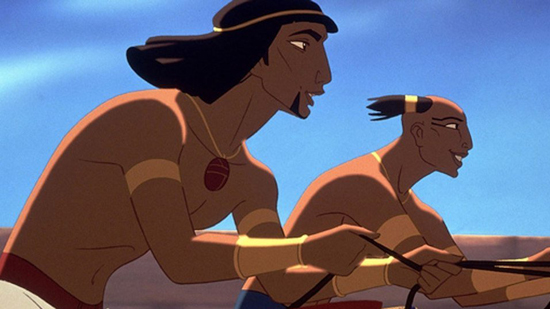
Of course, as important as it is to get the character of Moses right in the story, it’s also important to make his adversary the Pharoah work as well on screen. The Pharoah is never named in the Bible, but many scholars have theorized that the timeline of the Exodus lines up with the reign of Rameses II, the longest serving Pharoah in Egyptian history with an over 60 year rule. Whether this is accurate to history or not, Rameses does make for an interesting counterpoint to Moses in both films. But it is also interesting in how the two films differ in the dynamic between the characters. In The Prince of Egypt, Rameses and Moses start of as loving brothers, with Moses often being the troublemaker that gets Rameses in hot water. He’s voiced in the film by Ralph Fiennes, who does great job evolving Rameses from a loving older brother in the first half to a smiteful adversary in the second half. Fiennes is no stranger to playing great cinematic villains, but Rameses is a more complex character than you would expect for a version of this story that is literally animated. There’s regret in his vocal performance as he turns more venomous, hinting that a part of Rameses still wishes he could continue to love his brother even as this conflict drives them apart. There’s a fantastic sequence of animation in the film where we see Rameses go through a whole range of emotions after Moses returns his royal sigil ring to him, signaling that their kinship has come to an end. The way that Rameses goes from disappointment, to sadness, to pained turmoil and then ultimately vengeful hatred all through facial expression alone is a masterclass in animation, done by veteran animator Darlie Brewster. But as strong as this version of Rameses is, there still nothing that matches the iconic work done by Yul Brynner in DeMille’s classic. The version of Rameses in The Ten Commandments starts off as antagonistic to Moses from the get-go. Rameses in this version is petty and smiteful from the beginning, and while it doesn’t offer the same kind of tragic arc that the animated version gives us, Brynner nevertheless makes Rameses an incredibly memorable villain. His presence is a perfect counterpoint to Heston’s Moses, doing a whole lot more by never going over the top. Brynner’s stoic demeanor makes his Rameses all the more intimidating, painting the character as far more tyrannical than he is in the animated version. When you see him break and finally set the Hebrews free, it feels all the more triumphant in the film because of just how powerful we’ve seen him portrayed up to that point.
“There is one thing he cannot take away from you: your faith. Believe, for we will see God’s wonders.”
One of the other major differences between the films is the fact that The Prince of Egypt is far more streamlined in it’s re-telling of the story than The Ten Commandments. DeMille’s epic, like most other spectacles of the era, was produced as a Roadshow event picture, meaning it had an epic runtime of over 3 and a half hours with an Intermission. Even with a story as monumental as the Exodus, 3 1/2 hours still gives you a lot of space to tell that story. While Cecil B. DeMille does manage to use a lot of that runtime well, there are still moments when the movie lags, particularly in the dialog heavy parts. Other epic movies of the era like Ben-Hur (1959) and Lawrence of Arabia (1962) managed to make you forget about the lengthy runtimes by keeping things engaging and having scripts with a lot of witty, well written dialogue scenes. Ten Commandments unfortunately is written in an old fashioned way, which makes you very well aware of how unnatural it all is, and that unfortunately causes you to feel the lengthy run time all the more. The movie only picks up when we get to the iconic epic moments when DeMille can show off his skill at directing action. By contrast, The Prince of Egypt manages to cover the same ground and do it all in less than half the time it takes The Ten Commandments to do it. At a brisk 98 minutes, The Prince of Egypt manages to keep things moving by sticking to the essentials. It does this by keeping the story focused on Moses. Ten Commandments has numerous subplots going on alongside Moses’ story, some of which feel superfluous. The characters of Joshua, Lillia, and Dathan for example are nowhere to be seen in Prince of Egypt, and neither is Rameses’ queen Nefetiri. Nefetiri, played in Ten Commandments by actress Anne Baxter, is one of that film’s highlights because of Baxter’s campy over-the-top performance. But, it is clear why Prince of Egypt chooses to exclude her, because she’s ultimately there to be the fire that fuels Moses and Rameses’ rivalry, which is not something that defines their relationship in this film. Because of that change in the dynamic, The Prince of Egypt uses it’s time to flesh out other characters that didn’t get much to do in The Ten Commandments, like Moses’ true siblings Aaron and Miriam (voiced by Jeff Goldblum and Sandra Bullock) and his wife Tzipporah (voiced by Michelle Pfeiffer).
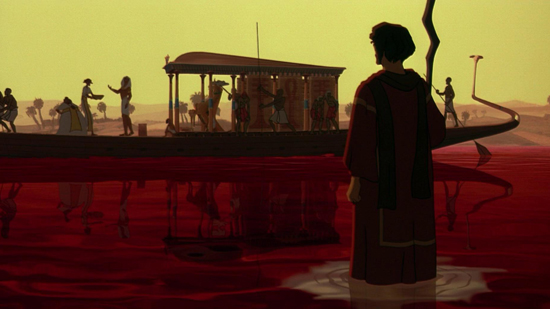
It’s also interesting that even with the length of time that The Ten Commandments has, it still rushes through some of the iconic moments in the Exodus story. The 10 Plagues are surprisingly glossed over in the film, with only 3 actually shown on screen; the Nile water turning to blood, the fiery hail, and the angel of death. The Prince of Egypt on the other hand not only shows every single plague, they also do so in a 2 1/2 minute song sequence. That’s the other big difference between the movies; The Prince of Egypt is also a musical, very much in line with the Disney Renaissance era revival of the movie musical format. While a lot of the songs (featuring lyrics written by Stephen Schwartz, the future creator of Wicked on Broadway) are pretty strong throughout, “The Plagues” is a particular highlight, and does what a lot of great musical storytelling can do which is to deliver a huge amount of story in a quick amount of time. The animation in that sequence is also some of the best in the film, especially that iconic split screen between Moses and Rameses at the end of the song. But, even as The Prince of Egypt uses it’s musical sequences to condense the story down to it’s bare essentials, it also speeds through moments that have more weight in the Ten Commandments. While their Red Sea sequence is impressive, the version of the scene in DeMille’s film just feels more epic. It perhaps has to do with the fact that the sequence involves physical actors contrasting with the visual effects. The parting of the sea was a breakthrough moment for visual effects back in it’s day, winning the film an Oscar in that category. While it’s easy to pick out the seams now, the effect still feels grandiose, and the movie allows for the scale to be felt. The Ten Commandments was shot in the Vistavision process, the closest thing that the 1950’s had to what we know now as IMAX, so this was a sequence that demanded to be seen on the biggest possible screen. In animation, this same sequence gets stylized to match the visual aesthetic of the film, and as a result it makes the sequence feel less tangible. A lot of Ten Commandments appeal comes from the fact that a lot of the sets were really built to scale in the movie. DeMille even went as far as to shot several sequences in the real Egypt. And you definitely get a sense of wonder when you see the Exodus realized with a cast of literally thousands of extras.
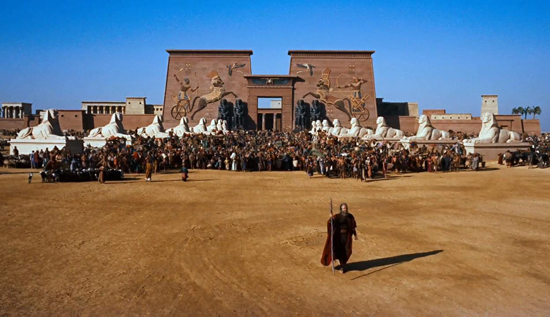
“So it shall be written. So it shall be done.”
There have been other adaptations of the Exodus story, including a rather boring one from Ridley Scott called Exodus: God and Kings (2014). To date, the ones that are of any note are Cecil B. DeMille’s Ten Commandments and Dreamworks’ The Prince of Egypt. Where DeMille’s epic film version excels is with it’s ambition. It is quite literally one of the biggest and boldest movies ever made; a great final hurrah from one of Hollywood’s pioneers. It does suffer from the fact that a lot of it’s elements (particularly the dialogue and some of the performances) have not aged well over the years. Compare this with another Charlton Heston led epic movie, Ben-Hur. Ben-Hur touches on religious themes too, but does so with subtlety in it’s performances and more natural sounding dialogue. Ten Commandments looks amazing, but feels like a relic of it’s time because no one in it acts or sounds like real people. Meanwhile, The Prince of Egypt does the best job it can to bring this story up to date with cinematic standards of today. It’s animation is world class, and remarkably refined for a first feature from a newly formed studio. It also gets the point of the story across much more efficiently. What it ultimately comes down to in the long run is personal taste. I get the feeling that more religious minded people may prefer The Ten Commandments, because it does come across like a cinematic version of a sermon at times. And more secular audiences probably prefer The Prince of Egypt with it’s more universal themes that transcend the story’s religious roots. The Ten Commandments stands as a more important part of movie history, but The Prince of Egypt is ultimately a better movie overall. One thing that I especially like about the approach that Prince of Egypt represents is the fact that they treat the story of Moses as a very human story rather than a religious one. At the end of the credits, the movie lists passages from the Bible, the Torah and the Koran all mentioning Moses as a key scriptural figure in all three religions. It shows that they weren’t treating this movie as a tool for evangelizing their audience, but rather reminding us the importance of telling stories across generations that help to inspire harmony among all people. DeMille wasn’t using his film to place one religion over another either, as he consulted many religious scholars across the spectrum of faith during the making of his film, but he was still ultimately making the movie for the purpose of instilling lessons from the bible on his audience. The Ten Commandments is monumental, but also anchored by it’s own pious shortcomings, while The Prince of Egypt succeeds by accomplishing more through doing less.
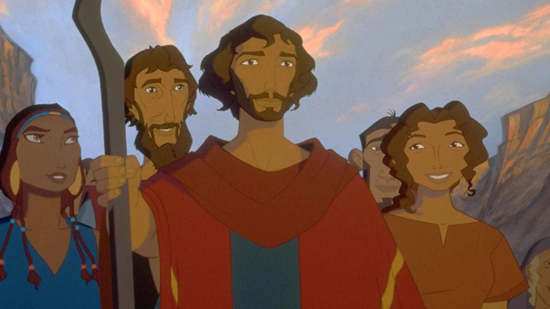
“Look at your people, Moses. They are free.”