Tag Archives: Top 10 List

Top Ten Wicked Witches in Movies

One of the most popular icons of this Halloween season is the Witch.  Of course, we all have our ideas of what a witch looks like; pointy hat, flying around on a broom, usually accompanied by a pet cat and brewing spells around a cauldron.  But, as pop culture has shown, witches aren’t all typical of that familiar image.  Witchcraft can be by just about anyone who knows the spells to cast.  We’ve seen witches in movies and television that look like they’ve stepped out of a Norman Rockwell painting and give the appearance of an ordinary life.  There are also many examples of good witches that have been portrayed in media.  The Wizarding World of Harry Potter for example is a story all about young witches and wizards learning to hone their craft for noble purposes.  And while it never explicitly states it in the book or the movie, it can be argued that Mary Poppins is a witch; of course using her command of magic for the goodwill of others.  But, when we think of witches in the movies, the ones who stand out are the wicked kind.  They are the kind of witches that live up to the scary image that we commonly refer to around Halloween time.  And they aren’t all the ugly, wart faced crones that we commonly see as the archetypes.  Sometimes bad witches are stunningly beautiful, using their beauty as a weapon in catching their prey.  For this Top Ten List, I’m taking a look at some of the most noteworthy movie witches that stand as the most wicked ever put on the silver screen.  Of course, each one of these entries has to be undeniably evil within their own stories; so no misunderstood outcast witches or good witches.  These represent the worst of the worst, and in turn, they are among the most iconic.  So, let’s take a look at the Top Ten Wickedest Witches of them all.

10.

THE SANDERSON SISTERS from HOCUS POCUS (1993)

Played by Bette Midler, Sarah Jessica Parker, and Kathy Najimy

The trio from this Halloween movie favorite certainly fit the bill of everything we expect out of a portrayal of witches.  But what makes these characters stand out is the campiness of their characterizations.  This Disney made comedy definitely makes the Sandersons very cartoonish caricatures of the classic witch aesthetic.  But it’s the actors performing the parts that really helps to make them memorable.  Bette Midler, a noteworthy performer known for her musical talents on the stage and screen, hams it up the most as Winifred, the de facto leader of the group.  It’s a testament to Midler’s acting chops that she manages to make the caricature work, especially with those chipmunk like buck teeth, and still find a way to make Winifred menacing within the story.  She’s also balanced well by Sarah Jessica Parker’s sultry portrayal of Sarah Sanderson and Kathy Najimy’s bumbling Mary Sanderson.  The Three Stooges come to mind as inspirations for the character dynamic between the sisters.  And while the movie itself is a mixed bag, never really being as funny nor as scary as it wants to be, the Sandersons are easily the highlight of the movie, and the element that indeed has helped to turn Hocus Pocus into a perennial favorite every Halloween.  And of course, given that Bette Midler is in the starring role, there has to be a musical number to show off her musical theater skills.  In this case, it’s a cover of Screamin’ Jay Hawkins’ “I Put a Spell on You,” which the movie puts a disco night club spin on.  When it comes to the Sisters, this movie definitely puts a fun spin on being Wicked.

9.

MOTHER HELENA MARKOS from SUSPIRIA (1977)

Played by Lela Svasta

One of the most surreal depictions of witchcraft on the big screen is found in Dario Argento’s horror classic Suspiria.  The story revolves around an American dancer named Suzy Bannion (Jessica Harper) coming to Germany to study at a prestigious ballet academy, only to find that the academy is a front for a coven of witches who feed off of the beauty and youth of their students.  At the center of the coven is a mysterious benefactor named Mother Markos, someone who the ladies at the school never see in person, and yet her dark presence is felt everywhere.  Markos is a great example of portraying the specter of witchcraft without letting us see her fully in person.  The spells she casts present to us the evil presence she holds over the academy, and that in it’s own way makes her scarier than just seeing the old crone that she would have normally been presented as.  The 2018 Luca Guadagnino directed remake does show us Mother Markos in it’s final act, and she’s portrayed as a grotesque, monstrous figure (played by Tilda Swinton under a ton of make-up).  The portrayal of the character is much more effective in Argento’s original film, with her being more of a specter than an actual physical presence.  The movie gets away with so much with just the littlest hints of evil lurking around.  An image of two disembodied eyes in the darkest is an especially unnerving moment in the movie.  We do eventually get the briefest of looks of her when Suzy manages to stab her in the neck while she has been sneaking around while invisible.  Lela Svasta, who was not a professional actress, does fit the imagined appearance of what Mother Markos would look like, and while she only gets a second of screen time, it’s enough to embody this mysterious figure that we’ve come to fear throughout the movie.  The whole coven of witches in the movie are terrifying enough, but by being the most enigmatic of them all, Mother Markos stands out as the scariest of the whole movie.

8.

MINNIE CASTEVET from ROSEMARY’S BABY (1968)

Played by Ruth Gordon

One of the prime examples of going against the stereotypical image of a wicked witch.  From the moment she first appears in Roman Polanski’s eerie thriller, Minnie Castevet comes across as disarming and a somewhat sweet old lady from across the hall.  Neighborly and attentive, she offers help to make Mia Farrow’s Rosemary time during pregnancy as comfortable as possible, which makes her seem like a kind matronly figure.  But, it’s only during the course of the film that we learn that Minnie’s true aim is to help Rosemary give birth to what will ultimately be the Anti-Christ.  All those kind gestures were in their own way subtle works of witchcraft in the service of her true master, Satan.  A glass of milk here, a piece of cake there.  It’s only after Rosemary pieces together all the peculiar things that have been happening around her that we ultimately see that Minnie this whole time was a diabolical witch.  And not just her, but everyone else in the apartment building; all part of a cabal of Satanists intent on bringing forth the Anti-Christ.  What is great about Ruth Gordon’s performance is that her character never changes, even after the truth of her intentions is revealed.  She plays Minnie as this charming, batty old lady who has this charmingly silly way about her.  Once she is revealed to be the witch that she is, she still acts like the disarming, sweet old lady that she was before, only now it comes off as more menacing that we know the truth of who she is.  Gordon was a Hollywood veteran who surprisingly got her start as a writer before going into acting.  She uses her witty bravado well in creating the character, and her performance ended up earning her an Oscar for Best Supporting Actress that year.  There are a lot of movie witches that certainly stand out as scary from the get go, but what makes Minnie Castavet so memorable is that deception in her character.  Like Rosemary, we are lulled into feeling safe around such a colorful and seemingly sweet person like Minnie, but it ultimately makes the reveal all the more terrifying when we realize all that was in the service of something truly demonic.

7.

MISS ERNST, THE GRAND HIGH WITCH from THE WITCHES (1990)

Played by Angelica Huston

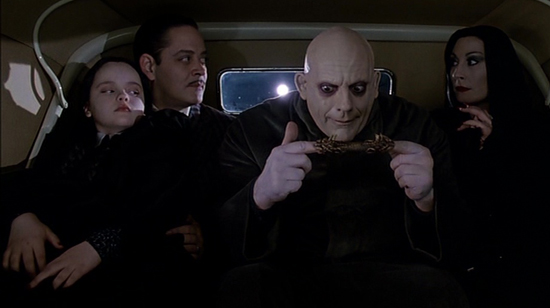
An actress like Angelica Huston definitely seems at home playing gothic characters.  She of course famously played Morticia Addams in The Addams Family (1991) only a year after playing a terrifying witch in this adaptation of a Roald Dahl novel of the same name.  She’s also an actress not afraid to disappear under a ton of make-up.  That’s what makes her performance in this movie so special.  We get to see her excel in both sides of the performance, in her human disguise of course, which certainly seems like a dress rehearsal for her role as Morticia, as well as her full blown appearance as the Grand High Witch.  The movie involves a boy stumbling upon a Witch convention at a hotel which leads to him being turned into a mouse which the witches then intend to eat him as.  The movie is exceptional in it’s use of practical effects, all done by the talented artists at the Jim Henson Company, and that is especially true about the transformation that Angelica Huston goes through to become the Grand High Witch in her truest form.  Her witch makeup is the most extreme of all in the entire movie, with a gigantic hooked nose and wrinkly skin all over.  The fact that Ms. Huston was still able to give a wildly expressive performance under all that make-up is especially impressive.  But when she’s in her more beautiful disguise, she also manages to deliver a menacing presence.  It wouldn’t surprise me if this role helped to make her the easy front-runner for that Morticia part in The Addams Family, as the characters have a very similar look to them; though of course, Morticia is the far less evil of the two.  And as a portrayal of this character in particular, she is far better than that nightmare inducing, CGI enhanced version that Anne Hathaway played in the Robert Zemekis directed remake from 2020.  This movie in particular is a clear example of why practical effects are better in bringing a fanciful story like this to life, as well as having an actress willing to fully disappear under some really imaginative make-up.

6.

URSULA from THE LITTLE MERMAID (1989)

Voiced by Pat Carroll

Disney has had it’s fair share of memorable witches, given that so many of their movies have been adapted from classic fairy tales.  Their first film had one of the most iconic witches ever put on screen when the Evil Queen in Snow White and the Seven Dwarves (1937) transforms into her hag disguise.  But one of the greatest Disney witches made her debut in the movie that helped to save Disney animation and launch the company’s Renaissance era.  In Hans Christian Andersen’s original story, The Little Mermaid’s Sea Witch is a fairly minor character, there simply to enable Ariel to make the transformation from Mermaid to Human, at the cost of her voice of course.  That’s all there is to the transaction, but for Disney’s version, they sought to make the Sea Witch a far more meaningful presence in the story.  Thus came the creation of Ursula, by far one of the most popular Disney Villains to ever come out of the canon.  Ursula has her goals of usurping the throne of King Triton by manipulating his daughter, and she has no qualms about using her magic for her own evil ambitions.  She even keeps the damned souls of the people she tricked as trophies in her “garden.” Everything about Ursula is iconic, especially her look which was heavily inspired by famed drag queen Divine.  And Pat Carroll gives a tour de force vocal performance as the character, making her equal measures of terrifying while also being surprisingly funny at just the right moments.  The huskiness of her voice especially makes her stand out amongst all other Disney Villainesses, especially with that cackle of a laugh she has.  It’s not surprising that to this day Ursula remains one of Disney’s most popular characters, let alone one of the most popular Villains.  It’s a good thing that Disney was at a point where they allowed their animation team to take some license and create a wholly different take on an evil witch in one of their movies.  With her drag queen like bravado and a killer vocal performance from Ms. Pat Carroll, Ursula was a new kind of movie witch that would indeed set a new high standard for years to come.

5.

AUNT GLADYS from WEAPONS (2025)

Played by Amy Madigan

One of the more recent depictions of a witch to leave a big impact on cinema, Aunt Gladys is the black hearted center of Zach Cregger’s hit mystery box horror flick.  A lot of Weapon’s success lies in the fact that the movie withholds the truth about what really is going on until late into the movie, which makes it a fascinating mystery to unravel.  When we finally find out that every disturbing event in the movie is the product of witchcraft, it helps to reframe the movie in a very satisfying way.  And this largely due to how well they pull off the reveal of the mysterious character that is Aunt Gladys.  Portrayed in an absolutely transformative performance by Amy Madigan, Gladys is a very different kind of movie witch compared to everything else we’ve seen.  She wears bright colored clothes, and almost has the look of a circus clown given her heavy use of make-up.  But, underneath all that color and a bubbly persona that she puts on, she is as black hearted as they come.  She uses her magic to essentially puppeteer people and make them do her bidding, which includes family members as well as an entire classroom of children.  It’s vague about why exactly she does this, and they movie never fully reveals how she became a witch in the first place, other than she uses it to keep herself alive; sort of in a succubus kind of way.  But, the damage she inflicts is pretty terrifying.  It’s a great way to reimagine witchcraft as an element in modern horror.  Zach Cregger wisely avoids using the classic symbols of witches from popular culture; there’s no brooms, no black cats, no cauldron.  Aunt Gladys merely uses twigs from an inky black shrub that she keeps in her room to conduct her black magic.  And Amy Madigan’s performance is remarkably effective, making Gladys an unsettling presence both in her silly moments as well as in her darkest moments.  And the comeuppance she faces at the end of the movie is one of the most cathartic and satisfying finales we’ve had at the movies in a long time.  Gladys will probably become one of cinema’s most iconic witches in the years to come, and it shows that there is a lot of spooky elements to the concept of witchcraft that can still be explored in modern horror movies today.

4.

BELLATRIX LESTRANGE from the HARRY POTTER series

Played by Helena Bonham Carter

It’s hard to have a witch character that stands out in a movie franchise about a school for witches and wizards.  But, one in particular really does leave a mark as one of the most terrifying witches ever put on the silver screen.  Bellatrix Lestrange is a witch that really defines the dark side of magic in J.K. Rowling’s long running series.  Though not the main threat to Harry Potter and his allies, as she is second banana to the Dark Wizard Voldemort, Bellatrix nevertheless stands out as a great and menacing villainess in her own right.  Wonderfully brought to life in an unhinged performance by Helena Bonham Carter, Bellatrix is chaos incarnate.  You really don’t know what she’ll do next, which makes her such a memorable threat in the series.  Carter definitely makes a meal out of her portrayal of the dark witch.  Her maniacal cackles is especially a key part to the portrayal, showing how she clearly gets a kick out of being as evil as she is.  Of course, she is impactful to the story as she ends up murdering Harry’s godfather and mentor Sirius Black (Gary Oldman).  She also commits all of her actions without remorse, including the torture of other wizards and witches.  One of her most sinister moments comes when she teases Harry’s friend Neville about torturing his parents, an act that left them in a vegetable like state.  It’s an effective characterization of a character that you just know is rotten to her very core.  While Voldemort is subdued in his presence, she is everything but, making herself big and loud wherever she reigns her destruction.  While she does fill the bill of a wicked witch, with her gothic attire and unhinged cackle, she manages to stay effectively terrifying throughout and avoids being too much of a caricature.  This is a real testament to Carter’s performance, where she was able to bring a lot more to the character than just her bad girl persona.  She managed to create an evil witch that exists out of something even more terrifying, which is desire to destroy purely out of her own twisted sense of fun.  And among other witches and wizards, that becomes something truly worth fearing.

3.

THE BLAIR WITCH from THE BLAIR WITCH PROJECT (1999)

Played by ???

It’s kind of remarkable that one of the most terrifying witches in movie history is one that we never get to see; an maybe doesn’t exist at all.  It’s a testament to the movie’s power of suggestion that the presence of the Blair Witch is still felt throughout the movie, and it makes her (or it) all the more scary.  The Blair Witch Project was a groundbreaking horror film that helped to launch the found footage style of storytelling in cinema.  Everything in the film is shot on video tape by the characters, making it a movie within a movie, and it adds to the true life feel of the narrative.  Over the course of the film, the characters document their hunt for the elusive Blair Witch and the deeper into the woods they go, the more weird stuff ends up happening.  We don’t know if this is entirely their own minds playing tricks on them, or if there really is a Blair Witch out there.  The movie does a great job of building that tension over time, and bringing us into the paranoid state of mind of the characters.  We hear strange noises out in the darkness of night.  Shadows begin to play tricks on us.  Eventually, we do see the most direct evidence of the Blair Witches own handiwork, as the explorers capture strange wooden figures displayed near their campsite.  Is it a prank being pulled on the characters?  We never know, and that’s what makes The Blair Witch Project such an effective experience.  It uses the limited information that we see from the found footage to suggest that a Blair Witch may end up being real, and it’s much more effective than actually showing us a real witch.  Something is out there in the darkness, and it is hunting them.  It’s great that the movie commits to the very end in keeping the truth about the Blair Witch literally in the dark, especially with the haunting final scene which is open to interpretation.  It’s a great way of showing how the idea of a witch being present alone is enough to drive out our worst fears.  That’s why the Blair Witch has become one of the most terrifying witches in movie history.  The less we know about it, the creepier and more powerful it becomes, letting our own imagination conjure up what the true evil specter may look like.

2.

MALEFICENT from SLEEPING BEAUTY (1959)

Voiced by Elanor Audley

While Ursula from The Little Mermaid and the Evil Queen from Snow White and the Seven Dwarves are iconic in their own right, there’s no denying that Disney’s greatest cinematic witch is the mistress of all evil herself, Maleficent.  Maleficent has become the gold standard by which all other Disney villains are judged by, and it’s for good reason.  She really epitomizes everything great about an iconic Disney Villain, both in her design and in her presence.  The combination of her dark flowing robes with the bat wing like collar around her neck and that crown of pointy horns just makes her stand out immediately.  Couple that with the absolutely chilling vocal performance from actress Elanor Audley, and you’ve got the makings of one of cinema’s greatest villainesses.  But, Maleficent is not just any witch.  She almost feels like a force of nature, able to command magic without a spell book or magic wand, though she does wield a staff that seems to channel her magic.  One of the best things about her character is her often calm demeanor.  She can loose her temper, but most of the time she is quiet and methodical in her evil deeds, clearly showing how much she knows she’s in command.  She doesn’t seek power; she knows she already has all of it.  Her evil is manifested in toying with those who don’t have magic.  And it’s that petty nature about her that makes her evil all the more loathsome.  Of course, her transformation into a spectacular dragon is one of the all time masterpieces of animation, but throughout the movie she is iconic.  To this day, she remains one  of Disney’s most popular characters, far eclipsing the movie she first appeared in and becoming something of a brand of her own within the Disney company.  There’s a reason why Disney made her the climatic showpiece of their nighttime spectacular at Disneyland called Fantasmic.  A true original all her own among cinematic witches and Disney villains alike, Maleficent is likely going to remain at the top tier for many more years to come.

1.

THE WICKED WITCH OF THE WEST from THE WIZARD OF OZ (1939)

Played by Margaret Hamilton

If there was ever a witch that set the standard for all cinematic witches to follow, it’s this iconic portrayal from the classic The Wizard of Oz.  The Frank L. Baum story was brought to magnificent life by MGM in a marvelous technicolor production.  But what really stood out to audiences over the many decades since it first premiered was this iconic portrayal of the villainous Wicked Witch of the West.  She has remained such a fixture in pop culture that even a musical adaptation centered around her called Wicked has become a massive hit on it’s own, both on stage and screen.  But there’s no doubt that the Wicked Witch’s memorable presence is all due to the remarkable performance given by Margaret Hamilton.  She brings the character to vivid life thanks to a delightfully eccentric performance.  From her high pitched cackle to her sinister grin, she delivers the quintessential portrayal of a witch on the big screen.  It’s perhaps the reason why so many depictions of witches today often include a pointy hat and green colored skin.  Hamilton’s portrayal of the Wicked Witch is true high fantasy, finding the actress really relishing the role and making the performance feel huge in every way.  It wasn’t all easy for her though.  She famously suffered severe burns when a trap door didn’t drop her in time to miss the pyro effects that followed her exit from the Munchkin land set.  And the performance remained so iconic that it unfortunately left her typecast for the remainder of her career, though she found ways of capitalizing on her fame as the character later in life, and she never regretted playing the role in the first place.  One can’t imagine anyone else playing this role, even though there were others who tried out for the part before she inevitably got it.  Margaret just feels like she was born to play this character, and even after 85 years, her performance still captures the imagination of audiences of all ages.  While there are plenty of iconic movie witches out there, it’s the Wicked Witch that more than any of them seems to define the ideal of what a cinematic witch should be.

So, there you have my picks for the most iconic wicked witches ever put on the silver screen.  A couple of them, particularly the Wicked Witch of the West and Maleficent have gone on to set the standard for what we think a witch should be.  And then you have some other ones like Minnie Castevet in Rosemary’s Baby that stand out by being contradictory to what we perceive a witch to be.  And then there’s the Blair Witch who remains unseen throughout the whole movie, and yet you can still feel it’s presence.  There’s so many ways to imagine a witch in cinematic storytelling, and so many different ways to make them terrifying to an audience.  There is something innately unsettling about witchcraft itself, even when it’s used for good purposes by good witches.  That’s why it’s still a potent element used in horror movies today, though to varying degrees of success.  The recent horror hit Weapons offers up an especially effective new take on witchcraft and how it would be used in a contemporary setting.  Likewise, Aunt Gladys has emerged as a very new kind of movie witch, and one that really turns into a terrifying presence in her movie.  During Halloween time, witches remain one of the most popular of icons, and it’s largely thanks to some of the witches on this list that many of them have made such an impact in pop culture.  Just look at the phenomenal success of Wicked to see just how much the Wicked Witch, and by extension Margaret Hamilton’s performance, still have a foothold in our culture.  It’s also why Disney continues to mine through so many fairy tales for their animated projects, because they know a good fairy tale is made all the better by the presence of an especially wicked witch.  And with Harry Potter, you get the best of both with good witches (Hermoine Granger) and the bad (Bellatrix Lestrange).  We’ll see a good many iconic witches in the years to come in cinema, but leading up to now, these have been the ones that have undeniably left a huge mark on our understanding of witches overall in pop culture.

Top Ten Robots in Movies

There are many types of characters that have come to define the stories we find in cinema.  Some are fun and lovable, while others are dark and menacing.  One particular type of character that can fall into either one of these categories are the artificial lifeforms known as robots.  Whatever type of robot they be, a toy, an android, or a cyborg, these characters have made an impact on the big screen, even going back to the earliest days of cinema.  These characters have particularly been a favorite staple of science fiction.  There’s nothing more futuristic in nature than the creation of artificial life, and robots have been central to that.  Of course we have seen stories where a robot is treated more humanely and they develop personalities of their own which ignites debates about the nature of creation itself, when the very idea that an individual can be manufactured and have a will of it’s own thereafter.  There are also just as many movies about the dangers of robotics, when artificial life turns against humanity and leads to it’s near extinction.  Either type of story has it’s own place in cinema history, but what both have done together is create a vast number of memorable robotic characters over the years.  These iconic character range from the friendly, to the menacing, to even that strange neutral ground in between.  For this article I am putting together a list of the most memorable robotic characters that have appeared in the movies.  There are some ground rules that I have to set for this list, just to be clear which types of robot characters count.  One, these have to be self-reliant robots, meaning they can’t be piloted or puppeteered by another character; so the Jaegers from Pacific Rim (2013) won’t make the list because they are more human powered mechs than actual robots.  Also, these have to be actual physical robots and not a AI program with it’s own sentience, unless it has also created a robotic body for itself.  So, no HAL 9000 from 2001: A Space Odyssey (1968).  Other than that, any type of robot qualifies.  So with all that laid out, let’s take a look at my picks for the Top Ten Robots in Movies.

10.

THE TIN MAN from THE WIZARD OF OZ (1939)

Played by Jack Haley

Here we begin with one of the better examples of a friendly robot in movies.  A character straight from L. Frank Baum’s original story, the Tin Man is very different from most typical robotic characters in movies.  What sets him apart is that his creation is more magical than mechanical.  He lives because the Land of Oz is a magical place, where scarecrows are also alive and lions can speak.  Still, as he tells his story, he shares that he was built by a woodsman for the purpose of chopping wood, so by that account he still would a robot.  There’s just one thing that the woodsman forgot; a heart.  It’s an interesting character trait for the Tin Man; that desire to have a heart, which means that he desires to be more human.  Of course, on his adventures with Dorothy, we know that an actual physical heart is not what’s key to being a human.  The Tin Man shows he has a heart through his compassion and devotion to his friends.  The portrayal of the Tin Man in this movie is particularly special, thanks to the performance of Jack Haley, an experienced song and dance man long before his role in The Wizard of Oz.  His jerky, robotic movements, particularly in his introduction scene, really help to sell the idea that he’s made of nothing but metal.  The creation of the costume is also quite a feat, particularly in the make-up, which they had to redo to make it less toxic as it sent the Tin Man’s original actor, Buddy Ebsen, to the emergency room due to a severe allergic reaction to the silver paint.  Even after the changes, it probably still was uncomfortable for Jack Haley to play the character, but he does in the end shine through, much like his metallic skin after it has been polished.  A lot of the other robots on this list are more creations out of realm of science, but the Tin Man stands out as a more magical entity, and one that definitely fits within the world of Oz.  Much more than an empty kettle, he a man on his mettle, because he always had a heart.

9.

AVA from EX MACHINA (2015)

Played by Alicia Vikander

Now we move on to another type of robotic character; one with a darker side.  This cautionary tale about rogue AI from writer/director Alex Garland is becoming more and more prescient by the day as we are going through an AI boom at the current moment.  Oscar Isaac’s eccentric tech billionaire brings one of his young technicians, played by Domhnall Gleeson, to his secluded cabin in the woods to conduct a Turing Test with his new AI programed robot, played by Vikander, in this sci-fi thriller.  The film is more about human hubris than anything else, showing that creating life is more than just a mechanical exercise.  The film does a great job of creating this intriguing question about the nature of humanity.  AVA is an interesting character because she displays all of the outward appearance of a human being, but underneath she is all metal shells and wiring.  The Oscar-winning visual effects used to create AVA’s robotic body are pretty spectacular, making it appear that Alicia Vikander’s physical body is broken up into detachable parts.  It’s eerie to see the clear shells with all the wiring link up seamlessly with the actress’ real face.  The movie delivers it’s message in an effective way, with AVA nearly stripped down completely when you first meet her, making no mistake that she’s a robot, but as the movie keeps moving forward, she puts on more layers concealing that fact, like wearing more clothes and putting on extra layers of artificial skin, to the point where her robotic insides are completely obscured.  And while she does this, she increasingly manipulates Gleeson’s technician, blurring the line further between his conception of her as being a robot.  in the end, we learn that she’s been the one testing her human captors, and not the other way around.  It’s a movie that definitely makes one wary about the implications of making AI too true to life, because there’s always the danger of it becoming too smart that it’ll end up out-smarting us.  And even still, AVA is not as malicious an AI as you would expect.  Over the course of the movie, we see that it has learned the very human trait of survival, and that’s why she manipulates the humans around her; to finally escape and be set free.  Alex Garland leaves it open as to what AVA might end up doing out in the real world, but as the movie showed us, AI reflects back all the things that human beings have programmed into it, and unfortunately a lot of our own programming as humans is not without a few bugs.

8.

THE MACHINE HUMAN from METROPOLIS (1927)

Played by Brigette Helm

A lot of AVA from Ex Machina and many other robotic characters from cinema in general owe a lot to this pioneering depiction of a robot in the silent Fritz Lang masterpiece Metropolis.  This nearly century old classic takes place in an imagined city of the future, where among other technological advancements a mechanical human being has been constructed.  Inspired a bit by the creation of Frankenstein’s monster, this Machine Human is the work of a deranged mad scientist who’s choosing to play God.  But at the same time, the Machine Human’s creation is meant to be the first in a string of robotic workers who will replace the human drones working in the underworld of the city.  This movie is becoming even more prophetic every day, as tech billionaires are using AI to create more automation in society, which is driving out more and more of the human workforce.  And Fritz Lang saw this coming a century ago, making this movie well ahead of it’s time.  The Mechanical Human itself is very iconic, working it’s way into so much of the science fiction that we’ve seen over the years.  It’s design particularly had a major influence on the creation of C-3PO in the Star Wars movies for example.  Another interesting aspect of the Mechanical Human is that it is given a human disguise, showing how it’s purpose is to blur the line between human kind and artificiality, and through that make it easier to manipulate those who are unable to tell the difference.  In the movie, it takes the disguise of a woman named Maria, who has been leading the working class humans in resistance against the upper class in the city above.  This function of manipulating the human mind through an artificial imposter is very much in the same vein of what we saw with AVA in Ex Machina.  It’s also something we see playing out in our own real world with bots manipulating discourse online through social media. Though in terms of personality, the Mechanical Human is very limited, mainly just being the robotic arbitor that it was programmed to be and nothing more.  But even still, it is an iconic depiction of a robotic being that in the nearly 100 years since it’s creation now seems even more realistic than how it was first imagined; a sad reality about how we as a society have used robotics and AI in very bad ways.

7.

ROBOCOP from ROBOCOP (1987)

Played by Peter Weller

Moving away from both the positive and negative depictions of robotic characters in movies, here we find one of the best examples of that gray area in the middle.  In Paul Verhoeven’s dark ultraviolent satire of capitalism run amok, we see a story where Peter Weller’s human cop is transformed into the ultimate weapon of justice.  But, as we see, the more mechanical he becomes, the less forgiving he is to the average criminal.  The movie explores the idea of humanity being further consumed by a technological world, where things like law enforcement no longer serves in the public interest but rather becomes a tool for keeping things in order, mainly in the interest of corporate elites.  A true human police force is subjected to things like personal judgment and ethical review.  Replace that with a fully mechanized form of law enforcement and yes you have a system that doesn’t discriminate but it’s also one that doesn’t empathize either.  It’s a system that carries it’s own biases that purely exists to follow the law and doesn’t take into account the nuances of circumstance that leads to crime.  Verehoeven plays around with this concept in a very broad sense in the movie, leading to some very shockingly violent imagery for it’s time (which at one point earned the film an NC-17 rating).  Peter Weller’s portrayal of the titular Robocop is pretty iconic as well.  The shiny metallic armor he wears is something that everyone remembers about the film, but Weller also perfectly captures that struggle between his character’s rigid programming  and whatever is left of his humanity.  Whether he’s good or bad depends on who’s in the driver’s seat at the time, but eventually Robocop does come around to fighting against the corporate machine that made him who he is, and ultimately chooses his humanity in the end.  As police forces become more militarized and law enforcement becomes more about protecting moneyed interests rather that protecting and serving the community at large, a story like Robocop becomes a more potent satire of how the balance between man and machine being thrown out of balance creates a far worse world overall.

6.

GORT from THE DAY THE EARTH STOOD STILL (1951)

Played by Lock Martin

Klaatu barada nikto.  These three words are the keys to the most powerful weapon the Earth has ever known.  This Cold War era Sci-Fi classic creates a powerful story about mankind’s first encounter with life from another world.  A flying saucer lands in Washington D.C. and the human like alien being that has travelled inside of it seeks to make peace with us primitive Earthlings.  However, trigger happy military personnel end up wounding Klaatu, the alien ambassador, and this awakens the Guardian sentinel that traveled with him; a massive robot named Gort.  Gort is without a doubt one of the most iconic robots in all of cinema, and an icon of this particular era of science fiction.  He’s limited in personality, more machine than anything else, but he still leaves a chilling impression whenever he’s onscreen.  With a laser blast from his cycloptic facial lens, he’s able to disintegrate anything that gets in it’s way, including unfortunate human beings.  But, he’s not a malicious mechanical being either.  His primary function is to protect Klaatu and the ship at all costs.  But, he also must obey anyone who uses the password I shared at the beginning.  The Day the Earth Stood Still was made at a particularly precarious time in human history, as nuclear proliferation and the tensions between the United States and the Soviet bloc were heating up.  Also the paranoia of the Red Scare was spreading across the country as well.  Gort is viewed by many as an allegory for nuclear deterrents; a weapon of immense power that proves to be so destructive that it fighting against it would mean one’s own destruction.  As the movie portrays him, he serves as a warning against the misuse of such weaponry.  The look of Gort is distinctively mid-century sci-fi.  He was played by 7’5″ tall actor Lock Martin, whose immense stature really helps to make Gort feel big on screen.  But his design is also sleek and simple, very much reinforcing his other-worldly nature.  When we think of mid-century science fiction, Gort will most likely be one of the first things people remember.  He may not stand out as a defining character of the era, but as a symbol there is no doubt that he stood out as an icon.

5.

ROY BATTY from BLADE RUNNER (1982)

Played by Rutger Hauer

Set in what was supposed to be Los Angeles in the far off year of 2019, this Sci-Fi neo-noir features a story about rogue androids known as replicants that are hiding in plain sight among us humans.  The replicants in Blade Runner are so human like that they require a complex exam called the Voight-Kampff test to identify them as the androids they are.  And the leader of these rebel replicants is a menacing and powerful replicant called Roy Batty, played memorably by Rutger Hauer.  The famed Dutch actor brings powerful gravitas to the role, creating a villain that really feels more soulful than a lot of other robotic characters that we’ve seen in the movies.  His portrayal strongly reinforces the idea put forth by the movie, which is the idea about artificial life being capable of having a soul to them.  As we learn in the movie, the replicants themselves are evolving and becoming more human like as a result; to the point where the Voight-Kampff can’t even detect all the clues, and this becomes a problematic dilemma for a society that has used replicants for purposes like hard labor and raises a profound question: Are replicants due rights for themselves, just like any other being.  As sympathetic as the replicants may be, there’s still no doubt that Roy Batty is a pretty bad guy as well.  He leaves a lot of bodies in his wake as he tries to infiltrate the Tyrell Corporation to meet his maker.  But, his time is also limited due to a built in flaw that makes the replicants live short lives as a necessity to allow for control over them.  Batty goes out in a harrowing final confrontation with Harrison Ford’s heroic Deckard, the titular blade runner tasked with hunting Batty down and terminating him.  Batty’s dying scene is one of cinema’s most iconic moments, as he shares his favorite “memories” to Deckard while his life slips away, all in a beautifully staged rooftop scene in pouring down rain.  Hauer often cited this scene as one of his proudest moments as an actor, and he has good reason to be proud.  In this moment, he does prove to us that even an artificial mind is capable of human emotion, and thus able to carry a soul, which sadly due to the flaw of his body will be lost “like tears in rain.”

4.

T-800 from THE TERMINATOR (1984) AND TERMINATOR 2: JUDGEMENT DAY (1991)

Played by Arnold Schwarzenegger

We’ve talked about friendly robots in movies, as well as malicious and menacing robots in movies.  But here we have in the Terminator franchise an example of one character that has been both.  The original Terminator has the T-800 model be the film’s main antagonist, sent from the future to hunt down the mother of a man who will some day lead human kind in a resistance against a world conquering AI program known as Skynet.  In the sequel, director James Cameron made a very interesting creative choice by having the T-800 return, except this time he’s here to protect young John Conner.  Schwarzenegger’s film career was made by his role in this franchise, and he’s honestly perfectly suited for playing this character.  His robotic monotone helps to hide his true Austrian accent, and he is without a doubt a strong physical presence as well.  But that all works in the favor of the character.  The T-800 is a formidable cyborg with an unstoppable drive to complete his mission.  The purpose of his character in the first film was to be mostly intimidating and scary, which Arnold pulls of well.  But it’s in the sequel, where we see the T-800 turned into a guardian instead of an assassin, that more character nuances are revealed.  He’s not just a machine with mission, but also one that is capable of learning as well.  One of the best moments of Terminator 2 is when we see teenage John Conner (played by Edward Furlong) try to teach the T-800 phrases to make him more personable and human, like saying “Hasta La Vista, Baby.”  It’s a great transformation between movies that helps to define the T-800 as more than just a cold, soulless robot.  When he makes the ultimate sacrifice at the end of the movie, we are at that point just as heartbroken as John Conner to see him go, which is a testament to just how well Schwarzenegger and Cameron made us warm up to his character.  He started as a very simple villainous force in the first movie; nothing more than a scary monster to hunt down our heroes.  But by the end of Terminator 2, he’s grown into more than just a machine; he’s a friend to be missed.  And Schwarzenegger absolutely made him look all along the way.  He’ll be back.

3.

R2-D2 from THE STAR WARS SAGA

Played by Kenny Baker

There are so many types of characters that have gone on to define the magnificent ensemble that is the cast of the Star Wars universe.  But one of the most iconic types of these characters are the droids.  Often represented in these movies as practically built, on set robots, they have become some of the most popular characters in the entire series; not to mention also the most lucrative in the merchandising department.  A lot of droids have populated Star Wars media over the years, but there is no doubt who the most famous ones are.  They are the only characters to appear in all 9 of the mainline movies of the Skywalker Saga; the droids C-3PO and R2-D2.  While C-3PO is a great character in his own right, R2-D2 emerges as a much more important droid in the overall storyline.  He’s the one who carries Leia’s message safely to Obi-Wan Kenobi, as well as the one droid that accompanies Luke Skywalker on his mission to blow up the Death Star.  And he’s able to stand out as a memorable character even though he can only communicate through beeps and boops.  Legendary little person actor Kenny Baker was often called upon to play R2-D2 in limited moments where he had to move back and forth on screen in a way that a remote controlled robot couldn’t do on set.  Otherwise, that’s as much real acting that could be put into a character like him.  The rest is all accomplished via puppeteering.  While the filmmakers were limited by what they could do with a faceless and voices robot in their cast, it’s remarkable how much personality they are able to get across with R2.  And like with his frequent companion C-3PO, he set the standard for all the droids that we’ve come to know in the Star Wars universe ever since.  To this very day, nearly 50 years later, R2-D2 is still a fan favorite, and an icon of the franchise as a whole that remains central to it’s identity.  That’s a pretty incredible legacy to have for such a simple little robot that looks like a trash can on wheels.

2.

THE IRON GIANT from THE IRON GIANT (1999)

Voiced by Vin Diesel

If there was ever a cinematic robot that warmed the hearts of audiences, it’s the titular giant robot from this animated masterpiece.  The Iron Giant comes to Earth with no memory of it’s purpose, and as a result he’s able to forge his own purpose, which ends up involving a young kid named Hogarth.  Hogarth and the Giant form a bond, and that bond helps the Giant overcome the instinctual programming that he was sent to Earth with, which was to destroy.  One of the sweetest aspects of the story is that he learns to see himself in a different way thanks to his friendships with the humans.  After reading comics, the Giant sees himself identifying with Superman, which becomes a major plot point when he must save Hogarth’s home from destruction.  The movie ends with the Giant sacrificing himself in a dramatic encounter with a nuclear warhead, and in his final moments he think’s back to Hogarth’s words of wisdom telling him that he can choose who he wants to be.  In his last words, he says “Superman” and embraces his fate with the warhead.  It’s a profound moment that brought audiences to tears and endeared him as one of the greatest robots in cinema history.  A lot of credit should go to the surprisingly nuanced vocal performance given to him by Vin Diesel.  The Fast and the Furious actor managed to deliver so much soulfulness and personality into the Giant with very few spoken words, something that he would also put to great use as the voice of Groot in the Guardians of the Galaxy movies.  And Diesel’s gravely voice sounds so perfectly matched for the character as well, even with the metallic filter put on it.  The animation of him in the film is also incredible.  He’s a CGI animated character that blends very well in the 2D animated style of the movie, and has a cool design that is very evocative of the 50’s era sci-fi style that fits with the period setting of the movie.  Though big and imposing, we quickly learn that this cinematic robot is one gentle giant overall, and one of the most lovable to ever star on the silver screen.

1.

WALL-E from WALL-E (2008)

Voiced by Ben Burtt

While there have been many great cinematic robots over the years of all types, none have perhaps displayed as endearing a personality as WALL-E from the Pixar classic film of the same name.  Like a robotic Charlie Chaplain, WALL-E is a lovable little goof that communicates so much through so many little gestures and quirks of character.  His design of course is perfectly constructed to make him instantly likable, with those binocular like eyes and stout box shaped body.  What is even more interesting about him is the setting that they chose to set his story within.  WALL-E has lived a solitary life on Earth after human beings abandoned it hundreds of years ago and all the other sanitation bots left to clean up the mess left behind have all shut down.  Somehow, WALL-E has managed to survive all this time and remains the last one left, dutifully repeating his directive every single day without end.  But over the centuries by himself, he has developed something unique.  He’s a collector, salvaging things from the planet wide junk yard that he finds interesting and adding them to his collection.  He also has developed a love for musicals, in particular 1969’s Hello, Dolly, which he likes to imitate the dance sequences of.  One of the remarkable things that the movie does is that it places us distinctly in WALL-E’s point of view from the beginning of the story, and because he is just a robot, the film tells most of it’s story early on without dialogue.  The first act is mostly wordless, making it more crucial to define WALL-E purely through pantomime.  That’s where the influences of great silent film comedians like Charlie Chaplain and Buster Keaton come in.  But even when the movie extends beyond it’s earthbound parts, the incredible portrayal of WALL-E still shines through.  The inclusion of a sleek, female coded robot named EVE also shows how the formation of WALL-E’s personality has made him a bit of a romantic as well;  another trait you don’t see in most movie robots.  Legendary sound engineer Ben Burtt (Star Wars, Jurassic Park) was largely responsible for designing WALL-E’s unique electronic voice, and even in the very few words that he’s able to say, it still fits the overall simple charm of the character.  Without a doubt, the most well rounded robotic character that we’ve ever seen brought to life on film.

There’s a tendency to view all robots in movies as limited in character.  For a long time, robotics were more science fiction than science fact, and for a lot of movies that featured a robot as a part of it’s story either had to make their creations limited based on what was capable within the scientific standards of the time, or have them be completely the creation of fantasy.  For a lot of films, robotics have been a part of many cautionary tales.  In the cases of Metropolis and Robocop, the idea of robots taking over our jobs comes across as a serious threat to humanity.  In the Terminator movies, we see the fruition of that fear, with mankind hanging on by a thread due to our foolish naivete in allowing artificial intelligence to take over every function of society, including our weapons systems.  But, there are many films that also show that robots can have a softer side, like with the Iron Giant and WALL-E.  And then you have the cyborg characters, who become almost human and wish to be regarded as equal in that sense despite being born artificially rather than organically, which is central to the story of Blade Runner (1982).  We are currently in a time period where AI is advancing at a rapid place, and some of the scenarios that seemed far off in movies from decades ago no seem to be a lot more relevant.  The worry is that AI will reflect back all of the bad aspects of humanity, and probably end up causing chaos as a result.  One hopes that the ones who are developing this new tech are not doing so recklessly, but then again, we’ve seen the worst case scenario play out in some of these movies.  Overall, there have many really interesting characters in the movies that are robotic in nature.  And many of them are not things to be feared, but rather a force for good in the end.  Good or bad, many of them definitely stand out as interesting and cool looking in their designs.  And their influence on science fiction cinema is particularly immense.  Whether those gears on the inside are turning or not, and the mind is thinking in ones and zeroes or something more complex, they make for some interesting characters in some of our favorite stories, and the hope is that many more in the future will stand out as well, even as robotics and AI evolve further over time.

Top Ten Funniest Performances in Movie Comedies

There are a variety of emotions that audiences go through when they’re watching a movie.  They can be scared, they can have a good cry, or if the movie is terrible, they will likely be bored.  But perhaps the greatest thing that can happen to an audience member while watching a movie is to have a really good laugh.  Indeed, comedy is one of the weapons that cinema has at it’s disposal because it’s the style of filmmaking that best appeals to the communal activity that is going to the movies.  It’s fine if you alone are laughing while watching a movie, but it’s even better when you are laughing along with other people in the theater.  Laughter is contagious and it’s something that a lot of moviemakers hope to deliver with their movies.  Even in a serious movie, a humorous moment can be a valuable thing, because it helps to break up the tension and allow an audience to relieve so pressure in between the heavier moments.  Comedy has been a part of the fabric of cinema from the very beginning.  Many comedy acts from vaudeville halls across the world began to take their routines to the big screen and became some of the most popular icons of the era.  The evolution to talkies also benefitted from comedy, with funny movies favoring more quick witted jabs than physical slapstick.  And all through the history of film, there has always been a place for a good comedy, even as tastes and norms have changed.  In all that time, movies have helped to establish iconic comedic talent through the years, from Charlie Chaplain as The Tramp to Will Farrell as Buddy the Elf, there are plenty of iconic performances that have left audiences in laughing fits that not only leave a mark in their own time, but also have endured many decades later.

For this top ten list I had to make some hard choices about who to leave out and who to put in.  There are so many good choices out there that it was hard to leave it to just 10.  That’s why you’re not going to see comedy icons like Robin Williams, Eddie Murphy, Peter Sellers, Chris Farley, Leslie Nielsen, Adam Sandler, Mel Brooks, Charlie Chaplin or the Marx Brothers on this list, even though they do deserve a place on here.  This list is purely my own preferences, so you can agree and disagree with my choices as much as you’d like.  So, with all that said, let’s take a look at the Top Ten Funniest Performances in Comedy Movies.

10.

GENERAL “BUCK” TURGIDSON from DR. STRANGELOVE OR: HOW I LEARNED TO STOP WORRYING AND LOVE THE BOMB (1964)

Played by George C. Scott

One of the finest examples of a hilarious performance coming from an actor not known for doing comedy.  Scott was renowned for his dramatic work in movies like Anatomy of a Murder (1959) and The Hustler (1961), but what surprised many people was a hidden talent in comedic acting as well.  In Stanley Kubrick’s Cold War era satire, Scott plays a caricature of a very hawkish general who’s extremely suspicious of the “ruuskies” and yet has to deal with the fallout of one of his fellow generals going rouge and possibly setting off a nuclear war.  Here Scott plays against the way you would typically suspect an actor like him would perform the role.  He’s naturally fitted for playing someone of military brass, considering that years later he would give an iconic performances as General Patton, but as you watch Dr. Strangelove, you see that veneer of authority diminish in his character and reveal the manic buffoon underneath.  It’s quite a feat when you’re sharing the screen with a comedic performer on the level of Peter Sellers and he’s the one who has to play straight-man to your performance.  Everything about George C. Scott’s performance is beautifully eccentric, with him even getting into some slapstick-y pratfalls as well, including an unplanned tumble where Scott trips over his own feet, does a summersault, and still gets his line out; a hilarious blooper that Kubrick still left in the film.  Even with the subject matter being as serious as it is, the comedic performances throughout the movie all still land and make the film a very unforgettable farce, with Scott’s Turgidson being one of the key highlights.  And it’s a great example of why it works to the comedy’s advantage to have a serious actor delivering some truly ridiculous lines.  Only Scott could sell the President on the idea of committing war crimes like it’s not such a big deal: “I’m not saying we won’t get our hair a little mussed.”  It’s a risky thing to poke fun at something as deadly serious as nuclear Armageddon, but Dr. Strangelove managed to do it in a classic way, and show that even serious people can be silly.

9.

CHER from CLUELESS (1995)

Played by Alicia Silverstone

Proof that girls can be just as funny as the boys, this may be the most iconic comedic role for an actress in the last 50 years.  Clueless was very much a product of it’s time, encapsulating the early to mid 90’s in a brightly colored time capsule.  But it’s the lead performance by Alicia Silverstone as the pampered Beverly Hills teenage matchmaker Cher that still feels timeless to this day.  Silverstone is perfectly cast in this modern retelling of Jane Austen’s Emma, playing Cher with a hilarious level of dimwittedness, but still retaining emotional intelligence that helps to keep her from just being a stereotype.  The way we see how she views the world through her small enclosed, pampered life is hilarious to watch, especially when a lot of it is way off from reality.  But, she manages to remain endearing because there is a funny sense of innocence behind all that.  As the film moves along, we do see her maturity grow, and that ultimately leads her towards being a more thoughtful individual.  But, both Silverstone and writer/director Amy Heckerling both know that the most appealing part of Cher’s character is that airheaded naivete that defines her early on.  There’s some hilarious one liners throughout the movie that very much makes the character live up to the title Clueless.  Everything she says, even the introspective comments, have to be tied into shopping and fashion.  It’s that well-meaning spirit framed within a very enclosed mind frame that makes the lines so hilarious, especially the ones where she thinks she’s saying something very intelligent but it comes out totally absurd.  I will forever laugh out loud when I hear her say “Spora-tacus.”  Sure, it’s a bit dated due to being a product of it’s era, but Alicia Silverstone’s Cher is still a comedic performance that can make me laugh even 30 years later.

8.

SHERIFF BUFORD T. JUSTICE from SMOKEY AND THE BANDIT (1977)

Played by Jackie Gleason

Jackie Gleason was already a legendary comedic actor long before he appeared in Smokey and the Bandit.  The star of the iconic Honeymooners TV series and a dozen comedic movies along the way had already cemented himself as a iconic performer.  But it was in this late career performance as the heavy in this Burt Reynold’s vehicle where Gleason perhaps created his most consistently hilarious character.  Buford T. Justice is a whole lot more than just a parody of a small town, Southern law enforcement agent.  He is a very larger than life presence that Gleason milks for every laugh he can possibly get.  The most hilarious part of the character is the pressure cooker like way that he grows more and more frustrated throughout the movie.  It’s also great that he has a foil to work off of with his dimwitted son Junior (played hilariously by Mike Henry) who agitates him even more.  The film itself is much more of a road action movie than a comedy, playing to Burt Reynold’s strengths as an actor, but Gleason’s presence easily makes this one of the funniest movies you’ll ever see as well.  He gets all the best lines, many of which Gleason got to improvise himself, and he delivers them with this hilariously over-the-top Southern inflection.  Only Jackie Gleason could make ordering a diablo sandwich and a Dr. Pepper into one of the funniest quotable lines in the movie (and make it fast, he’s in a goddamn hurry).  But even his subtle physical expressions can get a big laugh.  The way he tilts his head when he’s frustrated with Junior’s incompetence is also one of the funniest parts of the movie.  And nobody shouts out “sum-bitch” with more gusto than he does.  It showed that even during the tail end of his incredible career in comedy that Jackie Gleason still had it in him to leave us in stitches.

7.

RON BURGANDY from ANCHORMAN: THE LEGEND OF RON BURGANDY (2004)

Played by Will Farrell

Will Farrell has played a wide variety of characters both on the big and little screen, honing his craft during his time on Saturday Night Live like so many iconic comedic actors over the last 50 years.  The one thing that most of them have in common is Farrell’s hilarious talent with becoming loud and overly dramatic in his funniest scenes.  Perhaps the movie that bring this out most effectively is in the Adam McKay satire Anchorman.  Ron Burgandy is a true Will Farrell creation; a satirical impression of 70’s era machismo put into the persona of a local news anchor with an inflated ego.  He’s another character that becomes more hilarious due to the misplaced confidence he has in himself when he says things that he thinks are smart but end up being hilariously wrong instead.  One of the funniest bits in the movie though is the hilarious observation about how local news anchors will literally read out anything you put in front of them and not be aware of what they just said, from something as simple as a misplaced question mark (I’m Ron Burgandy?) to flat out telling the City of San Diego to go “F” themselves.  Farrell’s performance is hilarious both in the broader aspects of the character, such as the moments when Ron completely loses his mind and becomes overly dramatic (“I’m in a glass case of emotion”), but he also gets huge laugh through some of the subtler line deliveries that stand out just by how absurd they are (“The human torch was denied a bank loan”).  Anchorman itself is a movie about all the absurdities of male insecurity manifesting as false veneer of foolish self-confidence, and Will Farrell’s Ron Burgandy is a perfect deconstruction of that particular kind of character.  Whether it’s the boisterous WTF did he just say lines that he delivers with such confidence throughout the movie or the hilarious times he goes over the top with his physical pratfalls, this performance shows Will Farrell at the peak of his talent.

6.

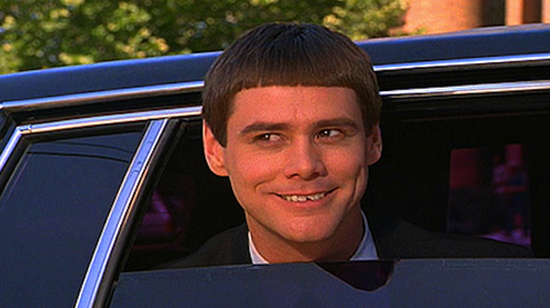
LLOYD CHRISTMAS from DUMB AND DUMBER (1994)

Played by Jim Carrey

It is undeniable that Jim Carrey is one of the funniest actors to have made it to the silver screen ever.  There are so many iconic comedic performances on his resume that it’s hard to nail it down to just one.  While there’s something to be said for his hilarious roles in Ace Ventura: Pet Detective (1993), The Mask (1994), The Truman Show (1998), Bruce Almighty (2003) and even some of his recent work as Dr. Robotnik in the Sonic the Hedgehog movies, I have to say that the role that is moment for moment the most consistently funny is Lloyd from the Farrelly Brothers’ Dumb and Dumber.  This movie uses every tool at Jim Carrey’s disposal effectively, from his wild facial expressions to his hilarious line reads.  Of course this is a movie where Jim Carrey has to come up with “the most annoying sound in the world,” but more importantly this movie is a great place for him to show off his talents as a physical performer.  There are so many great slapstick moments in the movie like when Lloyd eats something too spicy and his first instinct is to squeeze ketchup bottles so hard it creates a ketchup fountain and he sticks his tongue out hoping to catch some of it in his mouth.  Carrey’s performance is great, and it’s nearly matched by the surprisingly fearless performance of Jeff Daniels as his equally dimwitted companion, Harry.  Daniels is able to keep pace with Carrey throughout the movie, even though he’s known as more for his dramatic work, and that’s quite the achievement.  But even still, it’s Jim Carrey who delivers the biggest laughs throughout the movie, and it cemented his reputation as a comedy legend.  You can definitely feel the anarchic spirit of classic comedy that flows through his veins in this performance, which is natural given that the Farrelly Brothers made Dumb and Dumber as a throwback screwball in the same vein as the Three Stooges and Laurel and Hardy.  In a career full of laugh out loud hilarious performances, Jim Carrey’s Lloyd undoubtedly gives up the laughs per minute, and that helps the character stand just a bit taller than the rest.

5.

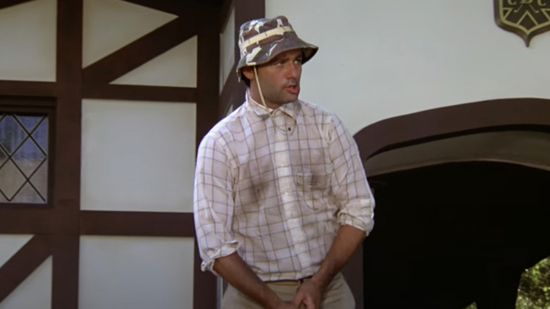
CARL SPACKLER from CADDYSHACK (1980)

Played by Bill Murray

Caddyshack was definitely one of the raunchiest of raunchy comedies made in the late 70’s and early 80’s.  It’s also become one of the funniest comedies ever centered around sports, in this case golf.  The film is already filled with great comedic talent, including Rodney Dangerfield and Chevy Chase, but it’s Bill Murray who steals the show as the grounds-keeping doofus known as Carl Spackler.  Murray does away with his usually sardonic persona that he brings to his other roles, like in Ghostbusters (1984) or Groundhog Day (1993), and instead creates this entirely different and hilarious character in Carl.  Murray’s Carl is a true oddball, mumbling all the time in this doofus like voice that often is accentuated with a crooked mouth.  And if that wasn’t weird enough, he spends the whole movie delivering strange anecdotes like the time he caddied for the Dalai Lama.  But it’s perhaps the moment when he pretends he’s playing for a championship at the Master’s Tournament that has become the most iconic moment for the character, and perhaps the whole of his career as an actor.  Pretty much any person who has stepped onto a golf course has at one time quoted this scene; I know the people I know who golf have done it (“Cinderella story, out of Augusta”).  One of the other great things about his performance in the movie is the hilarious rivalry that he has with a gopher that lives underneath the golf course, itself played by a puppet.  The way he treats exterminating this gopher like a soldier going into war is another hilarious layer added onto the performance.  It’s too bad that not many more performances like this came out of Bill Murray in the years after.  Certainly the slick talking jokesters that he brilliantly brought to life in the years after are all great, but Carl was a very different kind of funny for him, and it’s too bad we only got to see this side of him as a performance once.

4.

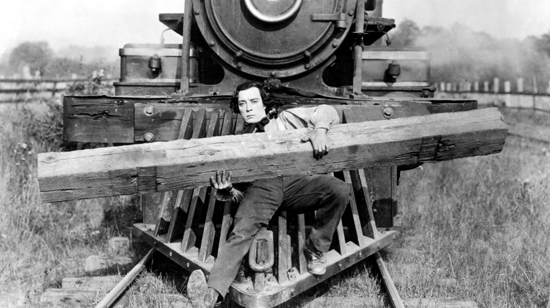
JOHNNIE GRAY from THE GENERAL (1927)

Played by Buster Keaton

Buster Keaton was a pioneer in how to use comedy on film.  Like his contemporary Charlie Chaplain, Keaton relied upon his talents as a physical actor.  The acrobatic actor often put a lot of effort into his comedic bits, and a few of them were fairly death defying.  He famously survived the collapse of an entire wall of a building all around him in Steamboat Bill Jr. (1927), with his placement being conveniently in the space of the window frame, sparing him from the worst of it.  Another stunt involving a train in Sherlock Jr. (1925) also left him with a broken neck that he left untreated for years.  But that accident didn’t deter him from raising the bar of physical comedy, nor make him stop working with trains either.  In what is perhaps his masterpiece, Buster Keaton delivers some of his most impressive visual gags ever in The General, a film that still garners huge laughs even nearly a century later.  There are some incredible stunts accomplished in this movie, including one where he could have killed himself many times as he rides the front grill of a real moving train.  But what really makes the comedy work even better is Keaton’s deadpan face through it all.  He delivers so much humor purely through the blinking of his eyes than he ever would’ve through dialogue.  The juxtaposition of his expressionless face along with the madcap situations that he finds himself in is beautifully realized and it make his performance here still as hilarious as it was when it first played in theaters almost 100 years prior.  While there are so many impressive performances in silent comedy that still resonate today, particularly from Chaplin and Harold Lloyd, Buster Keaton stood out just a little more just because of the huge contrast between what he was doing and how he was reacting to it, which often was without emotion.  And all that made his comedy brilliant is on display in every moment of his most impressive work in The General.

3.

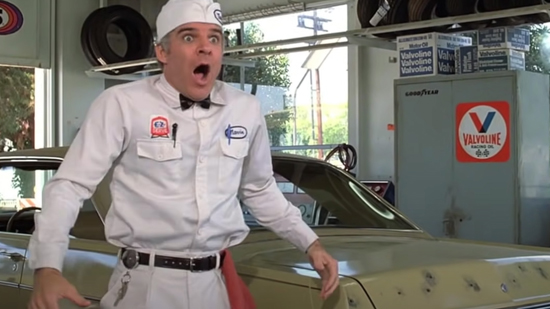
NAVIN JOHNSON from THE JERK (1979)

Played by Steve Martin

There are few comedic movies that feel as close to the style of stand up comedy of their creator as Steve Martin’s The Jerk does.  Steve Martin became a sensation in the 1970’s with his oddball style of stand-up, and he translated that kind of comedy perfectly into his first feature film.  This movie is entirely geared around his talents as a performer and it is a remarkable mix of comedy and absurdism all rolled together in one.  You know you are in for a hilarious ride when the very Caucasian Steve Martin introduces his character’s life story by saying, “I was born a poor black child in the South.”  It only gets sillier from there.  Steve Martin’s Navin Johnson goes through life with a hilarious wide-eyed innocent naivete, sort of like a much goofier version of Forrest Gump.  The film, directed by the legendary Carl Reiner, manages to keep up with Steve Martin’s manic performance, taking every wild swing that comes and hilariously staging each gag perfectly.  One of the classic bits involves Navin getting shot at while he works at a gas station, but the sniper keeps missing and ends up hitting the cans of oil on display.  Navin, not having a clue what’s really going on, starts to scream out “Somebody hates these cans.  Stay away from the cans!!”  What is great is the complete commitment to the bit that Steve Martin puts into his performance.  His performance as Navin is sincere even through all of the absurdity, and that makes the comedy hit all that much harder.  The film was a huge hit, and even found an unlikely fan in director Stanley Kubrick who apparently said it was his favorite comedy.  That’s when you know that your comedy performance has truly become transcendent when it earns the praise of the man who made Dr. Strangelove and 2001: A Space Odyssey (1968).  Steve Martin has continued to be a great comedic actor, but it’s in The Jerk where we see him at his creative zenith, and showing his style of comedy better than anything else that he has made.

2.

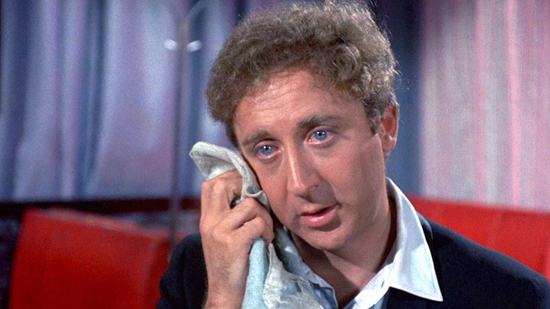
LEO BLOOM from THE PRODUCERS (1967)

Played by Gene Wilder

Mel Brooks is undoubtedly the greatest comedy filmmaker that Hollywood has ever seen.  He pretty much invented the genre spoof film with movies like Blazing Saddles (1974) and Young Frankenstein (1974), and in many of these movies he brought out some of the best work of some of comedy’s funniest performers, including the likes of Dom DeLuise, Madeline Kahn, and Marty Feldman.   But there was no other collaborator of Mel Brooks that shined as much in is films as Gene Wilder.  They worked on three films together, including the aforementioned Saddles and Frankenstein, but it’s in their first film together that we see Gene Wilder at his most hilarious.  His performance as accountant turned theater producer Leo Bloom is one that displays Wilder at his best.  One of the things that Gene was great at was going from understated to manic so effortlessly.  The bit where he gets hysterical during his first meeting with Max Bialystock (a brilliant Zero Mostel) is easily one of the funniest scenes in any Mel Brooks movie.  It’s the escalation of that scene that makes it iconic, where you just see Gene Wilder get more and more unhinged, even after he has water poured on him and slapped across the face as Max fails to calm Leo down.  Gene Wilder was also a master at a slow burn build-up into a manic state, which he also puts to great use in the movie.  It’s fitting that when Mel Brooks won his Oscar for the Screenplay he wrote for the movie, he gave a special acknowledgement to Gene in his acceptance speech.  He knew how much Mr. Wilder was integral to the level of comedy in that movie.  It even made him stand out against a comedy veteran like Zero Mostel, who is also giving a hilarious iconic performance in the film.  Gene Wilder was an undeniable comedy icon, and you can certainly find his best work in his three collaborations with Mel Brooks.  Each one is special in it’s own right, but it’s in The Producers where you see the actor at the peak of his talent.

1.

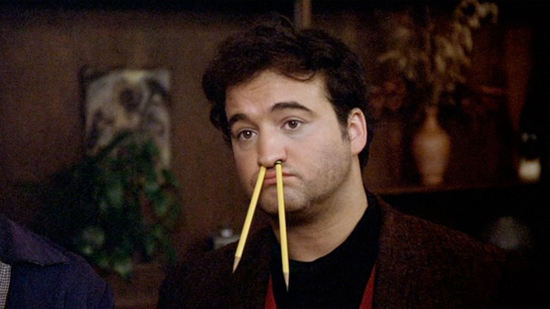
JOHN “BLUTO” BLUTARSKY from NATIONAL LAMPOON’S ANIMAL HOUSE (1978)

Played by John Belushi

If you were to ask me what I find to be the funniest performance in movie history, the one that never fails to make me laugh every time I watch it, it’s John Belushi’s iconic role as Bluto in Animal House.  This raunchy college set comedy has a lot of things that make it hilarious, but it’s Belushi being completely unleashed in this role that elevates it to the top.  Belushi sadly only ever acted in a handful of movie roles before he dies prematurely from an overdose in 1982.  Some are more iconic than others, especially here and in his big screen debut of The Blues Brothers (1980).  There are so many iconic moments that Belushi is responsible for in this movie.  There’s the food fight scene where Belushi shows off his impression of a zit.  His toga party arrival down a staircase where he breaks apart a guitar on the wall is also another moment that gets a huge laugh.  But it’s also the hilariously idiotic lines that he gets to deliver throughout the movie that also stand out.  His pep talk speech is hilariously dim witted, with him telling his fellow frat brothers “Was it over when the Germans bombed Pearl Harbor?”  There’s no other character that personifies the chaotic nature of college life better than him, and that makes his performance so brilliantly funny.  It’s not just his knack for hilarious line deliveries or physical comedy either.  Just by giving a look with a raised eyebrow or dead eyed stare he can get a big laugh out of his audience.  It’s easy to see why so many of his peers were jealous of his effortless ability to get a laugh.  He was a true comedy icon and Bluto from Animal House is undeniably where he showed us everything that made him great.  The movie called for a person you could believably see getting a GPA of 0.0 and still be someone charismatic enough to one day get elected to the U.S. Senate.  That’s John Belushi’s undeniable talent as a comedy legend.

So, there you have my choices for the funniest performances in movie history.  It’s pretty evident that tastes in comedy are shaped largely by the time we live in, and a lot of my picks are from movies that I certainly grew up admiring.  Even still, there are a lot of great classic performances in older comedies that are definitely worth spotlighting too, like Jack Lemmon’s cross-dressing turn in Some Like it Hot (1959) or Cary Grant’s rapid fire quips in His Girl Friday (1940).  Some of the best comedic performances can also come from actors you normally don’t associate with comedy, like Barbara Streisand in What’s Up Doc? (1973) or Ryan Gosling in The Nice Guys (2016).  One thing that you’ll probably notice in my top ten picks is the abundance of Saturday Night Live alum, with John Belushi, Bill Murray, and Will Farrell represented.  Even Steve Martin has been such a frequent host of the show that many would’ve mistaken him as a regular cast member.  SNL has been an institutional fixture in comedy over the last 50 years, so it’s only natural that so many of the most iconic comedies of the last couple decades have featured someone from that popular show.  But, there are some classic performances that have made it into my favorites as well.  I’m particularly impressed with George C. Scott’s hilarious turn in Dr. Strangelove, especially considering that he upstaged Peter Sellers.  Even with the top ten choices I made here, there are countless other that were certainly on the periphery of the list that should absolutely be celebrated in their own right.  Eddie Murphy in Coming to America (1988), Mike Myers in Austin Powers (1997), Robin Williams in Aladdin (1992), Peter Sellers in The Pink Panther (1963) and more.  Comedy is genre with so many styles and flavors that offer up so many different ways that can make us laugh.  Comedy is subjective, and different people have their preference, but when a movie comedy is able to make a room full of complete strangers all laugh at the same time, that’s a great sign of how well your comedy can work on a universal level.  And many of the performances I spotlighted here have been responsible for some of the best and biggest laughs that have ever been captured on film.

Top Ten Movies of 2024

The year that has passed has now been entered into the history books, and with 2024 behind us it’s time to look back at how the year went as a whole.  For Hollywood, it was a recovery year, after the strikes of 2023 brought the industry to a dramatic halt.  Some of the effects of those strikes were immediately apparent, but the long term effects may take years to fully manifest, but 2024 overall represented a year of adaptation for both the production side as well as the exhibition side.  Hollywood continued to move around their films on the calendar, with some of the most anticipated movies of the previous year finally getting their release in the last year.  Movie theaters also had to get more creative in the last year in order to bring audiences in more frequently due to the backlog of new movies that the strikes created.  This was the year where novelty popcorn buckets suddenly became a viral craze, with the ridiculous designs for Dune: Part Two’s and Deadpool & Wolverine’s buckets getting social media attention for which one looked more like a adult oriented product.  Regardless of the oddities of the designs, these must buy items were a welcome money generator for movie theaters in need of extra income, and more importantly it prompted more people to come to the movies again.  We saw the revivals of struggling brands like Disney, Pixar and Marvel, all getting huge box office wins this year.  The indie film market also saw a major boost, with indie labels like Neon and A24 seeing their biggest box office successes ever in 2024.  And then there was the record breaking Thanksgiving weekend this year, which saw Wicked, Gladiator II, and Moana 2 almost pulling off another Barbenheimer effect with their shared success.  So, while there are still a number of problems that are plaguing the movie business overall, there are also a number of positive signs about the resiliency of the cinematic experience.  And the hope is that many of those positive signs continue into the next year and beyond.

Of course, like every year, I’s sharing my personal picks for the Top 10 Movies of the year, as well as my choices for the bottom 5.  This year I broke my own personal record of seeing over 120 movies in a theater setting, so I had a very wide pool to choose from.  A couple of the movies that made my list were very easy, but there were a few hard cuts as well.  So, below are the honorable mention movies that I think are worth spotlighting, listed in alphabetical order: A Real Pain, The Apprentice, Bird, Blitz, Boy Kills World, Challengers, Conclave, Deadpool & Wolverine, Flow, Hit Man, Juror #2, Kinds of Kindness, Maria, Monkey Man, Nickel Boys, Nosferatu, Queer, Saturday Night, Sing Sing, Strange Darling, Thelma, Wicked, and The Wild Robot.  All of these movies are definitely worth seeing if you can, but the 10 selected below were the ones that stuck with me the most over the course of the year.  So, let’s take a look at my picks for the Top Ten Movies of 2024.

10.

LOVE LIES BLEEDING

Directed by Rose Glass

Starting off with the first of multiple A24 movies you’ll see on this list (it was a very good year for them), this sophomore directorial effort from Rose Glass was also the year’s most interesting love story as well.  Set in a grimy New Mexico town in the 1980’s, the movie presents a romance between a lady bodybuilder and the daughter of the local crime kingpin.  During the course of the movie, both girls have to confront the bad pasts that they’ve been trying hard to break away from, which leads them down some dark roads.  And yet all the while, there is an almost fairy tale aspect to their love affair that helps to pull them through.  The movie feels very much like a gritty and yet quirky crime thriller that would have come from the likes of the Coen Brothers in their early days, but director Rose Glass is also not afraid to take things in a surreal direction, blurring the lines with what’s real and what’s not in some very inspired hallucinatory moments.  But what helps this movie stand out is the cast.  Kristen Stewart continues to impress in her post-Twilight career as a risk-taking actress, and this film finally gives her a chance to play a queer romantic lead in a film, opposite Katy O’Biren who delivers a star making role as the bodybuilder that she falls in love with.  Ed Harris also delivers an amazing and terrifying performance as the crime family patriarch and father to Stewart’s character, standing out as one of the best cinematic villains of the year.  But it’s the twists and turns that Rose Glass takes with this story that make the whole experience truly unique and memorable.  It’s also strangely magical in the end and works in that oddball way that only an A24 movie could pull off.  The chemistry between the two leads really pulls it all together and it becomes oddly sweet by the end, even though the journey there can get strange at times.  It shows that not all the best love stories need to be rose tinted and elegant.  They can also involve a lot of bullets and blood as well.

9.

CIVIL WAR

Directed by Alex Garland

2024 was a contentious year to say the least when it came to politics in America.  Every election year is as well, but tensions this year have been especially high.  Into this tempest came a new movie from Alex Garland, a filmmaker known for making some provocative movies in the past through the lens of science fiction, and the subject for his new film was as big of a lightning rod you could build in year such as this one.  Many people tried to pick apart the movie to decide what kind of message it was going to deliver about the state of the world as it is right now, and the answer to that was, nothing.  Civil War was a very misunderstood movie that was not about the politics today, or of any era for that matter.  It uses a hypothetical scenario about a modern day Civil War breaking out in the United States as a backdrop for the narrative that Alex Garland was really interested in telling, which was about wartime journalism.  Garland depicts the daily grind of what war photographers and on the scene investigators go through in order to chronicle a war as it happens.  They are there in the thick of it, standing behind the firing lines all in the pursuit of capturing the reality of what war is like.  Sometimes they are doing it for the sake of preserving the truth, while some are doing it purely for the adrenaline rush.  But with the characters portrayed by Wagner Moura, Kirsten Dunst, Cailee Spaeny and Stephen McKinely Henderson, we witness the often unsung bravery that these individuals display in order to witness war and make sure that history is captured.  I especially like the way that Garland breaks up the mayhem of the battle scenes with the silent abruptness of a camera’s snap shot.  In these moments, we are given a window into what is behind those snapshots of war that we see printed in a newspaper or tagged onto a webpage, and it makes us consider the toll of war and the dangerous life that war journalists have.  The politics of this movie really are irrelevant, though there are slight hints about where the director stands on current events.  What matters in this movie is the affects that war has on the people in the middle of it, and the reason the movie sets it’s conflict in a modern day American setting is because we so far have not seen this kind of carnage on our own door step in a modern era, and the hope that this movie delivers is that we can hopefully avoid it again.

8.

PERFECT DAYS

Directed by Wim Wenders

Technically, this was a 2023 film that only finally got a wide release in 2024, but even still, my first viewing was in this last calendar year and it managed to stick with me all the way to the end.   This was last year’s nominee for the Oscar for International Feature from Japan, but it was directed by a legendary German director Wim Wenders in a strange confluence of cinematic forces.  The filmmaker behind classics like Paris, Texas (1984) and Wings of Desire (1988) applies the same grounded but poetic style to this tale about a Japanese man who cleans public toilets for a living.  There isn’t a whole lot of drama at play in this film; it merely observes the daily life of this man who takes his civil service seriously and enjoys the simple comforts of his life.  The only drama comes out of the unexpected arrival of his estranged niece, who forces her uncle out of his simple routine, though not in a way that fundamentally shifts his overall life.  It’s a profound film that speaks a lot about the simple things that make an impact in our lives, including something as simple as a game of Tic-Tac-Toe with a complete stranger you never meet.  Wenders apparently was inspired to make this movie after his visit to Tokyo where he was astonished by the variety and creative designs of the public restrooms found throughout the city, and it led him to craft this story about the kind of person who would be tasked with upkeeping these public facilities.  Honestly, you’ve never seen a movie film public toilets in such loving way and that’s part of the charm of this movie.  In addition, actor Koji Yakusho (who won the Best Actor award at Cannes in 2023 for this film) delivers a beautifully soulful performance as the caretaker Hirayama.  Wenders also fills the movie with a great soundtrack of classic rock standards, including the Lou Reed song that gives the movie it’s title.  Definitely the coziest watch of 2024 and a great life affirming piece of cinema that people will hopefully get to discover more in the years ahead.

7.

DUNE: PART TWO

Directed by Denis Villeneuve

Denis Villeneuve and Warner Brothers took a major risk when they began production on the movie Dune (2021).  Villeneuve split the famous Frank Herbert sci-fi novel into two parts, and only got Warner Brothers to greenlight the first part.  That meant that the completion of the story was contingent on the success of the first movie; which was a major departure from other franchise productions like The Lord of the Rings, which had all the films produced together.  Had Dune not succeeded, we may have been left with an awkward, unresolved half of a complete story.  To make matters worse, the first Dune had to deal with the fallout of the Covid-19 pandemic, which saw it’s release delayed a year and was truncated by the dual streaming and theatrical release plan that Warner Brothers enacted under the failed Project Popcorn in 2021.  Thankfully, the movie gained enough critical and box office success to convince Warner to greenlight Part Two, so that we could finally see the complete vision of Herbert’s legendary narrative.  But, the strike made a further delay in the completion of this cinematic epic, and it was finally released in the Spring of 2024.  Thankfully, it was all worth the wait as Denis Villeneuve managed to land the plane successfully and complete the story that he had long dreamed of bringing to life on the screen.  Dune: Part Two more than lives up to the promise of it’s predecessor, and surpasses it in many ways.  It’s bolder visually, has an even grander epic heft to it, and even has moments of great emotion between it’s characters.  All the returning cast is at the top of their game, with Timothee Chalamet continuing his win streak as a movie star on the rise.  Zendaya has the most significant upgrade in her screen time in this film, and she brings a lot to the character Chani that helps to elevate her presence in the series.  But perhaps the most surprising standout is Austin Butler playing the villainous Feyd-Rautha Harkonnen, one of the best cinematic villains to emerge in a big Hollywood film in a long time.  Denis also ups the ante in the scale of the film, with the iconic worm riding sequence being an especially epic experience to witness on a big screen, preferably in IMAX.  Far and away the strongest cinematic achievement from mainstream Hollywood in a year that surprising delivered very well in terms of popcorn entertainment.

6.

HUNDREDS OF BEAVERS

Directed by Mike Cheslik

There’s always that one movie that takes you by surprise every year that demands attention because it’s unlike anything you’ve ever seen before.  This high concept comedy is one of those films, as it is a strange beast of a film.  It’s also one of the most inventive movies I have seen in quite some time.  And to make things even better, it’s gut-bustingly funny as well.  The movie has the aesthetic of a silent film, but mixed with the cartoonish antics of a Looney Tunes cartoon.  The main protagonist, an apple famer named Jean Kayak (played by a hilarious Ryland Brickson Cole Tews) seeks revenge against a pack of beavers that destroyed his apple jack brewing business, and over the course of several chaotic scenes of hijinks, he learns that the critters are more cunning than he thought.  The whole movie is a beautifully created homage to the cartoons of classic Looney Tunes, as well as to the silent classics of Charlie Chaplin and Buster Keaton, but it’s also an impressive feat of cinematic storytelling as well.  Through some clever cinematic tricks, the movie comes pretty close to feeling like a cartoon brought to life.  The funniest part is that all the animals are depicted with mascot costumes, adding to the surreal absurdity of the whole piece.  The antics are hilariously chaotic and at times also surprisingly mean-spirited as well, in a good way.  It’s also refreshing to see a comedy that uses visual gags as the primary means of making us laugh, rather than inane banter that we see most comedies today using.  We’ve kind of lost the art of visual comedy over the years, where the filmmakers use the cinematic tricks to get a laugh; something that the silent masters pioneered, but were also carried along into the latter half of the 20th century by great comedians such as Jacques Tati and Mel Brooks.  Hopefully Hundreds of Beavers is that kind of transformative comedy that inspires more filmmakers to try more inventive visual gags in the future.  Easily the year’s best comedy, and I’m already happy to see that the film is already generating a cult following.

5.

GHOSTLIGHT

Directed by Kelly O’Sullivan and Alex Thompson

This little seen film that emerged from this year’s Sundance Film Festival managed to be one of the most surprising dramas of the year, and a profound statement about the healing power of art.  The film centers around a family that is broken apart by a recent tragedy and they find surprising solace in the form of theater, after the father ends up joining a small acting troop that’s putting on a staging of Shakespeare’s Romeo and Juliet.  The film stars Chicago based theater actor Keith Kupferer in a breakthrough role as the grieving father, and the deconstruction of his rough exterior through the embrace of performance is superbly conveyed in his work here, giving his character a very grounded and vulnerable presence.  His performance is matched by the actors playing his family, who just so happen to be Keith’s real life wife and daughter, Tara Mallen and Kathrine Mallen Kupferer respectively.  This real life family of actors are all astounding, and they are complimented very well by a scene-stealing Dolly De Leon (Triangle of Sadness) as the head of the theater troop.  Their journey towards staging the play, as well as the confrontation they face with regard to their past tragedy is all delivered in this movie with a beautifully poignant sense of authenticity.  And the finale of the film is going to knock a lot of people over with it’s emotional wallop; a tearjerker in the best sense of the word.  Keith Kupferer has been playing bit parts in Chicago shot films for many years, including The Dark Knight (2008) and Road to Perdition (2002) as well as a variety of TV appearances in addition to his acclaimed stage work.  Ghostlight is his first ever lead role in a movie, and he makes the most of that opportunity.  Hopefully Hollywood takes notice and gives him more substantive roles in the future, along with this talented family.  It’s a performance that I wish more people had seen as the film sadly had a very limited release.  It left an impact on this critic, and I hope more people discover it in the years ahead.

4.

LONGLEGS

Directed by Osgood Perkins

2024 was the year where I discovered my preferred type of horror movie.  I watched more new horror movies this year than in any year prior, and the film that stood out the most showed me that I have an inclination for slow-burn, atmospheric horror.  That movie was the new film from Osgood Perkins called Longlegs.  This film is definitely not your standard, shlocky horror flick.  There is a surprising lack of gore in most of the film, and for the most part it’s also free of other horror clichés like jump scares.  What it has instead is a very methodical pace to it that starts things off quiet and foreboding, before escalating more and more through the film until it hits a crescendo at the climax.  And that’s the kind of horror that I vibe with; one that envelopes you in that sense of building dread.  It’s been described as Satanic Silence of the Lambs, and that’s a worthy comparison to make.  It has that same kind of unsettling undertone of the Oscar-winning Silence of the Lambs, but also combines it with much more of a paranormal element.  Demonic possession is a genuine thing in this movie as we come to learn, and the slow-build of that realization also helps to make it’s emergence all the more creepy.  And speaking of creepy, Nicholas Cage gives a truly terrifying performance as the titular Satan worshipping serial killer, showing us that his over the top style of acting can indeed work wonders in a role that’s tailor made for it.  Osgood Perkins comes from a strong pedigree of horror filmmaking, as his father Anthony was famous for playing Norman Bates in Psycho (1960).  This is his most successful film to date and it shows that he indeed is one of the most interesting voices in horror filmmaking right now.  Too many horror films intend to shock us rather than scare us, and Perkins has created the first film that I’ve seen in a while that’s truly scared me.  Much like great horror classics such as The Exorcist (1973), Longlegs feels like you are actually witnessing true evil on the screen, and it’s not done with any flash, but rather with a carefully constructed sense of foreboding atmosphere.  I know it’ll be horror movies like this one that I’ll be pursuing more in the future, because it’s the one that hit that sweet spot of terror in my imagination.  Hopefully, Osgood Perkins will continue to be one of those filmmakers that continues to deliver in that terrifying mode of horror cinema in the years ahead.

3.

INSIDE OUT 2

Directed by Kelsey Mann

This past year also marked a triumphant return of one of the vanguard names in animation.  Pixar Animation has had one of the roughest rides of the decade so far, suffering a sudden halt to the release of their film Onward (2020) in the early days of the pandemic, and then having their parent studio Disney use them as a guinea pig in the early years of the streaming wars, with movies like Soul (2020), Luca (2021) and Turning Red (2022) all being denied theatrical runs and being dumped onto Disney+ instead, all the while the other animated films from the studio got to play in theaters.  This was a sad mistreatment of an animation brand that had once been the envy of all of Hollywood.  Now Pixar had to claw back their way to the top, and it didn’t help that movies like Lightyear (2022) and Elemental (2023) underperformed.  It should be understood, Pixar was still making great movies, but they were being denied the chance to prove themselves again in a post-pandemic market.  Thankfully, a savior came in the form of a sequel to one of their most beloved films.  Inside Out 2 not only reversed the fortunes of Pixar Animation, it broke every possible record there is for an animated film.  Grossing over $1.6 billion worldwide, the movie was the undisputed champ of the 2024 box office, and proof once again that Pixar is a force to be reckoned with.  And it deserves it too, as Inside Out 2 not only matches it’s beloved predecessor, but even surpasses it in many ways.  One of the best improvements with this film is that it makes the character of Riley, the girl whose mind is the home of the emotions that are the stars of the movie, a much more rounded character.  You really feel her agency a lot more in this film, and she becomes more relatable as she goes through her awkward puberty phase.  The returning emotion characters are all great and given even more weight in this story, but the newer emotions are just as interesting too.  The character of Anxiety (voiced by Maya Hawke) may be the best new addition to this movie, as she becomes a truly chaotic new force that raises the stakes in this story.  It’s easy to see why this movie was such a box office juggernaut, because it helped remind everyone what we love about Pixar movies in the first place; their commitment to emotional story-telling and visual innovation.  It’s profound in all the right moments, while also being immensely funny along the way.  And Disney definitely owes Pixar an apology for underestimating their value as a key part of their company.

2.

ANORA

Directed by Sean Baker

Sean Baker has been a filmmaker to watch over the last decade, and he’s been a re-occurring presence on my top ten lists ever since 2017’s The Florida Project.  This year, he released what may be his most assertive film yet with Anora.  It’s definitely the one that has gotten the industry’s notice the most of all his movies, as he became the first American filmmaker to win the prestigious Palme d’Or at the Cannes Film Festival in over a decade; the last being Terrence Malick for The Tree of Life (2011).  Since then, the movie has been building up a lot of awards season buzz, and it’s very much deserved.  Sean Baker definitely is a filmmaker with a distinct style and interest, focusing on people who live just on the fringe of the American dream (such as the outskirts of Hollywood in 2015’s Tangerine and outside of Disney World in The Florida Project) in a neo-realistic mode of storytelling.  Anora certainly has those elements too, but Baker also delivers here with a more polished, assured production.  Filming with 35 mm stock rather than his usual digital cam or 16 mm graininess, he manages to create a vibrant looking film that still retains the neo-realist character of his earlier films.  At it’s center is a breakout performance from Mikey Madison in a star-making role as a New York stripper who falls madly in love with the wrong boy, and quickly get entangled in his dangerous world of oligarchs and criminals, though they have their hands full trying to control her too.  Its a performance that will almost certainly earn her a well deserved Oscar nomination.  Her performance as the title character is a force of nature, and she continues the same tradition of compelling, flawed characters that are always at the center of Baker’s movies.  It’s also impressive how well Baker manages shifting tones in this movie, as the film evolves from a quirky romantic dramedy in it’s early moments to full on farce in the second act to a somewhat melancholy and tragic denouement in it’s final scene.  Sean Baker is a director who maintains a signature style, but is also showing a lot of growth as a storyteller and filmmaker as he takes on more complex stories.  Anora is his most profound cinematic statement yet, and it’s easy to see why so many people (including myself) see it as one of the best cinematic achievements of the year.  It will be interesting to see if the Academy agrees as well.

And my choice for the best movie of 2024 is…

1.

THE BRUTALIST

Directed by Brady Corbet

This year was a year of bold statements on the big screen.  Some were big swings and misses (like Francis Ford Coppola’s Megalopolis) but in some cases, there were a few attempts at bold filmmaking that actually connected this year.  And no other movie in 2024 managed to wow me personally as a filmgoer than this new epic from director Brady Corbet.  Watching this movie was like witnessing the birth of a new American cinema classic.  This is the kind of movie that I feel is going to be discussed in film studies for many years to come.  And even more remarkable, Brady Corbet was able to make this three and a half hour epic, complete with an overture and intermission, on a $10 million budget.  Hollywood should honestly take note of this movie and what it accomplishes, as Corbet was able to make a $10 million movie look like it cost around $100 million.  The movie reminded me a lot about another film that also topped my list the year it came out, which was Paul Thomas Anderson’s There Will Be Blood (2007).  Like that movie, Corbet is able to create a profound, intimate portrait about the human experience, in this case an immigrant architect schooled in the titular style of architecture, and have it become this profound statement about the American experience and all of it’s unseen flaws.  Adrian Brody gives a remarkable performance as Laszlo Toth, the architect at the heart of the film, delivering his best work in years.  He’s also matched by a scene stealing Guy Pearce as the heartless industrialist who funds Laszlo’s vision while also taking increasing possessive control over his life.  And like all the best 3 hour plus epic movies, it’s run time breezes by because Corbet has such a strong command of the narrative that you never feel it lag once.  By the time the intermission started, I was shocked by how quickly 100 minutes had already gone by.  It’s enormously impressive how Brady Corbet can craft a movie that features very economical film tricks (shooting in places in present day Hungary that look like 1950’s Philadelphia so they don’t have to build new sets, for example) and make it feel grandiose in a way that films like The Godfather has been seen over the years.  It’s the kind of movie that Hollywood used to make before getting cold feet after the failure of Michael Cimino’s Heaven’s Gate.  The movie even stays true to the architectural style it celebrates, with the music and even the style of the opening and closing credits feeling in character.  It’s the most impressive film that I saw all year and hopefully it becomes a blueprint for a more economical way of making epic movies in the future.

So, with my Top Ten Movies out of the way, it’s time to briefly go over the Bottom Five movies that I saw this year.  Keep in mind, I technically like to avoid bad movies when I can; I chose to not watch Part Two of Zack Snyder’s awful Rebel Moon for example, after having to sit through Part One in 2023.  Given the breadth of so many movies that I saw this year, it was still unavoidable watching a few of them.  So, here are my picks for the Five Worst Movies of 2024:

5. JOKER: FOLIE A DEUX –  Consider this the year’s most disappointing film.  It was kind of stunning to see the drop off this movie faced after the enormous success of it’s predecessor. The first Joker movie made over $1 billion worldwide and got it’s star Joaquin Phoenix and Oscar win for Best Actor.  All the same people returned to make this sequel, including Phoenix and director Todd Phillips, and they were also adding Lady Gaga to the mix.  But, nothing worked.  Making it a musical was not a bad, outside-the-box idea, but the execution was severely lacking.  It doesn’t have anything profound to say about comic book movies, the glorification of violence in society, or much of anything else.  It’s just a string of prison and courtroom movie clichés mixed in with musical numbers.  By the end, the movie even provides you with the final insult that (spoiler) the Joker in this movie isn’t even the Joker that will eventually face off against the Batman.  It’s one of the biggest squandering of cinematic potential that we’ve seen from Hollywood in a while, and is only saved from the bottom of this list by having just a little bit of quality craftmanship in it’s production design, but not much else to save it.

4.  DRIVE AWAY DOLLS – This road comedy about two lesbians in trouble with the mob may be more easily dismissed if it wasn’t for the fact that this was made by one of the Coen brothers.  This movie marks the solo directorial debut of Ethan Coen, who co-wrote the screenplay with his wife, editor Tricia Cooke, and it’s very clear that he is not well adept at making movies on his own without his brother Joel, whose own solo effort The Tragedy of Macbeth (2021) was a much better film.  The screenplay is a painful exercise in plot and dialogue, clearly showing a middle aged man trying to approximate the lingo of a younger generation, and failing.  It’s also a horrible waste of good talented actors, with Margaret Qualley, Geraldine Viswanathan, Colman Domingo, Pedro Pascal, and Matt Damon all delivering some of the worst performances of their careers.  Hopefully it doesn’t take long for Joel and Ethan Coen to reunite and start making films as a team again, because they are clearly not cutting it solo; or at least Ethan isn’t.

3. ARGYLLE – There was a time when Matthew Vaughn could do no wrong as an action filmmaker.  From Layer Cake (2004), to Kick-Ass (2010) to Kingsman: The Secret Service (2015), he was setting himself up as one of the most inventive and entertaining action filmmakers in the business.  And then something happened that changed all that.  The Kingsman sequels that followed were nowhere near as entertaining as the first film, and things have only gotten worse with this year’s Argylle.  This should have been a strong return to form for Vaughn, taking his favorite cinematic formula of using actors not known for action roles and turning them into iconic action characters in his movies, which he was trying to do with Bryce Dallas Howard and Sam Rockwell.  But neither actor had quite the same transformative performance like the one we saw from Colin Firth in Kingsman.  Instead, their performances are drowned out by a terribly overblown CGI extravaganza that never manages to connect with it’s audience.  All of the action scenes feel hollow and the comedy is stale and lifeless.  Matthew Vaughn is at that point where he should really re-consider his choice in film, because this kind of Kingsman style of quirky, violent action just isn’t cutting it anymore.

2. BORDERLANDS – Undeniably one of the laziest attempts at launching a movie franchise that I’ve seen in while.  Based on the popular video game series, this film fundamentally fails on nearly every level.  Directed by a mismatched Eli Roth, the movie feels like a poor man’s Guardians of the Galaxy, and features none of the same wit or creativity.  It’s characters are irredeemable jerks that never have that spark that allows for their edginess to be endearing.  Really talented actors, including Oscar-winners Cate Blanchett and Jamie Lee Curtis, just look lost amid all the mayhem.  The film is also aesthetically ugly to look at, washed out in browns and neons that try to emulate the look of the video games, but come across as pale imitation.  At a time when video games are starting to gain some respectability in Hollywood as potential franchises worth investing in, such as with Mario Bros. and Sonic the HedgehogBorderlands reminds us that it is often better to leave some video games off of the big screen.

And the Worst Movie of 2024 is…

1. MADAME WEB – Thank god the Sony Spider-verse is being put out of it’s misery, because this was an especially bad year for them.  It’s bad when you can say the only highlight for them this year was the Tom Hardy starring threequel Venom: The Last Dance, and even that was a lackluster movie.  Kraven The Hunter even closed the year out with a whimper by being one of the biggest box office bombs of the year, nearly wiped out of the cineplexes in just three weeks.  But no movie demonstrated the folly of Sony’s failed attempt to build a cinematic universe around obscure characters loosely tied to Spider-Man than the movie Madame Web. This film starring Dakota Johnson as the titular character was the hardest movie sit through that I’ve had since Dear Evan Hansen (2021).  It was astoundingly bad on every level, and it nearly made me want to walk out of the theater.  It gets everything wrong; the comic book lore, the dialogue, the performances, everything.  There was no question that this movie would be my choice for worst film of the year, and it held that distinction from as early as February all the way to the end of the year.  Thankfully, it looks like Sony is putting this Spider-verse thing to rest, at least with live action as their animated films still are performing strong, and are getting ready to relinquish the full Spider-Man stable back into the creative control of Marvel themselves.  Madame Web was an astounding failure that may end up being one of the worst movies of the decade, and I hope it doesn’t get any worse than this in the years ahead.

So there you have my picks for the Best and Worst Movies of 2024.  It was an interesting year to say the least.  The big winners I would say were the indie film studios, particularly Neon and A24.  They accounted for half of the movies on my Top Ten alone (Love Lies Bleeding, Civil War, and The Brutalist for A24 and Longlegs and Anora for Neon).  It wouldn’t surprise me if these two independent labels will also be the top competitors during this upcoming awards season as well.  It wasn’t just Indie producers that had a great year either.  Disney had a spectacular year that helped to lessen the blow of the box office woes they faced in 2023, and it was led by the financial and critical triumph that was Pixar’s Inside Out 2.  Warner Brothers had a mixed year with box office bombs like Furiosa: A Mad Max Saga and Joker: Folie a Deux being mixed in with the successes of Dune: Part Two and Beetlejuice Beetlejuice.  Universal may have also found their new big franchise with the immensely successful Wicked, which may also help revive the box office potential of Broadway show adaptations in Hollywood.  The hope is that 2025 will continue to deliver on the good progress that was made in the last year.  I’m interested to see what kind of effect a movie like The Brutalist will have on Hollywood.  It’s been an industry that has been plagued with a problem of bloat, with movies costly far more to produce now than they have in any era before, and that’s leading to a reduction in what kinds of movies get produced, which in turn leads to an overall reduced number of films at the box office.  I hope The Brutalist and Anora become the dominant Awards season favorites, and that they help convince Hollywood that movies can feel grand and important again without breaking the bank to make them.  There’s a lot of lessons to learn still, and hopefully we see this kind of trend bear fruit in Hollywood in the years ahead.  So, let’s hope 2025 is another stellar year for the movies and the movie going experience.

Top Ten Terrifying Performances in Horror Movies

The horror movie genre isn’t exactly known for being the place to find great acting.  Given the lower costs that most horror films are made under, it usually relates to a lower quality of performance seen on screen.  Bad performances in horror movies usually are attributed to the level of quality of the actor themselves, who perhaps are acting in front of the camera for the first time.  Or there might be a good quality actor in a role that is very much ill suited for them and they are just there to collect a paycheck.  Either way, horror movie sadly do not get the same good fortune that other genres get when it comes to showcasing the talents of the actors.  But, there are cases when great performances can coincide with some truly terrifying movies.  Even in some of the cases where a horror movie is clearly done on the cheap there can be an example of a performer giving it their all and treating schlock like it’s Shakespeare.  There are in fact some performances that have transcended the genre and have been heralded as among the greatest of all time.  In a couple cases, there are even Oscar winning performances that came from horror movies.  For a genre that is as old as cinema itself, it’s understandable that many actors have looked to the dark side to find a role that really allows them to flex their acting muscles in ways that other genres don’t allow them to.  For this list, I am going to share my choices for what I think are the top ten most terrifying performances to have ever come from horror movies.  To be on this list, the performance can’t just be a great but not scary one that happened to be in a horror movie.  The performances on this list are ones that genuinely send chills down the spine of audiences while at the same time showcasing just how good the actor is in playing the part.  And in some of the cases on this list, the roles have been so unforgettably terrifying, that they still stick with us many years later.  So, with all that laid out, let’s take a look at my picks for the Top Ten Terrifying Performances in Horror Movies.

10.

ANNIE GRAHAM from HEREDITARY (2018)

Played by Toni Collette

Not every performance in a horror movie starts out as terrifying.  Some evolve over the course of the movie and by the finale turn into the things of nightmares for audiences.  One of the most vivid portrayals of a slow burn descent into the terrifying can be found in Ari Aster’s Hereditary, where actress Toni Collette delivers one of her most stellar performances in a career that’s full of great ones.  The character of Annie Graham is on the surface a grieving mother, who not only lost her own mom with whom she had a complicated relationship, but also her daughter in a horrific accident, all in the span of a couple of days.  But, as the movie moves further into the plot, we begin to see Annie unravel in an unsettling way, lashing out at the family she has left and going to extreme measures to reconnect herself with the loved ones she lost.  The movie heads into some very dark territory with her character, revealing that she is a pawn in a satanic cult’s ulterior plans, which have been placed upon her family for some time.  And Toni Collette magnificently navigates the unraveling of her character, while still maintaining a grounded sense of who this woman is.  In the final act of the film, we see the character of Annie fully possessed, and that’s where the character really becomes a nightmarish demon on screen.  But even beforehand, Toni is terrifying in her role as she believably makes us see this character come apart mentally.  Toni Collette’s performance has been seen by many as one of the all time best performances to never get an Oscar nomination, and people attribute this to the Academy’s bias against genre films, particularly horror.  As my other picks on this list will show there are examples where there were horror performances too good for the Academy to ignore, but they did drop the ball by ignoring Toni here.  The only thing that keeps it from being higher on this list is that the terrifying parts of her performance don’t come out until almost the very end, but what we do get is good enough to get her recognized here.

9.

BABY JANE HUDSON from WHATEVER HAPPENED TO BABY JANE? (1962)

Played by Bette Davis

There was a weird movement in horror during the 1960’s that people have dubbed “Hag-sploitation.”  It was a trend where horror filmmakers would create movies that centered around “scary old women” to give their stories a more gothic quality to them.  In many cases, these “Hag horror” movies would give roles to aging actresses who were not getting any other work due to the way Hollywood devalued it’s female performers once they reached a certain age, and these roles were often seen as exploitational and indicative of the end of the road for these once beloved starlets.  But this certainly wasn’t the case for Bette Davis.  Even into her senior years, Bette was still at the peak of her talent, and Whatever Happened to Baby Jane? showcases just how much she still had that spark of talent and was able to completely own even a sinister “hag’ role like that of Baby Jane Hudson.  The film, interesting enough, is about an emotionally stunted former child actor who is clinging to past glory while taking out her aggression on her invalid sister played by Joan Crawford.  What starts out as passive aggressive insults eventually devolves into psychological torture and then eventually acts of murder.  And all the while, Baby Jane continues to slip deeper into insanity, which Bette Davis brilliantly displays in her performance.  By the end of the movie, she has even devolved entirely into a childlike state of mind, and this is where she is at her creepiest, especially in the way that her concept of reality becomes more fractured, and it puts her sister in greater danger as she is witnessing that downfall firsthand.  Davis’ performance certainly helps to raise Baby Jane above the otherwise bleakness of “Hag-sploitation.”  You can tell this wasn’t just a desperate ploy for work; she was really invested in playing this character and it shows.  It’s a masterful performance that even 60 years later still gives off creepy vibes and it was a benchmark role in horror filmmaking which led to a lot of imitations but none were ever able to deliver as powerfully as Bette did here.

RED from US (2019)

Played by Lupita Nyong’o

Sometimes the most terrifying kind of character is the one that looks exactly like us.  That’s the angle that Jordan Peele went with for his sophomore film as a director.  After tackling racial tension in his first film, Get Out (2017), he decided to look at class divisions in his follow-up, with a movie where affluent people on vacation are terrorized by their own doppelgangers, who seem to have come from underground laboratories and are tethered to our world while living in their hidden world under our feet; that is until they begin to rise up.  And their leader is a terrifying character named Red; the only one of the doppelgangers capable of speaking, which she does in a restricted, damaged voice.  Lupita Nyong’o plays the dual parts of Red and her “real world” counter part Adelaide, but it’s the former role where she really displays her acting talents.  Red, with her doll face like expression and husky voice is a nightmarish presence in the movie and Lupita does not hold back in making her a memorable character.  The fact that she’s the only one of the doppelgangers that displays any intelligence, as all of the others are feral by nature, makes her especially creepy.  Lupita brings this almost alien quality to the character, like she is investigating her victims while at the same time seeking malicious ends.  There is a twist revealed about the character, which does add another creepy layer to the character’s story, as well as to her relationship to Adelaide.  Lupita and Jordan Peele could have taken a more conventional route with their take on a home invasion horror scenario, but with the character of Red and the other doppelgangers, they create this twisted examination of a society where the divide between the haves and the have nots could not be more clearly defined.  And when we see our own selves presented back to us through the unnerving, almost frozen expression on Red’s doll like face, it clearly sends the message of the danger that lies beneath the surface of our class divides.

7.

LONGLEGS from LONGLEGS (2024)

Played by Nicholas Cage

This recent horror flick is already developing a reputation for being one of the creepiest in the last couple years, and part of that is due to an unexpectedly chilling performance from Nicholas Cage as the titular serial killer.  The film itself is a bit like Fincher’s Se7en (1995), only with more supernatural elements mixed into it’s murder mystery.  It’s a slow burn horror flick that takes place in an era where “Satanic Panic” was taking hold in pop culture, and the movie takes that theme to the extreme.  What is clever about the movie is that the mystery is not about who is committing the murders, but how and why, and when we get our answers it’s not what you’d expect.  Nicholas Cage is an actor known for going big with any role, and sometimes that can be a curse just as much as a blessing for some films.  Here, his unpredictability as an actor actually works for the character.  This Satan worshiping doll maker named Longlegs is deeply unsettling  from the very first moment he appears on screen, and Cage’s willingness to take the character over the top adds just that extra bit of terrifying to the role.  He speaks with this creepy Michael Jackson-like squeal of a voice and his face is pale and almost plastic like the dolls he creates.  And Nicholas Cage’s penchant for unhinged outbursts really drive home the creep factor of the character, where every moment he spends on screen just gives you this spine-chilling feeling.  It’s clear that Cage was really relishing this role, and the freedom it allowed him to just create something original.  It’s one thing to create a cold, foreboding persona for a serial killer; it’s another to have him smiling and blowing kisses while singing “Happy Birthday” like Cage does as Longlegs.  I have a feeling that this is going to be a character and a performance that people are going to be talking about for a while.  For me, it is certainly the most the creepiest character I’ve seen in a long while in a movie, and proof that Nicholas Cage can be a great actor when his over the top instincts fit the right kind of role.

6.

NORMAN BATES from PSYCHO (1960)

Played by Anthony Perkins

While Cage’s Longlegs performance is fully displayed without any nuance to show us a different side of the character, Anthony Perkins on the other hand presents a very different approach to portraying a murderer.  Norman Bates is one of the great misdirects ever achieved with a character in a horror film.  When we first meet him, Norman seems like a mild-mannered road side motel manager who is devoted to caring for his mother.  Perkins perfectly portrays this everyman aspect of Norman when we first meet him.  He is harmless and soft-spoken and the character of Marion Crane (played by Janet Leigh) feels safe in his company.  But as we listen to Norman speak a bit more during the fateful night that he and Marion meet, the mask slips ever so slightly, especially when they discuss topics like Norman’s mother and the “women” who come in between him and his devotion to “mother.”  Alfred Hitchcock masterfully hides Norman Bates true nature throughout the film.  Even when Marion is murdered in her hotel room, we quickly suspect that it’s Mrs. Bates and not Norman who did the deed, and we remain sympathetic to the mild-mannered man.  But, as we move further into the plot, we learn that Norman is not what he seems, and by the end we find out that “mother” has been long gone and that Norman is the true killer.  It’s the strength of Anthony Perkin’s performance that helps to keep the rouse up throughout the film, and it makes the ultimate reveal all the more satisfying as a result.  Hitchcock’s Psycho, which itself was based on the notorious Ed Gein murders, changed the horror genre forever, and showed us that monsters are not just the creatures that spook us in the night.  It showed that even the un-assuming boy next door could turn out to be a monster as well.  And that hiding in plain sight portrayal of evil is what makes Norman Bates so terrifying.  To drive that point home, Perkins delivers one of cinema’s greatest evil smiles in his final scene, with his mother’s decomposed skull briefly superimposed over his before the shot cuts away, showing us how the face of evil can sneakily appear so harmless at first.

5.

REGAN from THE EXORCIST (1973)

Played by Linda Blair; Voiced by Mercedes McCambridge

To be fair, the character of Regan herself is not the monster that terrifies in this film, but rather it’s the demon that has come to possess her.  Even still, it’s a remarkable performance from Linda Blair to throw herself into the mayhem of her character’s possession like she does in William Friedkin’s ground-breaking horror flick.  The deterioration of Regan throughout the film is terrifying to watch, and it’s incredibly shocking when we see this once sweet little girl causing self-mutilation and speaking profanities.  As the demon takes hold even more, even her childish voice disappears and is replaced with the raspy, other-worldly voice of the demon.  Veteran actress Mercedes McCambridge contributed her own husky voice to the role of the demon and it’s a remarkable vocal performance, making the demon sound unlike anything of this world.  Mercedes probably relished saying the shocking lines that the demon utters in the film, like “Your mother s**** c**** in Hell,” because not only were they barrier pushing for their time, but there was the added shocking factor that those words were coming out of a child; albeit a possessed one.  A lot of credit is due to Linda Blair perfectly lip-synching to the demonic voice as well.  For a movie like The Exorcist to work, the audience needed to buy into the belief that the demonic possession they were watching felt real.  The results from Linda and Mercedes performances not only made it feel real, they made Regan’s possession feel like evil literally captured on the screen before us.  It had to be daunting for an actress Linda’s age, and there are stories of Freidkin’s set being a bit hazardous at times, but she displayed a command of the role that you wouldn’t expect a young actor to have, especially when their job is to scare the daylights out of the audience.  And what her performance ended up giving us is one of cinema’s most terrifying performances ever.

4.

JACK TORRENCE from THE SHINING (1980)

Played by Jack Nicholson

Much like Toni Collette’s descent into madness in Hereditary, we see the same change in character from Jack Torrence in The Shining, only the fall is much, much bigger in this acclaimed adaptation of the Stephen King novel.  Jack Nicholson is another actor who likes to go big in his roles, and Stanley Kubrick very much let him go big here.  What’s great about Nicholson’s performance is that the build to insanity isn’t so much gradual as it is taking things one step further after starting in an already heightened place.  Jack Torrence is first introduced as even-keeled in the beginning, but the wheels begin coming off not too far from that, especially as isolation begins to take it’s toll on the character’s psyche.  Nicholson’s performance is quintessentially him, with himself ratcheting his own persona beyond it’s limits.  By the time he reaches his full murderous state, Nicholson’s performance becomes truly a nightmarish presence.  We get our first taste of the worst of his character during the “All work and No play” scene when he confronts his wife Wendy (played brilliantly by the late great Shelly Duvall), and it’s effectively creepy how he is able to scare us while also doing so with a smile.  And the of course there’s the climatic chase through the Overlook Hotel where the ax-wielding Jack pokes his face through the door and screams out “here’s Johnny.”  It makes it all the scarier that he’s playing around with his victims while hunting them down in a murderous rage.  By the end of the film, there is zero subtlety left in Nicholson’s performance, but that really is what makes him so effectively terrifying in that final stretch; just the unhinged nature of his character at that point.  That’s the scariest kind of evil, when the person you loved no longer feels anything but blinding rage, and seems to enjoy using their power to terrorize you.  The story leads us to believe that the Overlook turned Jack towards evil, but the movie and Jack Nicholson’s performance also indicates to us that Jack Torrence didn’t need that much of a push to go off the deep end, and they show that to us in quite a spectacular way.

3.

ANNIE WILKES from MISERY (1990)

Played by Kathy Bates

Staying with Stephen King for one more film, we find an example of a horror film performance so good that the Academy was wise not to ignore it.  Kathy Bates star making turn as Annie Wilkes in Misery did earn her a much deserved Oscar for Best Actress, and it’s a role that managed to display incredible acting chops on the part of Bates as well as be terrifying and not watered down at all in order to fit the Academy’s standards.  The character of Annie Wilkes seems to be an externalized expression of fear on the part of Stephen King, as she is the epitome of toxic fandom in the extreme.  What is interesting about Bates performance is that she appears warm and matronly at first, but only a couple scenes later we see her turn into a rage monster that snaps over the most minor of infractions.  There is clearly something going on with the psyche of Annie Wilkes, but Kathy Bates is wise to not soften her character too much.  Annie is a monster to be sure, and the strength of Bates performance is in showing the full range of dangerous extremes that Annie can go to at any time.  Perhaps the best example of Kathy Bates’ brilliance in her performance is the most famous scene in the movie when Annie has the writer Paul Sheldon (a great James Caan) tied to the bed, where she plans to hobble him by purposely breaking his feet with a sledgehammer.  The best part of that scene is just how soothing and calm Annie is, right before she does the shockingly violent act.  It makes her all the terrifying as a result; how disassociated she is from the horror she is inflicting.  Kathy Bates certainly goes over the top too with the character through some rage filled explosions, but it’s those quieter moments of madness that really give us the chilling effect.  Creating a character like her must have been cathartic for Stephen King as he probably encountered one too many fans who displayed a little bit of obsessiveness themselves; though not to the extreme that we see with Annie Wilkes.  I think it’s that familiarity with the character (her obsessiveness and rigid conformity) that makes her one of cinema’s most terrifying characters; evil personified with sugar-coated sweetness.

2.

COUNT ORLOCK from NOSFERATU (1922)

Played by Max Schreck

It’s amazing that one of the earliest horror movies still manages to hold up over a century later, and the same goes for the terrifying performance at it’s center.  Director F.W. Murnau was unable to secure the rights to the novel Dracula from the Bram Stoker estate, so he crafted a vampire story of his own that was still fairly close to the original.  Nosferatu became the first ever vampire movie, and much of the rules of horror cinema stems directly from this ground breaking film.  The vampire at it’s center, Count Orlock, is vividly brought to life by the unforgettable Max Schreck.  The lanky build and statuesque height of the actor creates this image of an otherworldly creature, and it’s a nightmarish image that still sticks with audiences today.  It’s especially terrifying when we see him standing at the end of a dark corridor in the middle of the night, and even more terrifying when he later stands in the frame of a doorway about to enter the room to feed on his prey.  Murnau effectively creates this sense of terror without having Schreck do much action at all.  It’s all about how Count Orlock’s mere presence creates this foreboding atmosphere in every scene that he’s in.  Murnau also makes brilliant use of shadows to invoke the vampire’s presence even when he’s not physically on screen.  The performance that Schreck gave was so convincing that speculation rose that he was an actual vampire, which became the basis for a behind the scenes biopic called Shadow of the Vampire (2000), where he was played by Willem Dafoe.  We have since seen Dracula brought to the screen many times, including brilliantly the first time by Bela Lugosi, but even in all his many versions, I don’t think there has been a Dracula that has terrified audiences the same way as Count Orlock.  For a 100 year old movie to still have the ability to terrify it’s audience is a real testament to the effectiveness of Schreck’s performance, and we owe every portrayal of vampires in cinema to the high bar that he set with his spine-chilling on screen portrayal.

1.

HANNIBAL LECTER from THE SILENCE OF THE LAMBS (1991)

Played by Anthony Hopkins

For all the critics who look down on acting found in horror movies, it should be noted that what many regard as one of the greatest performances ever committed to celluloid did in fact come from a horror movie.  Anthony Hopkin’s became a cinema icon with his portrayal of the hyper intellectual cannibal behind bars in this Oscar winning Jonathan Demme film.  It’s interesting to note that Dr. Hannibal Lecter, for as terrifying as he is, is not the main antagonist of the movie, nor is he an obstacle for the hero Clarice Starling (an equally brilliant Jodie Foster) as he spends the movie as her ally in her search for the “Buffalo Bill” serial killer.  But make no mistake, Hannibal is still a monster and the movie does such an effective job making every moment in his presence the stuff of nightmares.  The brilliance of Jonathan Demme’s direction is that he puts the camera right in the faces of his actors.  Anthony Hopkins delivers his chilling performance while looking right down the barrel of the camera, making his presence feel all the more invasive.  It’s also unsettling that we rarely see him blinking as well.  With Hannibal Lecter, it’s not about what he does that terrifies, but the way he casts a pallor of foreboding over a scene with his methodical way of talking and the stillness of his movements.  He’s like a demon that you feel waiting for you in the darkness, only he’s here fully lit and we are unable to escape his piercing gaze.  The movie still shows us how dangerous he can be with the prison break scene, where he goes on a bloody spree of violence after spending the whole rest of the movie behind bars.  Hopkins’ Oscar win for the role was a no-brainer, and he would continue to bring the character back to the screen in subsequent sequels and prequels.  But it’s here in The Silence of the Lambs  that we see him at his most terrifying.  No other performance on screen makes you feel like the villain is piercing right into your soul and haunting you without doing much at all.  It’s that psychological terror that makes Anthony Hopkin’s performance as Hannibal Lecter the most terrifying ever put on screen.  It raised the bar in portraying terror on screen, and showed that even horror could raise the bar high for all cinematic acting in general.

So, there you have my choices for the most terrifying performances ever in movies.  Some are more obvious than others, but what I find interesting is how well older horror films have held up over the years in showcasing great performances that still can terrify audiences today.  Anthony Perkin’s portrayal as Norman Bates is still a brilliant bait and switch that can still shock audiences, as well as Bette Davis giving us one of the most vivid portrayals of madness on screen as Baby Jane Hudson.  And then of course there’s Max Schreck whose chilling portrayal of a vampire is still the gold standard for the sub-genre 100 years after the fact.  Also the fact that both Anthony Hopkins and Kathy Bates have won Academy Awards for their unapologetic horror movie performances shows that the genre is just as capable of presenting quality acting as any other genre out there.  Recent examples like Toni Collette in Hereditary and Lupita Nyong’o show that great actors can still deliver their best work in scary movies, and I feel like Nicholas Cage’s recent work in Longlegs will also stand the test of time and be regarded as one of the best in the genre.  What is great about all the performances on this list is that they displayed great acting while also accomplishing the goal of being scary.  It shows that you don’t have to water down a terrifying performance in order to get critical praise.  Are there bad performances in horror movies?  Sure, but no more so than any other genre.  The low budget stigma surrounding horror movies seems to have also extended to the perceptions of the performances given in them as well, but that seems to have changed in the last few years as more and more A-listers are looking to spread their wings in the horror genre.  While it can sometimes be risky, horror movies tend to do better when they allow their actors to abandon their guardrails and just let loose, and that seems to be what is appealing to actors more and more these days.  There is a freeing aspect to what the horror genre can do for actors who just want to do something wild and weird every now and then.  And as this list has shown, some of those unhinged performances turn into some of our favorite performances.  That’s the blessing of horror in Hollywood; it gives it’s talent the chance to be weird, wacky and unbound in a genre where all that is valued.  And as we’ve seen, the best actors alive have been the ones who have scared us the most.

Top Ten Musical Moments in Non-Musical Movies

We all know what a movie musical is supposed to be.  There’s an expectation that most of the story is going to unfold with the support of catchy and emotional songs, and in most cases some incredibly well choreographed dancing as well.  But, not all of the best musical moments that have come from cinema are found in musical movies.  Sometimes there are moments where a magnificent musical number will suddenly break out in a movie that beforehand had none and will not have any thereafter.  And these unexpected musical treats can sometimes be among the most memorable moments ever in film.  You find these moments mostly in a comedy, where the joke usually is the unexpected break into a musical number.  Other times, the moment just springs out of the scene naturally, with the characters feeling the mood of a particular song that is playing within earshot and they either break out into a dance or sing along.  In any case, these scenes reinforce the power that music can have when it’s in the service of storytelling, and all it can take is just one song to do it.  For this article, I will be counting down what I think are the best musical moments from non-musical movies.  To make it on this list, the movies themselves have to specifically be not in the musical genre.  The movies can have more than one song in it, but the moment itself has to be one that is essential to the scene that it’s in; so no needle drops as part of the musical score.  The characters in the moment have to be actively participating in the music or reacting to it.  There are actually a surprisingly large amounts of great musical moments like these found in non-musical movies, so narrowing it down wasn’t easy.  And so with that, let’s take a look at my picks for the Top Ten Musical Moments From Non-Musical Movies.

10.

MONTY PYTHON AND THE HOLY GRAIL (1975)

“Camelot”

Remember when I said that many comedies will throw in a musical number as joke, intended to make fun of other musicals.  Well, here is one of the best examples.  Like most of the jokes found in this classic comedy, the musical number comes completely out of nowhere and blindsides you.  Where it falls within the story is after King Arthur (Graham Chapman) has assembles all of his Knights of the Round Table, played by all of the other Monty Python members.  Their journey begins as a search for a kingdom, and of course they arrive at the mythical Camelot (It’s only a model).  Arthur orders his knights to follow him there and we immediately jump into the musical number in all of it’s lunacy.  In typical Python fashion, the “Camelot” song is utter nonsense with the singers desperately straining themselves to rhyme words with Camelot.  At the same time, we see knights dancing in a chorus line, knocking plates off tables and a page using their metal helmets as a percussion instrument.  Even a cat getting stepped on becomes part of the musical bridge.  And the funniest part is that the scene contributes nothing else to the story other than to convince Arthur and his knights to leave Camelot, because “tis a silly place.”  It’s a fun, absurdist diversion that stands out in a movie that is full of absurdity.  Eric Idle, one of the Monty Python members who co-wrote the song, would take the joke further by actually creating a full stage musical called Spamalot based on the film Monty Python and the Holy Grail itself, which became a huge success on it’s own.  It’s easy to think that this small like musical number meant as a gag may have itself gone full circle and sparked into existence a who musical.  That in itself is funny when you think about it.

9.

BIG (1988)

“Heart and Soul” and “Chopsticks”

Sometimes you don’t even have to sing to create a great musical moment.  This is the case with this memorable scene from the movie Big.  The movie that centers around a teenage boy who makes a wish to grow bigger and the next morning finds himself in the body of an adult man (played by Tom Hanks) offers plenty of potential for comedic hijinks.  But, director Penny Marshall and screenwriter Gary Ross also managed to find a lot of heart in this story as well, giving it an emotional coming of age resonance.  A lot of the film’s best moments come out of Tom Hanks’ performance, where you see him not only convincingly playing a child in a man’s body but also someone who is learning to grow up at the same time.  That balance between becoming more mature while still having that childish sense of playfulness is perfectly captured in this scene, where Hank’s character is trying to connect with the owner of a major toy company that he works for, played by Robert Loggia.  They unexpectedly stumble upon a floor piano display and Hanks’ character’s childish instincts kick into gear.  He begins to play “Heart and Soul” by tapping his foot on the right keys and as he gets more into it, the piano playing becomes more of a dance.  He somehow manages to convince the senior business owner to jump in, and he too starts to feel a little bit like a child again.  It’s a simple but charming scene that just springs naturally out of the moment, and uses music as a great story-telling tool to show human connection.  It helps that it looked like Hanks and Loggia were having fun while filming the scene.  Indeed, the two made an effort to make the scene work, as there were apparently back up dancers on set in case they missed a note or two.  Neither missed a step and the stand-ins were never needed.  Just a sublimely charming use of music in a movie that otherwise is just a comedy.

8.

SLUMDOG MILLIONAIRE (2008)

“Jai Ho”

This Oscar winning film on the surface seems to be a film deeply rooted in the country of India.  But, when you look at the team behind it, it’s actually a British made film, from the director to the screenwriter to many of the key positions behind the camera all being filled by people who are distinctly not Indian.  But the film does make an effort to draw inspiration from the subcontinent’s vast cinematic history.  Bollywood after all is the second largest film industry in the world behind Hollywood, and even in recent years it has begun to catch Tinseltown by surprise.  The film Slumdog Millionaire is for the most part a straight forward drama about a young man named Jamal (Dev Patel in a star making role) trying to survive as an orphan and societal cast-out, only to take all of that struggle and learn from it and have it help him win millions of dollars on a trivia game show.  In many ways, the straight forward approach to the drama separates the movie from it’s Bollywood contemporaries.  That is until the finale though.  After the story comes to a close, and Jamal ends up a millionaire and with the girl he loves (played by Frieda Pinto), the credits begin to roll and suddenly the movie breaks into a full blown Bollywood musical number.  It’s a brilliant move to wait until the very end for the movie to spring this on us; it would have felt out of place anywhere else, which sometimes is something that Bollywood filmmakers are not concerned about.  The musical number in the end feels earned and is something of a victory lap for the film.  It helps that it feels tied into the story as well, as it takes place in a train station that was a key meeting place for the characters, both as children and as adults.  The movie brilliantly includes shots of the child actors who played the younger counterparts of the leads also dancing.  The song won composer A.R. Rahman an Oscar.  Over a decade later, a true Bollywood film would win the same award with the hit song “Naatu Naatu” from RRR (2022).  Slumdog may not have been a true Bollywood musical in the same sense, but it use the Bollywood style to give us one hell of a closing note to leave the movie on.

7.

RISKY BUSINESS (1983)

“Old Time Rock and Roll”

Sometimes a great musical moment can happen in a movie when a character just feels the vibe in the moment when a song comes on.  In this iconic scene from Risky Business, Tom Cruise’s character Joel is enjoying the freedom of having the house all to himself with his parents away.  So much so, he feels the urge to dance around, pants-less I might add, to his favorite rock song.  If it were any other actor than Tom Cruise, this scene wouldn’t matter as much as a great musical moment, but he is the ingredient that makes the difference.  It helps that he has those natural good looks, but Cruise’s whole performance in this is all in, and it looks like he is genuinely having a blast doing this.  It’s hard to listen to this Bob Segar classic, particularly the first few notes, and not think of Cruise sliding into frame back turned to the camera with his socks on that hard wood floor.  This moment has been widely imitated across media over the last 40 years, and I’m sure many people have even tried it at home when they see an open hard wood floor.  But it holds a special honor for being the moment that turned Tom Cruise into a movie star.  Sure he had already appeared in a films before this, like Taps (1981) and The Outsiders (1983).  But when people saw Risky Business, they couldn’t stop talking about “the scene.”  Without Tom Cruise’s lip-synching in his underwear, the Top Guns and the Mission: Impossibles might not have come after.  Risky Business does have a memorable soundtrack that includes the likes of The Police and Phil Collins, but they are merely mood setters, while “Old Time Rock and Roll” stands out as a moment where the movie lets the music make the scene.  And Tom Cruise’s career for that matter.

6.

WAYNE’S WORLD (1992)

“Bohemian Rhapsody”

It really says something about a song used in a movie when it forever puts an imprint on it afterwards.  The Saturday Night Live spinoff comedy starring Mike Myers and Dana Carvey was a perfect translation of the comedy sketch in a film format.  It maintained the humor from SNL while managing to expand on the concept well enough to make it work in full length.  And while the whole movie is hilarious and has many classic moments, nothing hits the mark more than this opening scene with Wayne and Garth and their crew driving to their favorite haunt listening to Queen’s “Bohemian Rhapsody.”  The sing along is appropriately goofy, with the characters going over the top with each lyric.  And I don’t think anybody ever since this movie came out can listen to the guitar riff transition after the lyric “FOR MEEEEE” without headbanging like Wayne and the gang do in this scene.  It’s such a joyful, funny moment showing rock music fans just really getting into the music in that moment.  This moment, as it would turn out, would have a larger impact beyond the movie.  Because of Wayne’s World, “Bohemian Rhapsody” suddenly jumped up back on the music charts, helping it become a hit once again.  Queen had kind of fallen out of popularity during the late 80’s, so this movie raised their profile once again.  And it had the extra poignancy of happening mere months after lead singer Freddie Mercury had died from complications of AIDS.  The remaining members of Queen would pay Mike Myers back by giving him a role in the award-winning biopic Bohemian Rhapsody (2018).  30 years later, it’s still a hilarious moment that remarkably is now ubiquitous with the song.  If anything, I don’t know if a song as weird and experimental as “Bohemian Rhapsody” would ever have been remembered beyond it’s era without this movie.  Today, it is seen as Queen’s signature song, and they have a bunch of local access TV party animals to thank for that.

5.

FERRIS BUELLER’S DAY OFF (1986)

“Twist and Shout”

John Hughes movies always incorporate pop music into their soundtracks that work as perfect tone setters, whether they be classic or contemporary.  Bands like Oingo Boingo, Simple Minds, and Spandau Ballet got a major boost by having their songs featured prominently in a Hughes flick, but the most memorable musical moment in any of his movies actually takes it’s cue from the greatest rock band of all; The Beatles.  In a scene that perfectly illustrates how the character of Ferris Bueller (Matthew Broderick) can charm his way into anything, Ferris is seen taking over a parade float in Downtown Chicago and he manages to lead the parade performers and audience into a playful performance of the Beatles’ “Twist and Shout.”  Sure it’s another lip-synching performance, but Broderick puts a lot of energy into it, and in that moment you see the character at his most charismatic.  The fun thing about the scene is that it seems to organically change from a spur of the moment routine from Bueller into a full blown movie musical moment, with people in the crowd suddenly staring to dance like they rehearsed it.  For a bit, it looks like John Hughes is breaking the veneer of reality a bit by making the sing along feel like a true Hollywood musical.  It’s no surprise that Broadrick was and still remains a Broadway musical performer of note, and that talent for musical performance can definitely be seen here.  The scene also feels like a love letter to the city of Chicago from John Hughes, who would set most of his movies in the Windy City.  Both Los Angeles and New York have been the spotlighted in classic musicals before.  With Ferris Bueller, we see the city come alive with it’s own musical spark.

4.

PULP FICTION (1994)

“You Never Can Tell”

One thing that definitely defines the movies of Quentin Tarantino is the soundtrack.  And what is particularly interesting about the music in a Tarantino movie is that he doesn’t always pick an obvious, popular song to underscore his scenes.  He likes his deep cuts, and it’s often the case where a long buried song from an obscure band may end up being re-discovered by being featured in one of Quentin’s movies.  For the most part, he uses music as a tone setter, being a non-diegetic factor in the scenes.  But there are instances where he does have his characters reacting to the music they are listening to.  In some cases, those songs become such an iconic part of those scenes, that it’s another case where those songs have been imprinted with the movie that they featured in.  The torture scene from Reservoir Dogs (1992) with Stealers Wheel’s “Stuck in the Middle With You” is a great example of this, as you can’t listen to the song anymore without picturing Michael Madsen’s little shuffle step before he cuts the policeman’s ear off.  But as memorable as that moment is, Tarantino’s most memorable musical moment is found in Pulp Fiction, with John Travolta and Uma Thurman’s iconic dance in the Jack Rabbit Slim’s Twist Contest.  Performed to Chuck Berry’s “You Never Can Tell,” their dance is simultaneously absurd and impressive to watch.  Travolta’s waving of the two fingers in a “V” across his eyes alone is a shorthand gesture that immediately recalls this film whenever somebody imitates it.  In all of Tarantino’s body of work, this is the closest he’s ever come to making an all out musical moment in one of his movies.  He probably felt that he had to put a scene like this in a movie that was going to feature John Travolta, the star of Saturday Night Fever (1977) and Grease (1978).  And it’s a good thing he did, because in a film full of some pretty dark and harrowing moments, it’s the one part of the movie that just allows itself to have a little fun; and in turn it makes for an unforgettable musical moment.

3.

DIRTY DANCING (1987)

“I’ve Had the Time of My Life”

A lot of movies like to finish on a strong note, and in most cases the best way to do that is with music.  Dirty Dancing, for most of it’s runtime is a simple romantic melodrama, complete with a soundtrack of 60’s standards to help set the time and place of this movie.  But, in the closing scene of the film, when dance instructor Johnny Castle (Patrick Swayze at the top of his game) pushes his top student and love interest Baby (Jennifer Grey) to show off all the dance moves he’s been teaching her in a public gathering, the film suddenly launches into a full musical number that to this day defines it’s era.  In contrast with the rest of the movie, the scene is scored not with a classic, era appropriate song but instead with a contemporary 80’s ballad, sung by Bill Medley and Jennifer Warnes. And the film suddenly shifts to staging the shots like it’s a music video.  For a film that had been a laid back drama up to this point, this final scene puts a fantastical spin on the moment and in many ways it feels earned.  You can definitely feel the shift in the movie when Swayze looks at Jennifer Grey sitting quietly at her table and delivers his now oft quoted line, “Nobody puts Baby in the corner.”  And the film just closes out it’s story purely through song and dance from then out, something that the rest of the movie wouldn’t have indicated up to that point.  Of course the moment that becomes the highlight of the scene is when Baby perfectly lands the leap into the air, where Johnny holds her aloft over his head.  This is a move that has been attempted at many weddings across the world in the nearly 40 years since, to varying degrees of success.  It may have been peak 80’s, but it’s a moment that still represents one of the best uses of music to carry a scene and present a grandiose musical moment into a generally straightforward film and help it become something truly cinematic.

2.

BARBIE (2023)

“I’m Just Ken”

It’s actually a bit of a surprise that we got a Barbie movie that wasn’t more musical.  This Greta Gerwig directed satirical comedy became a massive box office hit in no small part to it’s perfectly executed concept and hilarious observations about gender roles and the societal pressures that reinforce them.  It also had a great soundtrack that surprisingly also contributed to the messages of the movie.  Most of the songs are great to listen to, but only one stands out as being a true musical number in this movie.  And boy does it stand out.  Penned by songwriter Mark Ronson, whose had a hand in many Top 40 hits over the years, this show-stopper is devoted to the Kens that live in Barbieland, and is a tour de force that perfectly toes the line between absurd and sincere, which makes it the perfect encapsulation of the movie itself.  Ryan Gosling’s performance completely sells this song.  It’s a hilarious parody of a rock opera ballad that is absurdly over the top.  While the initial melancholy opening part is hilarious enough, the movie really hits it’s high when we reach the “dance off” portion.  From this point, the song goes from absurdly hilarious to epically hilarious, with these wannabe alpha males trying to assert their manhood by way of interpretive dance.  In a film that already has plenty of great comedic moment, this is where the movie takes everything to an iconic level.  It’s such an imaginative road to take with what is on it’s own a very absurd song.  It’s a relatively new entry compared with all the other musical moments on this list, but the fact that it lands so well as both a joke within the scene as well as a sincerely great song on it’s own really has elevated it to being one of the best musical moments of this type.  It’s an inspired moment that really punctuates the comedy of it’s film and shows how well an unexpected musical moment can help to elevate the movie as a whole.

1.

THE PRODUCERS (1968)

“Springtime for Hitler”

The legendary Mel Brooks has always tried to work at least one musical number into most of his films.  Whether it’s the title number from Robin Hood: Men in Tights (1993), or Lily Von Shtupp’s dance hall routine in Blazing Saddles (1974), or the iconic and hilarious version of “Puttin’ on the Ritz” from Young Frankenstein (1974), he’s always managed to get a musical moment that fits well into his movies that are otherwise more comedically driven.  But out of all of his big musical numbers,  I don’t think any stands out more than the title number for the intentionally bad stage musical “Springtime for Hitler.  In a multi-layered gag, Mel is able to poke fun at the over the top spectacle of musical theater while also getting in his shots at the expense of Hitler and the Nazi Party.  There’s actually a profound meaning behind the joke here.  Mel Brooks distilled the Nazis down to their pageantry, showing that this was the biggest weapon they had in spreading their propaganda, but when you take that pageantry out of the context of a scary Nazi rally and put it into a Broadway musical spectacle, you really see the absurdity of what it actually was in the end.  That’s the genius behind Mel Brooks’ satire in The Producers, that once you strip propaganda down to it’s naked pageantry, you rob it of it’s power by showing how ridiculous it looks out of context.  And the musical number “Springtime for Hitler” is a perfect illustration of this, with Nazi’s looking absolutely ridiculous when imagined as chorus line dancers.  The best part of the scene is seeing the horrified faces of the Broadway audience; just utterly petrified by the audacity of what they are seeing.  Even though the movie centers around musical theater, this is the one true musical number in the movie and it shows the talent that Mel Brooks had in staging a musical sequence for a film, even if the intention was for it to be a joke.  Mel would go on to take The Producers and turn it into a stage musical for real many years later, which itself would become one of the most successful Broadway shows of all time.  For a musical sequence that appears in a movie that’s not a musical, there really is nothing that quite hits as hard musically or thematically as this one does; a brilliant accomplishment from the comedic and cinematic genius that is Mr. Mel Brooks.

So, there you have my picks for the best musical moments in non-musical movies.  There is often a fine line between what we consider to be a true Hollywood musical.  Most movies contain great music, but to be a movie musical that music must also be an integral part of the story telling and not just a mood setter.  These examples that I spotlighted blur that line even more, because in most cases they are moments that you would normally find in a standard movie musical, and yet they stand alone within their movies.  Some were a part of their movie as an intentional parody of movie musical numbers, like with Monty Python‘s “Camelot” or The Producers‘ “Springtime for Hitler.”  Other times, it’s just the characters getting into the music they are hearing and that in turn creates an iconic moment on it’s own, like in Risky Business, or Big, or Ferris Bueller’s Day Off.  And then there is there’s the coda from Slumdog Millionaire where the movie divorces itself from the grounded story it was telling to give us a fun celebratory dance number to leave the movie on.  In all the cases, these scenes used music effectively to embellish their moments, and in turn created iconic moments that made their films even better.  Risky Business was defined by Tom Cruise’s bare legged dancing to rock music and Dirty Dancing was defined by that triumphant leap that Jennifer Grey made into Patrick Swayze’s arms, lifted high into the air.  And of course Pulp Fiction was given it’s most iconic moment with whatever dance Travolta and Thurman were trying to do in their scene together.  All of these show that a movie doesn’t have to be musical in the traditional sense to have a great musical moment.  Often these stand out as the best cinema has to offer because of how unexpected they usually are. And the best ones will also sometimes leave their mark on the songs they showcase, like what Wayne’s World did with “Bohemian Rhapsody.”  That’s a true sign of the power of music in storytelling.  One of the best kinds of surprises you’ll find in watching a movie is seeing how well one song can make a movie shine even brighter when it’s used in the best way possible.

Top Ten Movies Based on TV Shows

When television first emerged onto the scene in the post-War years, it shook up the entertainment world in a big way.  While it did pose an existential threat early on to the theatrical model of film distribution, it also in many ways made movies a whole lot better.  The mid-century disruption of television led the movie studios towards an era of innovation, hoping to coax away people from their TV sets with the spectacles of widescreen film and surround sound speakers; the kind of things that at the time you could only experience in a theater.  Eventually, a balance was struck where movie theaters were able to thrive even with the competition of television.  What television brought was the opportunity for studios to tell long format stories through serialized programs.  Over time, television shows had just as much of a cultural impact as the movies, and became a mighty pillar of the industry that generated enormous profits along the way.  The proliferation of media went even beyond that with the advent of cable television and the emergence of the likes of HBO, FX and AMC on the scene; creators of shows that very much feel cinematic.  But, the movie industry would continue to prosper, and in some cases they would inspire hit television series spin-offs, such as The Odd Couple or M.A.S.H.  What is definitely fascinating is the flip side of that; when a show inspires a film.  There are several instances when a series makes the big leap from the small to the big screen, and how much of a stylistic change that can be.  Working with a bigger canvas, sometimes the story or aesthetic of a series transforms the property into something very different than what we are used to.  There have been many failures in that translation to the big screen, but sometimes the marriage of cinema and television does work out and creates a film not just worthy of it’s place alongside the show that inspired it, but also is able to stand on it’s own as a great movie.  What follows are my top ten picks for what I think are the best movies based on television shows that have been made so far.

10.

21 JUMP STREET (2012)

Directed by Phil Lord and Christopher Miller

It should be noted that before this movie came out, nobody had any interest in seeing it.  We had been bombarded with a ton of bad movies based on television shows in the years leading up to this, most of them just nostalgia bait that never justified their existence on the big screen.  On the surface this just looked like another one, re-worked into a comedy vehicle for actors Channing Tatum and Jonah Hill.  So it was surprising once we saw the actual movie that it turned out to be a smart and hilarious meta commentary on the very notion of cheap nostalgia cash ins.  It helps that the movie was made by the same guys who turned what could have been a lazy toy commercial into one of the best animated movies of the decade with The Lego Movie (2014).  The team of Lord & Miller are just masterful at making movies that shouldn’t exist work extremely well.  21 Jump Street really bears very little resemblance to the more dramatic show that it is based on, basically just using the premise as a springboard for the comedy, but the movie goes above and beyond just easy fish out of water jokes about two undercover cops posing as teenagers at a high school.  It is very self aware that it is a nostalgia cash grab, and it leans into that meta aspect to some hilarious results.  Jonah and Channing also have incredible comedic chemistry in the film.  Given that the movie had a lot of things going against it, especially with the fact that it was based on an early 90’s drama that most audiences today have little knowledge of, it is refreshing to see how well Lord & Miller subvert our expectations at every turn.  But, even fans of the series do get some shout outs, especially given that two of the original cast members of the show, Johnny Depp and Peter DeLuise, have surprise cameos (which the movie also puts a hilarious subversive spin on).  Given that too many TV shows to movie translations miss the mark by just banking on their nostalgia, it’s nice that one such movie calls that out and has some fun with it in the process.

9.

SOUTH PARK: BIGGER, LONGER AND UNCUT (1999)

Directed by Trey Parker

One of the most common small screen to big screen translations that we see are from the medium of animation.  If an animated show is popular enough in the pop culture, it almost certainly makes the leap to the movie theaters.  Some of the times, it’s a show that gets translated from animation to live action, such as with The Flintstones (1994) or Transformers (2007).  But more often we’ve seen animated shows cross over with their animation style in tact, just beefed up with a cinematic budget.  In most cases, the movies just are just another episode taken to cinematic length.  This includes movies based on popular properties like Rugrats, Spongebob Squarepants, or The Simpsons.  Most of the time, these movie adaptations come out after the original run of the show is over, but a couple of these movies will make it to theaters even while they are still on the air on television.  And in the case of South Park: Bigger, Longer, and Uncut, it came out very early in the show’s run.  South Park was a mere 3 seasons into it’s run when show creators Trey Parker and Matt Stone created this movie based on the show.  And yet even with that brief amount of time under their belt, they managed to create one of the best TV to cinema leaps ever.  The movie is far more ambitious than anything they had ever done on the show up to then (or even since), becoming a full blown musical with an epic scale story line, and all the while still maintaining the same raunchy, subversive appeal that the show was beloved for.  The movie is a prime example of how a TV series adaptation brings out the full potential of what it can do on the big screen.  And even 25 years later, with the show still running on the air to this day, this is still the pinnacle of South Park for many.  Most of the jokes still hit today, and some feel even more relevant than ever.  Also, you’ve got to love any movie musical that brought out classic tunes like “Blame Canada” and “Uncle F$%#a” to the world.  There are a lot of great movies based on classic animated shows, but none hit quite as hard as South Park: Bigger Longer and Uncut still does all these years later.

8.

WAYNE’S WORLD (1992)

Directed by Penelope Spheeris

One of the most prolific shows to have spawned countless movie adaptations over the years has been Saturday Night Live.  The long running sketch comedy series has shepherded the rise of many comedic talents over the years, and with them they have also popularized many of the characters that these comedy actors have created.  Unfortunately, Saturday Night Live’s track record of success has been spotty.  It’s hard to take something that worked in a 5-7 minute sketch and expand it out into feature length.  And a lot of time it becomes a bridge too far, as you can really feel the premises stretch to their breaking point in so many of these SNL movies.  There are three adaptations that did buck the trend and became comedy classics in their own right.  One is the underrated MacGruber (2010), another is the classic The Blues Brothers (1980) which the first such SNL sketch to jump to the big screen, and the last one is what I think is the best of the bunch, Wayne’s World.  While so many of the SNL movies seem to be dragged down by too much adherence to back story, Wayne’s World in many ways was more free to develop into whatever it wanted to be.  The original sketch was just a parody of a low budget cable access show made in a basement.  The appeal wasn’t so much in who these characters were, but what they were.  Mike Myers and Dana Carvey perfectly maintain the appeal of their characters Wayne and Garth, and the movie builds around them and their show, allowing freedom to tell a story that doesn’t have to stick so strictly to formula.  As a result, we get a movie that is clever and creative, with fourth wall breaking jokes, hilariously cartoonish situations, and a surprising amount of heart as well.  What’s more, it’s a movie that actually feels like it adds something to the world of these characters, rather than just resting on the laurels of their familiarity from the show.  It’s something that sadly far too many other Saturday Night Live movies have forgotten to do.  It’s a movie that knows it’s playing in a bigger sandbox, and it makes the most of it while giving the characters the chance to grow along the way.  Party on.

7.

THE NAKED GUN: FROM THE FILES OF POLICE SQUAD (1988)

Directed by David Zucker

Sometimes a movie adaptation becomes so popular that it will even eclipse the TV series that it was based on, to the point where you even forget that the TV show existed in the first place.  The comedy team of Jim Abrahams and Jerry and David Zucker created a short lived comedy series called Police Squad after their success with the movie Airplane (1980).  The show ran a short 6 episodes i during the spring of 1982 before getting prematurely cancelled.  Though it’s run was short, the episodes that did air were given critical acclaim, as the show maintained the same hilarious visual gags that made Airplane an all time classic comedy.  A few year later, Abrahams, Zucker and Zucker re-pitched their Police Squad brand as a movie, retaining their star Leslie Nielsen and fleshing out the premise into a feature length story.  The result was a smashing success, leading to what many consider to be a comedy classic on the same level as Airplane.  Leslie Nielsen is in his best element as Lt. Frank Drebin, perfectly accentuating the hilarious sight gags with his no nonsense stoicism, something that he also brilliantly applied in Airplane.  The movie also fleshes out the cast with some talented supporting players that also nail the right tone; including George Kennedy, Priscilla Presley, Ricardo Montalban Nancy Marchand, and yes even O.J. Simpson (back when he wasn’t on trial for murder).  The comedy in these movies works is because everyone plays things straight amidst all the absurdity, with Nielsen hitting the mark exactly.  In the end, the failure of the Police Squad series proved to be a good thing, because it inspired this comedy classic into being, though I strongly recommend seeking out the original show too, which surprisingly still holds up even against the movies.  For Leslie Nielsen and the team behind the movie, this would be a hard act to maintain, as their comedic formula lost it’s potency over time.  This original Naked Gun is still the best the best of them all as it hits the right notes with the greatest frequency.

6.

THE ADDAMS FAMILY (1991)

Directed by Barry Sonnenfeld

While a lot of the show to movie translations tweak with the formula a bit, a lot of them still maintain a familiarity with what we already know from the original source.  Then there are movies based on television shows that completely reimagine them entirely.  Though the movie adaptation of The Addams Family owes a fair bit to the original comic strip that the series was based on, you can’t help but notice the DNA of the television show in the movie as well; especially with the use of the catchy theme song complete with the snapping fingers.  The movie is a wonderful re-imagining of the spooky themed comedy series, maintaining it’s tongue-in-cheek macabre sense of humor, while at the same time taking advantage of the cinematic medium to up the visual aesthetic.  Visually, the movie owes a lot of inspiration to the movies of Tim Burton, who surprisingly was not involved in the making of this film, with cinematographer Barry Sonnenfeld making an impressive debut as a director.  Ironically, 30 years later Burton would take his own shot at adapting The Addams Family by turning it back into a series with his hit spin-off Wednesday for Netflix.  What makes this adaptation really shine is the perfect casting of all the classic characters.  Raul Julia and Angelica Huston are just the ideal choices to play Gomez and Morticia Addams respectively.  Christopher Lloyd also makes for a wonderfully manic Uncle Fester.  But the movie’s absolutely dead on casting choice was a very young Christina Ricci as Wednesday Addams.  Her chilling deadpan delivery has left a lasting mark on the character, and her performance is the reason why the character has become so popular over the years.  The movie definitely ups the ante of the macabre aesthetic that never quite felt as spooky in the show, but it still remembers to stay true to it’s comedic roots, and it is a hilarious movie throughout, owing a lot to the talented cast that understood the assignment.  It’s definitely a case where the movie really took the full potential of cinema to deliver something new, mysterious and spooky with this familiar family.

5.

TWILIGHT ZONE: THE MOVIE (1983)

Segments Directed by John Landis, Joe Dante, Steven Spielberg, and George Miller

This adaptation of the classic anthology series unfortunately has a dark cloud of controversy hanging over it.  The film was a combination of four different stories adapted from individual episodes of the award winning anthology from acclaimed writer Rod Serling, with each segment given to some of the biggest movie directors of the time.  The segment that sadly has the bad reputation is the one directed by John Landis, who was fresh off of his success with comedies like Animal House (1978) and The Blues Brothers.  His segment features actor Vic Morrow playing a bigoted businessman who is transported into the middle of several crises where he must suffer through the same injustices that the people he professes to hate have gone through.  One such moment involves a recreation of a battle in the Vietnam War, and Morrow’s character must help two young Vietnamese children to safety.  Sadly, during the filming of this scene, a malfunction with a prop helicopter caused it to crash on Vic Morrow and the two children he was carrying with him, killing all three instantly.  It’s one of the most notorious on set accidents in movie history, and it’s something that has clouded Landis’ reputation ever since, given the lax safety standards on set that were discovered later.  They were able to finish the film without the star, and it is an otherwise dark side note to an otherwise excellent big screen adaptation.  Fittingly, the Landis portion is the least interesting of the segments, and Spielberg’s is wonderfully whimsical but perhaps a bit too bright for this kind of movie.  Where the movie really shines is in the more horror themed segments from Joe Dante and George Miller.  Dante’s re-imagining of the “It’s a Good Life” episode is especially weird and disturbing in all the right ways and is definitely the highlight of the movie.  And George Miller’s re-make of “Nightmare at 20,000 Feet” is elevated by an incredible unhinged performance by John Lithgow in the role famously played by William Shatner in the original series.  The movie had the unenviable task of taking one of the most iconic and influential shows on television and giving it a cinematic make-over, and thankfully these talented filmmakers were able to bring their own imaginative spins to help make it worthwhile.

4.

MISSION: IMPOSSIBLE (1996)

Directed by Brian De Palma

Brian De Palma was no stranger to adapting a hit series  into a movie before he tackled this movie based on the classic spy thriller show.  In 1987, De Palma put his own spin on the acclaimed Prohibition Era set crime show The Untouchables.  And while that movie was an excellent adaptation on it’s own, his more longer lasting legacy in translating a show for the big screen came with this adaptation of the show Mission: Impossible, which ran from 1966-73.  The interesting thing about this movie is that it is in the continuity of the show, integrating the main character from the show (Jim Phelps), but putting him in charge of a new team.  Out of this, a new lead character was created in Ethan Hunt, a character molded specifically for a movie star named Tom Cruise to play.  The great twist with this movies is that (spoilers) Jim Phelps, the previous main character, is revealed to be the villain this time around; an interesting subversion on the original premise.  That twist is probably why the original actor who played Phelps (Peter Graves) refused to appear in this movie, but award winning actor Jon Voight fills the role perfectly in his place.  There’s no denying, this was a vehicle first and foremost for Tom Cruise to shine, which is not surprising given that he’s also the producer of the film.  Brian De Palma does do a great job of taking the iconic elements of the show (the gadgetry and the famous face masks) and giving them a cinematic flair.  He also does a masterful job of staging the action scenes as well, with the break-in to a sensory security room via rope suspension being one of the most iconic ever put on screen.  Though Brian De Palma left after one film in the series, he still left a strong foundation on which Cruise and his team have continued to build over the years, creating one of the greatest action franchises in history.  It’s definitely a case where the movie takes the premise of the show and brings it to it’s full potential, and is even not afraid to take some creative risks in order to rewrite the history of the show itself.  It’s definitely a mission worth choosing to accept.

3.

THE MUPPET MOVIE (1979)

Directed by James Frawley

The Muppets throughout the 1960’s and 70’s were a television institution.  The felt made puppets created by Jim Henson and his company had two hit shows airing at the same time, with The Muppet Show being a primetime hit on network TV, as well as Sesame Street being a beloved program for younger audiences on public broadcasting.  So it wasn’t at all surprising that the Muppets would eventually make it to the big screen.  The only question was, what kind of movie would they make.  The Muppet Movie in some ways is an origin story of how the characters got their start in showbiz.  We start off with Kermit the Frog (played by Henson himself) and his friend Fozzie the Bear (Frank Oz) taking a road trip cross country to make their break in Hollywood.  Along the way, they meet up with all of the familiar faces we know from The Muppet Show.  In a nice meta joke, they also run into Big Bird, whose heading in the opposite direction to New York to start his own show on public television.  It’s a great way to build a movie story around familiar characters without having to adhere to the format of the show they came from.  One thing that the movie does carry over from the show is the many celebrity cameos sprinkled throughout the movie, with icons such as Mel Brooks, Bob Hope, Richard Pryor, and even Orson freaking Welles showing up at the end.  By the movie’s end, we see the Muppets given their big break, and it’s easy to see how the famed Muppet Show would have been a continuation of their story.  The movie is itself very iconic, with the Paul Williams penned song “The Rainbow Connection” becoming something of an anthem for the Muppet brand.  And of course this would lead to a series of loosely connected Muppet movies over the next several decades.  Most of them are excellent in their own right, but the fact that they made it to the big screen is because of how well this movie set the standard going forward.

2.

STAR TREK II: THE WRATH OF KHAN (1982)

Directed by Nicholas Meyer

If there is a brand that can definitively say it’s the most popular brand to have even come from television, Star Trek can make a very strong claim.  The sci-fi series created by Gene Rodenberry may have lasted only 3 seasons, but it’s legacy is enormous in the history of television.  It has created one of the largest and most devoted fan bases in pop culture and has spun off a whole bunch of hit television series based within the same universe.  About a decade after it’s original run, the series had grown so popular through years of re-runs that it convinced Paramount Pictures to pursue a big screen adaptation of the series.  Bringing back the full original crew of the starship Enterprise, the movie was a big budget spectacle, intended on giving the sci-fi brand the same cinematic appeal as other classics of the genre like Star Wars (1977) and 2001: A Space Odyssey (1968).  Unfortunately, director Robert Wise didn’t understand the fundamental basics of what made the show work in the first place, and Star Trek: The Motion Picture (1979) was a disappointing bore that alienated fans and turned away audiences.  Still, Paramount was eager to still make it work.  Nicolas Meyer was brought in to re-work the franchise for a sequel.  What he ended up doing was create a movie that indeed lived up to the legacy of the show while at the same time giving it a worthy cinematic upgrade.  What’s even better is that it picks up as a continuation of an on-going storyline from the series, bringing in Ricardo Montalban to reprise his role as the villainous meta-human Khan, with a performance now considered iconic to most Trek fans.  The Wrath of Khan really does feel like the true successor to the original series.  It rewards long time fans with a return of a classic villain and at the same time delivers moments that elevate the Star Trek franchise as a whole, including Shatner’s iconic guttural scream of  “Khaaaaan” and Leonard Nimoy’s tear-jerking final moments after Spock’s sacrifice.  This was the movie that truly resurrected Star Trek and helped to turn it in not just a force on television, but on the big screen as well; a legacy that continues to this day.

1.

THE FUGITIVE (1993)

Directed by Andrew Davis

While a lot of hit movies have been inspired by television series, only one can lay claim to have been so good that it got a Best Picture nomination at the Oscars.  The Fugitive is a classic in every sense of the word, taking the premise of the original hit series that ran from 1963-67, and updating it with a pulse pounding adaptation.  The story of wrongfully convicted Dr. Richard Kimble became one of the must see event shows of it’s time, and the final episode is still to this day one of the most seen in television history; on par with the finale of M.A.S.H.  It took nearly 30 years for a big screen adaptation to happen, and by that time there was enough separation from the source series to help make this film feel like a fresh new thing.  The movie wisely cast Harrison Ford as Richard Kimble, a role that perfectly utilizes his intensity as a performer while also feeling different enough from his work as Han Solo and Indiana Jones in the past.  It was the kind of meaty dramatic role that Harrison Ford really wanted to show his acting chops with, and he delivers a great performance overall.  But, the movie is made even better with the scene stealing performance of Tommy Lee Jones as Samuel Gerard, the top cop in charge of hunting Richard Kimble down.  Jones strikes the perfect balance between intensity and absurdity, with a whole movie’s worth of great one-liners.  The role would even win Tommy a well deserved Oscar for Supporting Actor.  Of all the movies based on television shows, this one feels like the one that strives the most to be a great movie, and for the most part it succeeds.  It’s another case where the film is so iconic it eclipse the show it was based on, and that show was an icon in it’s own day too.  There are moments in this movie that are just thrillingly cinematic, including Ford’s dive off of the top of a dam, which is the movie’s most iconic scene.  So many adaptations of television shows try perhaps a little too hard to break free of their small screen roots.  This adaptation is definitely a case where the story was calling for a great big cinematic re-telling and the filmmakers managed to craft a film that transcends any size screen.

One of the things that I noticed in putting this list together is that the success rate of creating a big screen adaptation of a television series is found more often on the comedy side.  It would seem that comedies lend themselves better to a feature length expansion.  It’s probably because comedies tend to be more stand alone stories with every episode, meaning that a movie fits in better with the continuity of a show by just being a longer episode.  Dramas on the other hand are serialized for the most part, which can be difficult to condense into a two hour length for the big screen, or to expand upon in a re-imagining.  The best dramatic adaptations of television shows are the ones that usually just take the premise and start with a fresh new take, kind of like what we saw with The Fugitive.  Because telling stories for television and for cinema are so different, it is often difficult to make that transition work.  Movies don’t break for commercial, and television shows have to adhere to more standards and practices than movies do.  They very much are two different formats for telling a story, so a lot of things are going to have to change in translation.  Still, there are a number of cases where it has worked and payed off immensely well.  Star Trek and Mission: Impossible are both cinematic franchises that have stood well on their own even with the television shows still standing out within the pop culture.  And in some cases, great movies can rise out of even the most trivial of inspirations seen on television, like Wayne’s World managing to become a hit comedy movie based on a short sketch from a weekly variety show.  The continuing blurring of the lines between television and cinema in the age of streaming is making the definitions of a small screen to big screen adaptation change as well.  At some point, a cinematic adaptation of a television series will not seem as much of a reward as it has been in the past, but more of an inevitability.  Even still, as seen with some of the examples on this list, there have been some great films that owe a lot to their success to the foundation that was made for them on television beforehand.  Great stories always find a way to capture an audience, and as we’ve seen it’s not so much the size of the screen that matters, but rather the strength of the story that comes through and entertains us and makes these classics endure in any format.

Top Ten Movies of 2023

The year that shook up Hollywood has come to a close, and the movies that defined it were certainly a far different band than usual.  The year of 2023 will probably be less remembered for it’s movies and more for the behind the scenes drama that played out for all of us to see.  The labor strikes that brought the industry to a halt were undoubtedly the defining moment of the year, with Hollywood having to confront the realities of it’s future, with the creatives asserting their concern over the disproportionate wealth distribution based on the profits made from streaming as well as the threat of AI taking over the work done by real people in the cinematic arts.  The studios dragged their feet on the negotiations, and the results of that refusal to meet the reasonable demands of the guilds will ripple through the industry for years to come.  As a result, the usually jam packed late season Awards push feels a bit lighter this year than in the past, as many films got pushed back into the next couple years in order to fill that void created by the strikes.  Even still, a lot of movies still managed to make it to the theaters, and overall box office was up compared to last year (though still lagging behind the pre-pandemic numbers).  A large part of that was due to some unexpected hits, like the unusually high response to video game movies like The Super Mario Bros Movie and Five Nights at Freddy’s and of course the whole “Barbenheimer” movement.  This year also showed us that once dominant box office brands like Marvel, Fast And the Furious, and Transformers are not so quite as resilient as we thought.  To mark the start of 2024 at the movies, it is time to close the door on the year before as I share my picks for the Top Ten movies of the year, as well as my bottom Five.  This was a difficult year to be honest, as I did have a good sampling of movies to choose from, but there wasn’t that one that rose above all instantly like I had seen in past years.  The race to number one for this year was honestly a photo finish, as a couple films made solid arguments to be up there.  But, I have compiled my final numbers based on some last minute re-watches.

Before I make my countdown of the Top Ten, here are a few movies that nearly made my list, and I strongly recommend that you see them too because they are all worth watching: American Fiction, Air, All of Us Strangers, Creed III, Dumb Money, Guardians of the Galaxy Vol. 3, A Haunting in Venice, The Iron Claw, Killers of the Flower Moon, John Wick Chapter 4, The Little Mermaid (2023), The Marvels, Priscilla, Shazam: Fury of the Gods, Showing Up, Spider-Man: Across the Spider-Verse, and Wonka.  So, with all that, let’s take a look at my picks for the Top Ten Movies of 2023.

10.

ORIGIN 

Directed by Ava DuVernay

It’s a very difficult trick to turn an essay into a drama.  But Ava DuVernay managed to make that work in her new feature adapted from the book “Caste:  The Origin of Our Discontents” by journalist and author Isabel Wilkerson.  Part biography, part video essay, DuVernay’s wide-reaching film is a captivating exploration of the roots of everything from racially motivated murders, to the rise of fascism, to the class divisions that still exist today in places like India.  DuVernary has a strong background in documentary filmmaking, with her Oscar-nominated 13th (2016) standing out as a great example of a non-fiction film that had the immediate visceral impact of a narrative film.  Here she does the opposite just as effectively, showing a dramatization of real peoples lives all weaving together to feel as informative and provocative as a documentary would.  The movie takes us through the steps of building a thesis and finding the facts to support that argument, and does so in a grounded and un-sensationalized way that you really feel like you are on this road of discovery with the author herself, piecing the truth together with her.  Aunjanue Ellis-Taylor gives a fantastic performance as Isabel Wilkerson, perfectly conveying her curiosity and intelligence on screen.  Ava DuVernay also does an incredible job of weaving together multiple vignettes of all the historical evidence that Isabel uncovers along the way, with strong attention to period detail from multiple time periods and varying cultures.  I was lucky to have caught this on a brief awards qualification run here in Los Angeles before it goes nationwide in a couple weeks.  For someone like me interested in history and the dots that are connected with the present that help us to understand the issues of our time a lot better, this movie was an eye opening experience.  It is also a strong reminder of how good Ava DuVernay is at making thought provoking cinema, with this being her strongest and most original effort yet.

9.

BLACKBERRY

Directed by Matt Johnson

One of the most unusual film trends of the last year was the surprisingly robust number of movies based on the history of corporate brands or products.  There was the movie Air, which showed how Nike landed Michael Jordan and changed the history of sportswear.  Apple released the movie Tetris, which showed how the game of falling blocks was able to escape the clutches of the Soviet Union.  And Flaming Hot, showed how a janitor was able to introduce the most popular flavor of Cheetos to the world.  While each one had their own interesting story to tell, the all still had one thing in common; it all lead to a happy outcome.  But there was one movie based on the history of a product that worked a little differently and in the end tells a much more compelling story.  Blackberry of course shows the history of the rise of the famous handheld device that at one time was the most widely used electronic accessory in the world.  But what makes the movie Blackberry so great is that it also shows the flip side of that story, chronicling the inevitable downfall of the corporation that was ahead of the curve until it wasn’t.  The standout in this movie is Glenn Howerton of It’s Always Sunny in Philadelphia fame, playing one of the most explosive corporate sharks ever on screen.  His magnificently unhinged performance is dynamite in this film, and much of the thrill of this movie is seeing just how far off the deep end he will go.  His volcanic performance is perfectly balanced off of Jay Baruchel’s understated performance as the mechanical genius who built the original device, but lacked the foresight to help him pivot when the market shifted.  It’s nice to see success stories play out on film, but it’s also fascinating to watch a company implode and fall off based on a series of terrible decisions.  The movie as directed by Matt Johnson, who also plays a key supporting role in the film, does a fantastic job of showing each and every bad choice that these corporate figures made, and it’s a captivating and often funny fall from grace, especially going in with the hindsight of where Blackberry ultimately ended up.  And in a year where these corporate brand stories wanted us to feel inspired by the adversity of their success, it was nice to see Blackberry remind us that corporate failure is another story worth telling, and in many ways is a far more honest look at the way the world works.

8.

BARBIE

Directed by Greta Gerwig

The movie that saved the Summer 2023 box office, along with a certain 3 hour drama based on a nuclear physicist.  We are going to be studying the peculiar phenomenon that was “Barbenheimer” for years to come, but regardless of how unexpected the moment was, there was one thing that certainly played a part in making the unlikely double feature as big a deal as it was; both movies were very good.  In fact, they were among the years best, and were deserving of their box office riches.  The biggest movie of them all, Barbie, could be considered yet another brand based movie to go along with the others that I mentioned, but it’s different because this was wasn’t a movie about the history of the doll.  Director and co-writer Greta Gerwig used the iconography of the Barbie doll line to tell a much different kind of story.  Through this high-concept fantasy story where Barbie journeys from Barbieland into the real world, Greta crafts this surprisingly nuanced exploration of themes about feminism, patriarchy, the corporatization of gender ideals, and identity itself.  And she does so with an incredible sense of humor along the way.  I absolutely love the way that Greta and her co-writer and real life partner Noah Baumbach dissect the “battle of the sexes” attitude that prevails through much of our culture and explains how Barbie herself has played a factor in it, while at the same time having fun with the whole Barbie “pink-colored” iconography.  Margot Robbie really shines as “stereotypical” Barbie, with a surprisingly heartfelt character exploration along the way.  She is also matched perfectly with Ryan Gosling’s hilarious take on Ken, easily the funniest performance of the year.  Ken’s show-stopping musical number may be the best single cinematic sequence of 2023.  And what I also love is that this movie really silenced the annoying “go woke, go broke” chorus, as this undeniably “woke” movie ended up being the biggest moneymaker of the year.  And for that alone, Barbie  is a genuine winner.  Greta Gerwig, with only her third feature as a director, made history this year, and did so without compromising her voice or her courage to speak her mind.  And the fact that she made it so much fun along the way shows that she will be a filmmaking force to reckon with.  And that’s good Kenough.

7.

MAESTRO

Directed by Bradley Cooper

Perhaps the most Oscar-baity of all the movies on this list, this sumptuous biopic of famed composer and conductor Leonard Bernstein is nevertheless a magnificent cinematic experience.  The movie has been in the works for over a decade, initially started as a directorial vehicle for Martin Scorsese, then passed along for time to Steven Spielberg, before eventually being picked up and completed under the direction of Bradley Cooper, who also plays Bernstein in the film (Spielberg and Scorsese still contributed as producers).  Working behind the camera for the second time after 2018’s A Star is BornMaestro is Cooper’s more audacious effort as a filmmaker, showing him taking more creative chances and playing around with form to create a truly dynamic portrayal of his subject’s life.  The movie is beautifully shot, almost re-creating with perfect detail the look of the kinds of movies that would have been made during the time periods in which the movie takes place.  The movie showcases 3 different time periods in Bernstein’s life and they all feel like time capsules of cinematic style; the formative years of the 1950’s in beautiful black and white, the transformative 1970’s in a muted color palette, and the twilight 1980’s in bold, primary colors.  Bradley’s performance as Bernstein may take some getting used to, because it’s definitely a more caricatured part for him, but he does a fine job of creating Bernstein as this creative force on screen.  The highlight of the film, however, is Carey Mulligan in the role of his wife, Felicia, in yet another performance that shows everyone just how transformative Mulligan can be in any role, proving she is one of the best of her generation.  Seeing where she takes this character in the movie is profound and at times heartbreaking, and she commands every moment.  I also love that Bradley Cooper forgoes any original musical score, and instead uses Bernstein’s own music to carry the film.  I saw this movie at the newly remodeled Egyptian Theater in Hollywood, and the acoustics of that storied venue made the music used in the movie all the more magnificent.  Hopefully people are able to get that same feeling on their own home system, as this Netflix made film is not widely screened in theaters.  It may be old fashioned in an Oscar bait kind of way, but it is the best kind of Oscar bait as well.

6.

ASTEROID CITY

Directed by Wes Anderson

Wes Anderson is, and continues to be an uncompromising filmmaker.  His films have become increasingly stylized with an aesthetic that can definitely be said is all his own.  But, this kind of artistic styling also makes him an acquired taste for many audiences.  Thankfully, I enjoy most of his work, though my opinion of his films varies more so on the strength of his storytelling than his visual flair, which I like consistently in every film.  I’m very happy to say that Asteroid City is one of his best narrative films in years on top of being one of his most visually inventive.  The movie has this Inception like structure where the narrative plays out for us in different layers of reality.  We see the story of a quiet desert town that has a peculiar encounter with extra-terrestrial life, which Anderson casts in a bright, colorful, almost story book like palette.  And then we see that the whole thing is a stage show, which it’s own creation is being dramatized through a TV recreation.  This Russian doll style of layered storytelling makes for a compelling experience and it’s one of Anderson’s richest films to date because of that; almost like he’s dissecting the very art of storytelling itself and examining how experiences in life find their way into art.  All the while, Anderson makes the whole thing charming and more importantly hilarious along the way, in his typical dry sort of way.  He brings back a lot of his frequent stable of actors (though noticeably absent one Bill Murray), and he even perfectly incorporates some first timers into his weird little world, like Tom Hanks, Maya Hawke, and Matt Dillon.  And of course as typical with the best of Wes Anderson movies, the best entertainment to be found is seeing all the little details that he throws into the backgrounds of each scene; some of which may take extra viewings to catch.  It’s refreshing to see Wes Anderson still finding new interesting ways to tell his stories, while at the same time maintaining his unique visual style.

5.

POOR THINGS

Directed by Yorgos Lanthimos

Like I said in my preview of the Fall 2023 movies, the arrival of a new film from Yorgos Lanthimos can often be a flip of the coin depending how you respond to it.  For me personally, I have experienced both extremes.  I have found myself hating one of his films (The Lobster) as well as loving one of his films (The Favourite).  Thankfully with his newest film Poor Things, I found myself in the latter camp.  Yorgos created what might be very well the most unique movie of the year.  Honestly, I don’t think there has been any movie that looks like this one, or is even thematically like this one.  It really is in a class of it’s own.  Yorgos re-teams with his Favourite leading lady Emma Stone and creates this wonderfully quirky spin on Frankenstein with a visual flair that defies explanation.  Stone is remarkable as a new brain in a woman’s body experiencing life anew, and creating chaotic results in her wake.  One of the things that I think has really helped Yorgos Lanthimos as a filmmaker has been teaming up with screenwriter Tony McNamara, whose writing style meshes with Yorgos’ visual style perfectly.  McNamara, who also wrote The Favourite as well as the Hulu series The Great, just has this way of making shocking and vulgar statements in his script sound as classy as an English garden party, and there are some laugh out loud whoppers that come out the mouth of Emma Stone in this movie.  I was worried about the odd visual style of the movie, thinking it looked a little too close to terrible AI generated art, but seeing it in context makes it all feel more appropriate for the movie.  The art direction is meant to have this dream like quality, like how a child would perceive the world they have barely begun to experience.  Yorgos’ trademark fish eye wide angles also perfectly encapsulates the weirdness of the visuals.  The whole thing has a very Kubrickian sense of detachment that really helps to spotlight the world-building.  Couple this with Emma Stone’s fearless work as well as some wonderfully goofy supporting performances from Mark Ruffalo and Willem Dafoe, and you’ve got another winner for the increasingly interesting Yorgos Lanthimos.

4.

THE ZONE OF INTEREST

Directed by Jonathan Glazer

In stark contrast with the flights of fantasy of some of the other movies I’ve spotlighted on this list, this newest film from Jonathan Glazer (Under the Skin) is shockingly earthbound in a way that will haunt you long after.  The movie shows us the day to day life of a family in an observational kind of way.  Only this family happens to be that of the commandant of the Auschwitz concentration camp, Rudolph Hoss (played in the movie by Christian Friedel).  We experience the lives of the people living near the worst horrors of the Holocaust, and the most shocking thing about the movie is how closed off their world is from the one we know is just over the walls.  We see the Hoss family having normal family dinners, walking through their garden, or playing in their pool.  What Jonathan Glazer brilliantly showcases in his film is the banality of evil that the Nazis were capable off.  We know what is going on beyond the walls, but the movie never shows us, completely staying within the bubble that the Hoss family has created for itself.  Their world is quiet and calm, but you get this un-ceasing sense of the horrors that go unseen.  Smoke is constantly rising over the horizon; there are faint gunshot blasts in the distance; every morning the gardeners blow ash off of the flower beds; and then there is the unsettling faint roar of a furnace chimney that can be heard constantly throughout the film.  It’s amazing how Glazer is able to convey the horrors of the Holocaust without us seeing it.  It’s a bold artistic statement that really speaks to us in the present day, as so many of us willfully close off ourselves to crimes against humanity even though we know it’s still happening.  Glazer uncomfortably reminds us that it’s all too easy to pretend that these things aren’t happening, even when it’s literally right next door.  The movie is masterfully crafted, especially with it’s sound design, and features unsettlingly real performances, with a special shoutout to Sandra Huller who plays Commandant Hoss’ wife, who was also great this year in the Palm d’Or winning Anatomy of a Fall.  The Zone of Interest is an unsettling experience, but one that is essential to understanding the depths of evil that any human being is capable of.

3.

SALTBURN

Directed by Emerald Fennell

With her sophomore film, Emerald Fennell has crafted one of the most twisted movies in recent memory, and it’s a theatrical experience that I certainly will never forget.  Initially, Emerald lulls the viewer into believing that the movie she is making will be a satire about the idle rich who make up what remains of the British aristocracy, as a commoner named Oliver Quick (an unforgettable Barry Keoghan) is brought into their good graces.  And then, Emerald turns the movie on it’s head and it becomes something else completely.  Honestly, this movie goes into some wild left turns, and I admired the audacity of Emerald Fennell for taking this movie into places that I feel most other filmmakers would’ve been too scared to go.  Just when you think the movie has reached the limit of good taste, Fennell will leap across that line and relish the chaos that comes after.  What really helps this movie from going too far off the deep end is the stellar performance of Barry Keoghan, who is proving to be one of the most interesting, and as this movie proves, one the bravest actors out there.  He creates this fascinating character in Oliver Quick who becomes this vampiric presence in the halls of the titular manor house, Saltburn; bringing a whole new understanding to the rebellious phrase “eating the rich.”  The actors playing the naïvely rich Catton family are uniformly perfect, with Rosamund Pike and Richard E. Grant being especially memorable as these upper class twits who nail every line of Fennell’s wonderfully playful script.  The movie is also a visual wonder, shot in the claustrophobic Academy aspect ratio of 1.33:1 (which has surprisingly made a comeback in recent years), giving each frame this almost portrait like quality.  I definitely understand that this is going to be a movie that will divide audiences, with a lot of people likely turned off by the gross excesses Emerald Fennell throws at us.  But for me, it was an experience that I was on board for.  Watching this movie with an audience also enhanced my experience, especially when it gets to the most shocking moments.  I’m certainly intrigued to see what other twisted tales Emerald Fennell will be spinning in her next film, because this was definitely something of a second feature.

2.

OPPENHEIMER

Directed by Christopher Nolan

Yes, no shock that a Christopher Nolan movie would make my end of the year Top Ten, given that he shows up here so frequently.  The other half of the “Barbenheimer” phenomenon, Nolan’s epic biopic of the “Father of the Atom Bomb” is also one of the unlikeliest box office successes in recent memory.  A three hour long, R-rated biopic about J. Robert Oppenheimer was not something that you would instantly say would be a near billion dollar grossing movie at the worldwide box office, but that’s the miracle that was pulled off this summer; with a little boost from Barbie.  This is the highest grossing movie of Christopher Nolan’s storied career not connected to Batman, and it shows that Nolan can indeed deliver box office success purely on his name alone.  This now puts him in the same league of the likes of Spielberg, Tarantino, and Scorsese, and that’s a good club to be in.  As a film, Oppenheimer may be in fact the most purely impressive directorial effort of the year.  Nolan uses every trick he has learned up to this point to create a vast epic that honestly shouldn’t have worked as well as it does.  We don’t just merely get the story of the creation of the atomic bomb itself, which does make for a harrowing middle section.  Nolan creates this complex narrative structure that plays around with his favorite narrative tool (time) and intertwines Oppenheimer’s greatest achievement with the ups and downs of his life before and after.  Carried by a stellar lead performance by Nolan’s favorite actor Cillian Murphy and supported by a mind-blowing all-star cast and Ludwig Goransson’s fluctuating heartbeat of a music score, the movie never lags in all of it’s 3 hour run time.  I remember writing a lukewarm review back in July, stating that I would need to simmer a bit longer on the movie to fully appreciate, including getting a second or third view.  That second view, which thankfully was still in IMAX, made the difference, and it probably was because I wasn’t sitting too close to the screen this time around.  I now consider this to be in the league with Nolan’s best movies, including Dunkirk (2017) and Inception (2010).  Especially on the technical merits alone, this is Christopher Nolan at his finest and possibly the movie that finally earns him the long overdue Oscar.

And finally my number one movie of 2023 is…..

1.

THE HOLDOVERS

Directed by Alexander Payne

Quite the change in pace from Oppenheimer and Saltburn.  It was honestly a close three way race for the top this year, but ultimately I was warmed over by the cozy charm of Alexander Payne’s latest.  The director behind About SchmidtSideways, and The Descendants makes a triumphant return to form with this easy going comedy about a couple of lovable losers who are stuck with other over the holiday season.  What I think this movie has above all the others on this list for the year is what I think is the year’s best screenplay, a feature writing debut for longtime TV writer David Hemingston.  On top of being a great comedic script with some of the year’s best one liners, it also has some of the best character driven moments of the year, which makes the talented cast really shine.  Paul Giamatti gives a career best performance as the cranky history teacher Paul Hunham, which is saying quite a lot given his remarkable career.  He is also perfectly matched with newcomer Dominic Sessa as the troublesome student he has to share his lonely days with at a snowed-in private New England boarding school.  And they are of course accompanied by a heartbreaking performance by Da’Vine Joy Randolph as a grieving school cook in what I think is the odd on favorite performance to win Best Supporting Actress at this year’s Oscars.  But this movie is special specifically because of the care Alexander Payne put into his direction.  This movie is not just a throwback to it’s time period; Payne even made it to look like a film of it’s time period.  You could swear you were watching a long lost classic of the 1970’s if it weren’t for the contemporary actors in it.  From the way that Payne blocks his shots, to the soft dissolves in his scene transitions, to even the subtle hint of dust and scratches on the film stock (which is remarkable for a digitally shot film).  Given that the film takes place during Christmas time, I can definitely see this becoming a Holiday classic over time.  But it earns my top spot for this year because of all the movies that I saw this year, this had the best re-watch value, with Oppenheimer obviously being the closest match.  I just love a movie that I know right away I will be seeing again and again for years to come.

And now that we’ve gone through the best of the year, it’s time to go through the worst.  Here are my bottom five Worst Movies of 2023.

5. FIVE NIGHTS AT FREDDYS – While the video game that this movie is based on has some genuine value as a horror experience, none of that managed to translate over into film.  This adaptation is a bland and ultimately non-scary experience that just looks goofy adapted to live action.  I didn’t find the animatronic characters frightening and the jump scares were too telegraphed to be effective.  Plus the twist ending is one you could see coming miles away.  Sadly, because this movie was a huge box office success, we are doomed to endure a bunch of sequels in it’s wake.

4. THE FLASH – This was overall a bad year for comic book movies in general, with only the Guardians of the Galaxy and Miles Morales defying the downward trend.  As bad as Marvel’s box office results were, they were nothing compared to DC’s historically bad run.  But, even though all their movies flopped, it didn’t mean the movies themselves were garbage; except one.  The Flash was the poster child for everyting wrong with the DC Universe, with a muddled adventure into the multiverse that makes Marvel’s looks coherent by comparison.  All of the off screen troubles of star Ezra Miller were no help to this movie, but even divorced from that, they were still bad and at times unwatchable as the titular hero.  Michael Keaton’s return as Batman was welcome, but ultimately wasted.  And then there was the messy CGI multiverse finale that did not sit well with me over time, and it just felt unethical in the long run considering it’s low bar pandering and questionable use of deceased actors.  It’s the kind of movie that definitely justified the end of the DC Snyderverse.

3. REBEL MOON: PART ONE – A CHILD OF FIRE – Speaking of Zack Snyder, here we have his lame attempt at launching a brand new franchise of his own.  At times, Snyder can create a neat looking visual, but he has just gotten worse as a storyteller over time.  Rebel Moon is pretty much exactly the same as every other space opera you’ve seen before, and almost a borderline plagiarize of Star Wars at times.  Even the die hard Snyder stans are having a hard time warming up to this film, because it just has nothing to latch onto.  Snyder has in many ways overcome Michael Bay as the most style over substance filmmaker in Hollywood, and this is the clearest example of his shortcomings as a filmmaker.  I don’t see how Part Two, which premieres in the Spring is going to improve on any of this.  I hate the worldbuilding.  I hate the characters.  I just wonder if Netflix feels that they got their money’s worth.

2. EXPEND4BLES – Why anyone thought this was a good franchise to dust off is beyond me.  All of the charm of the Sylvester Stallone led team up of classic action movie stars is gone.  In fact, of the main set of all stars, only Stallone returns here.  Schwarzenegger having the good sense to say no is not something I’d think would have happened, but there you go.  Jason Statham is clearly in paycheck mode, and somehow this movie thought adding Megan Fox to the team was exactly what the franchise needed in order spice up the box office, which by the way hit a new franchise low.  Very likely this will be the end of this franchise, which had it’s promise in the early run, but very much well over-stayed it’s welcome.

And the worst movie of 2023 is…..

1. HYPNOTIC – Unquestionably the dumbest movie I saw all year, and a very tragic low point set by director Robert Rodriguez.  In what I assume is Rodriguez’s attempt at an Inception like plot, Hypnotic tries to make a villain (played by William Fichtner) who uses hypnotism as a weapon intimidting.  Later on, the movie takes some left turns that just become increasingly stupid, and the movie isn’t helped out at all by some of the worst CGI effects of the year.  Rodriguez likes to do a lot of his filmmaking in house at his Austin, Texas based studio, but here we see him try to pull off a little more than he can handle and it shows the limitations of his home base operation.  What’s worse is the waste of talent on screen, including Ben Affleck giving a noticeably disinterested performance and the usually reliable William Fichtner playing the lamest of movie villains.  Rodriguez can and has done better, and it’s sad to see him wasting his time on a Christopher Nolan wannabe project like this.  I’ll even take another Machete sequel over this any day.

And there you have my choices for the best movies of the year.  It was a competitive year, as I didn’t immediately have that one movie that just leapt to the front immediately like in years past, such as Jojo Rabbit in 2019 or The Fablemans from last year.  Ultimately, I’m satisfied with the placements that I made, and The Holdovers and Oppenheimer were pretty much 1a and 1b in the running.  What I found to be especially pleasing is that three of my choices this year were films directed by women; a best yet showing on my annual list.  While none of them reached the top, having three a near third of my list represented by women (Emerald Fennell, Greta Gerwig, and Ava DuVernay) is a strong sign of the growing impact that female directors are beginning to have in Hollywood.  In fact, the year’s box office crown was won for the first time ever by a female directed movie (Barbie of course) and Greta Gerwig has the distinction of being the first woman to solo direct a billion dollar grossing film.  There’s certainly a lot more ground to make up still in the gender disparity in Hollywood, but this year gave us some very important milestones that hopefully leads to some real change in the industry.  Overall, despite all of the problems that Hollywood has had in 2023, it still left us with some great and important movies.  I just hope that the ripple effects of the labor strikes don’t lead to a relatively empty 2024.  For the sake of the theatrical industry, which is still in recovery mode post-pandemic, we really need movies that really motivate audiences to go out to the cinemas.  Apart from March’s Dune: Part Two, it’s hard to see ahead to any big movies that will serve that purpose.  Hollywood’s likely going to be going through some things in 2024 as it readjusts.  Overall, I just hope that the movies we do get are worthwhile.  We may even luck out and see something out of the ordinary like Barbenheimer happen, though that’s a phenomenon that Hollywood just can’t manufacture.  In any case, let’s all have a good time at the movies in 2024.

Top Ten Most Gruesome Disney Villain Deaths

One thing that has been the hallmark of the success of Disney Animation are the characters.  Over their 100 years, the studio has grown it’s roster to include hundreds of classic characters that have found their place in the hearts of generations of fans, from Mickey Mouse onward.  And while there are groupings of characters that standout more than others, I think that the most surprising fanbase to have popped up over the years has been the ones for the Disney Villains.  The Villains sometimes have even been the main attraction, remembered far more than the rest of the films they inhabit, and that’s perhaps because just by their very nature they are out-sized personalities that command every moment they are on screen.  In addition to being scene-stealing presences in their movies, the Disney Villains also can become more legendary by just how big of an exit they are given.  Because Disney has catered to a family friendly audience for most of it’s existence, they often shy away from violent imagery, and that’s largely the reason why they rarely enact violent ends for their villains.  Most of the time the villain receives their comeuppance through karmic retribution or ending up in prison for their crimes.  But, there are villains whose evil deeds are so great that a violent end does justify itself.  And in some cases, Disney says farewell to their villains in a surprisingly dark and graphic way; by their standards anyway.  With Halloween around the corner, and continuing on my look at Disney during their 100th anniversary, I decided to list what I think are the most gruesome villain death scenes from Disney movies.  I’m excluding their entirely live action films, so no Star Wars or Marvel since they could fill their own lists, but I will include villain deaths from films that have both live action and animation, as well as include films from Pixar Animation as well.  So, here are my picks for the Top Ten Most Gruesome Disney Villain Deaths.

10.

MALEFICENT from SLEEPING BEAUTY (1959)

SLAYED BY AN ENCHANTED SWORD

Certainly the “Mistress of All Evil” would have a death scene that was iconic in it’s own way.  The reason I don’t have her higher is because the thing that ultimately dooms her is nothing extraordinary with regard to fantasy storytelling.  The valiant Prince Phillip does exactly what any hero in a fairy tale does; he saves the kingdom by slaying a dragon.  Perhaps what makes the scene so iconic is not the kill shot, as much of a bullseye as it is, but the whole scene that leads up to it.  Maleficent calls upon all of her magical tricks to prevent Phillip from breaking her curse on the kingdom, in a tour de force sequence that shows Disney at it’s absolute best.  However, it is when she transforms into a dragon that the scene reaches another level.  You really feels the odds stacked up against the hero, with the villain seeming to be unstoppable.  And that’s what makes the defeat of Maleficent all the more satisfying by the end, because it all feels like a great evil has been vanquished.  The only downside is that the actual plunge of the sword into Maleficent’s heart comes at us a tad bit anti-climatic, though it is significant in the fact that we see a rare instance of on-screen spilled blood in a Walt era Disney movie.  It is still a strong moment in the movie, with Maleficent’s pained scream, even in her dragon form, feeling like the roar of an otherworldly demon.  Of course, even as the life goes out of her, Maleficent still attempts one final kill as she snaps at Phillip one final time before falling to the ground.  It’s not the most creative way for a Disney villain to go out, but the sequence it’s a part of is still an all-time masterwork of animation, and that certainly earns a place for it on this list.
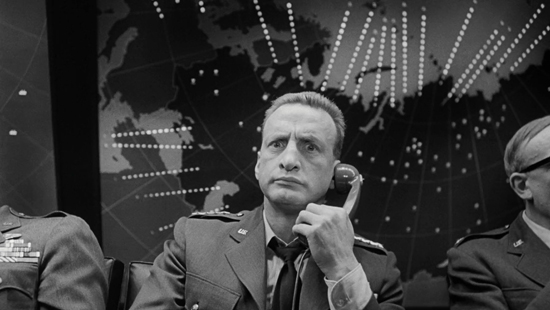
9.

SCAR from THE LION KING (1994)

EATEN ALIVE BY HIS OWN MINIONS

Scar is an interesting case of a villain who succumbed to the consequences of his own misdeeds.  His whole evil scheme was to take power through the regicide of his brother the king and his nephew.  To do so, he made a pact with the hyenas, giving them free reign over the Pridelands, his kingdom, and as a result he disrupted the food chain (or Circle of Life) as they call it that made the kingdom prosper and drove it into ruin.  There’s a Arthurian element to this story, where the return of the good king brings prosperity to the land once the bad king is driven out, and the makers of The Lion King borrow greatly from those kinds of legendary tales, as well as quite a bit of Shakespeare.  Certainly the thing that makes Scar such a great villain to hate is his lack of morals.  He is someone who will do anything to gain power, and that’s what makes his inevitable downfall all the more satisfying.  He is also a petty character as well, willing to throw anything in his way in order to survive.  That’s ultimately what leads to his downfall.  His nephew Simba easily overpowers him to reclaim his throne, but to buy himself an out after being cornered, Scar claims to Simba that he only acted the way he did because of the hyenas, saying it was their idea.  Simba of course doesn’t buy it, but he grants Scar mercy by condemning him to exile.  Scar, ever the petty one, attacks Simba when his defense is down, but ultimately he is no match and Simba sends him off the summit of Pride Rock in a steep fall.  Scar survives, but he finds himself surrounded by his hyena minions, who just happened to overhear him throwing them under the bus.  The hyenas have also been starving because of the shortage of food under Scar’s reign.  So, we see Scar’s evil schemes come full circle as he ultimately is undone by the very thing he empowered.  Of course Disney spares us the graphic details, playing out Scar’s end through shadows, but it’s obvious to us the grisly end that Scar meets, and it’s one that is significantly satisfying for such a weaselly manipulator who only cared about himself.
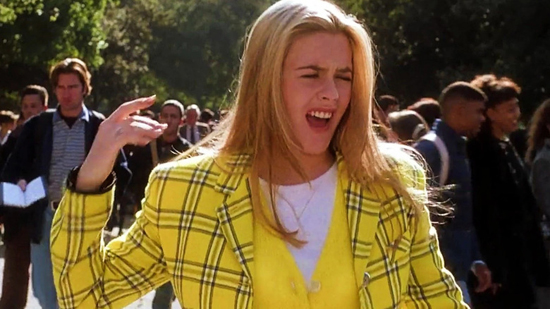
8.

HOPPER from A BUG’S LIFE (1998)

LATE NIGHT SNACK FOR BABY BIRDS

Hopper was an early Pixar movie villain that proved to be surprisingly brutal and dark for a family film.  The leader of a gang of grasshoppers who bully a colony of ants is not above using violent ends to not just get his way, but to also make his point.  One particularly dark moment involves Hopper crushing two of his minions to death under a mountain of food after they challenge his reasoning for demanding tribute from the ant colony.  It also is interesting to note that Hopper is the only Pixar villain voiced by a real life monster named Kevin Spacey.  Which makes it all the more satisfying that Hopper is one of the few Pixar villains who is done in by the end of the movie.  But, of course, the creative minds at Pixar are not going to kill off their dark and sinister bad guy in any ordinary way.  One of the few weaknesses that Hopper has as a character is his crippling fear of birds, which is something that the resourceful hero of the ants, Flik, takes advantage of.  He convinces the colony to build a replica bird as a defense against the grasshoppers, and while it works initially, Hopper eventually gets wise to the artifice.  However, this misconception that the ants have built a bunch of fake birds ends up leading to Hopper’s downfall, because during the final climax of the movie, Flik leads Hopper to a real birds nest and the villain doesn’t realize he’s been tricked until it’s too late.  Hopper’s demise is both hilarious in execution as well as a bit terrifying.  We know he’s about to be eaten alive, horrific as it sounds, but the ones doing the devouring are the cutest little baby chicks Pixar has ever animated; a nice little spin that the animators made to give it that extra bit of satisfying comeuppance.  It’s that mix of cute baby animals and Hopper’s helpless screams of terror put together that makes this villain death scene so memorable, and a brilliant way to make a gruesome death feel consequential but not out of place in a colorful movie like A Bug’s Life.
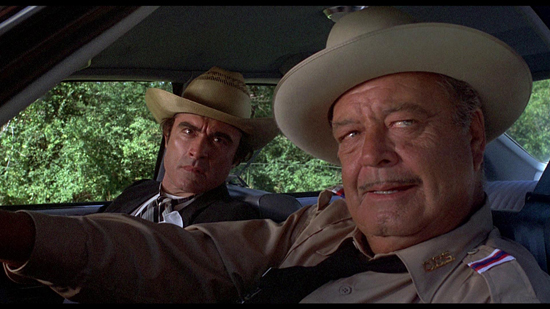
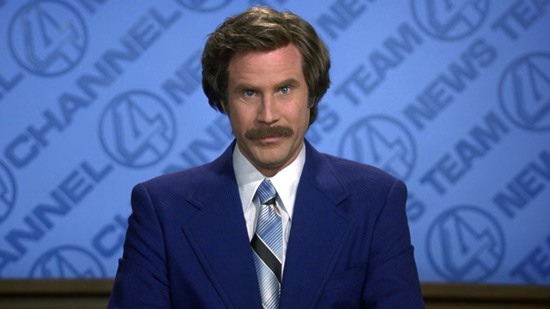
7.

JUDGE FROLLO from THE HUNCHBACK OF NOTRE DAME (1996)

PLUNGED INTO THE FIERY PIT

There’s a complaint that Disney tends to kill most of their villains off in the same way, which is to have them fall from a great height, making it a bit of a cliché.  The truth is that even though it does show up multiple times in Disney animation, it is an overall effective way to have the villain meet their end in a G-rated film; it’s bloodless and it doesn’t involve the heroes actively dealing a killing blow to the villain, thereby maintaining their purity of character.  A lot of Disney villains meet their end this way; Gaston, Professor Ratigan, Mother Gothel.  But it is perhaps Judge Claude Frollo’s fall from a high place that stands as the most memorable.  Not only is he falling from the balcony of the Notre Dame cathedral, but he is plunged head first while grabbing onto a very heavy stone gargoyle sculpture towards the square down below, which we know from earlier in the film has been covered in a layer of molten iron that the hero Quasimodo poured down to ward off invaders.  You’ve got to believe that it was not a pleasant end for Frollo.  Frollo is far and away one of the most vividly portrayed evil characters in any Disney movie.  His pious hypocrisy makes him an especially hateable presence in the film, and the fact that he’s a bit of a sadist is another layer to his villainy that makes him all the more potent.  That’s why his death scene has this satisfying and ironic karmic sense to it.  He believes he’s got the heroes, Quasimodo and the gypsy Esmeralda, cornered and he triumphantly holds his sword up high, quoting scripture by saying, “He shall smite the wicked and plunge them into the fiery pit.”  But, of course fate has other plans, as Frollo’s footing gives way.  Amping up the symbolism of the moment, the filmmakers had the gargoyle that Frollo is clinging to life to transform into a terrifying hell beast, indicating where Frollo is headed to in the next life.  It’s operatic and perhaps a little too heavy-handed, but still a satisfyingly gruesome end to one of Disney’s most evil human monsters.

6.

THE EVIL QUEEN from SNOW WHITE AND THE SEVEN DWARVES (1937)

STRUCK BY LIGHTNING, FALL OFF A CLIFF, AND CRUSHED BY A BOULDER

You wouldn’t think that Disney would take out their villain in a violent way during it’s early years, let alone in their first feature film ever, and yet they did just that.  Snow White and the Seven Dwarves pushed the boundaries of what could be done with the animated medium, and it’s interesting that Disney did not hold back when it came to creating a terrifying presence in their villainous Evil Queen.  Everything about the character is dark and foreboding, even during her regal scenes in her castle.  Once she transforms into her peddler woman form, she is the stuff of nightmares, with her gnarled fingers and buggy eyes.  As sweet and light as the rest of the film is, the Queen casts a dark shadow whenever she appears.  It’s to Walt Disney and his team’s credit that they remained true to the dark nature of the character, and it’s likely why they also chose to make her comeuppance in the story all the grander once it comes.  The moment Snow White bites the poison apple, it’s almost like nature itself has come apart, as the Queen’s triumphant laughter is punctuated by the sudden flash of a raging storm.  As she makes her way back to her castle, she finds that the Seven Dwarves are hunting her down.  She escapes them by climbing up a mountain slope, only to get cornered on a cliffside.  A precariously balanced boulder nearby gives her one final weapon to stop the Dwarves, and she tries to push it down their way, hoping to crush them.  In a real deus ex machina moment, her evil intent is stopped by a lightning strike right at her feet.  It crumbles her ledge away, causing her to fall to her death (it all started here).  To make the death even more gruesome, the boulder she intended to crush the dwarves with ends up toppling in her direction after she falls off screen with a final helpless scream.  It is amazing that even in their first animated film they managed to make their climax feel this monumental, and the Evil Queen’s over-the-top death scene really set the bar high for Disney afterwards.  It almost seemed like they were afraid to go as big as they did afterwards, because another Disney villain wouldn’t die on screen until Maleficent 22 year later.  Nevertheless, it is one that still remains memorable over 80 years later and is still a somewhat shocking moment for a Disney movie given when it was made.

5.

SYNDROME from THE INCREDIBLES (2004)

DEATH BY CAPE

Keeping in the same tradition of Hopper from A Bug’s Life, the main adversary of the Incredibles family also has a death scene that is both gruesome and hilarious at the same time.  Earlier in the film, the Incredibles’ go-to outfit designer Edna Mode makes it clear that she has one primary rule: No Capes!!  The reason for this is because though capes are an aesthetically pleasing and traditional part of a superhero’s overall presentation, it can also become a hazard depending on the situation.  The movie demonstrates this with a hilarious montage of different super heroes over the years who have had their cape get snagged on something or causes their wearers to get pulled into harm like they were lassoed in by a rope.  The Incredibles creator Brad Bird (who also voiced Edna Mode) brilliantly pays off this gag late in the film’s climax with the villain Syndrome being killed off by what else, his cape.  The great thing about this pay off is how sneakily Brad Bird brings it back into the movie.  Syndrome’s cape is not exactly a prominent feature of his costume, so we forget it’s there most of the time.  But once Syndrome is thwarted after Mr. Incredible throws his car at the villain’s hover plane, he is thrown back towards one of the plane’s jet turbines, and all of a sudden we are acutely aware of the cape.  It’s a hilarious way to finish off this villain, who certainly has earned this karmic death after the years of slaughtering super heroes to build better weaponry, but also at the same time when you think about it, it is also horrific in it’s own way.  What happens to the human body when it gets sucked into a turbine engine is pretty gruesome.  The movie spares us the blood and horror of it, instead showing the fireball aftermath, but we can still imagine what happened.  Given the gruesome nature of it, as well as the perfect punchline to a running joke throughout the movie, this is certainly the best villain death to have come from Pixar Animation.

4.

CLAYTON from TARZAN (1999)

HUNG EXECUTION STYLE IN TREE VINES

Tarzan is definitely one of Disney’s more action oriented films, so more on screen violence is to be expected.  This also leads to one of the more explicitly violent villain deaths in all of Disney Animation.  Clayton is not a particularly original villain.  His kind of trigger happy gentleman explorer type is just basic stock villainy for a lot of films similar to this one, both in animation and live action.  He still works as formidable foe for Tarzan in the movie, and is give a wonderfully boisterous vocal performance by legendary British character actor Brian Blessed.  But during the film’s climatic confrontation, Disney shockingly pushes the limit for what they can get away with in a G-rated film with the way Clayton meets his demise. He chases Tarzan into the treetops with his shotgun fully loaded.  Tarzan and him skirmish for a bit, before Tarzan manages to disarm him.  Tarzan could end the fight by pulling the trigger, but he proves he’s the bigger man by not sinking to Clayton’s brutal level and he smashes the gun to pieces.  Clayton then resorts to using his machete to lunge with murderous intent at Tarzan.  The fight ends up culminating in a tangle of vines, which Tarzan has a natural advantage in.  With his knowledge of the natural barrier that the vines provide, he manages to entangle his foe in the foliage.  But, the still bloodthirsty Clayton tries to hack his way out, not knowing that one of the vines has roped around his neck.  Tarzan tries to intervene, but Clayton cuts one vine to many and begins to fall.   After a quick freefall, we see the last vine attached to Clayton go taut.  We don’t see explicitly what happened, but a quick lightning flash shows the shadow of Clayton’s lifeless dangling body hanging off screen.  This is one moment where Disney gets the closest to not leaving anything to the imagination, and it is a shockingly brutal end for the villain.  It fits with the tone of Tarzan as a whole, which is among the more mature Disney animated movies, but even still compared to all the other Disney villain deaths, the fact that it is so grounded in reality makes the moment feel all the more shocking overall.

3.

URSULA from THE LITTLE MERMAID (1989)

IMPALED BY A SHIPWRECK

One of the most memorable Disney Villain divas should absolutely have a death scene as over-the-top as their personality.  Ursula the Sea Witch gets hers through one of the craziest turn of events seen in any Disney film ever.  After gaining her rival King Triton’s crown and trident, Ursula commands enormous power over the ocean.  She enacts her malice by growing to giant size and creating a chaotic storm.  Ariel the mermaid and the love of her life Prince Eric get swept into the maelstrom of Ursula’s creation, but the swirling water also dredges up ship wrecks from the ocean floor.  Eric manages to climb aboard one of these wrecks that has reached the surface and using his seafaring skills, he manages to steer it in Ursula’s direction.  Ursula is distracted by her focus on killing Ariel, and doesn’t see the ship making it’s way toward her, with the decayed bow having now become a nice pointy end.  She only notices a half second before and the sharpened bow cuts right into her.  The colossal Ursula has been completely impaled from front to back, and she quickly melts away as the life leaves her, leaving a smoky pool behind on the water’s surface.  It’s been told by the filmmakers that Ursula’s confrontation with Ariel and Eric was more low key in early versions of the story, and it was actually Disney Animation chief at the time, Jeffrey Katzenberg, who told them to make the climax a lot bigger, saying in his words, “I need it to be more Die Hard.”  And I guess they took it literally, because they made the climax bigger by making Ursula bigger.  But, given the enormity of her personality to begin with, this climax just fits the character a lot better.  In a strange way, this seems like the way Ursula would have wanted to go out; in spectacular fashion.  And kudos on Disney for once actually not taking the safe route and minimizing the gory details.  It’s a violent end, but one that is appropriate for this kind of classic villain.

2.

THE HORNED KING from THE BLACK CAULDRON (1985)

RIPPED APART BY THE POWER OF THE CAULDRON

Of all of the films made by Disney Animation, the darkest by design was their fantasy epic The Black Cauldron.  Made at a time when Disney was desperately trying to re-invent themselves in what was known as their Dark Age, The Black Cauldron was a far more violent and adult-oriented movie.  It was also the first time Disney received a PG Rating.  The shift in tone didn’t work out, as the movie was a financial flop that almost killed the animation department at the studio.  But, there have been elements about the movie that have helped it to gain a cult fanbase over the years.  One of them is the very memorable villain, The Horned King.  The Skeletal faced adversary is far and away one of the most terrifying characters to ever appear in a Disney animated film, or any animated film for that matter.  And of course, with a villain this terrifying and with so many evil deeds done in his wake, the comeuppance that he faces in the climax has to be as fittingly as gruesome as he is.  Given that The Black Cauldron was made in a moment in time when Disney felt unencumbered by the need to keep things family friendly, they decided that the Horned King’s death had to be a shocking one, and boy did they deliver.  Once the spell he has casted on the Cauldron begins to reverse itself, all of the magic begins to return back to the cauldron in a powerful black hole like vortex.  The Horned King tries to evade the pull of the Cauldron, but it overpowers him.  He makes one final desperate cling to life at the Cauldron’s rim, but the force begins to peel the skin off of the King’s bones.  The Horned King is violently torn apart piece by piece as the Cauldron consumes his essence and he is finally obliterated in one final violent explosion.  I don’t think you’ll find a more visibly gruesome villain death in any other animated Disney movie.  The Black Cauldron wasn’t afraid to take it’s story into violent places and show it all on screen, and that was evident by the visually explicit way that the Horned King meets his end.

1.

JUDGE DOOM from WHO FRAMED ROGER RABBIT? (1988)

MELTED BY DIP

Sure this is not a canonical Disney Animated movie, but the Disney Animation studio did work on this and Judge Doom is technically a cartoon character, so that makes this a Disney Villain death.  And the reason why he has managed to top this list is because I don’t think any other Disney Villain has had their life ended in a more gruesome and violent way than how Judge Doom meets his end.  The main villain of Who Framed Roger Rabbit? is definitely one of the most terrifying characters ever put on screen (played brilliantly by Christopher Lloyd) and that’s true even before we see his final form.  At one point with his climatic battle with the heroic Eddie Valiant, Doom appears to have met his end under the crushing power of a cement roller.  But, we soon learn that he was a cartoon the whole time, wearing a rubber mask disguise to appear human.  When he regains his shape, we see the terrifying red eyes now poking through the mask, creating a sight that drove terror into this writer as a child every time.  But, much like other villains on this list, Judge Doom falls victim to his own hubris, and is killed off by his own invention.  Doom had created a liquid mixture of Turpentine, Acetone and Benzine (all paint removers) to melt cartoon characters out of existence.  His master plan was to destroy all of Toontown (home of all the cartoon characters) with the nasty mixture, but Valiant manages to turn the tables of the maniacal judge and causes a spill of the substance to shoot out in Doom’s direction.  Judge Doom slowly melts down into the green colored pool, all the while screaming “I’m melting” in a nod to the Wicked Witch’s similar fate.  You really get the sense that Judge Doom went out painfully in the end, and it’s fitting given the sadistic way that he put a cute little cartoon shoe through the same fate earlier in the film.  Even as much as he deserved what came to him, there is this incredible sense of grimness in seeing a character just melt away into nothing, especially knowing just how painful each second of it would have been.  That’s why Judge Doom’s death scene is the darkest and most gruesome that Disney has ever put on screen.

Disney certainly doesn’t go dark and violent often, but as we’ve seen in some of the cases above, that when they do they make it memorably visceral and even sometimes graphic.  Of course, some of the most memorably evil baddies get grandiose exits, like Maleficent and Ursula.  But, at times Disney may even throw in a shockingly violent end to even a lesser villain.  The example of Clayton in Tarzan shows how they’re not afraid to give a vividly violent death to a more grounded character who left a lesser impact.  And there are of course the examples of the Horned King and Judge Doom, where Disney made use of the added freedom of a PG rating to show a bit more violence on screen.  Whatever the case, there definitely are rules that Disney still sticks with when it comes to how they give their villains a comeuppance that either leaves them dead or not.  For one thing, I notice that when a villain dies in a Disney movie, it’s mainly because they had already taken a life beforehand, and ending up dead themselves is just karmic retribution.  That’s definitely the case with on screen murders committed, like with Judge Doom, Scar, Frollo, Hopper, Clayton and the Evil Queen, or those implied off screen like with Maleficent, Ursula, the Horned King, and Syndrome.  Another rule that Disney applies is that their heroes can’t kill their villains unless it is a last act necessity.  That’s why so many villains meet their end through their own hubristic mistakes in Disney films, hence why a fall from a high place is so commonly used.  It’s always interesting to see Disney take more creative routes in dealing with their villainous characters, even when it means showing them mercy in the end.  Not every villain needs to meet a terrible fate, and as much as people like to see a big violent end for these characters, the movie doesn’t need it always to have a satisfying conclusion to a story.  For this list, it does offer up some interesting insights into how a company like Disney tends to handle darker moments within their movies, and it shows that they can go surprisingly hard when it comes to giving their Villains a violent and gruesome death.  They were even capable of doing so even in Walt’s time, with the Evil Queen’s three fold comeuppance in Snow White.  For this spooky time of year, I hope this was an interesting look into the different times Disney took a risk and gave their Villains a really hardcore exit out of their movies; even to some very shocking levels.

Top Ten Moments From Disney Animation… So Far

The Walt Disney Company is unlike the other big studios that make up Hollywood.  While the likes of Universal, Warner Brothers, and Paramount built up their brands with their stables of stars and filmmakers, Disney came to prominence a different way.  They had their own stars, but they weren’t dashing leading men or entrancing leading ladies; they were cartoons.  Begun a century ago in the back of a tiny law office in the Los Feliz neighborhood of Los Angeles, The Disney Brothers studio was born and out of that tiny back room grew one of the most powerful media empires the world has ever known.  Now the Disney Company has expanded to include other valuable brands like Star Wars, Marvel, 20th Century Studios, as well as having a major foothold in theme parks and even it’s own cruise line.  But, even with all that growth, Animation is still at the core of the studio.  The character of Mickey Mouse undoubtedly was responsible for making Disney what it is, but what has also come to define Disney over it’s 100 years are their historic milestones that pushed the medium of animation further.  Not every invention in animation can be credited back to Disney, but they are responsible for mainstreaming innovations.  It was going to be inevitable that someone would attempt a feature length animated film, but it took the initiative of Walt Disney and his artists to actually take that first step, even when many in the industry thought he was crazy.  Snow White and the Seven Dwarves (1937), their first feature film, sparked a revolution in the art of animation, and all that followed for Disney can be attributed to that success.  In the 85 years since Snow White, the Disney Animation Studio has produced 61 feature films, with the upcoming Wish (2023) marking their 62nd this November.  This group of films has come to be known as the Disney Canon; an official grouping of films linked  back to Snow White and meant to stand apart from all the rest of the films made at Disney.

In the Disney Canon, there are six distinct eras; the Golden Age (1937-42), the War Years (1943-49), the Silver Age (1950-67), the post-Walt Dark Age (1968-88), the Disney Renaissance (1989-2004) and the Digital Age (2005-present).  From all of these names, you can imagine the different shifts the Disney company went through, and the movies released in these eras are very much reflective of that.  The Golden, Silver, and Renaissance years were times of incredible growth and prosperity for Disney, whereas the War Years and the Dark Age were very disruptive.  But even during those disruptive years, Disney still produced a lasting classic every now and then, like The Three Caballeros (1945) in the War Years, and Robin Hood (1973) in the Dark Ages.  Looking over all of the Disney Canon films, it really is interesting to see the evolution of animation playing out before you as each film is it’s own time capsule.  And in many of the films, there are moments that remain iconic no matter what age it is.  These are the moments that stick with us for years afterwards and they are also the moments that have come to define the Disney name in the pop culture.  What follows is what I think are the Top Ten Moments from Disney Animation that have appeared so far throughout the years.  I’m drawing solely from the Disney Canon and at 9 decades and 61 films worth of material to go through, there are some tough choices about what to leave in and out.  So, with all that said, here are the Top Ten Disney Animation Moments..so far.

10.

MULAN VS. THE HUNS from MULAN (1998)

Disney is most well known for their lavish, Broadway style musical numbers and slapsticky cartoon hijinks.  What they are less well known for is staging epic battle scenes.  Sure, there have been climatic one-on-one battles, but a harrowing battle featuring armies numbering in the hundreds is something very out of character for them.  That’s not to say they couldn’t do it; all they needed was the right story.  They eventually found such a story with the Chinese legend of Mulan, the girl who impersonated a man in order to join the army.  The movie Mulan does an admirable job at building a captivating story around it’s heroine, but where the film really excels as a work of animation is in it’s staging of it’s more epic moments.  The film made use of the studio’s new innovative computer enhanced animation tools, which included the ability to fill a scene with literally hundreds of characters with a crowd simulator.  The most amazing use of this tool is found in a harrowing battle scene on the slop of a mountain.  Drawing inspiration from filmmakers such as David Lean and Akira Kurosawa, this battle against the Huns showcases a level of scale and scope never seen before in a Disney animated film, or any animation up to that point in fact.  You really get the sense of the overwhelming odds on screen, as the villainous Shan-Yu leads the charge down the slope, followed by all of his soldiers spilling over the crest on horseback in a seemingly unending horde.  Impressive as the effect is, the movie also gives us a surprising twist as Mulan uses her quick witted thinking to defeat the enemy single handedly, by launching a cannon at the mountaintop, causing an avalanche.  To this day, even with all the advances in computer animation, this scene still manages to wow, mainly because of the epic way it is staged.  You really get the sense of scale that Disney’s animators were trying to go for, and as a result, it shows that they could do so much more than just the cartoon stuff.

9.

FAIRY GODMOTHER’S GIFTS from CINDERELLA (1950)

The movie that sparked the beginning of Disney’s Silver Age is also one of the more grounded of the era.  Sure, talking mice is a fanciful touch, but Cinderella’s dilemmas are much more grounded in reality than the typical Disney fairy tale narrative.  Our heroine is not under some curse, or is the key to solving a magical riddle.  She is a poor soul being tortured and humiliated in her own home by a wicked Stepmother and her vain step-sisters.  Where the fairy tale element of the story comes in is at the moment Cinderella hits her lowest point; after the step-sisters have torn her dress to shreds, preventing her from attending the Royal Ball.  As she loses all hope for happiness, that’s when the Fairy Godmother arrives and works her magic.  The whole scene that follows is pure Disney magic, as the Fairy Godmother gifts her a full royal entourage out of all the animals in the garden and a magnificent carriage out of a pumpkin.  Set to the memorable tune of “Bibbidi Bobbidi Boo,” the whole sequence is a delight, but it reaches it’s high point when the absent minded Fairy Godmother finally remembers that Cinderella is in need of a dress.  And the moment Cinderella’s dress forms out of the rags of the old one may just be one of the most iconic single moments in animation ever.  Drawn by the iconic animator Marc Davis, one of Disney’s notable Nine Old Men, this moment really shows you what animation is capable of in contrast to any other form of filmmaking.  Any live action effect, especially in that time, couldn’t effectively do the same as what animation was capable of in realizing that moment, from the swirling of magic dust all around her to how the dress itself forms fluidly from the rags that Cinderella is wearing.  And it’s an iconic dress as well, complete with the all important glass slippers.  It may not be one of Disney’s flashiest moments, but it is one of the most magical.

8.

THE ICE PALACE FORMS from FROZEN (2013)

The Digital Age of Disney Animation is one that is still trying to find it’s identity compared to eras of the past, and for many die hard Disney Animation fans, they have a harder time finding things to love about computer animation when contrasted with the hand drawn films.  But there are certainly moments that are too good to ignore from this period in time, and one of the most iconic naturally comes from the biggest hit of this era.  The movie Frozen is noteworthy in the Disney Canon for a lot of things, but the moment that everyone remembers in the film is the show-stopping musical number “Let it Go.”  After fleeing her kingdom and finding herself in exile in the chilly mountains that border those lands, Queen Elsa resolves to cast aside the fear and self-loathing that caused her to hide her ice-based power for so long.  In doing so, she finally gives herself the motivation to “let it go” and take her power to the extreme without any inhabitations.  The song itself is quite the uplifting number, but the sequence definitely reaches it’s high point when Elsa begins to create a palace of ice on the mountain peak.  Shown in an incredible one shot, we see the foundations of the palace rise right out of the snowy slopes, followed by the cathedral like walls and then finally in a magnificent snowflake chandelier.  The way the virtual camera floats through this whole sequence is what really makes the scene special, putting us right in the middle of the magic.  And even after that breathtaking tracking shot, we get another magical moment as Elsa uses her power to change her royal garb into a icy blue and white gown.  Out of all the movies of the Disney Digital Age, this is the moment that still rings out as iconic almost a decade later, and it easily stands as one of the most memorable in the Disney Canon.

7.

LOVE’S FIRST KISS from SNOW WHITE AND THE SEVEN DWARVES (1937)

It would be wrong to overlook an iconic moment from the movie that started it all.  When Walt Disney first proposed to make a feature length film at his studio, many in Hollywood thought he was crazy.  “Disney’s Folly” is what they called it, and there were several in the industry that believed it was impossible to hold an audience’s attention for more than the average 7-10 minutes when it came to animation.  But, Walt Disney persisted, believing quite rightly that this was the future of the medium.  His team of animators pushed themselves to innovate and take animation in a direction that could believably support such a monumental project.  In the end, they managed to go above and beyond, with Snow White not just showing that a feature length animated film was possible, but that it’s story could rival anything told in live action.  The animators really got a sense of how successful they were when they attended the film’s premiere at the Carthay Circle Theater in Los Angeles.  At the climax of the film, Snow White is put into a death like sleep by a poisoned apple given to her by her step mother, The Queen, in the disguise of a hag.  The Seven Dwarves eventually chase down the Queen, who receives her comeuppance falling off a high cliff, but they return home believing their beloved Snow White is slain.  They chose not to bury her, instead placing her in a glass coffin in the forest, where the Prince pays her a visit to share his own grief.  He gives her a kiss, and this act magically revives the sleeping Snow White, leading to a triumphant celebration.  What struck the animators at the premiere was that they were seeing members of the audience, including A-List stars, openly weeping in the theater.  One of Disney’s animator’s, Ward Kimball, recalled the moment in amazement, realizing that what the audience was crying at was just a stack of drawings.  This showed that Disney transcended the medium of animation and could tell a story as captivating as any other made in Hollywood.  These were no longer just drawings; they were fully fleshed out characters whose stories could make you forget that you were watching a cartoon.

6.

THE SPAGHETTI DINNER DATE from LADY AND THE TRAMP (1955)

Sometimes the most magical moments in Disney movies don’t have to have actual magic.  Sometimes it can be something as simple as a Spaghetti and Meatball dinner.  That’s the case with this iconic moment from Lady and the Tramp.  The movie is one of Disney’s more grounded films, with a simple love story told from the point of view of dogs.  Lady is a cocker spaniel from a nice neighborhood, while Tramp is a mangy mutt from the rough side of town.  Circumstances bring them together, as Tramp helps Lady remove a muzzle forced on her by a  cruel new caretaker.  Still far from home and afraid to return, Lady needs some guidance, so Tramp agrees to show her around town.  Eventually they arrive at Tony’s Restaurant, one of his favorite haunts where the namesake owner is always happy to give him a handout.  Upon seeing that Tramp this time has company, Tony has the idea to give the two more than just scraps.  Tony gives them a full spaghetti dinner, complete with candlelight ambiance and Tony and his assistant Joe giving them a musical serenade.  In the real world, this would all be absurd, but in the hands of Disney’s animators it becomes one of the most romantic moments in cinema history.  The song, “Bella Notte” is itself a beautiful tune, and it perfectly sets the tone for the scene.  Of course the iconic moment that everyone remembers is when Lady and Tramp both start to chew and swallow the same strand of spaghetti, causing their heads to be pulled closer together until they lock lips.  Lady bashfully looks away and Tramp gallantly pushes a meatball closer to her.  The moment is so subtle and beautiful, and one of the most sublimely romantic moments ever put on film.  And it’s all the more remarkable that they are doing this with dogs as the main characters.  It’s a far more mature take on finding love than the standard fairy tale love at first sight.  Here, we see love bloom in the most unexpected way, and it’s a moment that still continues to delight many years later.

5.

WILDEBEEST STAMPEDE from THE LION KING (1994)

The Disney Renaissance marked a high point for Disney Animation.  After languishing in the Dark Ages of the post-Walt Disney years, Animation made a triumphant return with the release of The Little Mermaid (1989).  Of the Disney Renaissance films, none was bigger than The Lion King, a film that truly showed that Disney had grown bolder in it’s storytelling during this transformative era.  The Lion King was epic in scale, showcasing the vast wilds of the African savannah in a majestic tapestry of beautiful naturalistic animation.  It very much was a Disney film in the grand tradition that came before, but it also was innovative in a lot of other respects.  Computer animation had been coming a long way through the other films prior in the Renaissance Era, but in The Lion King, they created one of the most complex scenes that had ever been done in animation.  With the intent of killing both the king and his son in one fell swoop, the deceiving villain Scar lures his nephew Simba into a trap, unknowing of the peril he’s about to get into.  Simba is brought into a canyon where a huge herd of wildebeests are forcibly chased into, creating a stampede in which Simba is right in the path of.  The moment is truly terrifying, as the Disney animators used for the first time a duplication software that allowed them to create a limitless amount of wildebeests, making the horde heading Simba’s way to be an overwhelming force.  It’s the same software used in the battle from Mulan, but here it’s even more impactful.  When the wildebeests begin to crest over the ridge of the canyon, you get the feeling of dread of an oncoming storm, and the filmmakers punctuate that moment with a simulated smash zoom onto Simba’s terrified face.  Simba’s father Mufasa does eventually save him, but he’s overwhelmed by the sheer force of the wildebeest’s size and numbers.  Scar of course sabotages Mufasa’s escape, and it leads to one of the few on screen deaths in a Disney animated movie.  Though The Lion King has it’s fair share of iconic scenes, this is the one that has come to define the movie as an all time classic.

4.

THE CAVE OF WONDERS from ALADDIN (1992)

The Lion King may have been the most epic scale film of the Disney Renaissance era, but for the most action packed scene of this Age, you’d have to watch the movie that preceded it.  Aladdin is a magnificent ode to Golden Age Hollywood, with it’s incredible mix of high adventure, iconic music, and a general sense of campy fun.  In the most harrowing part of the film, Aladdin, deemed the “diamond in the rough,” is sent to retrieve a magical lamp from the Cave of Wonders.  The cave itself is vast and treacherous and Aladdin eventually finds the lamp high on a pedestal above a subterranean lake.  He takes the lamp, believing the worst is over, until he sees his monkey companion Abu trigger the self-destruct trap of the cave.  Massive boulders fall from the ceiling and the lake turns from water to lava instantly.  With the help of the Magic Carpet, Aladdin and Abu have a means to escape, but the lava lake magically follows after them in a fearsome tidal wave.  The flight through the cave itself is the moment that sets this scene apart.  While Aladdin and Abu are still hand drawn, their environments were completely rendered in computers, creating a 3D environment so complex it became immersive.  Sure it looks graphically primitive today; coming across just slightly more complex than a CD-ROM era video game, but in the early 90’s, this was ground-breaking.  Disney’s CGI team apparently looked to flight simulators, such as the one found in the Star Tours ride at Disneyland, for inspiration for this sequence, and it shows.  The flight through the cave definitely feels like you are on a ride with the characters, and it was a brilliant way to use computer graphics in a traditional animated film, helping them to do things that never had been seen before.  And it also fits well within the film’s whole general sense of fun.  Aladdin is a film full of moments that boldly pushes the limits of animation, and the Cave of Wonders sequence is where you especially see the film take things to it’s wildest and most edge of your seat potential.

3.

MAN IN THE FOREST from BAMBI (1943)

Moving to a completely different tone in Disney Animation, there is one other thing that the studio has excelled at and that’s pulling at the heartstrings of it’s audience.  There are some definite heart-breaking moments in their movies, like the aforementioned death of Mufasa in The Lion King, or the reunion scene of Dumbo and his mother in Dumbo (1941).  But, if there was ever a moment in a Disney movie that left a scar on the hearts of generations of children, it’s the fate of Bambi’s Mother in the film Bambi.  Throughout the movie we are told of the ominous threat of “man” in the forest.  The incredible thing about the film is that you never once see a single human being, at yet their foreboding presence is felt throughout.  The only trace they leave in the film is the sound of a gunshot.  And that sound itself plays a very key role in the moment that defines this film.  On a seemingly normal morning, Bambi’s mother leads him to a fresh patch of grass they can feed on in the midst of a snowy field.  As they feast, the “man” theme begins to creep into the score.  Bambi’s mother’s sense flare up, and she tells her son to quickly run to shelter.  Bambi runs ahead, with his mother motivating him onward, and then “bang.”  Bambi makes it to the shelter unharmed, but he made it alone.  He heads back out just as a flurry of snow begins to fall, calling for his mom.  After a fruitless search, Bambi runs into the Great Prince of the Forest, his father, who sadly confirms his worst fear, that he won’t be seeing his mother anymore.  This was a shockingly harsh moment for a Disney film to have, especially in it’s early days.  Unlike so many of their other films, this one delivered a harsh truth about the real world.  Bambi’s mother was not going to come back through any type of magic; she was just gone and never coming back.  A lot of children probably learned a lot about mortality and dealing with grief from this moment in the film.  Disney has a history of tugging at heart-strings, but none broke our heart as much as this moment did.

2.

THE DRAGON BATTLE from SLEEPING BEAUTY (1959)

The Silver Age of Disney came at a time when Hollywood was changing as a whole, embracing big widescreen epics as the answer to the rise of television.  Disney likewise embraced the widescreen medium as well, applying it to animation in innovative ways.  Lady and the Tramp was the first official widescreen film for Disney, but it was shot in that format in a last minute change-up, with much of the compositions on screen not really designed for the full wide frame.  Their follow-up, Sleeping Beauty would on the other hand be designed for widescreen from the get go.  And there are some incredible moments that beautifully utilize the full dimensions of the wide frame.  Of course, the one that stands out the most is the climatic battle at the end of the film, between Prince Phillip and the Mistress of All Evil herself, Maleficent.  The movie’s climatic battle, which sees Maleficent transform into a massive fire-breathing dragon, has become something of a gold standard for epic climaxes in other Disney movies.  You can see the battles against Jafar as a giant cobra in Aladdin and against Ursula as a giant version of herself in The Little Mermaid having been inspired by the battle against Maleficent’s Dragon in this movie.  It is a harrowing climax to a sequence that had already seen Phillip and the good fairies escape from giant rolling boulders, fireballs from the sky, and a forest of razor sharp thorns.  And the widescreen frame makes it feel even more grandiose, especially if you see this on a big screen.  The use of color in this scene also helps to heighten the tension, as the sky turn from somber grey to bright yellow as Maleficent’s inferno engulfs the whole scenery.  The dragon is only on screen a short while, but every second she’s there it is memorable.  The image of Prince Phillip tossing sword against a lunging dragon across the bright yellow sky is by itself a still image as great as any medieval work of art, and a perfect showcase of Disney Animation at the peak of it’s power.

1.

THE BALLROOM from BEAUTY AND THE BEAST (1991)

All of the moments on this list left a lasting impression in it’s own way on both the film they were in as well as the era that they represented.  But there is a moment in Beauty and the Beast that exemplifies all of the tricks of the trade that Disney had built up to that moment in time all working together to create a truly pure cinematic moment that just stands above all in animation.  Set to the melody of the title song, Beauty and the Beast brings the film to another level as the two characters make their way to the ballroom.  Aladdin and The Lion King both had incredible moments that showcased incredible integration of CGI into traditional animation, but none were as sublime as what they accomplished with the ballroom scene in this film.  The way that the camera sweeps across the floor with Belle and the Beast and then shoots up into the ceiling is breathtaking, as is the spiral downward from the chandelier back down to the floor.  The moment is both complex and subtle at the same moment.  The computer animation team knew they could create even more dynamic camera movement, like they would eventually with the Cave of Wonders in Aladdin, but here it’s restrained enough to wow us, but also feel natural in it’s sweep.  The scene after all is meant to be romantic.  The camera’s trek in a way mirrors the balletic movement of the dancing duo.  And the integration of the traditionally animated characters into this three dimensional space is impressive, even by todays standards.  Here we see animation taken to it’s cinematic power.  It’s interesting to note that the filmmakers were unsure that they could pull the scene off, and even had a back up plan called the “ice capades” version, where Belle and the Beast would dance in complete darkness with a spotlight following them.  Thankfully the rendering of the 3D Ballroom worked out, and we have this iconic moment presented in it’s full glory.  Beauty and the Beast was the first ever animated film nominated for Best Picture at the Oscars, and it probably helped that this iconic wow moment left so many audiences so enchanted by the film.  It may not have been the most exciting scene in a Disney film, but it is definitely the scene that showcased the animation studio working all of the knowledge of their long history of innovation into a pure cinematic moment.

So, there you have my picks for the most iconic moments in the first 100 years of Disney animation.  There were certainly many other moments that I wish I could’ve included, like the “Hellfire” sequence from The Hunchback of Notre Dame (1996), the Wizards Duel from The Sword in the Stone (1963), The Sorcerer’s Apprentice casting his first spell in Fantasia (1940), the Pink Elephants from Dumbo, Ariel hitting her high note with a wave crashing behind her in The Little Mermaid, the Big Ben fight in The Great Mouse Detective (1986), the flight to Neverland in Peter Pan (1953), and the escape from Monstro the Whale in Pinocchio (1940) to name a few.  Suffice to say, there is a proud legacy of iconic cinematic moments that have come out of the Disney Animation studio.  The moments that stand out the most however are the ones that surprise us the most, like the Ballroom from Beauty and the Beast, or the Spaghetti Dinner from Lady and the Tramp.  The death of Bambi’s mother is also one where the sheer brutality of that moment hits incredibly hard, making it memorable in a way that transcends the artform and makes us consider the morale meaning behind what we saw in that moment.  And of course, there are those moments that we remember because they just felt magical, like the moment when Cinderella gets her stunning ball gown.  Disney Animation just has that special ability to connect with their audience, and it’s managed to stay strong through a tradition of excellence and imagination that goes all the way back to when Walt and his tiny team of animators were working out of that back room in Los Feliz.  Hopefully that spirit of innovation and imagination continues to remain strong going into their second century.  For now, we have a long legacy of exceptional animated art from the most storied animation studio in the world, with a canon of films 61 one strong and growing.