The United States of America is a nation unlike any the world has seen before. Now in it’s 250th year, it is a nation of nations, built over all that time through the migration of people from all over the world coming here for the hope of a better future. And the reason why the world has looked to America as a great beacon of hope is because it is a nation where freedom has been one of it’s founding principles. Of course, America hasn’t always lived up to that concept of freedom in it’s history, as Americans have battled within it’s own borders just to make common sense things like the abolition of slavery and votes for women and minorities a reality. And there have been several other movements in America that have fought to uphold the rights for indigenous, queer, and disabled people in society. But all of that struggle is another reason why America has become a great nation, is because it is a country where our ability to speak out is enshrined into law. The U.S. Constitution is the greatest gift that the founding fathers left us because it guarantees us of those rights to life, liberty and the pursuit of happiness. And it is a document that is not set in stone, but rather can be amended to adapt to changing times, as long as it is done with the consent of the people of this nation. This helps to make our system of laws greater than any government that we put into power. It grants us the power to govern ourselves while also limiting the authority of those who govern us, preventing us from becoming the very thing that we fought to break ourselves away from; a monarchy. It’s not at all surprising that the very first right enshrined into the Constitution is the freedom of speech, because it enables all the other rights that follow it. It’s a right that has helped America prosper beyond most other nations, because with it, we’ve seen the American people exercise their ability to speak up for their own rights and against injustice. This has been a valuable thing to have in the world of politics, especially for those who often are made voiceless in other parts of the world, but it also has been valuable in culture as well. In America, we’ve seen freedom of speech lead to a flourishing of art both in the physical sense as well as with the written word. And it’s also been especially true with an artform that began in America as well; cinema.
American History has often been a popular subject to tackle in filmmaking. The stories of American progress through the years have made for some profound works of film, and often with the complexity needed to tell the truth about what made America the country it is today. However, cinema is a very potent kind of artform that when used the wrong way can also distort history. One of the most unfortunate things about the history of cinema is that one of the movies that was most instrumental in creating the language of filmmaking for the century that followed was D.W. Griffith’s The Birth of a Nation (1915), a horribly racist film that lionized the Confederacy and the Ku Klux Klan in it’s depiction of the Civil War. With a movie like Birth of a Nation, we see cinema used for the purpose of propaganda, telling a skewed account of history in order to satisfy the agenda of a particular group. Fortunately, the viewpoint of that particular film did not last long beyond it’s release, and civil rights in America took hold instead. What it does show is that American filmmakers have a responsibility to their audiences when they tackle historical subjects. Creative license can be useful, but it can also make a film feel dishonest when faced with actual historical facts. That’s why so many of the best historical films are the ones that incorporate historical fiction. Basically it allows for storytellers to tell their own story with the backdrop of a real historical event while at the same time not feeling constrained by the limitations that real history may put on their ability to tell that story. That’s how our best depiction of the D-Day invasion comes from a movie about fictional soldiers called Saving Private Ryan (1998). It’s not about showing us history as it happened, but allowing us the viewer or reader to experience history as it happens. It’s about putting us in a time and place, often through the eyes of a witness who is a complete fabrication for the story that the author wants to tell. The witness may participate in actual historical events, or their journey may just be to show us the life that one would have lived in those times. In any case, these stories are valuable in helping to make history come alive. Hollywood has certainly used historical films to help define our understanding of American history, especially through war and the struggles for human rights. But strangely, one part of American history has largely been overlooked over the years, and that’s the story of America’s founding.
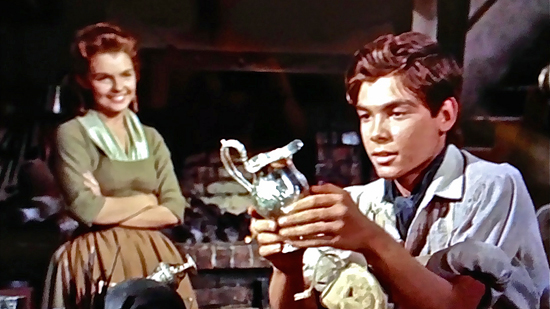
“There is a time for casting silver and a time for casting cannon. If that isn’t in the Holy Writ, it should be.”
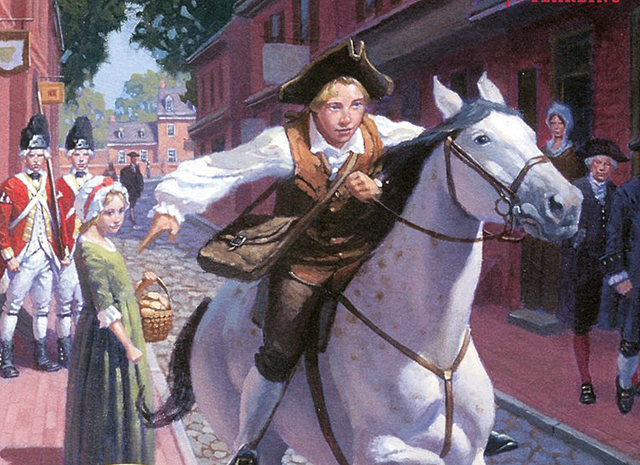
The Revolutionary War is one of the most defining moments in America’s history, and one that still to this day is influential in defining this nations identity. But on the big screen, the American revolution has been underserved. Most of the dramatic interpretations of America’s founding have been centered on founding fathers like George Washington, John Adams, Benjamin Franklin, and Thomas Jefferson. But the War itself has often been treated as an afterthought. It wasn’t a war of ideas like the biopics on the founding fathers seem to show, but a bloody conflict that tested the fortitude of the people of America against the Colonial British forces. There have been some films, most notably the Al Pacino flop Revolution (1985) and the Mel Gibson war epic The Patriot (2000); neither of which are very subtle in their depictions of American history. But, there are many worthwhile tales to be told about the Revolutionary War that do a better job of placing their audience into the shoes of the early American patriots. One such story is that of Johnny Tremain, a fictionalized participant in key revolutionary events like the Boston Tea Party and Paul Revere’s midnight ride. The novel Johnny Tremain was written in 1943 by historian and novelist Esther Forbes. Esther had written many fiction and non-fiction books about colonial New England during the 20’s and 30’s, but it’s Johnny Tremain that is her most famous work. It won the prestigious Newberry Medal for it’s contribution to children’s literature. Though Mrs. Forbes was not exclusively a writer for children, her book nevertheless served as a valuable entry point into American history for young readers, and it remains a popular choice for classroom curriculums to this day. Despite being a work of fiction, it is still a meticulously researched tome that recreates life in colonial Boston during the start of the Revolution. And young Johnny is an easily relatable child that proves to be a valuable witness to the sweeping movements of history around him. The book was an enormous success, and it’s not surprising that Hollywood took interest in it too. Naturally, there was one place in the industry that this story seemed to be tailor made for; the Walt Disney Studios.
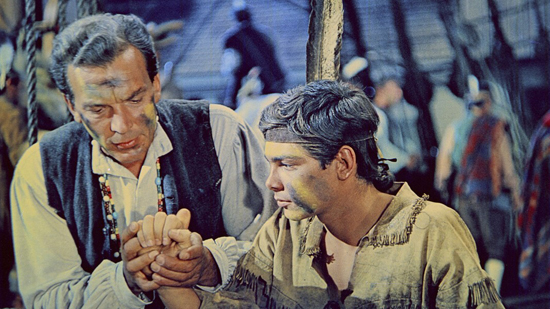
“Isn’t it odd? These Indians seem to prefer principles to profit.”
Disney was in it’s prime in the Post War years. Not only were they reaching their Silver Age with their animated films, with hits like Cinderella (1950) and Peter Pan (1953), but they were also achieving huge success with their live action films as well, including the blockbuster 20,000 Leagues Under the Sea (1954). Not only that, but Walt Disney was gambling big on another major expansion of his company, with the opening of Disneyland. Part of what was helping to drive this booming Disney’s business was the success they were finding on television, particularly with the show Disneyland. On the Disneyland program, Walt Disney was able to tell stories in different ways than he would on the big screen. In the Frontierland segment on the show, Disney would showcase stories about the American west, which often drew upon legends and true stories of historical figures. One of the breakout hits that came from this segment were the episodes about real life American pioneer Davy Crockett. Those Davy Crockett episodes became a phenomenon that spread fast across American culture, with young boys across America wearing coonskin caps just like Davy in the show. Because of the success of Davy Crockett, Walt Disney wanted to look for other stories about American history that could also capture the imagination of young audiences. He found the ideal match in Esther Forbes’ Johnny Tremain, given it’s youthful protagonist and connection to real historical events. As the production went into development, Walt saw that it was going to be a more ambitious project than the usual episode of Disneyland that they produced. So, the choice was made to give Johnny Tremain a theatrical release instead of the original two part adaptation they had planned for television. A lot of care was put into recreating the Colonial setting of the story, though not a single frame was shot in the real city of Boston. The movie was actually mostly shot on the Disney Studio lot in Burbank, California, with the Lexington battle scene shot on ranch land in nearby Canoga Park. And yet even still, the movie does a fine job of transplanting it’s audience into Colonial times.
While Disney put a lot of work into the production value of their adaptation, they also oftentimes have the habit of sanitizing their subjects as well in what many call Disneyfication. For a story like Johnny Tremain the problem with looking at it through the Disney lens is that you’re not really getting a true account of history, but the Disneyfied version of history. Disney is first and foremost an entertainment company, and even when they tackle historical events in their storytelling, it will come in a sanitized fashion mainly due to their commitment to family entertainment. That only becomes a problem if they are presenting their story as a more profound depiction of history; case in point, the historical revisionism that you find in something like their animated Pocahontas (1995). Johnny Tremain was already a story written for young readers, so there wasn’t much to sanitize already, as Esther Forbes made her book a more palatable read. But, there is a sense that you are not getting a true sense of the real history either while watching this movie. It’s an idealized version of historical events, which can at times be misleading. For instance, the depiction of the Boston Tea Party is portrayed in the film like it’s a well organized and peaceful protest where the patriots even clean up after themselves in a polite manner. This is very much not even close to what the tea party might have been like, as most protests (even peaceful ones) tend to be more chaotic and rowdy, even if the protesters are in the right. What Disney is giving us is the G-rated version of American history that is more palatable for all audiences. We like to think it was this clean and planned out, but the true history probably differs significantly. That’s not to say that the movie is intentionally trying to mislead us when it comes to the history of the story. It does feel more honest in it’s depiction of Paul Revere’s midnight ride as well as the battles that follow (albeit without the blood). The movie’s purpose is to draw your attention to the story being told and not to the minutia of it’s historical accuracy. What it primarily is meant to do is to make us feel connected to the history that is happening, mainly through the eyes of it’s young protagonist.
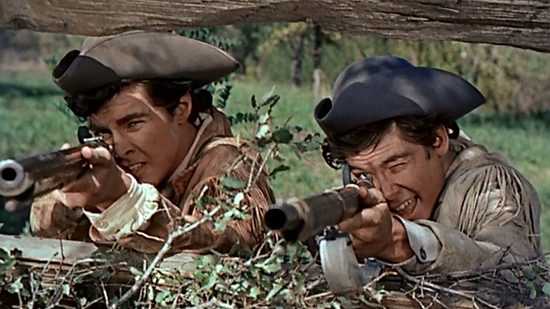
“We stand by our orders, but if they mean to have a war, let it begin here.”
Johnny Treamin as a character is an interesting one to put into the center of this kind of story. What most people remember from the book is that Johnny is left crippled in a silver smithing accident, with his right hand horribly burned and scarred, making him unable to perform many tasks he needs to do in order to provide for himself. In Johnny Tremain, Esther Forbes displays a perfect example of the American spirit, as even someone with a crippling disability at such a young age is still able to rise up and make a difference. Despite the loss of function in his hand, Johnny is still able to run communications between patriot organizations, doing his part to help spark a Revolution. In doing so, he meets important figures like Paul Revere, Samuel Adams, James Otis, and John Hancock. The book is very much a coming of age story that shows Johnny maturing very quickly through the experiences he goes through during this tumultuous time. He’s also described as being very young as well, barely into his teens. In Disney’s version, they age up Johnny a bit, with him being in his late teens, perhaps so they could fit in a romantic subplot for him with a girl he likes named Priscilla Lapham (who is in the books as well and younger than even Johnny). Actor Hal Stalmaster was 16 when he landed the role of Johnny, and he clearly looks much older than the way Johnny is described in the book; though his short stature does give him a bit more youthful character that helps to make him close enough to the ideal portrayal of the role. Hal does a fine job portraying the character of Johnny, though the way he is written in the film makes him more of a passive character than the cocky, strong willed character in the book. The movie’s version of Johnny is mainly there to be the witness to events rather than an active participant. Yes, he takes part in the Boston Tea Party and the Battle of Lexington, but those events seem to be happening around him rather than as an active part in Johnny’s development. We see Johnny participate, but we don’t get to see the impact they have on him as a character. The book very much treats Johnny’s development as a much more key part of the narrative, showing how extraordinary times shaped the people who lived through it.
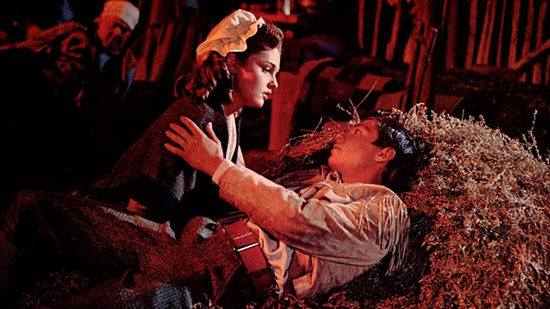
What gets lost in the translation is the long term effects that the story has on Johnny Tremain. One of the biggest changes to the story in the film adaptation is the fate of Johnny’s best friend Rab. In the book, Rab (the one who helped Johnny get more involved in the revolution) is fatally wounded in the Battle of Lexington, which leads to Johnny becoming more involved in the fight for independence so that his friend’s death would not be in vain. It also leads to Johnny seeking out the help of another patriotic character, Dr. Joseph Warren, who helps to surgically remove some of the scar tissue from Johnny’s hand so that he can at least have the ability to shot a rifle. In the movie, both events are either changed or removed completely. Rab Silsbee is portrayed in the film by future West Side Story (1961) alum Richard Beymer, and like the character in the book, he acts as a mentor to Johnny’s patriotic awakening. But the movie changes his fate completely, allowing him to not only survive, but also it has him fighting side by side with Johnny in the battle. The reason why Johnny is able to fight in the film is because they took the choice for him to have the surgery on his hand, which is how the book ends, and places it in the middle of the story, during the Boston Tea Party scene in fact. The next we see of Johnny afterwards, he is miraculously healed with a fully functioning hand. While it’s clear that the filmmakers wanted to have Johnny be a more active player in the battles that follow, it at the same time undermines the journey that his character should be going through. For Disney, they wanted things to have a nice easy flow in the story, with the characters getting what they want in the end and sacrificing nothing. It’s wholesome, but it undermines what Esther Forbes’ narrative, which was the cost that it took to achieve American independence, and how it still shapes us as a country today. While the changes Disney made are not in malice to the actual history of America, it at the same time steals the story of the emotional impact that it may have otherwise have had. They wanted this movie to be another Davy Crockett; a rousing adventure that audiences of all ages could enjoy. But in doing so, they also lost a bit of the emotional impact that this adaptation could otherwise have had.
“We fight. We die, for a simple thing. Only that a man could stand.”
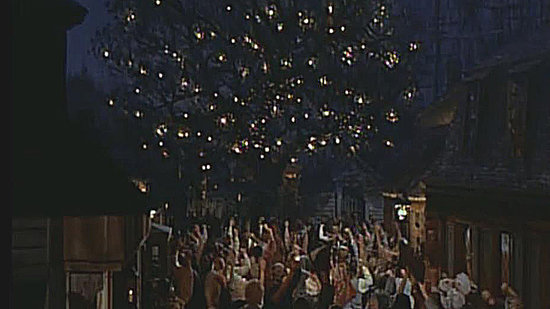
It’s one of the reasons why filmmakers should be careful when putting history on the big screen. There’s much about our country’s history that could be lost in the need for making it more entertaining. While Johnny Tremain is no where near the worst offender in sanitizing history for the sake of cinema, it still shows that some things can be manipulated in order to maximize the appeal to a mass audience. It’s interesting looking at Johnny Tremain as a story through the context of it’s time period. The movie came out in post War America, a time of fervent Patriotism that extended into the culture itself as America emerged as a global super power. While it was a time of national pride, it was also a politically volatile time that also saw the rise of the Red Scare and the blacklist in Hollywood. Was the intent of movies like Johnny Tremain to do justice to the fascinating history of America, or was it made to present an idealized version of this country in order to reinforce it’s place in history. The most interesting thing about the movie Johnny Tremain is what it leaves out from Esther Forbes’ book. Not mentioned in the movie is that Johnny is an immigrant to America. He was born in a convent in France before his mother brought him to Boston when he was still little. America has always been a country that has thrived through the influence of immigrants, including with founding fathers like Alexander Hamilton, and that’s just as much a part of Johnny Tremain’s story as anything else. But with movies made in the ultra-patriotic 1950’s, the drive was to show America as being more of a home grown phenomenon. Though Walt Disney was very much a patriotic man himself, his interest in a story like Johnny Tremain was more out of an interest in the time period than any sort of agenda it had. Disney loved American history and wanted to show it off not just on film, but in his parks too. It’s the reason why there’s a show devoted to Abraham Lincoln to this day in Disneyland, and in Disney World a whole land called Liberty Square lovingly recreates Colonial America, including having a Liberty Tree lit up with lanterns like the one in the movie. Johnny Tremain is a fine piece of entertainment, but a better adaptation of the book should still happen. Johnny Tremain as a character especially still feels underserved, and if Disney ever decided to do a remake, they should put more effort in showcasing the emotional side of Johnny’s story. Johnny Tremain represents so much of what America should stand for; perseverance and concern for those who have been hurt by injustice. He is America’s son of liberty, and a great symbol of patriotism that transcends politics and culture.
“It’s a tall old tree, and a strong old tree. And we are the sons. Yes, we are the sons. The Sons of Liberty.”