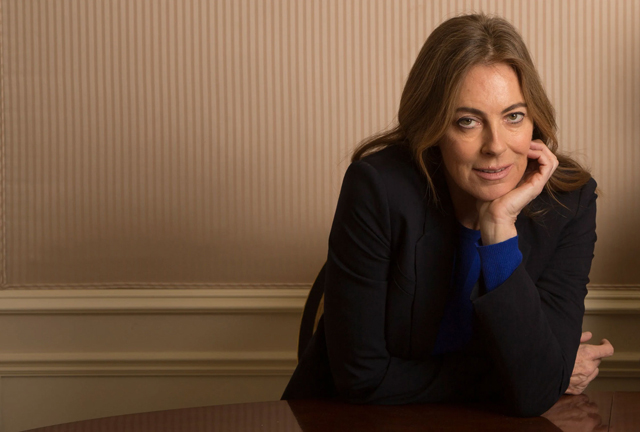
The Director’s Chair – Kathryn Bigelow

History was made at the 2010 Oscar ceremony when, for the first time ever, the prestigious Best Director award went to a woman.  There have been female directors for almost all of cinema history, but sadly most of them were overlooked by the Academy.  It was often because women directors were often looked down upon by the industry establishment.  “Women directors make women pictures,” was often the refrain that went across Hollywood over the first half century of industry, but that was a stigma that often was not true.  Sure you had your Nora Ephron’s and Nancy Myers’ making movies that catered to a female audience.  But there were also directors like Amy Heckerling, Elaine May, and Jane Campion who were making movies that reached a wide ranging audience that went beyond just female tastes.  And then there was Kathryn Bigelow, the women who finally broke through the Oscar glass ceiling in the Best Director category.  Bigelow by contrast was the complete opposite of her female contemporaries in the directing profession.  She made movies that were harsh, gritty, and action packed; traits that you would more quickly associate with appealing to male audiences.  I’m sure that a lot of men out there may be surprised to learn that their favorite action movies were helmed by a woman, but Kathryn Bigelow indeed was behind some of the most successful action movies of the last 40 years.  And this wasn’t a case of her trying to placate her talents in order to pander to a male audience in order to get ahead in show business.  Her vision as a director just so happens to fit into the types of movies that we normally would classify as masculine in nature.  She has an exceptional eye when it comes to filming action, often shooting it in a documentary like style that puts us the audience right in the middle of it.  This was something she excelled at with her early popcorn action movie work, but in her later years, she would focus her style into more dramatic and historical work; a shift that ultimately led her to success at the Oscars.

Born and raised in the southern end of the San Francisco Bay area, Kathryn Bigelow initially channeled her creative expression through painting.  She attended the San Francisco Art Institute, which then led to a Independent Study Program at the Whitney Museum of Art in New York City.  She struggled to find consistent work during her time in New York before enrolling in a graduate program at Columbia University.  She eventually found her way into Columbia’s film program where she ended up finding her calling at last.  She created what would be her first short film as a director called The Set-Up (1978), which she submitted as her thesis project for her MFA.  The Set-Up was very well received after Bigelow submitted the film to a number of festivals, and this eventually got her the chance to direct a feature film.  She would co-direct a biker movie with her Columbia classmate Monty Montgomery called The Loveless, which wouldn’t just be her debut on the big screen, but also that of a young theater actor named Willem Dafoe.  She would get the chance to solo direct her next film, the horror infused vampire flick Near Dark (1987).  In between that and her third film, Blue Steel (1990), she would end up marrying another rising star filmmaker from the 80’s named James Cameron.  Cameron would also act as the producer of her next film, which would end up being the movie that would launch her career to the next level, Point Break (1991), starring Patrick Swayze and Keanu Reeves.  But, Bigelow and Cameron’s relationship was not meant to last as they divorced after only two years.  Still, Cameron still helped Bigelow get her next film off the ground, the gritty sci-fi flick Strange Days (1995).  After 2002’s poorly received K-19: The Widowmaker, Bigelow would take long break from filmmaking to decide where to go with her career in the next decade.  Her search for a challenging project eventually led to a script from Iraq War correspondent turned screenwriter Mark Boal about the dangerous work of explosive disarmament in a war zone.  The movie that would come out of this paring of script and director would be The Hurt Locker, which won Kathryn her historic Oscar, along with the award for Best Picture.  This would then lead to an era for Bigelow where she went from action genre director to prestige director of serious, gritty dramas.  Even still, traces of her style from her early days of a filmmaker still inform her style today, and what follows are some of the trademarks that have defined her as a unique and groundbreaking director.

1.
EXPERIENTIAL ACTION

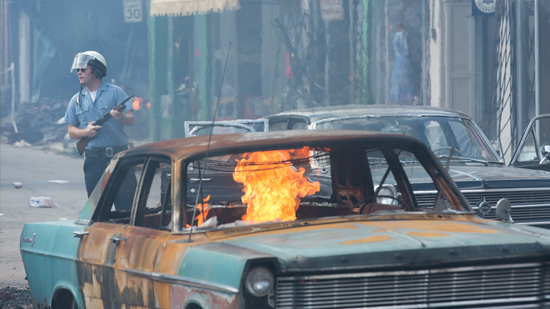
One thing that defines a Kathryn Bigelow movie above all else is the way she films action.  She has never been a lock it down kind of filmmaker.  In every movie she makes, she has the camera constantly moving around, often handheld, even in the quieter scenes of her movie.  Her intention is to put the audience in the experience of a scene, which means creating a sense of velocity and momentum through quick edits and an always moving camera.  This is a trick used by many action filmmakers, but few have the skill that Kathryn Bigelow has in creating a rhythm in these scenes.  The post-bank robbery chase through a neighborhood in Point Break is a great example of the way Kathryn is able to create that heart-pounding sense of adrenaline in a scene as we the audience are often following right behind the bank robbers as they run from one alleyway to another.  This scene made extensive use of a new kind of portable Steadicam, that allowed the cameraman to keep pace and run right behind the actors while still rolling film.  She would go one step further with Strange Days, where the actors themselves were wearing helmet cams in some scenes, which put the audience right in the POV of the characters themselves.  Even in her later dramatic work, Bigelow still incorporates this kind of experiential filmmaking.  Even in a movie like Zero Dark Thirty (2012), where half of the movie involves scenes taking place in war room meetings, the camera is still always in movement, albeit subtly.  Kathryn wants us to be present in the room with the characters, and that means making the POV of the camera act the same way that the human eye does, always wandering to catch new information.  Her most recent film, the triadic doomsday scenario thriller A House of Dynamite (2025) also follows this sense of experiential filmmaking, where she has some of the actors filming themselves through selfie cams on their phone as they take a meeting call while they are walking.  It’s a filmmaking trait that unites all the movies she has made, and it’s been the her most easily definable trademark.

2.
GRITTY, UNFLINCHING VIOLENCE

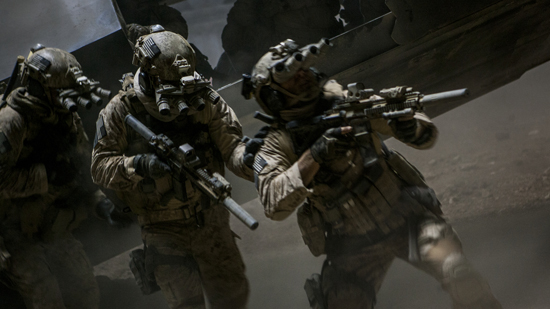
Most action filmmakers like to portray violence in their movies, but Kathryn Bigelow makes you feel the violence in hers.  She doesn’t glorify violence, but instead tries to maximize the impact you as an audience feels when it happens on screen.  She makes every bullet impact resonate, usually by making them so viscerally loud in each scene.  She blends the use of silence and the breaking of that silence through chaotic violence magnificently, and it’s all the more immersive given that she rarely underscores her scenes of violence with any dramatic music.  She also rarely uses slo-mo to heighten the violence in her movies, the obvious exception being the big explosion at the beginning of The Hurt Locker, which was probably intended to feel surreal.  The reason why she doesn’t try to employ any fancy tricks of the trade in shooting her action scenes is because she wants to maintain a sense of authenticity in her films.  This is especially true in her latter films, which take a more documentarian approach to their often true to life subject matters.  Perhaps the greatest example of her true to life approach to portraying violence is found in the climatic battle scene of Zero Dark Thirty, which dramatizes the famous raid on Osama Bin Laden’s compound by Seal Team Six.  In that closing 30 minute scene, Kathryn Bigelow masterfully utilizes builds tension through the balancing of the rising and lowering of violence shown on screen.  The moments when bullets are blazing are impressive enough, but it’s the near silence in between that really is expertly handled, as it raises you anticipation for the next outburst of violence to come as the soldiers move deeper into the compound.  It’s a masterclass of action filmmaking in that pivotal scene, as we indeed feel like we are in the middle of this historical moment in time, witnessing the true harrowing mission that Seal Team Six undertook.  It’s also what makes the violent outbursts feel so visceral in movies like The Hurt Locker and Detroit (2017) as well.  She’s also not one to shy away from how ugly violence can be, especially when we see moments of torture in Zero Dark Thirty, or as they called it in the midst of the War on Terror, “enhanced interrogation.”  For Kathryn Bigelow, she wants the violence to be a shock to the system, and not a thing to glorify for the sake of popcorn entertainment.

3.
THE HEAT OF THE NIGHT

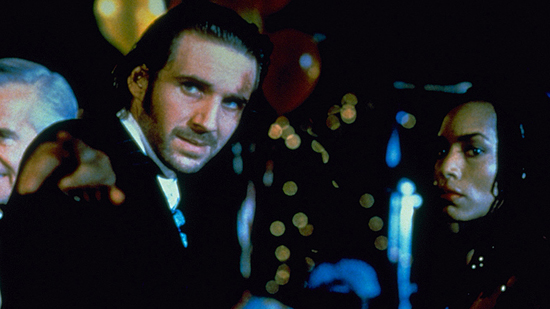
Kathryn’s movies also feature their fair share of night time scenes.  But what is unique about the way that she films these scenes is that she makes the night still feel as hot as it does during the day.  There’s a sweltering like atmosphere to the scenes that take place at night in her movies.  A lot of this has to do with the way she has her scenes lit.  There’s an orange like glowing filter to these scenes, which gives the impression of heat.  You can certainly feel this in movies like Strange Days, which uses warm hues through most of it’s nighttime scenes.  While most of The Hurt Locker is set during the day, the few nighttime scenes also carry over the feeling of it’s still being very sweltering, which it probably was for the cast and crew.  They filmed the movie in the Kingdom of Jordan where temperatures climbed up to 130 degrees Fahrenheit, and it probably didn’t dip down that much once the sun went down either.  But perhaps the movie that best illustrates just how well Kathryn Bigelow’s use of warm hues in night time scenes plays a role in setting the mood of a scene is in Detroit.  Kathryn’s tense thriller set during the 1968 Detroit Riots depicts a historically gruesome chapter of the event involving the Algiers Motel Massacre.  The movie mostly takes place over the course of one grueling, tension filled night in the middle of a hot summer season.  The sweltering heat hitting the city during that night is perfectly captured through the warm hues of cinematographer Barry Ackroyd’s lighting, and it helps to raise the tension of the scene to a boiling point.  We get the impression of it being a hot day even if it wasn’t one for the actors, and it helps to enhance the immersion of the experience.  But, Kathryn can also juxtapose these moments with scenes of cool lighting to emphasize a shift in the atmosphere of a scene.  Compare the warm scenes in the middle east with those of the cold, sterile offices of the CIA building.  Night time scenes in Kathryn Bigelow movies often are where harsher, more violent moments happen, and in her films violence and heat often coincide as a part of the experience.

4.
COMPLICATED, OBSESSIVE CHARACTERS

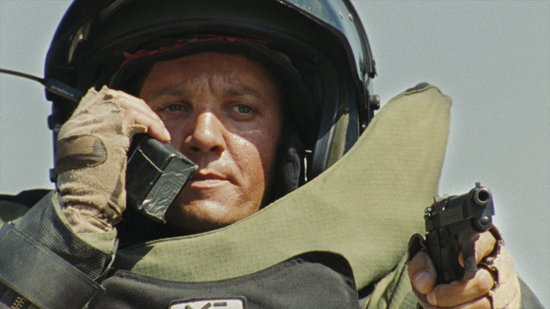
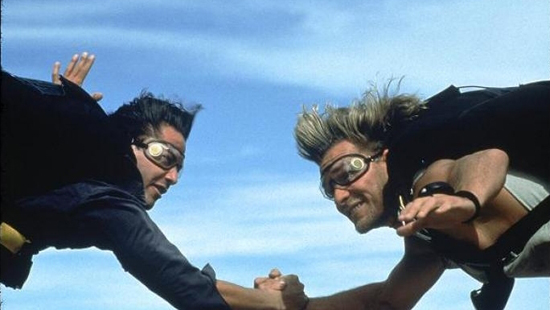
In a lot of Kathryn’s movies, there often seems to be a focus on characters that are consumed with some kind of obsessive behavior.  Jeremy Renner’s Staff Sergeant William James in The Hurt Locker is perhaps the best example of this in one of her films.  The Hurt Locker is pretty much a character study of what motivates someone to do one of the most dangerous jobs in the world.  William James’s primary job in combat is to disarm Improvised Explosive Devices, or IEDs, before they are detonated from afar to damage and/or destroy American military targets.  He dons the protective but restrictive suit, the titular “hurt locker” and walks right up to danger like it’s nothing to him.  Kathryn Bigelow and screenwriter Mark Boal clearly were fascinated by the mentality of a person who would do that kind of job on a daily basis, and Jeremy Renner plays the part perfectly.  He’s clearly great at his job, and he becomes a little cocky because of it, but we also see that his obsessive behavior when it comes to doing his job puts a wedge between him and everyone else.  Without this line of work, he has nothing else.  The same kind of fascinating exploration into the obsessive mentality of a person on a mission can be found with Jessica Chastain’s Maya in Zero Dark Thirty.  Maya, who was a fictionalized character made from an amalgamation of a number of real life people who helped track down Osama Bin Laden, is also a fascinating character defined by her singular obsession to find the mastermind behind 9/11.  She’s also Kathryn Bigelow’s sole female protagonist in any of her movies, which is an interesting thematic choice for the movie.  But even in her more genre heavy films, the idea of people being motivated by singular obsessions was something that still showed up in the narratives.  Patrick Swayze’s Bodhi in Point Break is a fine example, as his motivation in life is to chase after thrills, even when it involves robbing banks.  It’s not surprising that Kathryn Bigelow cites psychology as one of her secondary interests beyond filmmaking.  She wants to explore why her characters go to such extreme lengths in addition to showing us the extreme things that they do.

5.
PURPOSEFUL STORYTELLING

Kathryn Bigelow would probably tell you that she doesn’t intend to make films that deliver stated messages; instead choosing to let the film act as it’s own sense of truth.  This led to some criticism of Zero Dark Thirty, where critics took issue with the fact that her movie didn’t come out harder against the American military’s use of torture in the interrogations of enemy combatants.  While Kathryn does show the ugliness of such practices in the movie, she refrains from making any statements for or against it’s usage as a part of the gathering of information about Bin Laden’s whereabouts.  She could have made a movie where she took a stand, but that’s not what Zero Dark Thirty is.  The movie is very much a chronicle of how we finally got Bin Laden after a decade at war.  The movie takes a journalistic approach and not an editorial one.  She wanted us to see the process and make the judgments on our own.  That’s been the purpose in her storytelling; presenting something as close to the truth as possible, both the good and the bad.  The Hurt Locker was one of the first movies to really address the toll on soldiers in the then still on-going Iraq War, but she did so with a personal story about one man’s own experience.  Even in her earlier work, she managed to subvert genre tropes by adding unexpected layers to her characters’ stories.  Point Break flips the Cops vs. Robbers storyline on it’s head by making the story more about the power of male bonding, and how that ends up complicating a police officer’s undercover mission.  Detroit may show one harrowing night of tension and slaughter, but it also spells out the cruelty of institutional racism that still hasn’t fully gone away since the days of the Detroit Riots.  By making her movies experiential, Kathryn is able to let the movies speak for themselves about issues that matter, and prevents them from turning into lectures.  Authenticity is what matters to her the most in her filmmaking, even when it complicates the message of a movie, and it’s shows a level faith that she puts on her audience to understand the deeper meanings of the stories.  A lot of other filmmakers would try too hard to hammer home the message, and Kathryn instead allows the messages of her movies to be a warranted biproduct of the experiences she creates.

It’s a good thing that Kathryn Bigelow is no longer alone as a female winner of the Best Director award, having now been joined by Chloe Zhao (Nomadland) and Jane Campion (The Power of the Dog) in recent years.  But for a while, she was the sole winner of that coveted award.  And frankly, I don’t believe it’s a historical accolade that she ever intentionally sought after.  Kathryn Bigelow, for most of her career, has never really made what one would consider Oscar-type movies.  She was a genre film director, dabbling mostly in action with a little bit of horror and sci-fi here and there.  Her first attempt at making a serious drama (K-19: The Widowmaker) flopped so hard that it probably made many doubt that she would even be considered a serious filmmaker.  But, with The Hurt Locker, no only did her instincts as a filmmaker finally coincide with the preferences of the Motion Picture Academy, but she has since maintained that reputation as a serious filmmaker in all her movies after.  She probably would’ve been content just being a consistently working filmmaker who had no Oscar to her name, but fate seemed to fall her way and she made history in doing so as well.  Probably the sweetest bit of irony is that she won the Oscar by beating out her ex-husband James Cameron, who was nominated that same year for Avatar (2009).  The best thing to come from her Oscar win is that it finally showed Hollywood that female directors are just as capable as their male counterparts in producing impactful films that are deserving of Oscar gold.  We still have a long way to go before there is full parity in Oscar wins for female directors, but thankfully it’s become more common to see women directors getting high profile jobs.  We now have people like Greta Gerwig and Chloe Zhao not just directing small dramas, but also doing big blockbusters as well.  Kathryn Bigelow has more or less remained true to her own tastes as a filmmaker, with her only pivot being she moved from genre fare to serious dramas in her latter films.  And in being a strong example of resilience in Hollywood, she has proven to be an inspiration to young female directors everywhere.  Yes, her movies tend to be more male oriented, contrary to what most female directors tend to make, but it’s a prime example of how great cinematic vision knows no gender, and a great female filmmaker can find success making any movie they prefer to make.  For Kathryn Bigelow, action filmmaking was her calling, and she truly has been one of the best directors ever in that field of filmmaking.
Project Hail Mary – Review

Author Andy Weir has become of the most surprising rising stars in the world of science fiction literature.  Fifteen years ago, he was a programmer living in a two bedroom apartment in Mountain View, CA writing short stories for free on his website in between gigs at AOL and Blizzard.  In 2011, he began to self publish chapters of what would end up being his first novel on his website, and his readers convinced him to take his work to a publisher and make it available to a wider reader base.  That novel would turn into The Martian, a heavily researched and detailed account about how an astronaut stranded on Mars manages to survive the conditions on the Red Planet before being intercepted by a rescue mission.  The Martian was a critical and commercial success, becoming a best-seller and launching Weir into a new career as a novelist.  The book also captured the imagination of Hollywood too, and the novel was quickly adapted into a 2015 blockbuster film directed by Ridley Scott and starring Matt Damon.  Weir quickly went to work on his next novel, which would be a much more high concept science fiction story called Artemis (2017), which was less grounded in real science as The Martian was.  Several years later, Weir would write his next novel, a project that incorporated the high concept strangeness of Artemis, but also would have the grounded foundation of real science like The Martian.  That book would be Project Hail Mary; a story about a lone scientist out in the cosmos who is humanity’s last hope for survival in a future where the Sun is dying.  The book won acclaim from readers everywhere, and the book was a finalist for the prestigious Hugo Award.  Of course, just like The Martian, Hollywood was interested in adapting this novel as well.  Screenwriter Drew Goddard, who also adapted The Martian, would return to tackle the adaptation of Hail Mary to the big screen as well.  But, instead of seeking out someone of Ridley Scott’s caliber to direct, the executives at MGM decided to look outside the normal pool of likely filmmakers.

Who MGM ultimately settled on was the directorial team of Chris Miller and Phil Lord.  Lord & Miller as they have been more widely called have been one of the more unconventional teams of filmmakers working in Hollywood over the last decade.  The two started of in animation, working on the cult adult animation series Clone High before getting their first feature film at the still fledgling Sony Animation Studio called Cloudy With a Chance of Meatballs (2009).  But, they didn’t just see themselves as animation directors.  Instead of working on a sequel to Cloudy, they opted to jump into live action, and were given the job of directing a movie adaptation of the 90’s crime drama series 21 Jump Street (2012).  But their Jump Street film wouldn’t be just a simple one-to-one adaptation.  It would be a self-aware, comedic adaptation that matched the duo’s irreverent sense of humor.  The movie was a hit with audiences, and it led to them moving over to Warner Animation, where they would create the surprise hit, The Lego Movie (2014).  With both 21 Jump Street and The Lego Movie, Lord & Miller created a reputation for themselves as being filmmakers who could take bad movie ideas and turn them into beloved classics.  But, since the sequel 22 Jump Street (2014), the duo have not directed a film together until this year.  One of the reasons for this is the bad experience they had as the original creative team behind the Star Wars spin off movie Solo (2018).  They left their lucrative gig at Warner Brothers because they were eager to work in the Star Wars franchise as long time fans, but Lucasfilm didn’t like their approach and they were fired halfway through filming and replaced with Ron Howard in the director’s chair.  Now freelance again, Lord & Miller returned to Sony Animation, where they helped to produce the enormously popular Spider-Verse series, which also earned them their first Oscars as the film’s producers.  They would continue to work on many other projects throughout the 2020’s, including a brief revival of Clone High, but the sour taste of the Solo experience left them reluctant to step back into the role of directors again; unless the right project came along.  Surprisingly, MGM was interested in their involvement in this adaptation of Project Hail Mary, and now we have our first Lord & Miller directed film in nearly a decade.  The question though remains if was indeed worth all that wait?

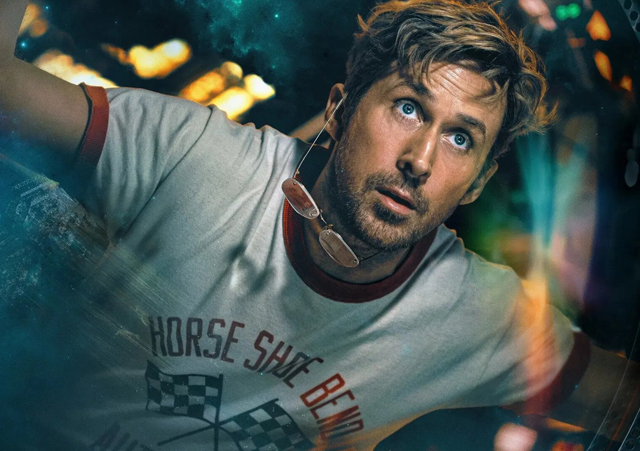
Project Hail Mary takes place mostly many light years away from planet Earth.  On a space ship hurtling through the cosmos, Ryland Grace (Ryan Gosling) wakes up from a medically induced coma that has kept him in hibernation throughout the multiyear journey in far reaches of space.  He has no memory of who he is or why he’s on the ship, but he uses his scientific mind to quickly piece together what mission he was meant to undertake.  Flashbacks help to fill in the blank spots of his past.  Ryland became part of a top secret department made up of leading scientists from all over the world, led by a stern but encouraging project leader named Eva Stratt (Sandra Huller).  A groundbreaking discovery uncovers the terrifying secret that microscopic parasites called Astrophage are absorbing the energy of the sun and causing it to dim.  The dimming is resulting in the plummeting of temperatures on Earth, which could lead to the extinction of all life on the planet, including humans.  Ryland became the first scientist to document and understand the properties of this mysterious single celled organisms, and his research makes him one of the most valuable minds in the agency’s team.  Their research has shown that what is happening to our Sun is happening to stars all over the local cluster, except for one, Tau Ceti.  The mission becomes clear; a team of astronauts must travel to the Tau Ceti system and discover why it has not been infected like all the other stars around it.  The amount of energy that Astrophage gives off when it consumes electromagnetic radiation and Carbon Dioxide also proves to be a good source of fuel for near light speed propulsion, so the engineers on the team manage to create an engine for just that purpose using the very thing that’s destroying their world as the key to humanity’s survival.  Many years later, Ryland finds that he is the last surviving member of a crew that died during hibernation.  He makes it to the Tau Ceti system, but he learns that he’s not alone, as an alien space craft intercepts his.  Though imposing at first, Ryland finds that the life abord the craft are in the same situation he’s in; trying to help save their planet as well.  He makes contact and finds an alien being that looks like it’s made of stone.  Ryland makes attempts to bridge the communication gap, and even gives his new friend the name Rocky.  It then falls on Ryland and Rocky to put their minds together to help stop the Astrophage and save their respective worlds.

We’ve had a lot of amazing space based movies over the last decade.  Christopher Nolan delivered his IMAX screen spectacular with Interstellar (2014), and of course there was the already mentioned The Martian from Ridley Scott as well as Alfonso Cuaron’s Gravity (2013).  Ryan Gosling also is no stranger to space based epics, as he got to play legendary first man on the Moon, Neil Armstrong, in the film First Man (2018).  One of the reasons why we’ve had so many of these types of movies lately is because the vastness of space and interplanetary travel lends itself very well to big screen spectacle.  You even see it be a major part in epics fantasies like the Star Wars and Dune franchises.  These movies especially seemed designed for the grandeur of the big screen.  This is something that we’ve known since the days of Stanley Kubrick’s 2001: A Space Odyssey (1968).  Project Hail Mary follows in the footsteps of these space based epics, and is intended to be a major crowd pleaser.  For the most part, it succeeds in what it hopes to accomplish.  It’s an incredible spectacle that really need to be seen on the big screen to fully appreciate.  It also does a great job in grounding it’s scientific concepts in ways that make sense to the average viewer, without also insulting the true science that forms it’s foundation.  But, the movie also seems to hold us at a distance, which unfortunately undercuts the effectiveness of the story.  The way the movie is structured is that it tells the story in a non-linear way, cutting away from the main story of Ryland in space to show us why and how he got there.  While all the individual scenes are fine on their own, the way they are structured together kind of makes the pacing of the film feel a bit uneven.  The main plot, involving Ryland and Rocky forming their bond and working together to solve the mystery behind the Astrophage is definitely the best part of the movie, but every time the movie cuts back to the past, it felt like the momentum of the main story was being halted.  I understand that it’s supposed to be like in the book, as Ryland slowly pieces together his memory, but it just felt like a whole different movie was trying to force it’s way into another one.  It just made the whole experience feel awkward and keeps a pretty good movie from becoming a great movie.

Despite that, there is still a lot to like about the story of the Project Hail Mary.  Just like The Martian, the movie takes it’s time to give us details about what the problem is and how our heroes must solve it.  While it’s science is a little more on the fictional side that the far more grounded Martian, it’s nevertheless treated like something that actually could be scientifically true.  Just like The Martian, it’s great to see a movie treat science so respectfully.  At a time when scientific literacy is at a low point, it’s great to see movies like this show why it’s essential for the fate of humanity to “science the shit” out of our current problems.  But the movie doesn’t treat it’s audience as idiots either.  It does go out of it’s way to be true to real science as possible.  There are some leaps of logic at times, but none that come across as insulting to the audience’s intelligence level either.  Lord & Miller assume that their audience has the basic understanding of how space based physics work.  Sometimes they even play against your expectations, like how objects move in the vacuum of space, or moments when they play around with the complete silence of space as well.  Of course, Lord & Miller use their background in comedy to help lighten many moments in the movie, and some of their best gags are reserved for those subversions of how physics work in space.  At the same time, they don’t undermine the seriousness of the situation either.  As far as their filmography goes, this movie is probably the most dramatic film that Lord & Miller have made.  It shows that they are indeed branching out as filmmakers, not just confining themselves to comedy alone, even if it is their strongest suit.  One wonders what might have been with their version of Solo.  Were they really that bad of a fit for Star Wars?  This movie does prove that they were capable of pulling off the spaced based spectacle on the big screen, and they could even take themselves a little bit more seriously in the process.  Regardless, I hope some of that experience is what helped to fuel their approach to this film, which while uneven still demonstrates a strong step forward for these two filmmakers.

One of the things that was central to making the movie work as a whole was the casting of Ryland Grace himself.  The movie for the most part is almost entirely a single-hander, with his only co-star being an alien creature without a discernable face.  It would require an actor with a lot of charisma to hold a movie like this together almost completely solo.  Ryan Gosling proves to be the right guy for the job.  Gosling embodies this charming everyman quality that makes it easy to like him on screen with not much interference.  Given that he’s by himself for a good chunk of the movie, you need that everyman quality to center the movie in something grounded and genuine.  He can be aloof and funny, but we also buy him as a man who seriously is trying to think his way out of a problem.  Some readers have raised concerns that Ryan is too handsome an actor to play Ryland Grace, as the character in the book is described as being more of a plain looking, out of shape guy.  And while there are attempts to make Gosling look a tad more plain in the movie, it really doesn’t matter in the long run.  We just need to believe in him as this character; someone who will use his mind to science a way out of this situation.  Of course, what a lot of people are going to talk about is the on screen chemistry that Gosling will have with the alien Rocky.  Rocky may be the movie’s greatest triumph because of the limitations on how he is able to communicate.  He’s a stone based creature that walks around like a crab and has no discernable facial features.  And yet, he’s incredibly expressive, showing emotion through pantomime, often imitating what Ryland does to show he’s friendly.  What’s remarkable is that Rocky was actually an on-set physical puppet for many scenes, puppeteered by James Ortiz, who also provided his the voice of Rocky’s computerized translator.  Obviously for some of the more complex movement scenes, Rocky’s puppet was switched out for a digital model, but you really have to give credit to the movie for actually going out of their way to build a real puppet for the film, which I’m sure Gosling really appreciated as an actor needing something to react to on set.  And though her presence in the movie is minimal, Sandra Huller also brings a great presence in what is her debut in a Hollywood studio film after a distinguished career working in German cinema.   It may not be a big cast, but they manage to carry this movie very well, even through it’s big epic moments.

Of course what a lot of people are going to discuss about this movie are the visual.  The film is grandiose in scale, but it also manages to capture the small moments pretty well in between.  Most of the movie takes place on the space shuttle Hail Mary, and the production team did an excellent job of making the sets for the shuttle look true to life as possible.  The filmmakers certainly must have done their research with how space stations are built and function, and also included theoretical plans about how such facilities would work in the near future.  Of course, the movie also plays around with theoretical science as well, especially in the way it imagined what Rocky’s own space ship would be like, and how it functions.  The planets of the Tau Ceti system are also incredibly realized.  To create these visuals in a way that does the vastness of space justice, it’s easy to see why Lord & Miller got Oscar winning cinematographer Greig Fraser on board, given that he’s been the one who’s photographed the Dune movies for Denis Villeneuve.  The movie uses two types of film formats.  The scenes on earth are shot in the standard scope widescreen aspect ratio of 2.39:1.  But all the scenes in space (which is roughly 70% of the film) was shot on 70mm IMAX.  If you are lucky enough to see the movie projected in 70mm IMAX (as I was), you are seeing the movie as it was truly meant to be shown.  The vastness of space can only really be appreciated in the IMAX format.  Greig Fraser does an incredible job of capturing both the emptiness of that void, as well as the overwhelming scale of the planets once these space ship arrive near a celestial body.  Fraser also does a great job of shooting the interior spaces of Ryland’s space shuttle.  The movie does a nice job of playing with perspective sometimes, where Gosling moves around the spaceship contrary to where we expect the floor and ceiling to be; a trick also used very well in 2001: A Space Odyssey.  The visual effects team should also be applauded because it also appears that a lot more practical effects were used on this film than what we’d expect.  The Rocky puppet is one thing, but it’s also clear that a lot of scenes of the two space ships were done with real physical models as opposed to CGI; another nod to 2001, but also something that Christopher Nolan also made extensive use out of for Interstellar.  Lord & Miller clearly wanted to make this film feel grounded, and it’s great to see that they didn’t just rely on heavy usage of CGI to do the job.  It works so much better to make this story believable when what you are seeing are real, physical things shot on camera.

There is certainly a lot to like about Project Hail Mary, and I have no doubt that this will be a winning film for most audiences.  It’s got a positive message about teamwork and making personal sacrifices for the sake of saving others.  It’s also a beautiful looking movie that demands to be seen on the biggest screen possible.  But also I felt coming away from the movie that it lacked that certain element that could have made it even greater.  I feel like it’s fundamental flaw resides in it’s uneven pacing.  The movie is 2 hours and 36 minutes long, and I feel like it could have worked better if it maybe reduced those flashback scenes to a minimum.  The problem is that those flashbacks end overstaying their welcome and they don’t really add much overall to the story other than providing context.  There are some nice flashbacks in there, especially the karaoke scene with Eva, but what we learn about Ryland as a character is mostly found in his scenes out in space, and that ultimately makes the flashbacks superfluous.  The main thrust of the story is Ryland and Rocky, and that’s where the heart is.  Whenever it cut away from the their story to one of these flashbacks, I felt that momentum of the movie got halted, and it reduced the overall experience.  It needed consistency in it’s pacing, and that was found mostly in those space scenes.  That’s why I feel that it didn’t work as well as The Martian did as an adaptation of Andy Weir’s writing.  The Martian has a much clearer and linear line in it’s storytelling, and that’s what helped it to be a much briskier film overall, even with the near identical run time of 2 1/2 hours.  Even still, Lord & Miller are showing a lot of growth as filmmakers, and this movie shows just how well they can handle big spectacle in a live action movie.  Their handling of the Ryland and Rocky storyline is especially well done.  If anything, that the thing that most audiences are going to take away from this film, which is the surprisingly charming bromance between Ryland and Rocky.  Project Hail Mary follows in the footsteps of some major cinematic classics like 2001, Gravity, and Interstellar, and while it may fall short in terms of the execution of it’s story, it still nevertheless does justice to the visual legacies of those films as spectacles.  I have my misgivings about how the story was told, but I certainly recommend seeing this movie for the big screen spectacle it offers.  It’s movies like these that bring us the closest to sailing through the stars.

Rating: 7.5/10

The 2026 Oscars – Picks and Thoughts

We’ve come to it at last, and much later in the year than usual.  The Super Bowl for movie nerds; an event that can either lead to great triumph or great disappointment.  The Oscars culminates a year’s worth of anticipation, waiting to see who will be honored for their work in the past year.  This year’s Oscar race has also been a particularly groundbreaking one.  It started off with the record-shattering 16 nominations for Ryan Coogler’s genre bending Sinners (2025).  The previous record was 14, held in a three way tie by All About Eve (1950), Titanic (1997), and La La Land (2016), and in the case of two of those, that then record number led to Best Picture wins.  No matter what happens on Oscar night, Sinners will still stand alone for quite a while as the most nominated movie in the history of the Oscars, which is quite something for a movie with vampires in it.  But, as we saw with last year’s most nominated film, Emilia Perez (2024), having the most nominations in a given year doesn’t always guarantee a Best Picture win.  Though it won’t flame out in controversy like Emilia Perez did, Sinners also hasn’t run in this race as a front runner either.  The odds this year have favored Paul Thomas Anderson’s One Battle After Another, giving the veteran filmmaker his best shot at getting the top prize thus far.  One Battle does have a lot going for it; impressive production values, an all-star cast (many of whom got nominated alongside the movie), and a groundswell of support for a filmmaker who many believe is overdue.  It’s also won many of the precursor awards, so it’s still looking like a clear front-runner.  But, Sinners seems to be making a late charge, especially with an upset victory at the SAG-AFTRA Actor Awards.  What we know right now is that the night will belong to either of these juggernauts, as few others have made much buzz in the Best Picture race.  But, it should make for one of the most exciting Oscars in a while, because it looks like the race to Best Picture is very much coming down to the wire.

As with every year, I will be sharing my thoughts and personal picks for this year’s Oscars.  The top categories are the ones that I go into the most depth with; sharing how I think each category will go and explaining why I am making my pick.  I follow the Awards season pretty closely, so I come to this with an educated understanding of the nominees.  One of my goals each year is to see every single one of the Best Picture nominees, and in a theater setting no less.  I’m happy to say that I accomplished that goal again this year; yes, even with the Netflix ones.  While I try my best to make a well informed choice, I am also never 100% correct on everything.  The Oscars have been known to throw a few surprises our way.  This year’s Oscars may in fact be one of the most unpredictable ever, given how so few categories have runaway favorites.  So, take my predictions as they are, and we’ll see how well I guess the winners.  Of course, I also share my personal picks alongside who I believe will win, just to show how I would’ve voted on this year’s ballot.  So, with all that said, let’s take a look at my picks for the 2026 Academy Awards.

BEST ADAPTED SCREENPLAY

Nominees: Will Tracy, Bugonia; Guillermo Del Toro, Frankenstein; Chloe Zhao and Maggie O’Farrell, Hamnet; Paul Thomas Anderson, One Battle After Another; Clint Bentley and Greg Kwedar, Train Dreams

Both Screenplay categories have some pretty clear front runners this year, but it is worth taking a look at all the nominees, given that it was a strong year for writers.  Both of the screenplays for Hamnet and Train Dreams did a fine job of adapting their literary sources, with Maggie O’Farrell getting to adapt her own novel alongside director Chloe Zhao for Hamnet.  Will Tracy’s screenplay for Bugonia took the concept from an obscure Korean film, and brilliantly crafted it into a surreal exploration of conspiracy theory culture in America.  And you also have to commend Guillermo Del Toro for finding new territory to cover in Mary Shelley’s iconic 200 year old story of Frankenstein and his monster; a story that has been adapted countless times before.  But, of all the nominees in this category, the easy favorite is Paul Thomas Anderson’s One Battle After Another.  To say that it is loosely based on the Thomas Pynchon novel Vineland is an understatement.  Sure, Anderson uses enough of Pynchon’s premise to make this screenplay qualify as being adapted, but pretty much everything else is pure PTA.  For a filmmaker whose writing credits are just as impressive as his directorial ones, his One Battle screenplay is indeed among his best work.  He managed to create a perfectly taut thriller with a fair amount of humor thrown in to keep things bouncy.  A particular highlight of this screenplay is the increasingly frustrated interactions Leonardo DiCaprio’s Bob Ferguson has with the underground rebellion’s hotline, which is some of the funniest character writing that I have seen in any movie in a while.  The satire of the screenplay is also particularly sharp and, might I add, prescient, which is something that may be influencing the voters in this category.  The fact that it and the front runner in the next category have both come away with WGA awards pretty much secures a victory her for Paul Thomas Anderson, who shockingly has never won before.  That’ll change this year for sure, and will be absolutely deserved as well.

Who Will Win: Paul Thomas Anderson, One Battle After Another

Who Should Win:  Paul Thomas Anderson, One Battle After Another

BEST ORIGINAL SCREENPLAY

Nominees:  Robert Kaplow, Blue Moon; Jafar Panahi and Nader Saeivar, It Was Just an Accident; Josh Safie and Ronald Bronstein, Marty Supreme; Joachim Trier, Sentimental Value; Ryan Coogler, Sinners

One of the interesting things about this category is the strong representation of international films in the original screenplay category.  Joachim Trier’s Sentimental Value in particular got a hefty 9 nominations this year, with most of his cast all securing acting nods.  His tender and emotional script is the kind of thing that actors yearn for, as it gives them a great opportunity to showcase some raw emotions on screen.  Jafar Panahi getting nominated here is also a big deal, given that his native country Iran is currently being targeted by U.S. forces in the early stages of a war.  He already has a reputation for being one of the boldest filmmakers in the world, practicing his craft of filmmaking even in defiance of the authoritarian theocratic regime in Iran, and he certainly deserves to be honored.  In any other year, he would’ve been a heavy favorite here.  But, this category belongs to the movie that received the most nominations ever at the Oscars.  Ryan Coogler’s Sinners is one of the boldest big swings to come out of a major studio in many years; a genre bending portrayal of black culture in the Deep South during the Great Depression, and combining it with an attack from vampires.  In less capable hands, this movie would’ve been a mess, but Ryan Coogler manages to bring it all together in a brilliantly crafted story that transports you into it’s world and takes you for a ride.  It’s one of the reasons why One Battle After Another and Sinners are out in front of the pack at this year’s Oscars; because they are seminal works that could’ve only come from these two distinctive filmmakers.  No one makes a movie like Ryan Coogler, just as no one makes a movie like Paul Thomas Anderson.  These are movies that needed the visionary minds of their creators to become a reality, and we have two genuine movies that stand alone in their field.  The great thing about Coogler’s script is just how well it weaves it’s many different threads together; the story of a preacher’s son learning to use his gift of music to bring people together, and how it may sometimes attract the wrong kind of people too.  It’s combination of true cultural history with supernatural vampirism is nothing short of magical, and Coogler will earn a well deserved Oscar becuase of that.

Who Will Win: Ryan Coogler, Sinners

Who Should Win:  Ryan Coogler, Sinners

BEST SUPPORTING ACTOR

Nominees:  Benicio Del Toro, One Battle After Another; Sean Penn, One Battle After Another; Stellan Skarsgard, Sentimenal Value; Jacob Elordi, Frankenstein; Delroy Lindo, Sinners

This is perhaps the most up in the air category at this year’s Oscars, because the winners thus far have been all over the place.  Stellan Skarsgard won the Golden Globe, Jacob Elordi the Critics Choice Award, and Sean Penn won the Actors Award.  This is going to be one of those that goes down to the wire, because there is definitely no front runner here.  Sean Penn certainly has momentum off of that Actor Award from SAG-AFTRA, but he is also a two time past winner and he may lose some votes in competition with his co-star Benicio Del Toro.  It’s also a interesting year where you have the hot newcomer, Jacob Elordi, going up against a field full of established veterans.  Elordi did a fantastic job bringing Frankenstein’s creature to life and giving him a soulful character; something that probably wasn’t easy under full body make-up.  It’s also thrilling to see two long time journeyman actors like Stellan Skarsgard and Delroy Lindo finally get their first nomination after decades of esteemed work.  Lindo’s nomination was particularly surprising, given that many people thought it was going to go to Miles Canton, Lindo’s much younger co-star from Sinners.  I would definitely love to see either one of these veterans win the Award on Oscar night, but I do have a clear personal favorite here, and it’s Sean Penn.  Penn’s performance as Col. Lockjaw in One Battle After Another was perhaps my favorite performance across all categories this year.  He delivered a truly wild and unhinged performance that was easily the highlight of the movie for me, and it’s truly remarkable that he was able to steal the movie away even with an ensemble as strong as this movie had.  Can he pull out a win.  The weird scenario that I see playing out is that all the veterans may end up cancelling each other out, and Jacob Elordi being the newcomer may steal away a win, similar to how Adrian Brody beat out a field of established veterans in his 2003 win for The Pianist (2002).  Then again, Delroy could sneak in and win depending on how big a night Sinners is having.  Anything is possible at this point, and a win for any one in this category would be well deserved.  Elordi may have a slight advantage, but for me it’s Sean Penn that deserves it the most.

Who Will Win:  Jacob Elordi, Frankenstein

Who Should Win:  Sean Penn, One Battle After Another

BEST SUPPORTING ACTRESS

Nominees:  Elle Fanning, Sentimental Value;  Inga Ibsdotter Lilleaas, Sentimental Value; Amy Madigan, Weapons;  Teyana Taylor, One Battle After Another;  Wunmi Mosaku, Sinners

This may be another one of those wide open races like the Supporting Actor category, but recent weeks have helped to thrust a potential front-runner in the race.  Amy Madigan has been charming her way through the Oscar race, with the industry loving her breakout role in the surprise horror hit Weapons.  Madigan’s performance as the diabolical witch Gladys in the movie was one of the reasons why the movie became such a big hit, with people instantly turning her character into a new horror movie icon.  Madigan has been a long established veteran in Hollywood, going all the way back to movies like Streets of Fire (1984) and Field of Dreams (1989), and Hollywood loves a good comeback story, with this being one of her most high profile roles in many years.  And it’s an Award that would be well deserved too.  Of all the nominees in this category, she’s the one that truly defines the movie that she’s in.  Weapons quite simply wouldn’t have worked as well as it did had she not been so perfect for the role.  Does that make her the front runner.  For the most part, she is definitely the favorite, but there are other contenders who could possibly claim victory here too.  I don’t think either of the first time nominees for Sentimental Value have much of a chance here, and they are like to cancel each other out.  The other spoilers could rise and fall depending on how their respective movies do.  If One Battle After Another is having a strong night, it may be likely that Teyana Taylor wins, despite her character getting the least amount of screen time in this category.  Wunmi Mosaku could also win if Sinners is having a big night.  In Taylor’s case, she gets the award for having the best character name of the year; Perfidia Beverly Hills.  It’s a strong category all around, but I feel that Amy Madigan has the edge here.  She’s a veteran actor getting her long overdue recognition in a performance that will likely go down as a definitive one in the horror genre.  But, it’s a category that we may also see an upset win possibly happen, depending on the amount of support for the Best Picture front runners.  I’m confident in Amy Madigan winning here, but either of her opponents would also be welcome on the Oscar stage as well.

Who Will Win:  Amy Madigan, Weapons

Who Should Win:  Amy Madigan, Weapons

BEST ACTOR

Nominees:  Timothee Chalamet, Marty Supreme;  Leonardo DiCaprio, One Battle After Another;  Ethan Hawke, Blue Moon;  Michael B. Jordan, Sinners;  Wagner Moura, The Secret Agent

A couple weeks ago, this category looked like it was being locked up around a single front-runner.  Timothee Chalamet seemed to be running far ahead with his showy performance in Josh Safdie’s Marty Supreme.  Chalamet has had a pretty strong run in his young career, getting his first nom in 2017 for Call Me By Your Name, and earning his second for last year’s A Complete Unknown, playing musical legend Bob Dylan.  And of course, he’s the star of the mega popular Sci-Fi franchise Dune.  And he’s done all of this before reaching the age of 30.  Now, he seems poised to get the Oscar for Best Actor on his third try, pretty much cementing him as the most successful actor of his generation.  But, that sure thing seems to be less certain now.  The Actor Award from SAG-AFTRA instead went to Michael B. Jordan, for his performance as the Smoke Stack twins in Sinners.  Just like the movie Sinners itself, Jordan seems to be riding high on some late momentum in this race.  And this now looks like a two man race instead of just a sure thing for Chalamet.  And I for one am happy about that because Michael B. Jordan would be my pick too.  Chalamet’s performance is a bold one, especially given how unlikable his character becomes throughout the movie.  But, Jordan is doing a lot more interesting things in his role.  Not only is he playing twins convincingly, making them two distinct personalities, but then he also plays two different versions of one of the twins as he becomes (spoilers) a vampire halfway through the movie.  It’s an incredible balancing act of a dual role, and it’s Jordan’s best work thus far in his already impressive career.  The race still should be between these two, as the other nominees seem pretty much on the outside looking in.  It’s nice to see Ethan Hawke get recognized for his transformative and talky performance as Lorenz Hart in Blue Moon.  And DiCaprio is hilarious in his wild burned out revolutionary role in One Battle After Another,   but he already has won before and for a much more challenging role in The Revenant (2015).  While Michael B. Jordan may in fact pull an upset here, let’s also remember that Adrian Brody also lost the SAG award before winning his Oscar for The Brutalist (2024) last year; ironically to Timothee Chalamet.  Chalamet may still end up winning, but Michael B. Jordan would indeed be worthy victor here too.

Who Will Win:  Timothee Chalamet, Marty Supreme

Who Should Win:  Michael B. Jordan, Sinners

BEST ACTRESS

Nominees:  Jessie Buckley, Hamnet;  Rose Byrne, If I Had Legs I’d Kick You;  Renate Reinsve, Sentimental Value;  Emma Stone, Bugonia;  Kate Hudson, Song Sung Blue

Of all the acting categories this year, this is the one that is most set in stone leading up to the ceremony.  Jessie Buckley has dominated in this category across all the precursor awards leading up to the Oscars, so it makes sense that people are handicapping her as the most likely winner.  Is there potential for an upset?  Of course; anything can happen at the Oscars, but it’s highly unlikely here.  The Irish born and raised actress has had a chameleon like rise in Hollywood, mastering many different accents and appearances which has made her one of the most versatile actors working today.  Let’s just hope the Academy ignores her starring role in the currently box office bombing The Bride! (2026).  Her performances as Agnes, the wife of William Shakespeare, in Hamnet is one of those emotional, pull at the heartstrings kind of roles that the Academy values very much, and it’s one that uses her talents very well.  It’s also a performance that I feel may have been too easy for her too.  She really isn’t transformative in the role; she’s just playing it straight most of the time.  It’s very low key, just like the movie itself, which is one of the reasons why it was a movie that I liked, but didn’t love.  Perhaps what’s really carrying the groundswell of support for Buckley’s performance in the movie is the much talked about final scene in the film, which is where her acting really shines the brightest.  She is most likely going to win this award easily, but I feel like the performance that tried the hardest this year was Rose Byrne’s unexpectedly raw turn in If I Had Legs I’d Kick You.  Byrne’s very severe, dramatic performance in the movie is a huge departure from her more comedic work, and she delivers some truly unexpected depth in her role as a mother on the edge of sanity.  If there was ever a spoiler in this category, it would be Rose Byrne, whose also mastering accents by hiding her natural Australian for an American accent in the film.  But, an upset on her part is very much an outside shot, because Buckley has won pretty much every award there is thus far.  She’s put in a lot of good years thus far playing a variety of different characters, and it just seems like her time this year, giving Hamnet it’s only sure shot Oscar.

Who Will Win:  Jessie Buckley, Hamnet

Who Should Win:  Rose Byrne, If I Had Legs I’d Kick You

BEST DIRECTOR

Nominees:  Chloe Zhao, Hamnet;  Paul Thomas Anderson, One Battle After Another;  Ryan Coogler, Sinners;  Joachim Trier, Sentimental Value;  Josh Safdie, Marty Supreme

If there was another category that seemed like a sure thing at this year’s Oscars, it would be Best Director.  Like Jessie Buckley in the Best Actress race, Paul Thomas Anderson has won every precursor award leading up to the Oscars in the Directing category.  And it’s easy to see why.  Anderson has been an industry staple for over 30 years in Hollywood.  From Boogie Nights (1997), to There Will Be Blood (2007) to Phantom Thread (2017), the man has made one masterpiece after another.  Now with One Battle After Another, it finally looks like he’s going to get his long overdue recognition from the Academy.  One Battle is certainly his most ambitious movie to date; his first with an over $100 million price tag.  And yet even with that budget, it still feels like one of his movies, showing that his directing style works just as well in small and big scales.  The movie is also a tour de force in the craft of filmmaking.  One of the most thrilling moments of cinema that I witnessed all last year was the final car chase scene in the movie, where the rolling hills made the sequence feel surreal, especially on a big screen.  Anderson’s DGA Award win pretty much cinches his front runner status, but there’s always the possibility of a spoiler.  The strongest competition would be from Ryan Coogler, whose movie is also a seminal work.  Coogler certainly has one of the best sequences of the year with his amazing oner that glides through the night club and shows us icons from black culture spanning across time.  He would have been an easy front runner in any other year, but Coogler is unfortunately going up against a beloved veteran who is getting his long overdue recognition.  Not only is Paul Thomas Anderson a beloved filmmaker, but he’s also an ambassador in Hollywood for the culture of cinema itself.  A strong advocate for the cinematic experience, Anderson has used his influence to help preserve old films and help support independent movie theaters in both Los Angeles and across the world.  He is cherished in this industry, and that in addition to One Battle being one of his greatest films overall is what is making his Oscar win pretty much a guarantee.

Who Will Win:  Paul Thomas Anderson, One Battle After Another

Who Should Win:  Paul Thomas Anderson, One Battle After Another

BEST PICTURE

Nominees:  Bugonia;  F1: The Movie Frankenstein;  Hamnet;  Marty Supreme;  One Battle After Another;  Sentimental Value;  Sinners;  Train Dreams;  The Secret Agent

Definitely want to single the odd one out and say that there is no way F1 is winning this award.  It’s the movie that got the benefit of the blockbuster spot this year, and with Wicked For Good and Avatar: Fire and Ash failing to generate much hype this year, F1 became the surprise beneficiary.  But, there is little doubt that this is a two movie race, and it pretty much has been since the start of the season.  Sinners has the benefit of being the most nominated movie in history, a feat that will still cement it’s legacy for years to come.  But, Paul Thomas Anderson’s One Battle After Another had a solid 13 nominations of it’s own.  And the movie with the most nominations doesn’t always end up victorious; look at La La Land, for example.  I do feel like One Battle After Another has the slight edge, given that Best Director and Best Picture often come as a pair.  But, it could indeed be one of those split years, where one movie wins Director while the other wins Best Picture.  We’ll only really know for certain who ends on top if one is having a better night than the other.  It would be really funny and also historic if this year’s Best Picture race ended up in a tie.  It’s happened in other categories, but never for Best Picture, but stranger things have happened.  The ranked choice voting system used by the Academy possibly makes this scenario very unlikely, but you never know.  A win for Sinners would be impressive, given that it released all the way back in April.  For me, either film winning would make me happy, since they were my number 1 and number 2 films for the year of 2025.  Of course, I want my #1 (One Battle After Another) to win, but Sinners winning would be great as well.  It’s been two years in a row in fact where my #2 film of the year won Best Picture (2024’s Anora and 2023’s Oppenheimer).  We’ll see if it happens a third time.  And if One Battle wins, it will be the first time since 2014’s Birdman that my favorite film of the year won Best Picture.  We’ll see how it all plays out, but I’ll be happy regardless and that’s a win for me.  I don’t see much from the rest of the nominees in terms of spoilers, with maybe Sentimental Value having the most outside of chances.  It’s One Battle or Sinners for the gold, and it will probably be the closest race we’ve seen in years.

Who Will Win:  One Battle After Another

Who Should Win: One Battle After Another

And here is my quick rundown of picks for all the other categories:

Best Cinematography:  One Battle After Another; Best Film Editing: One Battle After Another; Best Production Design: Frankenstein; Best Costume Design: Frankenstein; Best Sound: Sinners; Best Make-Up and Hairstyling: Frankenstein; Best Original Score: Sinners; Best Original Song: “Golden” from KPop Demon Hunters; Best Visual Effects: Avatar: Fire and Ash; Best Casting: One Battle After Another Best Documentary Feature: The Perfect Neighbor; Best Documentary Short: All the Empty Rooms; Best Animated Feature: KPop Demon Hunters; Best Animated Short: Papillon; Best Live Action Short: Two People Exchanging Saliva; Best International Feature: It Was Just an Accident

So, there you have my picks and thoughts about this year’s Oscar races.  Thus far, I feel like this year has been fairly civil.  There have been fierce attacks in the past to slander some movies over ridiculous reasons.  Some were deserved, like those leveled at Emilia Perez which quickly took that movie out of the Oscar race last year, and some were not so deserved, like the allegations of using AI on The Brutalist, which we came to learn was merely used as part of the editing process and had nothing to do with the look of the film nor the performances.  This year, most of the controversies surrounding individual films are pretty mild.  It’s a good year when the only scanalous thing to happen in Awards season was Timothee Chalamet throwing unwarranted shade at the ballet and opera communities during an interview.  Otherwise, it’s been fairly civil.  Probably the reason for things not being nasty this year is because Hollywood has other things on their mind.  Apart from all the turmoil going on in the Middle East, there’s also the existential dread about what a Warner Brothers and Paramount merger may mean for the industry.  Yet another major studio may be swallowed up by one of it’s competitors, and suddenly there will be one less place to work in this industry.  Movie theaters are already starving for more films, and the Warner Brothers/Paramount merger would make the outflow of new films even smaller coming from Hollywood.  We are still a year out from this deal being finalized, but it’s nevertheless going to cast a pallor over this year’s Oscar ceremony.  Ironically, Warner Brothers is pretty much guaranteed to win Best Picture, as they were the studio that put out the two front runners, One Battle and Sinners, so this may indeed be one last hurrah for the legendary studio.  One thing I am looking forward to is seeing Conan O’Brien return as host.  He did a great job last year, and he’s the ideal guy to bring light hearted entertainment in troubling times.  With all that said, I hope we have a fun and generally positive Oscar ceremony this year.  And no matter who wins, just know that movies far outlive their campaigns for Oscar glory and this year has given us plenty of movies that we’ll be talking about long after the Awards are through.  An Oscar statue is just the desert after a good, filling meal, and all the greatest movies can thrive with or without being a winner on Oscar night.

Hoppers – Review

It’s been a tumultuous road in the 2020’s for Pixar Animation.  They were caught up in the massive disruption of the Covid-19 pandemic, with their spring 2020 release of their movie Onward (2020) getting shut off once theaters began closing for the lockdown.  Then for the next 3 releases on their line-up, the powers that be at their parent company Disney decided to skip theatrical releases altogether and take their movies directly to streaming. Pixar wouldn’t see the big screen again until the release of the Toy Story (1995) spin-off film, Lightyear (2022), which was a highly divisive film that alienated longtime Pixar fans.  While a lot of Pixar’s problems were out of their control, such as with the pandemic, they were nevertheless determined to keep their high quality standards up at the studio, but internal pressures were also taking their toll.  The re-shuffling of management at the top of Disney, with the much disliked Bob Chapek lasting only 2 disastrous years as CEO before being replaced by his predecessor Bob Iger who came back to clean up his mess, also negatively affected Pixar.  During Pete Doctor’s tenure as head of the studio, Pixar has unfortunately seen massive layoffs come down on them from Disney’s corporate offices, and it has affected the creative culture that helped to fuel Pixar’s rise.  Doctor has tried the best that he can do to keep Pixar humming along through all the turmoil.  Despite the falling box office, audiences are still approving of Pixar’s output, with their movies often getting strong critical and audience scores.  Elemental (2023) managed to survive a disastrous opening weekend and become a modest hit through strong word of mouth.  And Pixar did have it’s biggest hit ever a year later with the box office phenomenon Inside Out 2 (2024).  But a year later they suffered their biggest box office failure ever with Elio (2025), which became their first non-pandemic affected film to ever fail to gross over $100 million.  It seems that Pixar’s only saving grace now is in making sequels to their past hits, and that in itself is yet another demoralizing blow to the studio.

It’s disheartening to see Pixar having to justify it’s existence now by banking on their already established franchises, but sadly they are at the mercy of the accountants over at Disney.  The corporate offices aren’t taking into consideration the quality of the story or the animation.  What they look at is the fact that Elio lost Disney a lot of money, while Inside Out 2 made all of the money.  That’s why the future line-up of Pixar Animation is so sequel heavy, with movies like this summer’s Toy Story 5 in the works as well as Incredibles 3, Coco 2, and Monsters Inc. 3 all coming in the years ahead.  Now, of course Pixar is no stranger to sequels.  In the past, they have put out four Toy Story’s and three Cars film, plus sequels to Finding Nemo, The Incredibles, Monsters Inc. and the aforementioned Inside Out 2.  But in between all of these sequels, they have continued to also put out original movies, and these are the ones that more often have the longer staying power.  In fact, the eras that seem to define Pixar the most are when they are trying new things.  The 2000’s was the time period where Pixar was at their strongest, with movies like The Incredibles (2004), Ratatouille (2007), Wall-E (2008) and Up (2009) helping to define Pixar as not just another animation studio, but as a brand that defined quality.  The 2010’s saw them still continue to perform strong, but they also seemed to be relying a bit too much on sequels to help boost their box office.  However, their justification for these sequels was that it would help keep them financially secure so that they could keep experimenting with their untried new ideas.  Sadly, the pandemic cut short what would have been a planned roll out of nothing but originals for a solid five year run.  Onward, Soul (2020), Luca (2021), and Turning Red (2022) all were movies that came from new original ideas from first time filmmakers who were being promoted through the ranks at Pixar (except Soul, which Pete Doctor made himself).  Because none of these movies got the big screen exposure that they deserved, they unfortunately have muted Pixar’s reputation as an innovator, and now they are sadly trying to play it safe.  There is one last original film coming this year from Pixar that could help salvage the studio and prove that they can still prosper on original ideas.  The only question is whether Hoppers (2026) can be the movie that can do that?

Hoppers tells the story of a spirited young woman named Mabel Tanaka (Piper Curda).  Mabel is passionate about nature, which was passed down to her from visits to a special secluded glade outside of town with her Grandma Tanaka (Karen Huie).  Unfortunately, the glade is about to be paved over for a new beltline freeway, promoted by Mayor Jerry (Jon Hamm), who Mabel has had a longtime beef with.  Mabel has tried every tactic to slow down the construction of the freeway, but to effect.  She then comes up with the idea of reintroducing the beaver population into the area, with the hopes that their construction of a beaver dam will help bring the wildlife back.  However, when she finds a beaver in the wild, she sees it behaving very weirdly.  She follows it to a secret laboratory at Beaverton University, where she attends school.  There Mabel finds her professor Dr. Sam (Kathy Najimy) has created a top secret program that allows human consciousness to be transferred into robotic animals, which has allowed them to better observe the behavior of animals.  Seeing this technology as a perfect way to communicate directly with the animals in nature, Mabel puts herself into the machine and transfers her mind into that of a robotic beaver.  She manages to make it to the woods outside of town, where she quickly realizes that she can understand everything the animals are saying.  Not only that, but she also learns there’s a code that they all live by called Pond Rules.  Confused by their social order, a couple of the animals called Ellen the Bear (Melissa Villasenor), Tom Lizard (Tom Law) and Loaf the Beaver (Eduardo Franco) decide to bring Mabel to the Pond where she can talk to King George (Bobby Moynihan), the leader of their animal community.  George turns out to be a welcoming leader who respects Mabel’s passion about saving their community from human development.  But, Mabel wishes to stop Mayor Jerry’s plan once and for all, so King George summons the Animal Council, which includes the Bird King (Isiah Whitlock Jr.), the Amphibian King (Steve Purcell), the Fish Queen (Ego Nwodim), the Reptile Queens (Nichole Sakura), and the most feared member, the Insect Queen (Meryl Streep).  Mabel makes her case to the Council, but they unfortunately take the wrong conclusion and decide that Mayor Jerry must be “squished,” leading Mabel to realize that she may have gone a tad overboard in her crusade.

The one thing that helps Hoppers to stand out is the fact that it not only is an original idea for a movie, but it also is one that never once goes down a familiar path.  One of the great things about Pixar Animation is that their ideas for movies have always been atypical, and embraced original concepts that may have sounded too weird at first.  That’s why you had movies where Monsters power their energy grid off the screams of children, or a rat becoming a gourmet chef by puppeteering a human by pulling on his hair.  They are a studio that has always embraced weird ideas and it’s what has made their movies feel so fresh over the years.  Hoppers thankfully embraces that oddball spirit, and even goes a step further.  What I particularly loved about Hoppers was the fact that it was so unpredictable.  The concept itself is not the strong point of the movie.  The idea of our main character doing a body swap to put their mind in the body of an animal is nothing we’ve never seen before.  In fact, the movie itself points this out with Mabel herself saying this is just like Avatar (2009), to the chagrin of Dr. Sam.  But it’s what the movie does with that set-up afterwards where the story really shines.  The story doesn’t just follow plot points, it just kind of unravels in an ever escalating series of chaotic situations, each more bizarrely inspired than the next.  It has a very stream of conscious flow to it, where one bizarre idea flows into the next, and that made the movie all the more enjoyable because it always kept us the audience guessing what may happen next.  And yet, in typical Pixar fashion, it doesn’t lose track of the heart at it’s center.  There in fact is a strong through line of Mabel learning to be more responsible with her activism and finding better ways to inspire others to follow her lead.  The friendships she builds along the way are also a strong point of the movie, especially the bond she makes with King George.  The movie also delivers a potent message about conservation and living in communion with nature that thankfully naturally flows out of the story and never feels heavy handed.

If the movie has a flaw, it’s that it doesn’t really find it’s footing until midway through the film.  The pacing in the first half of the movie is a bit too frantic, making it difficult at times to connect with Mabel and her plight.  I’d say it’s at the point where King George enters the picture close to the mid section of the movie that things start to settle, and that’s also the point where the movie begins to let loose and defy convention.  One of the most surprising things about Hoppers is just how funny it is, and I don’t mean in the usual Pixar family friendly way.  Hoppers‘ sense of humor can get surprisingly dark at times, to the point where I was shocked that Disney allowed them to get away with some of these gags.  Not that this is adult humor that is inappropriate for children, or something that may end up traumatizing little kids.  It’s just so surprising that this movie was allowed to be as weird as it is.  There’s a bit with a shark that especially had me giggling in the theater.  There’s also another moment where something is “squished” that may be the darkest gag that Pixar has ever put into one of their movies, and it got a massive reaction out of the audience I was watching the movie with.  This is the thing that I think may be the difference maker for Pixar with Hoppers; the fact that it didn’t try to play things safe and just repeat formula.  While many of their recent slate of films have all still had a lot of heart and charm to them, Pixar also really hasn’t taken this big of a swing either.  By embracing a wildly stranger tone and sense of humor, Hoppers really does feel the most like the Pixar of old, where the attitude was more centered around “anything goes.”  When they were creating the original Toy Story, the Pixar creative team actually threw out much of their original script because it was too formulaic, and they instead went with the philosophy of making something that isn’t aimed at all audiences, but rather aimed at what they themselves would want to see, and that in turn made their movie funnier and more daring in the flow of it’s story.  From that point, Pixar followed this ethos for a long time, making sure they only put the work into the movie if the story felt right.  Hoppers feels like the best implementation of that idea from Pixar in a long while.

One of the reasons why the humor in this movie hits so well is because the voice cast does such a great job of bringing character and personality to the film.  Piper Curda brings a lot of passion and energy to the character of Mabel.  She may come across as too strong in the beginning, which may be a result of the first half’s awkward pacing, but Piper manages to nail the more heartfelt moments later on in the film when Mabel goes through her realization phase in the story.  But perhaps the one who stands out the most in the film is Bobby Moynihan as King George.  Moynihan is no stranger to voicing cartoon characters, and in fact he’s been in a couple past Pixar films already in minor roles, such as Monsters University (2013) and both Inside Out movies.  Here he now gets to play a featured role for the first time for Pixar, and the Saturday Night Live alum makes the most of it.  He brings so much warmth to the character of King George, making him a bright ray of optimism in an often cynical world.  He might actually be my favorite character from a Pixar movie in a very long time, just based on his upbeat demeanor that both is funny in contrast with Mabel’s sharper edges and also in how he constantly tries to make the best out of impossibly bad situations.  Moynihan embodies that perfectly in his vocal performance, managing to deliver on both the more hysterical and tender moments with the character.  The remainder of the cast also delivers some great moments, and in typical Pixar fashion, they always look for the voices that are best suited for the characters, rather than chasing after a big marquee name.  Jon Hamm does a great job voicing Mayor Jerry, allowing him to be more than just a stock antagonist for the film and even finding ways to be as silly in his performance as the rest of film.  It’s also hilarious how they end up using Meryl Streep in the film, given how prestige she brings with her.  Just like the movie itself, it’s great to see the cast letting loose in their roles, embracing the oddball vibe that pervades the story.  But, Pixar also manages to make their roles work in service of the story as well.  It’s one thing that I always appreciate about Pixar movies, where you feel like the voice actors are embodying the characters, and you never get the sense that this was just a quick job in a recording booth for them.

Hoppers is also a visually impressive movie as well, which for Pixar is standard practice.  A lot of naysayers of recent Pixar have lamented over how the studio has changed their style in recent years, particularly with their character animation.  This has been dubbed the “bean mouth” era of Pixar by some critics, as Pixar has used a simplified character modeling style where the characters (particularly human ones) have open mouths that appear bean shaped.  This can be seen in movies like Luca, Turning Red, and Elio, where the human characters are very much more stylized and simple in design that Pixar characters of the past.  I for one don’t mind this kind of style, because one I find it charming and two Pixar isn’t the first animation studio to try to update their house style.  Look at their sister animation studio Disney, which has updated their house style many times; even in Walt’s era this was true, with Sleeping Beauty (1959) looking vastly different from Snow White and the Seven Dwarves (1937).  Hoppers continues this trend with the “bean mouth” style, and it honestly helps to make the movie look even better.  I love the highly expressive faces that these characters make, and their more stylized look fits better with that manic nature of the humor in this movie.  One of the best visual ideas in the movie is how characters appear different through the perspective of hopping from human to animal.  From the perspective of the humans, all the animals (including the robotic ones) looking like animals, with beady eyes and expressionless faces.  But once the characters transplant their consciousness, or find a way to communicate with the animals, the faces on the animals change, with big expressive eyes and human like mannerisms.  It’s a simple visual idea, but one that works very well and also helps to enhance some of the comedy, especially when the perspectives suddenly change.  The movie is also colorful and beautifully detailed.  This will be a movie that’ll play especially well on home video, especially if people have HDR set ups on their TV sets.  But, it should definitely be experienced on a big screen first, because it’s a beautifully immersive experience.  It’s great to see that even through the ups and downs of Pixar’s fortunes, they still haven’t lost their edge as visual artists.

It may not be the absolute pinnacle of Pixar Animation overall; seriously this studio has the highest bar to clear of any animation brand in the world.  But, Hoppers is probably the most assured and daring movie they have made in quite some time.  I’ll need to stew a bit longer over where I would rank it among the best of Pixar’s films, but for what it is, I definitely say that I had a lot of fun watching this movie.  The thing I appreciate the most is that it refuses to stick with formula and go by the Pixar playbook.  The way this movie unfolds, with each twist and turn being unexpected is what really helped to make this movie so entertaining.  In an animation industry that has been hit hard by layoff and facing the existential threat of AI, it’s inspiring to see Pixar defying the headwinds that’s pushing them towards just coasting on their brand.  Pixar has always been an industry leader, setting the bar high, and they should indeed continue to be challenging themselves by taking chances.  It’s certainly seems like Hoppers is an unexpected example of this, because on the surface a movie about talking animals seems like the most formulaic movie idea of all in animation.  And yet, Hoppers throws out convention at every turn and makes this a movie that truly does feel unlike anything you’ve seen before.  I love the bold swings it took to make it funnier at every turn, and not be afraid to go a little dark at times.  This is the same kind of spirit that fueled Pixar’s rise in the first place, and it’s inspiring to see a little bit of that still alive at the Emeryville, CA based studio offices.  Whether we can still see that spark of creativity inspire more original ideas in the future remains to be seen, as Pixar’s upcoming slate seems to be very sequel heavy.  My hope is that Hoppers manages to do well enough to convince Disney that there needs to be more original films sprinkled within all these sequels to help keep the spark of originality going, both at Pixar and at Disney’s own studio.  For the time being, Hoppers proves to be a genuinely pleasing surprise that I think represents the best of what Pixar has to offer, and hopefully audiences will agree and help bring Pixar back to the peak of their powers once again.

Rating: 8.5/10