Category Archives: Tinseltown Throwdown

Tinseltown Throwdown – Armageddon vs. Deep Impact

armageddon deep impact

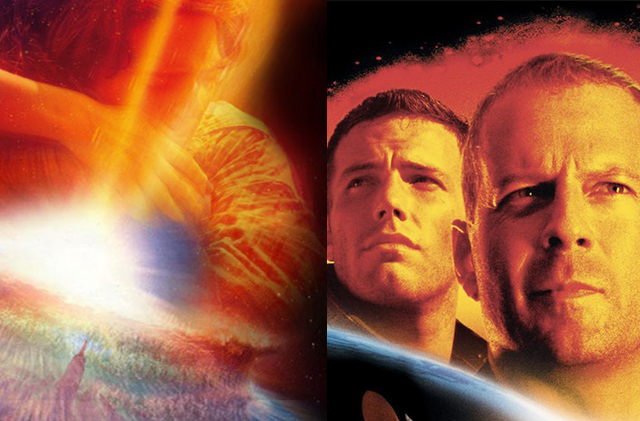
Hollywood is in the not so enviable position of having to fill every week of the year with big, new and expensive movies.  Not all of them are going to be great, but usually the big studios can ride upon the success of one huge hit to help with the financing of all the others.  Usually, these kinds of movies are the tentpoles of each movie season and they are the ones that movie companies place all their resources into.  It’s no wonder why huge action films get more publicity and exposure than the small indie flicks released along side them as a result.  But, in order for the tentpoles to do well each and every year, they must be able to connect with what the audiences are in the mood for, which can change unexpectedly.  Unfortunately for Hollywood, it means that they must rely heavily on fresh new ideas for films, something that they sadly don’t have all the time.  When ideas are sparse in the industry, filmmakers then resort to playing it safe, relying on the tried and true genre flicks.  Now, this strategy works well sometimes, but resorting to old genre standbys sometimes results in making movies that are less original, and more like every other film out there.  And sometimes, Hollywood will even run the risk of not only having an idea that’s already been done, but is also being done at the same time by someone else.  Thus we get what is commonly known as the “copycat” pictures, where two different studios will have competing movies in development with almost the exact same premise. Sometimes there will be a space in between their releases, but there are other times when both movies end up in direct competition with each other, which is what happened in 1998 with the big summer disaster movies Armageddon and Deep Impact.

The releases of Armageddon and Deep Impact came out at an interesting time because it was at a point of ferocious contention between two different studios.  Deep Impact was released by the newly formed Dreamworks Pictures, a joint venture created by filmmaker Steven Spielberg, music publisher David Geffen, and exiled animation producer Jeffrey Katzenberg.  Katzenberg only years prior had been unceremoniously let go by the Walt Disney Company, then under the leadership of Michael Eisner, and part of the formation of Dreamworks came as a direct response to the very public feud between the two studio heads.  Some of that resulting tension manifested itself over the next few years as each studio tried to top each other with their upcoming projects.  After the success of Toy Story (1995), Dreamworks soon put into production their own gritty toys coming to life movie called Small Soldiers (1998), directed by Joe Dante.  After Pixar announced their next film would be A Bug’s Life (1998), Dreamworks quickly announced their own film to launch their animation wing called Antz (1998).  To answer this, after Dreamworks announced their new disaster tentpole, Deep Impact, Disney owned Touchstone Pictures announced that they would have their own doomsday action flick, Armageddon.  For these few years, both Disney and Dreamworks were trading serious blows, and the releases of these two movies represented one of the most contentious battles in the war.  Coming out of battle of egos like this, it’s interesting to see how the two movies measure up against one another, which is what I’m going to look at with this article, and see if there were any winners in this cinematic war, or just all losers.
armageddon couple

“I’m leaving on a Jet Plane.”

First of all, it should be stated that neither film is any good.  They’re both perfect examples of the dumb action tentpole that Hollywood was fond of in the late 90’s, when CGI opened up the possibilities of the medium.  When the style trumps the substance of the picture, all that you’re left with to the define each movie is the premise, and for both of these movies, it is almost exactly the same story.  A giant celestial object is heading for a collision with the Earth, capable of wiping out all life on the planet.  The fate of mankind rests on the success of risky manned space missions, aimed at intercepting the objects and destroying them with nuclear bombs before time runs out.  That’s pretty much the plot of both movies right there in a nutshell.  Sure, there are subplots throughout, but does anybody really remember them, or care?  All people remember from Deep Impact and Armageddon is the scenes where parts of the earth are nearly destroyed by these massive objects (a comet in Impact, and an asteroid in Armageddon).  But, are any of these films less bad then the other.  The most interesting comparison made about them is that they are flawed, but in very different ways, particularly from a film-making standpoint.  Deep Impact’s main flaw is that it takes itself way too seriously, which comes across as ridiculous once the film tries to portray this over the top premise realistically.  Armageddon on the other hand is more playful with the premise, but is way more excessive; which is no surprise given who made it.  Some of these flaws are definitely attributable to the demands put on them by the studios, but certainly the decisions made by the filmmakers also contribute to the big differences between the movies.

That’s the thing that has favored Armageddon now 17 years later.  It has the distinction of being one of the earliest movies from the King of Excess, Michael Bay.   Bay up until that point had made a name for himself as a highly regarded and stylish commercial director, which he then transitioned into a career as an action filmmaker.  He found success with his first movie Bad Boys (1995), and even more with what I would consider his best movie to date, The Rock (1996).  Coming off back to back hits, Touchstone and Disney trusted him with this huge production and the result was a movie that indeed catapulted Bay’s status as a filmmaker, but also began his decline as a quality storyteller.  Honestly, you can pinpoint the origins to all the problems with Michael Bay’s style from this movie.  The lack of restraint, the excessive running times, the macho bravado of his characters, and his just hyper-kinetic and distracting editing style.  By contrast, Deep Impact is much more subdued, under the direction of Mimi Leder, but that’s also not such a good thing.  Mimi Leder was, and continues to be, an accomplished television director, but her career as a big screen filmmaker unfortunately was short-lived, thanks in no small part to the lukewarm response to this movie.  It was a cool move on Dreamworks part to entrust a big budget production to a female director, something which hadn’t happened before in Hollywood up until then, but Leder’s inexperience unfortunately sinks the production in the end.  Leder doesn’t have a distinctive style, so the look of Deep Impact is very plain and uninspired.  For all the awful, excessive choices made by Bay in his film, like the pointless strip club scene or the way too long space station rendezvous, at least they leave an impact on the viewer.  Deep Impact is sadly the more forgettable of the two.
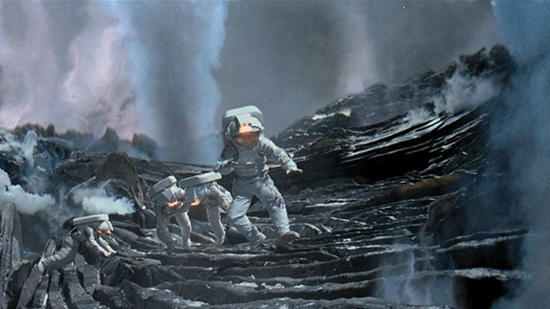
deep impact comet

“Well, look on the bright side.  We’ll all have high schools named after us.”

If there is one thing that does work in Deep Impact‘s favor, it would actually be how it uses it’s story.  By taking the more subtle approach, the movie does help to audience garner more sympathy for the characters.  Not only that, but it chooses to place less emphasis on the mission itself, helping to make the scenes where the astronauts make contact with the comet all the more interesting.  Armageddon makes the space mission almost 70% of the movie’s running time, which after a while can become grating on an audience as Michael Bay doesn’t give us any time to rest between the big action sequences.  Now, that’s fine for a movie to do if it’s paced well enough, but Armageddon is over 2 1/2 hours long, and by the end of that audiences are exhausted with the sensory overload that the movie presents.  Deep Impact is more of a slow build, which can be boring at times, but it makes the big action set pieces more worth it in the end.  The landing on the comet is an especially impressive sequence, and is made all the more impressive today after the recent landing of the Rosetta space probe, which sent back pictures of a terrain not unlike the one seen in the movie.  Deep Impact also tells a bigger story, showing the lives of many characters both on the ground and in outer space, and does so within a nice compact 2 hour run time.  Unfortunately, most of the subplots of in Deep Impact are really boring, but the variety is what helps to make it a more enriching story-line compared to Armageddon’s relentless action.
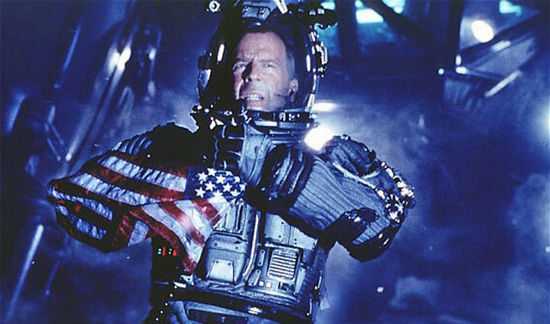
“Look, we’ve got front row tickets to the end of the Earth.”

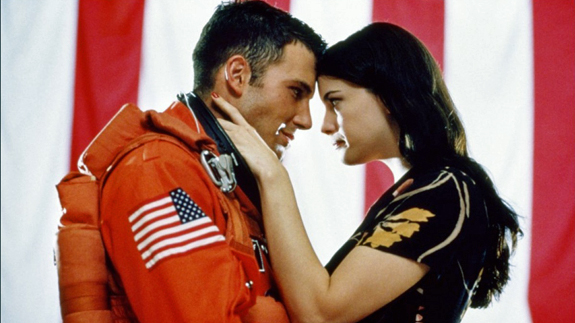
Another distinctive difference between the two movies would also be the cast.  Dreamworks clearly wanted Deep Impact to be a special event movie and that’s represented by the stellar, all star line-up of actors they assembled.  It’s actually quite impressive when you look at all the names on the cast list; Robert Duvall, Elijah Wood, James Cromwell, Jon Favreau, Morgan Freeman, and even unlikely participants like Maximillain Schell and Vanessa Redgrave.  With a cast like that, it’s a shame that they are wasted with such a bland script.  Armageddon on the other hand, you could say, is filled with all the usual suspects.  Action main stay Bruce Willis seems like the natural choice for the lead, and he’s backed up by many notable character actors like Will Patton, Peter Stormare, and William Fichtner.  Sure, there are some award winning actors thrown into the mix, like Steve Buscemi and Billy Bob Thornton, but everyone is operating at pretty much the same low level in this movie, which is to say that no one is giving a damn in their performance.  Now, that can be a plus as it gives some of the more eccentric actors like Buscemi some room to improvise, but otherwise it leads to stilted performances from the other less talented actors.  Chief among the worst performances in the movie are the two actors in the love story; Ben Affleck and Liv Tyler.  This was at a time long before Argo and Gone Girl would elevate Affleck’s acting chops, and his performance here is absolutely laughable.  Couple that with zero chemistry with Tyler, and you’ve got the makings of one of the worst romantic subplots in action movie history.  By contrast, even though Deep Impact‘s characters are boring, at least the actors try their best to make the performances resonate.  Hell, that whole cliche of having the President of the United States be African-American in these disaster movies stems from Morgan Freeman’s stand out performance here.  They may be working with nothing, but at least they do the work.

But, what does elevate Armageddon beyond it’s rival, and has kept it fresh in people’s minds since it’s release is in it’s visual effects.  Both Armageddon and Deep Impact portray global destruction on an ambitious scale.  Unfortunately for Impact, it has become a victim of it’s own adherence to a more realistic style.  Both movies were made in the early days of CGI in film-making, at a time when the industry was still trying to feel out all the different avenues that they could go.  Movies like Twister and Independence Day (both 1996) showed that you could indeed make mass destruction look real on film, and just a year prior, James Cameron’s Titanic (1997) showed that CGI could even put the audience right in the middle of the chaos seamlessly.  But, at the same time, what looked cutting edge in the late 90’s unfortunately can seem dated today, especially if it’s presented unmasked without a distinctive style.  Such is the case with Deep Impact.  Though the comet surface scene does hold up, thanks to the help of hand crafted sets, the actual destruction scene at the end is painfully dated.  The exploding comet and ensuing tidal wave have an unfortunate cartoonish look when seen today, which spoils some of it’s impact it has (no pun intended).  In a way, that’s why Armageddon is helped by the excess of Michael Bay.  His very eccentric style helps to mask the dated CGI and make it less distracting.  Really, it’s everything else in the movie that proves distracting, and the visual effects are just impressive enough to make the action scenes work.  I actually like how the asteroid itself is not realistic by any means, and is almost alien in design, with it’s jagged and dark green terrain, making it a much more interesting setting.  It’s not the most impressive CGI ever done, but Armageddon looks less dated thanks to it’s director’s distinctive style, which has changed little over the years, for good and bad.  Deep Impact unfortunately is now relegated to being a product of it’s time purely by it’s own limitations.
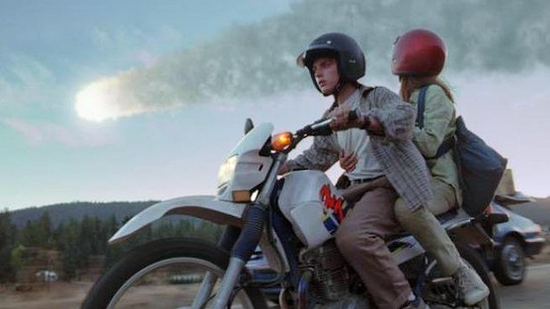
deep impact cycle

“The waters receded.  Cities fall, but they are rebuilt.  And heroes die, but they are remembered.”

When the movies are as deeply flawed as these two, it’s hard to see how any can be considered better than the other.  If I were to choose between the two, I would give the slight edge to Armageddon, just because it sticks more distinctly in my mind, even though it’s mostly because of just how notorious it is.  Deep Impact, despite a capable cast and noble intentions, just falls flat by comparison, not leaving a single impression on me in these last 17 years.  Even after re-watching it, I’m still struggling to remember exactly what happened in the plot.  I think the only reason both of these movies continue to be talked about in the same breath today is because of the once contentious rivalry between two studios.  Things have changed dramatically since then.  Eisner left Disney in the mid 2000’s and the studio no longer competes heavily with Dreamworks Pictures.  In fact, Dreamworks had it’s own schism a few years back when Jeffrey Katzenberg split his animation wing off from it’s parent company and made it independent.  The remaining Spielberg and Geffen wings of Dreamworks ironically teamed up with Disney after this and are now partnering with Touchstone, the distributor that they were once in direct competition with.  For these two movies, it represents probably the most extreme case of two competing “copycat” films in the marketplace and are probably more distinctive as being weapons in this little skirmish rather than as stand out films on their own.  Still, they weren’t the first time Hollywood placed two like-minded films into competition, nor were they the last.  But, even though the fight is interesting to observe, it’s clear that the battle was a losing one for both ends.
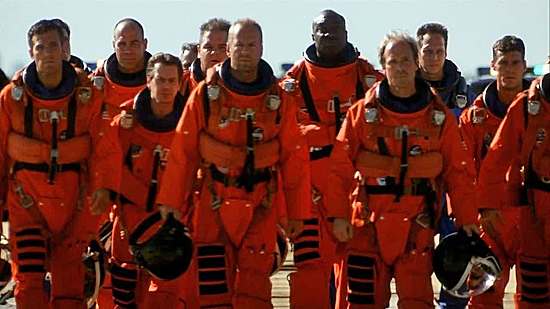
armageddon walk

“Get off…the nuclear…warhead…NOW!!”
Tinseltown Throwdown – Pacific Rim vs. Transformers

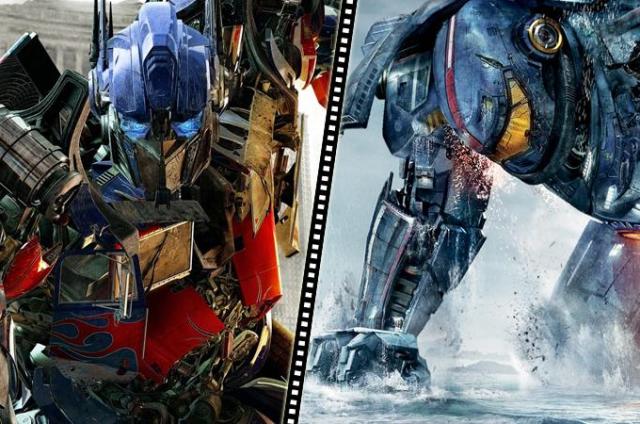
pacific rim transformers

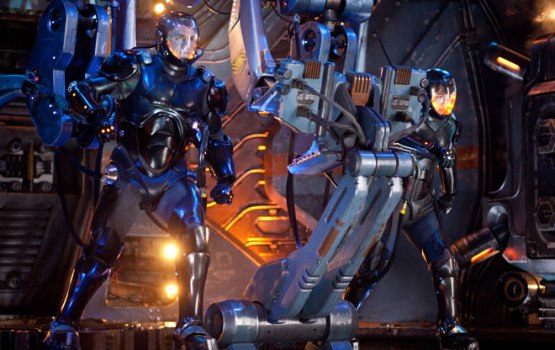
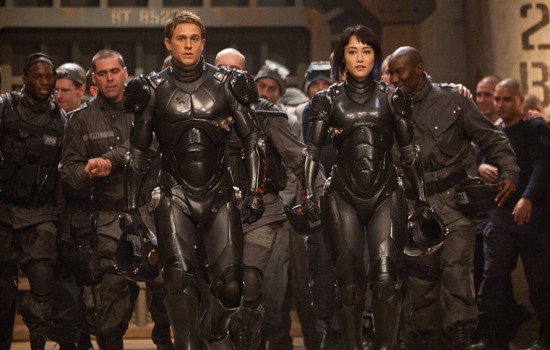
Finding a franchise that not only hits the jackpot once but many times is usually hard to find in Hollywood, let alone sustain.  The subjects on which you can build these franchises can also be just as unpredictable.  I’m sure Hollywood never believed that movies centered around giant robots would ever become a multi-billion dollar juggernaut in the worldwide box-office, but that’s what they found out when Michael Bay’s Transformers (2007) made it to the big screen.  Transformers, for better or worse (mostly worse), has become one of the most successful franchises in recent memory, with three of the entries from the series making it past the billion dollar mark in worldwide grosses.  But, even with all the success it has achieved, it has it’s fair share of detractors, who certainly have justifiable complaints about the bloated and insipid movies in the series. Though Transformers has it’s many faults, there’s no denying that they’ve made an impact on the industry, including opening the door for many other like minded action films.  Most of them have been even more ridiculous knockoffs like Hasbro Studios Battleship (2012), which was nothing more than a $200 million game commercial.  But among all the bad movies in Transformers wake, one that did stand out was Guillermo del Toro’s Pacific Rim (2013).  Like TransformersPacific Rim involves great battle set pieces set in our real world with giant robots.  But, there was one thing that del Toro’s movie got that Bay’s film didn’t; critical praise.  On the surface, these two films should be received almost exactly the same.  So why is one more highly regarded than the other.  In this article, I’m going to look at how the two movies shape up against one another, and see where this disparagement comes from.

To understand these movies, one also has to look at their influences, and how well they are used to back up both the action in each movie as well as the story.  For the most part, the most obvious influences for both franchises comes from Japanese pop culture; particularly with regards to the embodiment of the samurai warrior and the mythologies around giant kaiju monsters.  The Transformers we know now started off as a toy line in the early to mid eighties, which spawned a popular Saturday morning cartoon series which ran from 1984 to 1987 and culminated in a theatrical animated film.  Though conceived and developed in America, most of the animation was completed in Japan and South Korea, and was always meant to appeal to audiences from both sides of the Pacific.  Much of the Japanese influence comes out of the sense of duty from the Transformers themselves, not unlike the warriors code of the samurai, as well as with the aesthetic look of the characters themselves.  One look at characters like Optimus Prime and Megatron, and you can see the influence of feudal Japanese armor in their design. This is coupled with the gigantic size of the characters and how their constant skirmishes wreck havoc in our world.  That’s where the Kaiju influence comes about in the series, which is the same kind of inspiration that Guillermo del Toro draws from.  Kaiju monsters have long been a part of Japanese literature and cinema; including the highly influential Godzilla series.  With Pacific Rim, del Toro put his own fresh spin on the material, delivering a mash-up of all these different influences, but with a narrative that stands well enough on it’s own.  And like Transformers, it takes these very culturally distinct aspects and makes them work towards a worldwide sensibility.  In that sense, both do an equally fine job of presenting their influences well in their selective stories.

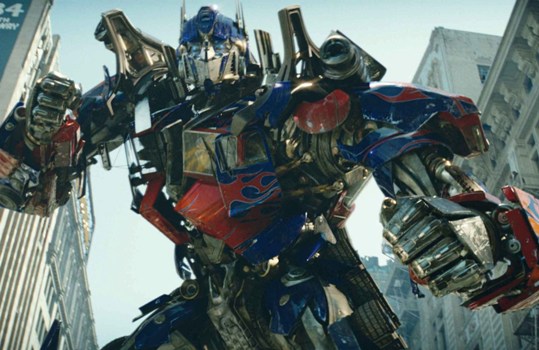
tranformers 2

“Autobots, roll out.”

Where the two movies ultimately part ways, at least in the effectiveness of the story-telling, is in their executions.  Primarily, it all has to do with the intents of their selective filmmakers.  Michael Bay is very style oriented, choosing to highlight the camera work and visual effects of his movies above the plot and character development.  Guillermo del Toro concerns himself with the opposite, devoting much of his movie to character interactions as well as building the world in which they live in.  That’s not to say that del Toro’s movies are not without style either; it’s just that sometimes the plot moves along so briskly that you hardly even notice the creative designs that del Toro has added.  But, if you look at the movies separated from their respective filmmakers, you would almost think that they were crafted by the same people.  So, what makes Transformers so loathsome and Pacific Rim so enriching?  The difference comes from the self-awareness that is found in each film.  Guillermo fills his movie with cheesy dialogue and flat characterizations, but he did that by design.  These are staples of many often unintentionally funny and campy sci-fi thrillers, and Guillermo is celebrating that aspect by making it an essential part of his own movie.  Michael Bay’s film on the other hand uses the same kind of cheesy dialogue and stale characterizations, but it seems to be the result of neglect rather than intent.  Because Bay spends so much time building the look of his movies, the things that matter most like plot and characters seem to be forgotten.  Instead, plot convenience and character archetypes are in place instead of real, meaningful development.  Not to mention a lot of pointless filler, like most of the stuff with the insufferable Witwicky parents.

The lack of development is one of the things that I have found most problematic with the Transformers franchise.  The series seems to have no thrust behind it, because Michael Bay never tries to explore something new in each entry.  Watching them all together (which I don’t recommend) it is astonishing how very little differences there are with the the plots.  It’s just the same movie done over and over again.  What’s even more infuriating is the fact that with every rehashed plot, they introduce brand new characters and then never address them ever again in the follow-up.  Hence, why so many of the characters are superfluous in the Transformers series.  But, to compare this aspect of the movies with Pacific Rim is a little unfair, mainly because Transformers has seen four releases in the franchise, compared to Pacific Rim’s one (though a sequel is on the way in 2017).  So, let’s just compare how the story holds up in it’s initial outing; the original 2007 movie, which is by default the best one as well.  What Michael Bay got right in his first film easily was the look of the movie; making a surprisingly gritty take on a Saturday morning cartoon work out beautifully.  For a movie based around such a simple premise, he managed to set the world up effectively, making it believable that giant robots from space could find themselves at war on our planet.  But, by minimizing the emotional development of the characters and the complexity of the plot, Transformers also feels remarkably minor in the grand scheme of things, and no amount of visual scale and scope can hide that.  Pacific Rim on the other hand, presents the global ramifications of it’s world much more effectively.  We see the destruction of the Kaiju and the toll it puts on our heroes; the ones who pilot the giant robot suits called Jaegers.

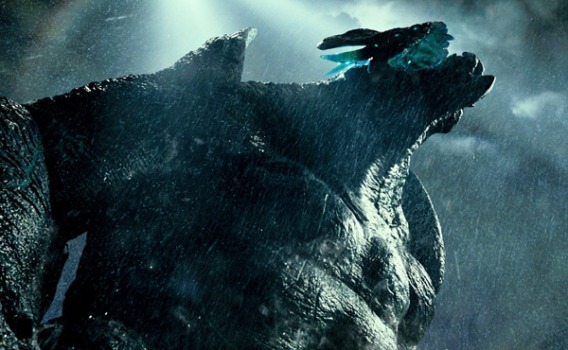
pacific rim 2

“Now we have a choice here; we either sit and wait, or we take these flare guns and do something really stupid.”

For the most part, Pacific Rim stands ahead of Transformers purely because it treats it audience intelligently, rather than pandering to them.  Guillermo del Toro knows that if he puts conviction behind the silliness of his movie, the audience will feel rewarded for having witnessed a creative experience.  Michael Bay just takes moves from his own playbook, and transplants that into anything he desires.  Michael Bay is a talented director, but directing skills alone doesn’t make a movie watchable.  Anyone can get good at shooting during “magic hour” or capturing different angles of a controlled explosion; but in the end that means little unless it elevates the story.  Michael Bay seems to think that his style can carry any story along, regardless if it’s good or not.  Now, to be fair to the man, it is a plan that has indeed paid off for him over the years.  His movies are huge money-makers and that’s primarily because they are easy to digest action thrillers; simplistic and not challenging to follow.  The casual viewer doesn’t mind what’s lacking in story, and indeed they’re the one’s who drive Bay’s films to huge box-office numbers.  And, even though it’s a rough pill to swallow, Pacific Rim would not exist today if it weren’t for Transformers.  That movie’s success is what got del Toro’s movie green-lit, so really it stands on the foundation that Bay cemented first.  But, after seeing something that delivers the same kind of action, but with a degree of clever creativity behind it like Pacific Rim, we can clearly see that Guillermo del Toro is trying to cook us up a gourmet dinner while Michael Bay is serving us just more Happy Meals.  Bay could honestly do better and has done so too.  When given a better script to work with, he can actually deliver a worthwhile film, like 1996’s The Rock, 2005’s The Island, or even 2013’s Pain and Gain.   Why he can’t put that kind of focus into what is arguably his biggest claim to fame is beyond me.

transformers 1

“At the end of this day, one shall stand, one shall fall.”

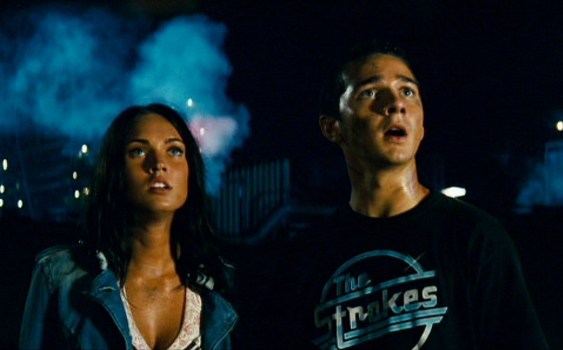
Focus is primarily what is lacking all the Transformers movies, even in the less problematic first film.  What is most infuriating is the way that the movies actually push aside the characters that matter most, namely the Transformers themselves, in favor of characters that nobody likes.  This should be problematic for any fans of the original cartoon series, seeing as how their beloved characters have been reduced to supporting characters.  Michael Bay does deserve credit for preserving actor Peter Cullen as the voice of Optimus Prime (something which he’s done from the very beginning), but the fact that he’s sidelined so that we can have more scenes of douchebaggery from the series’ very unlikable protagonist Sam Witwicky (Shia LaBeouf) is a big mark against the franchise.  If Sam were a more likable and interesting character, there would be no issue, but given that his presence is so pervasive and in place of character development for the ACTUAL TRANSFORMERS, it’s just another sign of Michael Bay’s lack of focus and concern for what’s best for the series.  Compare that to the characters in Pacific Rim.  They are cliched and simplistic, but are given enough screen time to become sympathetic as well.  Guillermo del Toro doesn’t try to force his characters into slap-sticky situations or have them deliver cocky, one-liners.  Letting the characters breathe allows for those things to come through naturally.  That’s why we cheer when Idris Elba’s Stacker Pentacost delivers his rousing speech, even though on paper it sounds ridiculous, as with the intentionally campy scientist characters played by Charlie Day and Burn Gorman.  Devote attention to the characters in the end, and the audience will warm to them.  Try to force characterizations like Transformers‘ Sam’s unwarranted cockiness, and you’ve got characters worthy of scorn.

Even the lack of focus on the visuals can hurt a movie, and with all the visual flair that Michael Bay can cook up, he still manages to undermine his movie with too much style.  The first film in the Transformers series is a bit more focused than the others, but what I found to be problematic is the frenetic nature of the editing and camera work.  Michael Bay loves to move the camera around, which is fine for a kinetically charged action scene, but problematic for everything else. The animation of the Transformers, in particular, is indeed impressive, with hundreds of individually moving parts.  Unfortunately, any time the movie gets close to showing us all the intricacies of the CG artists hard work, Michael Bay chooses to hide it with some of his stylish film-making.  I don’t understand why he keeps distracting the viewer when it’s not needed.  Did he really not have the confidence in the visual effects team to give them the showcase they were calling for?  It becomes more annoying in the later films, that remarkably feel even less focused despite their longer running times.  Pacific Rim by contrast not only gives the visuals the screen time they deserve, but at times almost indulges us in how impressive they are.  I especially like the way that Guillermo del Toro presents us with scenes devoted entirely to showing off the mighty Jaeger robots.  Early on in the film, we get an almost step-by-step demonstration of the Jaegers in action, which even details how the pilots are able to make the giant contraptions move; grinding gears and all.  It may seem indulgent, but plot wise it’s very worthwhile, because it presents us visually with all we need to know about how this whole world works.  Del Toro also holds the camera still, allowing the audience to understand what is going on even in the big action sequences.  That is ultimately why it’s important to have a focus on your visuals in any given movie.

pacific rim 1

“Fortune favors the brave, dude.”

Overall, it’s unusual to see two movies that follow many of the same visual cues and same cultural influences end up with such different outcomes.  Transformers is a box office phenomenon that at the same time has been blasted by critics and audiences alike.  With Pacific Rim, you have a critical darling that surprisingly had to fight to get barely above $100 million domestic.  And yet, by looking at the two together, you can clearly see how intent and execution really comes to play with each of the different films.  It’s clear that Guillermo del Toro crafted Pacific Rim out of love for the things that he’s parodying.  By contrast, Michael Bay is just exploiting an already established franchise for his own gain.  Not that Michael Bay doesn’t value what he’s creating for the series; he wouldn’t have stuck with it for so long if he wasn’t enjoying the end result.  But, he’s the kind of filmmaker who would take that approach to any other established intellectual property, without regard for what has come before it.  Transformers just so happened to be the franchise that caught his eye at the moment.  And I’m sure it won’t be the last to get the Michael Bay make-over either.  We already saw Teenage Mutant Ninja Turtles become the next victim.  It’s a financial situation that has worked out for Bay, but I think the lack of empathy for the direction of the series has unfortunately left a black mark on both the filmmaker and the Transformers brand.  I’m sure the original creator of Optimus Prime and Megatron never expected to have their brand associated with racially insensitive stereotypes and up-skirt shots of the movie’s female leads.  Transformers is a franchise in desperate need of a new vision, while Pacific Rim is one of infinite potential.  Luckily del Toro’s movie has developed enough of a following to warrant a sequel, which I too am anticipating.  In the end, even when it’s about giant monster fighting robots, substance still triumphs over style.

pacific rim 3

“Today we are cancelling the apocalypse!!”

Tinseltown Throwdown – Hunger Games vs. Battle Royale

hunger games battle royale

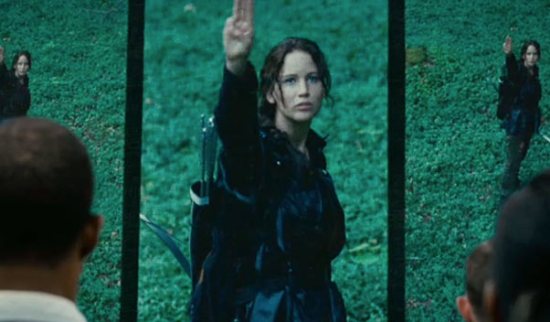
It’s inevitable that sometimes two or more movies are going to be so similar that they’ll raise suspicions from audience members of idea theft.  The Young Adult novel adaptation craze has been the foundation of a current swath of similarly themed movies, and it’s one that currently is being dominated and dictated by the success of the Hunger Games franchise.  Based on the book trilogy by author Suzanne Collins, Hunger Games is a post-apocalyptic tale focused on the destinies of a select group of young fighters that are forced into combat for the benefit and amusement of their oppressive political system.  Both the novels and the films have become monumental successes and are continuing to inspire many like-minded franchises based around many of the same themes, like this year’s Divergent  and The Maze Runner.  But, even though The Hunger Games is a standout series, many people have questioned it’s own originality, and have even gone as far as to claim that it was a complete ripoff of another popular story.  That story happens to be the Japanese made Battle Royale series.  Originally created in Manga comic form in 1999, the book quickly inspired a film adaptation that was released in 2000, which also spawned a 2003 sequel.  Battle Royale precedes Hunger Games by nearly a decade, and it’s very clear that there are some strikingly close similarities between the two.  They both depict young people forced into combat by an oppressive government, they both have a central love story between it’s main heroes, and they both show the characters working the system in their favor in order to undermine it.  But, even with all the similarities, did Hunger Games real steal the idea, or did it do enough to differentiate itself from Battle Royale.

A simple argument in Hunger Games favor is that Battle Royale isn’t all that original either.  In fact, the basis for these stories goes back a long way, as themes of oppressive governments and conformity gone horribly wrong has been present in literature and media for centuries.  Just look at George Orwell’s 1984, and you can see the inspirations for much of the Hunger Games visual aesthetic.  Likewise, Battle Royale’s setting on a deserted island far off the Japanese mainland recalls a similar backdrop from the Richard Connell 1924 short-story The Most Dangerous Game, which of course was all about the hunting of human beings.  Other literary inspirations include the 1948 Shirley Jackson short story, The Lottery, which very directly served as an inspiration for both Hunger Games  and Battle Royale.  In The Lottery, a small American town selects one of their youngest citizens at random out of a basket of names to be ritually sacrificed in order for them to have a prosperous harvest season.  Obviously, that random choosing from a lottery of names sounds familiar to any Hunger Games fan out there.  Another influence on these movies could also be the 1982 Stephen King novel The Running Man, which later spawned the 1987 Schwarzenegger headlined film adaptation.  That film not only influenced the human vs. human combat seen in Battle and Games, but it also inspired some of the sharp satire of the media seen in each, to varying degrees.  Suffice to say, both Battle Royale and Hunger Games are following a long line of similarly themed stories, so to say that one is stealing from the other is ignoring the fact that they’re all part of the same trend.  In the end, it’s not about the same ideas but how well they execute them in their individual stories that makes these movies distinct from one another, and as a result, they are much more different than you might think.

hunger games 1

“May the odds be ever in your favor.”

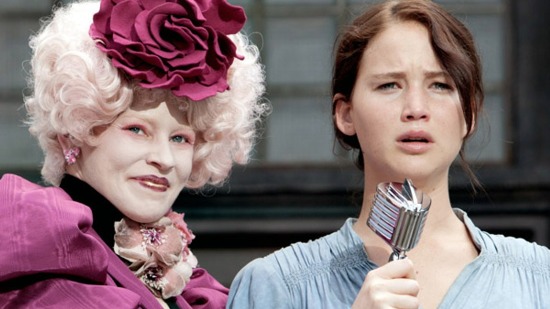
One way in which the two are very different is in terms of scale.  Battle Royale is ambitious, but is also crafted on a modest budget.  Everything takes place in the same location and the visual effects are kept to a minimum.  In some cases, the only effects that Royale actually employs are pyrotechnics and specialty make-up on the actors.  Hunger Games on the other hand has all the visual splendor of a grand scale Hollywood epic.  It’s clear that Hunger Games benefited from a full studio treatment when you see all the work put into the set design, the visual effects, and even the costumes.  The dresses worn by actress Elizabeth Banks as the flamboyant character Effie Trinket probably boasted of a seven figure budget alone.  But, all this works to the different movies’ strengths.  Battle Royale feels very immediate and closer to reality, so a smaller scale helps to make that feel more authentic.  Hunger Games is otherworldly, so it’s got to reflect that by immersing us into sights unseen, and that obviously costs a lot of money in the end.  Overall, it’s the big advantage that Hunger Games has over Battle Royale.  It does a much more effective job at world-building, or to put it more directly, presenting us with the why, where and when of the film’s setting.  With the help of Suzanne Collins novels as the groundwork, we get a better sense of how the titular Games fits within the society, and how the characters’ struggles fit within the larger picture.  Couple this with the fact that Hunger Games also retains it’s own identity because of it’s unique setting and by how well the filmmakers have brought that to life.  Less capable hands may have not brought out the subtlety in the material and would have let the movie’s visuals run amok, but Hunger Games has thankfully transported us while still feeling firmly grounded.

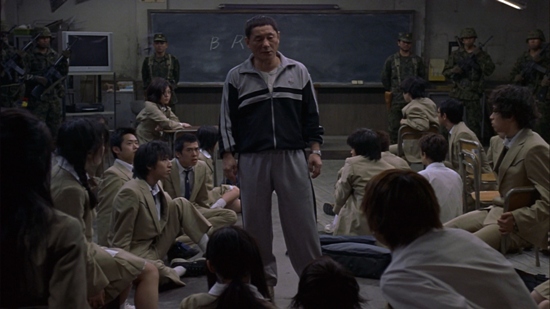
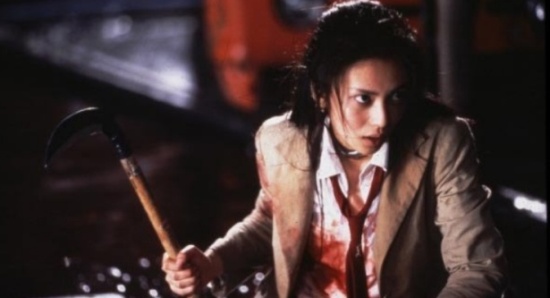
Battle Royale doesn’t have the same amount of time, however, to explain the details of why these events are taking place.  The movie quickly takes us right to beginning of the battle without presenting too much in the way of context.  All we see are a group of 40 teenage students all gathered together in a rundown school on a deserted island where they’re all told that they will be thrown into forced combat with one another.  Any attempt to disobey and try to escape will result in their death and the last survivor will be granted their freedom.  We get just the basic outline of the rules, laid out by the overseer of the Battle, Kitano-sensai (Takeshi Kitano), who represents in a subtle way the embodiment of government oppression that’s forcing this cruel act on these kids.  And it’s this subtlety that works very much to Battle Royale‘s advantage.  It doesn’t waste any time plunging us into this strange new world.  Instead, it lets the audience piece together all the rules and has us discover the intricacies of the plot as they happen.  I particularly like how character details that weren’t apparent before come out in interesting ways as the characters are pitted against one another.  Hunger Games allows character moments to happen as well, but they feel a bit more telegraphed due to the fact that the they’ve been established long before the Games even begin.  When characters are thrown through an ordeal like this, different emotions come out and the characters turn to more animalistic instincts in order to survive.  Battle Royale shows this in a much more interesting way, and I think that’s partially due to the blank slate that we are given with these characters from the beginning.  In this case, the more visceral, small scale approach gave this type of story the edge it needed.

battle royale 2

“Life is a game. So fight for survival and see if you’re worth it.”

The same subtlety also works well with depicting the theme of government oppression.  Both stories do a good job of presenting the competitions as a means of dehumanizing the less fortunate and offering them up as fodder for the upper classes’ amusement.  What I believe Battle Royale achieves to a better degree than Hunger Games is showing the face of that oppressive body on screen.  In Royale, the government body is brilliantly humanized in the form of the character Kitano.  Takeshi Kitano brilliantly portrays the inhuman coldness of an oppressive government through his portrayal of an unforgiving social servant.  Once a school teacher to all the same students forced into competition, Kitano applies the same attitude to this inhuman practice that he would apply in the classroom.  Throughout the film, he is constantly talking down to the kids, as if he was still delivering them a lecture, which is a great subtle way to reinforce the idea of how governments can devalue human life in order to get them to do what they want.  Hunger Games is less subtle with it’s depiction of government oppression, showing the whole fictional land of Panem ruled over by President Snow (Donald Sutherland), a pampered aristocrat who rules with an iron fist from his lofty palaces in the Capitol.  It’s made very apparent from the beginning who the bad guys are in the story, and there’s no sense of any other interesting layers with the antagonists in the Hunger Games; although Sutherland still performs the hell out of the role, and is a joy to watch.  I think the reason the theme of oppression works better in Battle Royale is because of how unexpectedly it comes out of the story.  It’s an added layer to a violent story-line that is very well appreciated.

hunger games 2

“I don’t know how else to put this: Make sure they remember you.”

But, what Hunger Games lacks in one theme it makes up for in another.  One thing that I did appreciate a lot from the story was it’s very shrewd observations on the role of media.  The influence of propaganda is particularly focused on in the story, as is how different parties can manipulate the media to their own advantage.  What I particularly like about this aspect of Hunger Games is that it works both as a subtext to the story and as a functioning element in the growth of the characters.  Katniss Everdeen (Jennifer Lawrence) is depicted throughout the story as a the most skilled and resourceful fighter in the entire games, but throughout the story, we also learn her one weakness, and that’s the ability to fit within society’s expectations.  Once she becomes a part of the games, Katniss must not only be a good fighter, but also be beloved by the public as well.  Considering her rebellious attitude, as well as her awkwardness in  front of a camera, this becomes a challenge for her.  And considering that her livelihood inside the games is dependent on her ability to find sponsorship, it becomes a life and death situation as well.  This is a great way to make the theme of propaganda and media manipulation work both as satire and as a plot thread in the story-line.  The film does a great job of skewering the way media works, especially with the absurdity that we find so abundant in reality television.  But, it also helps to define the characters as well.  With it, we see that even Katniss has flaws, and by overcoming them, she’s better able to be a true hero.  This is something that is only hinted at in Battle Royale, and never truly explored or explained.  I’m not even sure the whole event is even televised.  Only a subplot with computer hackers gives us any hints into this kind of theme in the film.  So, it’s definitely a case where Hunger Games presented something very different and interesting.

There is one plot thread that did manage to become a part of both story-lines, and that’s the romantic subplot.  The romantic plots are so similar in fact, that it probably is what has sparked so many claims of plagiarism among many Battle Royale fans.  Both stories find two of the combatants from the same background and social class linked together from early on and bound together to the very end, relying on each other for survival.  And in each story, they are also the last two to survive, subverting the rules of the competition as a result.  In Battle Royale, it is love that bounds the two survivors Nanahara (Tatsuya Fujiwara) and Nakagawa (Aki Maeda) together, though their relationship is played up in an innocent way.  In The Hunger Games, the love story is more complicated.  Katniss has had one love back home (played by Liam Hemsworth), but during the competition, she finds herself more drawn to her friend and fellow competitor Peeta Mellark (Josh Hutcherson), whom she relies heavily on for comfort and assistance as the Games grows more deadly.  Though Hunger Games has a love triangle in it’s story-line, it’s the relationship between Katniss and Peeta that drives the heart of the story more, and in that sense, it feels as much the same as Battle Royale.  Both work to varying degrees, but are never the main focus.  I don’t believe that it represents Hunger Games being a copycat in terms of story, however.  Suzanne Collins drew inspiration from a lot of other love stories built around adversity, so the fact that it feels so similar to Battle Royale is just a byproduct of the fact that some themes have universal meaning and usually wind up going towards the same places.

battle royale 1

“What’s wrong with killing?  Everyone’s got their reasons.”

So, with two similarly plotted movies, is it true that one stole from the other.  I think that history has shown that this kind of story has been done many times before, and neither is really as original as either of their fan-bases would claim.  Still, they are close enough to draw comparisons and some of their similarities work better in one over the other.  I do admire the subtext underneath both, showing that they are more than just a collection of brutal action scenes.  But, based on my own personal tastes, I would actually give the edge to Battle Royale over Hunger Games.  Games is a beautifully constructed series of films that does translate the material in a smart and engaging way.  Battle Royale does, however, feel more visceral and it gets away with a lot more.  Hunger Games feels like it’s shackled by the PG-13 rating that is standard for all blockbuster franchises from Hollywood.  Battle Royale, on the other hand, displays everything in full graphic detail.  Whenever a character dies in the movie, you feel the full impact of the horror of the moment, no matter how minor the character is.  Hunger Games feels tamer because so much happens off-screen.  In fact, most of the other combatants in Games remain nameless to us, and are therefore more expendable, as the movie only focuses on the main characters.  That works to The Hunger Games advantage, but for me it didn’t have the same impact.  Battle Royale is a very interesting import from Japanese cinema and presents a very interesting look into their culture.  After all, Government oppression is something that is all too familiar in Japanese history, so it’s not surprising that they would have such a grounded view on the theme.  Hunger Games by contrast plays it safe, and that’s it’s disadvantage.  So in a direct competition between the two like-minded films, it turns out that the odds fall into Battle Royale‘s favor.

battle royale 3


Tinseltown Throwdown – Twister vs. Sharknado

twister

There are many cases in Hollywood where films with similar premises arise at the same time; sometimes so identical that they’re hardly distinguishable.  Oftentimes these movies tend to be ridiculous popcorn flicks that more or less are trying to cash in on a fad or a topical event.  Sometimes these movies go into development at the same time and are released within months of each other.  Others are made in response to another’s success, either trying to duplicate the same formula or taking the earlier film even further.  Either way, movies like these are often looked at as the reason why people believe that Hollywood is running out of ideas.  That could be true, but then again, why would somebody put effort into making a movie that they already know has been done before.  I wrote an article about copycat films earlier this year, and in that article I noted that following a trend usually factors into why these movies get made, but what I find interesting here are films that follow similar formulas that seemingly rise out of nowhere.  The blockbuster era of the 90’s saw a lot of this, with disaster movies dominating the cineplexes.   It seemed like at this particular time, studios were sold more on concepts than stories and it ended up starting a race to see who could capitalize on them first.  This particular idea of concepts driving development has led me to create this new series where I take a look at movies with similar scenarios, and decide which one did it better.  In particular, I will take a look at these so-called “cinematic twins,” as well as movie remakes, copycat films riding the coattails of other popular flicks, and movie homages where they copy other films on purpose.  And by contrasting these movies, I will hopefully make it clear how one or both succeeds and/or fails with the premises that they share.

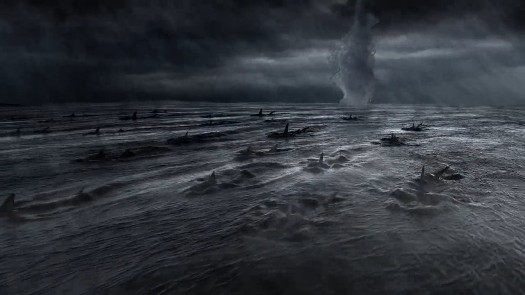
For my first article in this series, I thought I would look at two movies separated by 17 years of film history, but are still deserving of a comparative analysis.  Sticking with the disaster movie genre, I am bringing Jan de Bont’s 1996 thriller Twister and SyFy Network’s 2013 blockbuster Sharknado into the ring, and see which one is the better cyclone-based action film.  Now, on the surface, you may think that these two have nothing in common.  Apart from the lengthy space of time in between their premieres, the movies are also significantly different in scale and production values.  One is a big budget film that features a star-studded cast and top-notch special effects work, while the other movie is a made-for-TV schlock-fest featuring D-List actors and C- grade CGI.  But, the question that I pose is whether or not those differences in film quality make any difference.  Let’s be honest, they are both incredibly flawed films, but does one of these movies actually benefit from it’s flaws, while the other is sunken by them?  Do lowered expectations come into play, or must a movie purely be judged on the quality of it’s production?  I put forth the idea that Twister and Sharknado are very comparable movies, because of the way that they exploit their premise with very little thought for anything else like plot and character development; or science for that matter.  In some ways, that’s what makes them both entertaining to watch.  But what definitely separates these two movies significantly is their tone, and that’s primarily where I will find the strengths and weakness in each.  So, between Twister and Sharknado, who made the better corny Tornado movie?

sharknado

“We can’t just wait here for sharks to rain down on us.”

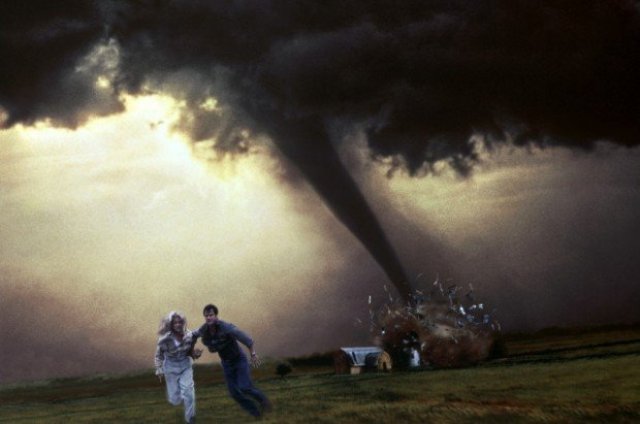
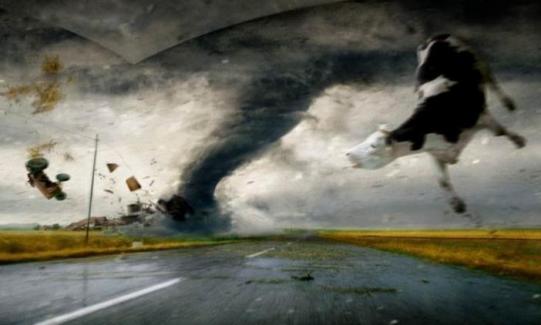
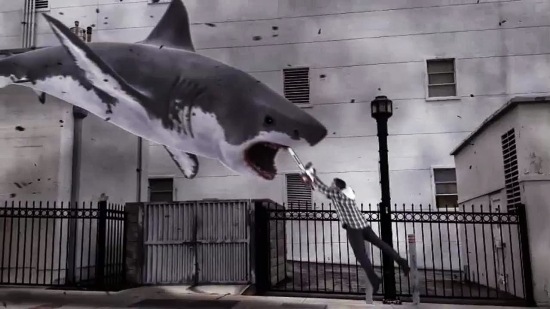
First of all, we’ve got to exclude comparisons in the quality of the special effects in the two movies, because on that front, Twister clearly would win.  On top of that, Sharknado isn’t even attempting to try to match Twister’s quality of CGI animation, nor would it be allowed to.  The only way that the two films can be comparable here is when it comes to and how they use their production values.  What I find interesting about the way Sharknado uses it’s effects is that every special effect is there to punctuate a moment in a hilarious fashion.  In Twister, the effects are there to create a foreboding atmosphere, something that it does very well.  Honestly, the best thing you can say about Twister is that it actually looks like the characters are really caught up in a storm.  Sharknado on the other hand doesn’t even try to hide the fact that it was shot in the middle of Summer in Los Angeles, with the titular “Sharknado” appearing out of clear blue skies.   But, then again, Sharknado delivers on what it promises, which is the mindless destruction of a famous city.  While it does look cheap as hell, it nevertheless paints a broad picture.  Twister on the other hand, with all it’s endless resources, tends to keep things squarely grounded, and as a result it feels smaller in ambition.  All we get in Twister is a lot of torn up farmland, but not much else.  The only time that Twister really goes a little nutty is towards the end, when Bill Paxton and Helen Hunt’s characters are fleeing the massive F-5 tornado, including a part where they drive their truck straight through a displaced farm house.   By keeping things a little more subdued in the beginning, Twister almost undermines it’s ability to entertain with it’s premise, something that the more outlandish Sharknado takes full advantage of.  So, yeah the sharks in Sharknado look totally artificial, but they’re used to their full potential.  Better looking tornadoes in Twister cost more, so it limits how much they can be used, thereby lessening their impact.

But, restraint can be a blessing.  Those moments when the tornadoes appear in Twister are very impressive, even by today’s visual effects standards.  And by limiting their presence in the film, it also make them stand out and be more impactful.  If only everything in between worked as well.  Twister’s main flaw, above all the other big ones, is that there is no consistency of tone.  It goes from melodramatic to absurd many times over throughout the very thin plot, and sometimes the tonal shifts are jarring.  There’s also a certain uncomfortable grimness through many of the scenes, particularly regarding ones centered around Helen Hunt’s character, Jo.  She has a tragic past that is alluded to frequently, but is never fully explored.   This has actually resulted in some of the movie’s most notorious scenes, like the infamous “finger of god” moment halfway through the film.  The moment’s attempt at sincerity falls flat on it’s face, and ends up being hilarious instead.  But, while a moment like that is remembered fondly for how awful it is, it unfortunately is not true for the rest of the movie.  Twister never cohesively comes together, and is only remembered for parts than as a whole.  Sharknado on the other hand is consistently absurd from beginning to end.  It wears it’s preposterous-ness proudly and manages to carry it through to the end.  But in many ways, that can also work as a negative.  At some point, when your film is consistently ridiculous, the humor can run it’s course and start to feel old.  To it’s credit, unlike so many other SyFy films, Sharknado doesn’t lag too much.  But there comes a point where you begin to get tired of those long scenes inside the getaway truck with inconsequential dialogue between characters .  There is a balance that these kinds of movies have to adhere to in order to keep them from going to either extreme, but when comparing these two films together, it seems like Sharknado benefits a little more by going further in one particular direction.

twister cow

“I gotta go Julia.  We’ve got cows.”

What ultimately determines what makes one of these ridiculous movies better than the other is the intent vs. result factor.  Did each film do what it was meant to do ends up being the defining question, and in this case, the results work more in Sharknado’s favor.  Sharknado was conceived from the very beginning to be exactly what it is; low-budget cheese meant to exploit an already ridiculous premise.  And in every respect, it fulfills that promise.  Lowered expectations makes the shoddy production values acceptable for audiences wanting just that, and Sharknado never disappoints by always disappointing.  Twister on the other hand is trying to reach higher aspirations, but the results don’t reflect that.  Twister was never intended to be seen as a joke, but rather a sincere look at the destructive effects of tornadoes in America.  The fact that it fails at this so measurably is what has made it noteworthy, but it also makes the film much more notorious.   Sharknado actually encourages it’s audience to laugh along with it, but when you laugh at Twister, you can’t help but think that it’s at the expense of someone else’s serious intent, deserved or not.   Twister is exceptionally well made, but because it failed in the story and script department ultimately makes it seen as a failure with regards to making it’s premise work.  Sharknado accomplished it’s goal of giving us a tornado filled with sharks along with intentionally bad acting and dialogue, and that was a result worth rewarding.  Sometimes it helps to step back and embrace the absurdity whole-heartedly.

And again, the tone shifts matter with this distinction.  There are instances in Twister where the film does deliver some memorably absurd moments.  They had cows flying in tornadoes long before there were sharks.  But, whenever the love triangle story-line works it’s way in, the story derails.  And what’s more, the movie tries to make it’s science seem logical, when any meteorologist will tell you that it’s complete nonsense.   Whenever the movie tries to sell itself as thought provoking when it’s obviously based off of junk science, that’s when you begin to question it’s validity as a whole.  Sharknado on the other hand so obviously doesn’t care about scientific accuracy, and it actually makes the absurdity of the movie all the more enjoyable.  The character’s big plan for stopping the “Sharknadoes” in the movie is to drop explosives into the vortexes and blow them up.  That idea is so ridiculously stupid that it’s genius, on the part of the writer I mean.  What better way to end a movie with this ridiculous a premise than by having the characters take on the most absurd actions possible.  At least the filmmakers had the good sense to make it purposefully dumb.  When Twister tries to make the implausible happen in their movie, we can’t just turn our brains off and accept it, because the movie’s tone hasn’t allowed us too.  When Bill Paxton and Helen Hunt survive a tornado’s path of destruction by strapping themselves to a pipe near the movie’s end, we don’t know whether to accept that as a believable conclusion or to laugh at it’s preposterous-ness, because the movie never makes the tone clear.   With Shaknado, madness is it’s ultimate purpose, while there never seems to be any purpose in Twister other than to get the plot where it needs to go.

sharknado chainsaw

The reason why I feel that these two movies should be judged against one another is because it shows how Hollywood movies ultimately rise and fall in unexpected ways.  Here we see a big budget blockbuster fail to make good on it’s premise despite having all the resources available to do so, while another film gets made on a shoe-string budget with very little expectations and delivers on what it promises.  In the end, both movies are absurd disaster flicks that end up being more stupid than thought-provoking.  But what makes one better than the other is that one movie was made that way on purpose, while the other squandered it’s potential.  It’s amazing that a movie with wooden performances from the likes of Ian Ziering and Tara Reid could be more entertaining than a film with future Oscar-winners like Helen Hunt and Phillip Seymour Hoffman in it’s cast.  But then again, Twister is a movie where Hoffman is reduced to saying the phrase, “I’m talking imminent rueage.”  Twister hopes that people will excuse it’s lack of subtlety while Sharknado draws attention right to it, and that ultimately makes it feel like a more honest film.   The independent film market can be full of itself sometimes, but so can blockbuster movies, and that’s why I cherish the ridiculousness of Sharknado, because it shows that movies like Twister can never be taken seriously or should.   Yes the conditions for each film’s productions are different, but in the end, they are not that dissimilar, and that’s a result of Sharknado‘s success and Twister’s failure.  So, in the end, Sharknado stands as the better movie, thanks to a consistent tone and a knowing sense of humor.  Twister has it’s moments, but it hasn’t aged well over the years, and considering that a made-for-TV monster movie has done the tornado disaster premise better (and with sharks no less), it doesn’t reflect well on the studio movie-making machine.