Author Andy Weir has become of the most surprising rising stars in the world of science fiction literature. Fifteen years ago, he was a programmer living in a two bedroom apartment in Mountain View, CA writing short stories for free on his website in between gigs at AOL and Blizzard. In 2011, he began to self publish chapters of what would end up being his first novel on his website, and his readers convinced him to take his work to a publisher and make it available to a wider reader base. That novel would turn into The Martian, a heavily researched and detailed account about how an astronaut stranded on Mars manages to survive the conditions on the Red Planet before being intercepted by a rescue mission. The Martian was a critical and commercial success, becoming a best-seller and launching Weir into a new career as a novelist. The book also captured the imagination of Hollywood too, and the novel was quickly adapted into a 2015 blockbuster film directed by Ridley Scott and starring Matt Damon. Weir quickly went to work on his next novel, which would be a much more high concept science fiction story called Artemis (2017), which was less grounded in real science as The Martian was. Several years later, Weir would write his next novel, a project that incorporated the high concept strangeness of Artemis, but also would have the grounded foundation of real science like The Martian. That book would be Project Hail Mary; a story about a lone scientist out in the cosmos who is humanity’s last hope for survival in a future where the Sun is dying. The book won acclaim from readers everywhere, and the book was a finalist for the prestigious Hugo Award. Of course, just like The Martian, Hollywood was interested in adapting this novel as well. Screenwriter Drew Goddard, who also adapted The Martian, would return to tackle the adaptation of Hail Mary to the big screen as well. But, instead of seeking out someone of Ridley Scott’s caliber to direct, the executives at MGM decided to look outside the normal pool of likely filmmakers.
Who MGM ultimately settled on was the directorial team of Chris Miller and Phil Lord. Lord & Miller as they have been more widely called have been one of the more unconventional teams of filmmakers working in Hollywood over the last decade. The two started of in animation, working on the cult adult animation series Clone High before getting their first feature film at the still fledgling Sony Animation Studio called Cloudy With a Chance of Meatballs (2009). But, they didn’t just see themselves as animation directors. Instead of working on a sequel to Cloudy, they opted to jump into live action, and were given the job of directing a movie adaptation of the 90’s crime drama series 21 Jump Street (2012). But their Jump Street film wouldn’t be just a simple one-to-one adaptation. It would be a self-aware, comedic adaptation that matched the duo’s irreverent sense of humor. The movie was a hit with audiences, and it led to them moving over to Warner Animation, where they would create the surprise hit, The Lego Movie (2014). With both 21 Jump Street and The Lego Movie, Lord & Miller created a reputation for themselves as being filmmakers who could take bad movie ideas and turn them into beloved classics. But, since the sequel 22 Jump Street (2014), the duo have not directed a film together until this year. One of the reasons for this is the bad experience they had as the original creative team behind the Star Wars spin off movie Solo (2018). They left their lucrative gig at Warner Brothers because they were eager to work in the Star Wars franchise as long time fans, but Lucasfilm didn’t like their approach and they were fired halfway through filming and replaced with Ron Howard in the director’s chair. Now freelance again, Lord & Miller returned to Sony Animation, where they helped to produce the enormously popular Spider-Verse series, which also earned them their first Oscars as the film’s producers. They would continue to work on many other projects throughout the 2020’s, including a brief revival of Clone High, but the sour taste of the Solo experience left them reluctant to step back into the role of directors again; unless the right project came along. Surprisingly, MGM was interested in their involvement in this adaptation of Project Hail Mary, and now we have our first Lord & Miller directed film in nearly a decade. The question though remains if was indeed worth all that wait?
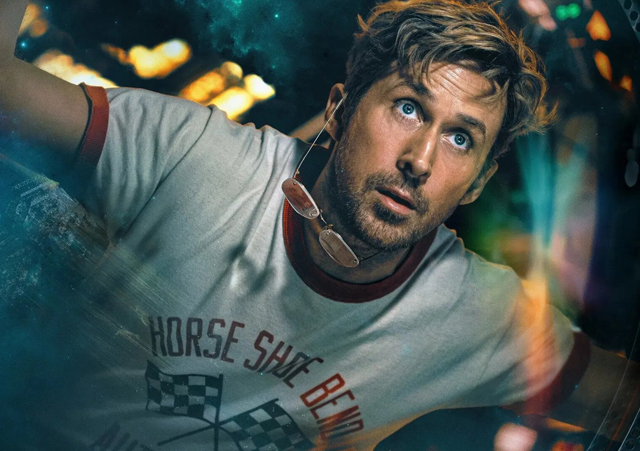
Project Hail Mary takes place mostly many light years away from planet Earth. On a space ship hurtling through the cosmos, Ryland Grace (Ryan Gosling) wakes up from a medically induced coma that has kept him in hibernation throughout the multiyear journey in far reaches of space. He has no memory of who he is or why he’s on the ship, but he uses his scientific mind to quickly piece together what mission he was meant to undertake. Flashbacks help to fill in the blank spots of his past. Ryland became part of a top secret department made up of leading scientists from all over the world, led by a stern but encouraging project leader named Eva Stratt (Sandra Huller). A groundbreaking discovery uncovers the terrifying secret that microscopic parasites called Astrophage are absorbing the energy of the sun and causing it to dim. The dimming is resulting in the plummeting of temperatures on Earth, which could lead to the extinction of all life on the planet, including humans. Ryland became the first scientist to document and understand the properties of this mysterious single celled organisms, and his research makes him one of the most valuable minds in the agency’s team. Their research has shown that what is happening to our Sun is happening to stars all over the local cluster, except for one, Tau Ceti. The mission becomes clear; a team of astronauts must travel to the Tau Ceti system and discover why it has not been infected like all the other stars around it. The amount of energy that Astrophage gives off when it consumes electromagnetic radiation and Carbon Dioxide also proves to be a good source of fuel for near light speed propulsion, so the engineers on the team manage to create an engine for just that purpose using the very thing that’s destroying their world as the key to humanity’s survival. Many years later, Ryland finds that he is the last surviving member of a crew that died during hibernation. He makes it to the Tau Ceti system, but he learns that he’s not alone, as an alien space craft intercepts his. Though imposing at first, Ryland finds that the life abord the craft are in the same situation he’s in; trying to help save their planet as well. He makes contact and finds an alien being that looks like it’s made of stone. Ryland makes attempts to bridge the communication gap, and even gives his new friend the name Rocky. It then falls on Ryland and Rocky to put their minds together to help stop the Astrophage and save their respective worlds.
We’ve had a lot of amazing space based movies over the last decade. Christopher Nolan delivered his IMAX screen spectacular with Interstellar (2014), and of course there was the already mentioned The Martian from Ridley Scott as well as Alfonso Cuaron’s Gravity (2013). Ryan Gosling also is no stranger to space based epics, as he got to play legendary first man on the Moon, Neil Armstrong, in the film First Man (2018). One of the reasons why we’ve had so many of these types of movies lately is because the vastness of space and interplanetary travel lends itself very well to big screen spectacle. You even see it be a major part in epics fantasies like the Star Wars and Dune franchises. These movies especially seemed designed for the grandeur of the big screen. This is something that we’ve known since the days of Stanley Kubrick’s 2001: A Space Odyssey (1968). Project Hail Mary follows in the footsteps of these space based epics, and is intended to be a major crowd pleaser. For the most part, it succeeds in what it hopes to accomplish. It’s an incredible spectacle that really need to be seen on the big screen to fully appreciate. It also does a great job in grounding it’s scientific concepts in ways that make sense to the average viewer, without also insulting the true science that forms it’s foundation. But, the movie also seems to hold us at a distance, which unfortunately undercuts the effectiveness of the story. The way the movie is structured is that it tells the story in a non-linear way, cutting away from the main story of Ryland in space to show us why and how he got there. While all the individual scenes are fine on their own, the way they are structured together kind of makes the pacing of the film feel a bit uneven. The main plot, involving Ryland and Rocky forming their bond and working together to solve the mystery behind the Astrophage is definitely the best part of the movie, but every time the movie cuts back to the past, it felt like the momentum of the main story was being halted. I understand that it’s supposed to be like in the book, as Ryland slowly pieces together his memory, but it just felt like a whole different movie was trying to force it’s way into another one. It just made the whole experience feel awkward and keeps a pretty good movie from becoming a great movie.
Despite that, there is still a lot to like about the story of the Project Hail Mary. Just like The Martian, the movie takes it’s time to give us details about what the problem is and how our heroes must solve it. While it’s science is a little more on the fictional side that the far more grounded Martian, it’s nevertheless treated like something that actually could be scientifically true. Just like The Martian, it’s great to see a movie treat science so respectfully. At a time when scientific literacy is at a low point, it’s great to see movies like this show why it’s essential for the fate of humanity to “science the shit” out of our current problems. But the movie doesn’t treat it’s audience as idiots either. It does go out of it’s way to be true to real science as possible. There are some leaps of logic at times, but none that come across as insulting to the audience’s intelligence level either. Lord & Miller assume that their audience has the basic understanding of how space based physics work. Sometimes they even play against your expectations, like how objects move in the vacuum of space, or moments when they play around with the complete silence of space as well. Of course, Lord & Miller use their background in comedy to help lighten many moments in the movie, and some of their best gags are reserved for those subversions of how physics work in space. At the same time, they don’t undermine the seriousness of the situation either. As far as their filmography goes, this movie is probably the most dramatic film that Lord & Miller have made. It shows that they are indeed branching out as filmmakers, not just confining themselves to comedy alone, even if it is their strongest suit. One wonders what might have been with their version of Solo. Were they really that bad of a fit for Star Wars? This movie does prove that they were capable of pulling off the spaced based spectacle on the big screen, and they could even take themselves a little bit more seriously in the process. Regardless, I hope some of that experience is what helped to fuel their approach to this film, which while uneven still demonstrates a strong step forward for these two filmmakers.
One of the things that was central to making the movie work as a whole was the casting of Ryland Grace himself. The movie for the most part is almost entirely a single-hander, with his only co-star being an alien creature without a discernable face. It would require an actor with a lot of charisma to hold a movie like this together almost completely solo. Ryan Gosling proves to be the right guy for the job. Gosling embodies this charming everyman quality that makes it easy to like him on screen with not much interference. Given that he’s by himself for a good chunk of the movie, you need that everyman quality to center the movie in something grounded and genuine. He can be aloof and funny, but we also buy him as a man who seriously is trying to think his way out of a problem. Some readers have raised concerns that Ryan is too handsome an actor to play Ryland Grace, as the character in the book is described as being more of a plain looking, out of shape guy. And while there are attempts to make Gosling look a tad more plain in the movie, it really doesn’t matter in the long run. We just need to believe in him as this character; someone who will use his mind to science a way out of this situation. Of course, what a lot of people are going to talk about is the on screen chemistry that Gosling will have with the alien Rocky. Rocky may be the movie’s greatest triumph because of the limitations on how he is able to communicate. He’s a stone based creature that walks around like a crab and has no discernable facial features. And yet, he’s incredibly expressive, showing emotion through pantomime, often imitating what Ryland does to show he’s friendly. What’s remarkable is that Rocky was actually an on-set physical puppet for many scenes, puppeteered by James Ortiz, who also provided his the voice of Rocky’s computerized translator. Obviously for some of the more complex movement scenes, Rocky’s puppet was switched out for a digital model, but you really have to give credit to the movie for actually going out of their way to build a real puppet for the film, which I’m sure Gosling really appreciated as an actor needing something to react to on set. And though her presence in the movie is minimal, Sandra Huller also brings a great presence in what is her debut in a Hollywood studio film after a distinguished career working in German cinema. It may not be a big cast, but they manage to carry this movie very well, even through it’s big epic moments.
Of course what a lot of people are going to discuss about this movie are the visual. The film is grandiose in scale, but it also manages to capture the small moments pretty well in between. Most of the movie takes place on the space shuttle Hail Mary, and the production team did an excellent job of making the sets for the shuttle look true to life as possible. The filmmakers certainly must have done their research with how space stations are built and function, and also included theoretical plans about how such facilities would work in the near future. Of course, the movie also plays around with theoretical science as well, especially in the way it imagined what Rocky’s own space ship would be like, and how it functions. The planets of the Tau Ceti system are also incredibly realized. To create these visuals in a way that does the vastness of space justice, it’s easy to see why Lord & Miller got Oscar winning cinematographer Greig Fraser on board, given that he’s been the one who’s photographed the Dune movies for Denis Villeneuve. The movie uses two types of film formats. The scenes on earth are shot in the standard scope widescreen aspect ratio of 2.39:1. But all the scenes in space (which is roughly 70% of the film) was shot on 70mm IMAX. If you are lucky enough to see the movie projected in 70mm IMAX (as I was), you are seeing the movie as it was truly meant to be shown. The vastness of space can only really be appreciated in the IMAX format. Greig Fraser does an incredible job of capturing both the emptiness of that void, as well as the overwhelming scale of the planets once these space ship arrive near a celestial body. Fraser also does a great job of shooting the interior spaces of Ryland’s space shuttle. The movie does a nice job of playing with perspective sometimes, where Gosling moves around the spaceship contrary to where we expect the floor and ceiling to be; a trick also used very well in 2001: A Space Odyssey. The visual effects team should also be applauded because it also appears that a lot more practical effects were used on this film than what we’d expect. The Rocky puppet is one thing, but it’s also clear that a lot of scenes of the two space ships were done with real physical models as opposed to CGI; another nod to 2001, but also something that Christopher Nolan also made extensive use out of for Interstellar. Lord & Miller clearly wanted to make this film feel grounded, and it’s great to see that they didn’t just rely on heavy usage of CGI to do the job. It works so much better to make this story believable when what you are seeing are real, physical things shot on camera.
There is certainly a lot to like about Project Hail Mary, and I have no doubt that this will be a winning film for most audiences. It’s got a positive message about teamwork and making personal sacrifices for the sake of saving others. It’s also a beautiful looking movie that demands to be seen on the biggest screen possible. But also I felt coming away from the movie that it lacked that certain element that could have made it even greater. I feel like it’s fundamental flaw resides in it’s uneven pacing. The movie is 2 hours and 36 minutes long, and I feel like it could have worked better if it maybe reduced those flashback scenes to a minimum. The problem is that those flashbacks end overstaying their welcome and they don’t really add much overall to the story other than providing context. There are some nice flashbacks in there, especially the karaoke scene with Eva, but what we learn about Ryland as a character is mostly found in his scenes out in space, and that ultimately makes the flashbacks superfluous. The main thrust of the story is Ryland and Rocky, and that’s where the heart is. Whenever it cut away from the their story to one of these flashbacks, I felt that momentum of the movie got halted, and it reduced the overall experience. It needed consistency in it’s pacing, and that was found mostly in those space scenes. That’s why I feel that it didn’t work as well as The Martian did as an adaptation of Andy Weir’s writing. The Martian has a much clearer and linear line in it’s storytelling, and that’s what helped it to be a much briskier film overall, even with the near identical run time of 2 1/2 hours. Even still, Lord & Miller are showing a lot of growth as filmmakers, and this movie shows just how well they can handle big spectacle in a live action movie. Their handling of the Ryland and Rocky storyline is especially well done. If anything, that the thing that most audiences are going to take away from this film, which is the surprisingly charming bromance between Ryland and Rocky. Project Hail Mary follows in the footsteps of some major cinematic classics like 2001, Gravity, and Interstellar, and while it may fall short in terms of the execution of it’s story, it still nevertheless does justice to the visual legacies of those films as spectacles. I have my misgivings about how the story was told, but I certainly recommend seeing this movie for the big screen spectacle it offers. It’s movies like these that bring us the closest to sailing through the stars.
Rating: 7.5/10