Stop motion animation is sadly an artform that has died out throughout the years. What was once one of the essential tools of visual effects in blockbuster Hollywood movies is now only being barely kept alive by a small number of independent studios around the world. Computer animation has largely supplanted stop motion animation in visual effects, but for a time it was the best possible way of bringing life to what would normally be inanimate objects in live action movies. Thanks to pioneers like Ray Harryhausen and Phil Tippet, it was an artform that thrived in Hollywood as part of the visual effects process. But, stop motion could also stand on it’s own as another form of animated entertainment. Rankin Bass and Will Vinton built their animation studios on the artform and found great success in doing so. And then in 1993, Tim Burton and Disney used stop motion animation to create the first full length feature film entirely made in the stop motion process; The Nightmare Before Christmas. With Nightmare, people saw that the process was capable of dynamic, cinematic filmmaking, and other stop motion animation studios began to expand into features as a result. Aardman Animation from the UK took their unique style and created a hit film called Chicken Run (2000). Disney also would continue to make more stop motion films with Tim Burton, namely James and the Giant Peach (1996) and Frankenweenie (2012). Another live action director, Wes Anderson, would also dabble in stop motion with two features of his own, Fantastic Mr. Fox (2009) and Isle of Dogs (2017). But there perhaps has not been an animation studio that has carried the banner of stop motion more valiantly over the last 20 years thank Laika Animation. The Portland, Oregon based studio, created from the remains of the Will Vinton studio that passed hands when the animation legend retired, has not just been continuing the artform, but they’ve been pushing it further, challenging it’s limits to make stop motion feel even more boundlessly cinematic. Over so many years, Laika is not only celebrated for it’s films but for also staying true to the creative spirit of hand crafted animation at a time when animation in the digital age is becoming more and more homogenized.
When Laika was created, it was a drastic change from how the Will Vinton studio operated. Vinton animated mostly with clay, which often gave his animations a very hand molded look. Best known for the California Raisins, Vinton’s style would be one of the most recognizable of the time period, especially across the many ad campaigns that the studio was commissioned for. But when his studio changed hands and was now owned and operated by Travis Knight, son of Nike founder Phil Knight, the animation style changed with it. Laika would still be a stop motion animation studio, but clay would no longer be the material of choice in the puppetry. Instead, vinyl plastic (created through 3D printing) would be used to create the characters more expressive facial animations, and clothing would actually be made with real cloth. Set making also became more focused on the details, making them feel more realistic. In many ways, Laika was taking a page from the success of Nightmare Before Christmas, which also took stop motion in a more cinematic direction. And that connection is apt since Laika’s first feature film, Coraline (2009) was directed by Nightmare’s Henry Selick. Coraline instantly helped to put Laika on the map, becoming an instant cult classic. Through the 2010’s, Laika would continue making more features, with Paranorman (2012), The BoxTrolls (2014), and Kubo and the Two Strings (2016) following in quick succession. But there was one thing that was eluding them all this time; box office success. All of their movies won critical acclaim, but none of them were profitable either. Stop motion is a very time consuming and expensive process, and unfortunately even the most beloved ones barely register at the box office compared to their computer animated contemporaries. To this day, Coraline remains Laika’s only profitable film, and that was nearly 20 years ago. If it weren’t for the fact that the studio is owned by a family of billionaire benefactors, it likely would’ve gone under by now. Thankfully, Travis Knight is invested in the work the studio does, even directing a couple features himself, and he wants to make it succeed without sacrificing the quality of the work. After the middling performance of Missing Link (2019), Laika took a lot of extra time making their next feature; one that would be their most ambitious yet. The only question is, does Wildwood (2026) deliver on all the potential that the studio has to offer, or is it a desperate Hail Mary for a struggling artform that ultimately misses the mark.
Wildwood tells the story of a teenage girl named Prue (Peyton Elizabeth Lee), a restless youth living in Portland, Oregon with her hippie Dad (Jake Johnson) and Mom (Maya Erskine), and her infant brother Mac. Mom and Dad entrust Prue to look after her little brother on a day when they both have to go out, but they also warn her to stay at home and definitely never go near the forests on the outside of town. Prue doesn’t listen to her parents’ warnings and takes Mac on a stroll across the city, where she has a run in with a nerdy classmate from school named Curtis (Jacob Tremblay). While on their excursion, a murder of crows swoops in and steals Mac, flying him towards the forbidden forest. Prue desperately tries to follow them, but the crows disappear into a shroud of fog surrounding the forest. Prue has no other choice but to venture forward in the hopes of finding her brother with Curtis by her side. The further they go into the woods, the weirder things get. They find animals that not only can speak, but are also wearing clothes and walking upright like human beings. In addition, there has been a longstanding conflict going on in this enchanted realm. On the one side is group know as the Bandits, who are led by their king named Brendan (Mahershala Ali). On the other side is the Dowager Countess Alexandra (Carey Mulligan), who has been ravaging the woods in a mad quest to find her lost son that was claimed by the forest many years ago. Alexandra has been dabbling in dark magic, and her aim is to cast a spell on the ivy that grows across the entire forest, thereby giving her command of the woods itself. As it turns out, part of her plan involves a blood sacrifice of a child from the outside world, which is why she took Prue’s brother Mac. In order to save her brother, Prue must seek the help of the people fighting against Alexandra’s dark ambitions, but before that she needs to find a way to prevent them from fighting among themselves. Those who might have the answer to helping Prue win back her brother include a wise owl named Owl Rex (Richard E. Grant) and an old shaman woman named Iphigenia (Tantoo Cardinal), both of whom remember what the land was like in peaceful times. Will Prue be able to save her brother in time, or will the Wildwood itself be destroyed by the fury of war.
It’s been 7 long years since Laika’s last animated feature, Missing Link, but the story of getting Wildwood to the big screen goes even further back than that. Travis Knight optioned the rights to the story, based on a novel of the same name written by Colin Meloy, all the way back in 2010, right after the release of Coraline. Knight and the rest of the Laika crew hoped that they would get to make that one of their upcoming projects, but the technical challenges to pull off a complex story like it on the scale it needed would mean that the movie would need some extra time to develop. Movies like Boxtrolls and Kubo were pushed ahead, and Travis Knight was spending more time working outside of Laika on live action projects for other studios like Bumblebee (2018) in the Transformers franchise. So, it took 16 years for Wildwood to finally become a reality. The one question is, was it worth the wait? On a technical level, the answer is unequivocally yes. Wildwood is an absolute triumph when it comes to the stop motion animation. You really have to step back and marvel at the fact that everything you are watching was crafted by hand. Only minimal CGI was used on this movie, and that was mainly to remove the strings and support structures that were used to move the figures between shots. It’s clear that Laika put everything they have learned so far in stop motion animation into this movie. This is stop motion on a scale we have never seen before, taken to an epic scale level. Travis Knight has said that they wanted to treat this movie like an animated Lord of the Rings, with sweeping epic battle scenes and lush panoramas of the landscapes. And they had to build it all by hand. It’s clear that they researched a lot about the photography done on epic movies like Lord of the Rings, and applied it to the staging of their own film. They even hired an actual, Oscar-nominated cinematographer, Caleb Deschanel (The Right Stuff, The Natural) to oversee the filming of this movie. Given the complexity of the camera angles they were using, as well as the scale they were working on, it’s understandable that this movie took 7 years to make, and it’s time that was not wasted at all. The results are absolutely impressive and breathtaking.
The only thing that unfortunately keeps the film from becoming an all time great is in the story-telling. The film is the longest stop motion movie ever made at 132 minutes, but even with that extra length it does feel like the movie is stuffing too much into the run time. This is a sprawling story with a cast of hundreds, and even with the longer runtime, it does feel like the movie doesn’t devote enough time to the things it needs too. The biggest casualty is unfortunately the main character Prue. Prue sadly never becomes that compelling of a character in the movie. The filmmakers spend so much time bringing a ton of personality to the rest of the film, that they sadly kind of overlooked the main character. She’s not a terrible character by any means. The actress doing her voice, Peyton Elizabeth Lee, does a good job with what she can. It’s just that her character never really gets a chance to grow in the story. She changes very little from beginning to end, with her only real character development being she goes from being a skeptic about magic to very quickly accepting it as a reality. I think the reason why Prue feels so uninteresting is because we’ve seen Laika tackle this kind of character type before and did it much better. That character of course was Coraline. Just like in that film you had a rebellious pre-teen girl who navigates her way through a vibrant fantasy world, but in her film, Coraline is given a much bigger range of development to go through, ultimately making her a more fascinating character overall. The fact that Wildwood has to breeze by so much story in a short amount of time unfortunately leaves Prue with little impact put on her character, and it unfortunately lessens the impact of the movie as a whole. But that lack of development with the main character doesn’t ruin the movie experience as a whole. All it does is just keep the movie falling just short of perfection. Perhaps if they kept out one or two minor characters that don’t impact the story that much and gave more time towards defining Prue as an individual personality, we might have had an all timer with this movie.
That being said, there are a lot of great characterizations found in this movie. One of the particular standouts is the villainess Alexandra. While Prue is not as interesting as she could have been, Alexandra more than makes up for that by being an endlessly fascinating presence in the story. She very much is not like most other fantasy film antagonists. The film does go out of it’s way to show her tragic backstory and explain why she is the way she is. But at the same time, the film also doesn’t let her off the hook either for all the horrific things she does. The temptation could have been there to make her too sympathetic and as a result would have lessened the threat she poses in the story. The tragedy of her back story is there to be a layer in the complexity of her twisted character, and she manages to maintain her menacing presence throughout the film. Carey Mulligan also does a brilliant job of voicing her, giving her a chilling calm demeanor that makes her all the more sinister. One of the other highlights is Jacob Tremblay’s performance as Curtis. Curtis manages to get a satisfying arc throughout the film, and the film thankfully makes him more than just the nerdy tagalong friend to the main character. He goes on a journey of his own that goes into some unexpected places, and Tremblay does a great job of bringing that personality out in his vocal performance. There are also so pretty great supporting work from an impressive and varied ensemble of voice actors, including Mahershala Ali Jake Johnson, Tom Waits, Charlie Day, Richard E. Grant, Angela Bassett, Jemaine Clement, and Awkwafina. One of the standouts though is Native actress Tantoo Cardinal as the priestess Iphigenia. She masterfully brings a warmth and humor to the character that again helps her to be more than just the archetype of the wise sage guiding the main hero towards their destiny. Despite the movie feeling a like rushed at times, the film does manage to build some wonderful character moments that do lead to a fulfilling story overall.
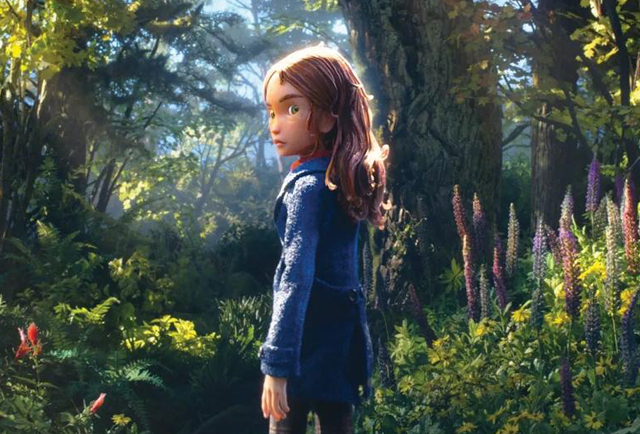
Of course, the main attraction is the look of the movie itself. It will probably take multiple viewings to fully appreciate the amount of detail that went into the building of this film. Every set feels like a real lived in space, but it of course was done in miniature to accommodate the stop motion process. Wildwood is somewhat of a departure for Laika, because the character models are far less exaggerated than what we’ve seen in their other movies. From Coraline on, Laika has given their human characters very exaggerated facial features, including big cartoon eyes and weirdly shaped heads. With Wildwood, they went in a more realistic route. The characters here still feel like animated characters, but their features are more natural and less cartoony. This fits with the more serious tone that the movie is going for, and the animation put into the characters is still wonderfully expressive. One other thing that I also love about the movie is that it’s a love letter to the natural beauty of Oregon. I always love to see my home state represented on film, and it’s even rarer to see it in animation. Coraline also had an Oregonian setting, but Wildwood goes much further beyond, showcasing many distinct landmarks found throughout the state. There’s even a great montage early on in the film showcasing the city of Portland, including well known spots like Powell’s Bookstore and VooDoo Donuts, and of course the Willamette Riverfront and all of it’s many bridges. Travis Knight, also a native Portlander, wanted to make his hometown feel like a magical place, and the movie succeeds in faithfully recreating the city in animation, and also creating a magical world within that still maintains that quirky quality that the city lives up to. The visuals of the Wildwood also are incredibly rendered on screen. The level of detail they put into the forests is staggering, and it probably took half of the production time filming this movie just to build out all the sets for these hand crafted forests. This movie really shows you how special stop motion animation can be, especially when it is scaled up to this degree and treated with this amount of cinematic artistry.
Thus far, Laika Animation has not missed once in terms of the quality of their animation. Even their lesser films like Boxtrolls and Missing Link are far more imaginative than about 80% of the computer animated movies put out today. Wildwood is unmistakably the most ambitious thing that the studio has ever done. It very much succeeds at being what Travis Knight described as a Lord of the Rings for stop motion, at least on the visual level. It unfortunately falls just a little short in terms of story, mainly due to the fact that it’s trying to tell too much story, and as a result it lessens the development of some of the characters, especially the main protagonist. But, you can still see the love that was put into this film from all the wizards that work at Laika. There is so much detail put into every scene, and multiple viewings will likely even enhance the movie over time as we pick out more of the things we missed the first time around. I’ll definitely have to think more about where I would rank it with Laika’s other films. I can definitely say it ranks among the best, and is probably their greatest achievement overall on the level of the craftsmenship behind it. I do strongly recommend people see it, because we need more movies like it. At a time when the standards of quality are dropping for big studio made computer animation films, and the creeping threat of AI is starting to emerge, we need to celebrate and promote the films that are still proudly handcrafted. The film spotlights the power of animation in it’s truest form, crafted one frame at a time by human beings physically putting it together. Not that computer animation is all bad; Pixar still puts out great movies every year in that format. But we should really be putting our support towards the animated movies that are outside of the norm and dare to be challenging. Laika has taken an artform as old as cinema itself and is making it feel fresh and new with levels of craftsmanship that is unrivaled in the industry. The studio is also in need of a hit as well, so that they can continue to make more movies like this in the future; and that we hopefully don’t have to wait another 7 years to see their next one. Take a nice stroll into this Wildwood and lose yourself into this magical enchanted forest.
Rating: 8.5/10