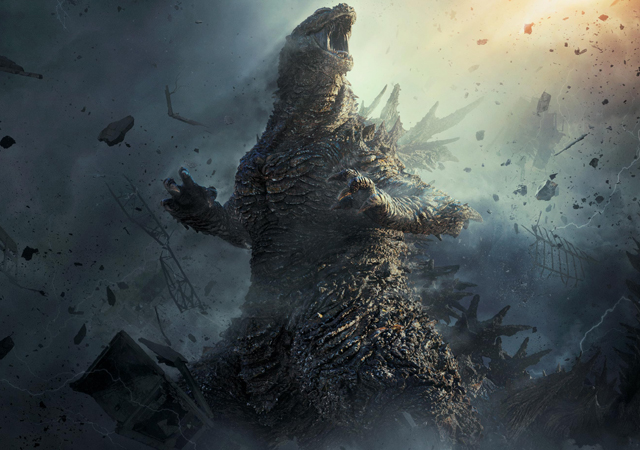
It’s been a very good time to be a fan of monster movies. The subgenre of big movie monsters (or kaiju) rampaging through busy cities full of people has come a long way from it’s B-movie roots. Now with CGI as a valuable tool in helping the impossible appear real on the big screen, we have monsters that feel far more larger than life and far from the artificiality that defined the earlier visual effects that brought them to life. We are at a point now where Legendary Pictures has built up a whole cinematic universe where all of the legendary giant movie monsters can appear alongside each other. But, if we were to define the genre as a whole, no character represents that popularity of monster movies more than the King of Monsters himself, Godzilla. Created in Japan in 1954 by the legendary Ishiro Honda, Godzilla gave this genre that was more or less mired in B-Movie cheese some actual weight and importance. With Godzilla, Honda created a powerful metaphor for the post-war anxiety that plagued Japan in the 1950’s; a nation that was reeling from not just loosing the war, but also having suffered the world’s first and only nuclear strikes. Godzilla represented that specter of fear of more nuclear war that weighed heavily on the Japanese people, and it made the creature Godzilla a far more fearful presence than most of the other monsters found in movies at the time. Since it’s first release, Japan has revered the movie Godzilla as an important cultural landmark, and the character has since become one of the nation’s most important cinematic exports. The name Godzilla has become known worldwide, and Hollywood of course has done it’s own part to keep Godzilla in the public eye. There was of course the awful Roland Emmerich movie from 1998, which completely messed up the adaptation of the character for a new generation. But a generation later the Monsterverse led by Legendary Pictures helped to resuscitate the character by bringing him back to his classic look and power set. Those movies have also given him a chance to battle against Hollywood’s own homegrown monster icon, King Kong. But if there was ever a better steward for the character than Hollywood, it would be the company that brought Godzilla to the big screen in the first place: Toho Productions.
Toho is primarily known here in the states for two things: Akira Kurosawa and Godzilla. They are Japan’s most legendary movie studio and for good reason, given the pedigree of legends that walked it’s halls. Of course Kurosawa gave them the prestige in international cinematic circles, but Godzilla was the one who brought in the big money for Toho. After the original 1954 film, Toho would make 32 total films starring the king of kaijus. For the most part, these movies would stick to a formula, having Godzilla facing off against a new rival monster in every movie. Toho also kept the tradition of having Godzilla be brought to life with a man in a giant lizard suit walking around in a miniature set, with actor Haruo Nakajima often being the guy in that suit over the span of 20 years. But as time went on, that old school way of making monster movies fell out of style. Eventually Toho moved away from the Godzilla franchise, with a couple modern attempts like Godzilla 2000 (1999) and Shin Godzilla (2016) made in the new digital age of cinema. But then came a fresh new take on the character of Godzilla that surprised everyone. Godzilla Minus One (2023) stripped away all of the cheesiness of past Godzilla movies and brought the genre back to it’s roots as a parable of wartime anxiety. What really helped Minus One stand out from all the other Godzilla movies from before was the fact that it didn’t treat the human side of the story as an afterthought. Indeed, the movie’s human drama was just as compelling, if not more so, than the fight against Godzilla himself. In Minus One, Godzilla became a source of existential fear once more; a force that weighs heavy on the characters, even when he isn’t present on screen. In the movie, we see characters that have to suffer through a lot just in order to find happiness in a world that gives them so little hope. And the movie wisely also brings the story of Godzilla back to that post-war period in Japan; further emphasizing his connection to the mood of a broken nation trying to find it’s way back to normal again. The movie was widely praises, and it even became a surprise Oscar winner in the Visual Effects category; a first for the nation of Japan. Now, Toho and the team behind Godzilla Minus One are bringing us a much anticipated follow-up. The only question is does it live up to the success of the original and stand on it’s own, or does it show that the former was a one off fluke?
The story picks up not long after the event of Godzilla Minus One. War hero and survivor of the operation that brought down Godzilla, Koichi Shikishima (Ryunosuke Kamiki), is trying to re-establish his life after that harrowing ordeal. He became reunited with his wife Noriko Oishi (Minami Hamabe) after she was believed to have died during the attack on Tokyo by Godzilla. Noriko lives, but she hides a secret condition from the rest of the world. Her close contact with Godzilla has left her body slightly mutated. Unlike most of the other survivors of Godzilla’s attacks, her body didn’t succumb to the deadly after effects of exposure to Godzilla’s cells. Her condition remains hidden thanks to an eyepatch she wears everywhere, and she spends most of her time looking after orphaned children, including her and Koichi’s adopted daughter Akiko (Sae Nagatani). Meanwhile, the team of scientists that have studied the after effects of Godzilla’s rampage through Japan, including Kenji Noda (Hidetaka Yoshioka) and Kanji Murakami (Min Tanaka) have discovered a new threat emerging from the mountainous regions. A new winged kaiju that kills it’s prey with sparks of lightning shot from it’s mouth has been discovered and is terrorizing the countryside similar to how Godzilla had before. They give the creature the name Ghidorah and attempt to find ways to subdue the creature and hopefully eliminate it like they had Godzilla. Unfortunately, Ghidorah is a far more formidable monster than they expected; capable of evolving into a new and more indestructible form after being pressured. Making matters worse, the once thought dead Godzilla has re-emerged from the ocean depths. The anti-Godzilla team must now deal with a dual threat that they are very ill-equipped for, even with the less than helpful American military also making their play to harness the power of these monsters for their own ends. One key that may make a difference in the fight is Noriko’s special connection to Godzilla. Both her and Koichi are once again called upon to save the people of Japan from these massive monsters. The only question is will they be able to survive this time around, especially when it looks like the two monsters are on a path towards fighting each other in what will likely be a very bloody death match.
When Godzilla Minus One came out, it took the world by storm. It’s far more serious take on Godzilla was praised for it’s emotional story and groundbreaking visual effects. After seeing the genre fall into farce over the decades, and become more fodder for popcorn flicks than actual societal commentary, people embraced this film that brought the genre back to it’s roots as a serious exploration of post-war trauma. Setting it in the past ironically helped to modernize the genre and help it speak to contemporary audiences. So, it made sense for a sequel to keep the franchise in that same period of time, which of course harkens back all the way to Godzilla’s cinematic origins. Godzilla Minus Zero picks up right where the last film ended and keeps things more or less on the same level as before when it comes to story and tone. The question is, did it make things any better. I have to confess, my own reaction to Godzilla Minus One wasn’t quite as enthusiastic as it was for many other people. Not that I disliked the movie by any means. I thought it was quite good and impressively made. It just wasn’t the masterpiece that everyone else was proclaiming it to be. For me, I found myself being a tad bit underwhelmed by the actual parts with Godzilla, which seemed to happen too few and far between. They weren’t bad scenes, but I felt there could have been more. What really stood out to me was the human drama, which was exceptionally well done, and quite the shift for the genre which usually treated their human characters as afterthoughts. Overall, Minus One was an admirable film, but I felt that it could have been just a bit more. So, how does that compare with the sequel. Strangely enough, my opinion of Godzilla Minus Zero is that I felt exactly the same about it as the first, in that it was pretty good but still had something that was lacking. This time around though, I think the reverse happened. I found that the action moments with Godzilla and Ghidorah were an improvement over the first movie (and they take up a lot more of the screentime) but it comes at the expense of the human drama which gets less focus this time. It would seem that a trade off happened between movies, and while the whole film is still an impressively mounted piece of cinema, it also feels like it left something out that could have made it a masterpiece.
I think the main reason why the action scenes feel improved here is because we get more than one monster this time. Of course Godzilla is still the main attraction, but it’s also fun to see him have to face a opponent his own size and the chaos that that showdown will bring. I am happy that the team behind Minus Zero didn’t just make up a new monster for Godzilla to fight, and instead called in one of the classic foes from the old school movies. Ghidorah, or King Ghidorah as he’s mostly been called, is a great choice, and he looks pretty spectacular in this movie. With his serpent like hydra heads to the lightning bolts he blasts out from his mouth, he is every bit the same character we all know and love, and yet made all the more epic with this new refreshed treatment. Not only that, the movie does an excellent job of making him a terrifying force. He’s established very well early on with an aerial battle that definitely shows the stakes of what kind of destructive power and malice he brings towards mankind. We also get a lot more screentime for Godzilla himself that definitely feels welcome. Both of these recent movies have a reverence for the character Godzilla. They understand how much importance this character has in the history of Japanese cinema. He may not be the largest version of the character that has ever been put on screen, as I think the Monsterverse version actually is a good 100 ft taller by estimates. But this is a Godzilla where you just feel the weight of the character presented on screen. The sound production team deserves a lot of praise as they make every footstep of Godzilla’s as low base as possible, which just gives you a sense of the mass this creature must carry with him as he moves around. And the fight scene between Ghidorah and Godzilla does not disappoint, especially when they each get to pull out their special abilities. I’m happy that this part was given more focus, and it’s honestly what helps me to grade this film just slightly better than the first one. There were stand out moments in the first movie when it came to the action, but this film delivers quite a bit more over the course of it’s runtime.
It unfortunately means that something had to be sacrificed in order to make more room for the monsters. Godzilla Minus One’s best attribute (it’s human storyline) is unfortunately stripped down in order focus on the monsters. While still done fairly well, the story unfortunately doesn’t give much extra character development to it’s humans. They are pretty much the same characters from beginning to end, without much growth. Even still, you’ll still find yourself rooting for these characters. Thankfully most of the same cast returns. Ryunosuke Kamiki plays ace pilot Koichi once again and his performance is still as powerful as ever. You just get a sense of how beaten down this guy is in Ryunosuke’s powerful performance. He’s had to survive both a losing World War and an attack by Godzilla only to be called to duty once again when another monster shows up. All of that pain very much comes out in the frustration the actor perfectly conveys in the performance. Another highlight in the cast is actor Min Tanaka as the scientist Murakami-san. The veteran performer has been a presence in both Japanese and even Hollywood cinema, and he gives a commanding performance here as a man with deep, deep scars left on him by the war. He’s the one character in the movie who witnessed the bombing of Hiroshima, which itself was a real life destruction event that the movie parallels with the new attacks by these giant kaiju monsters. The way we see him suffer through his own survivor’s guilt brings the movie it’s most emotional moments, which becomes part of the moral of the movie as a whole. Unfortunately most of the other human characters are mainly there to just look in awe at the destructive force that these monsters are bringing. One other thing that I thought was fun and interesting is the way the movie treats the American military in the film. All of the American servicemen in the movie seem to be intentionally played as very one note and wooden, which I feel is a little commentary by the Japanese on how Hollywood would often portray Asian characters in their own war movies as one note and stereotyped. The American actors do a good job of playing into this inside joke, and interestingly enough, one of them is played by Jordan Vogt-Roberts, the director of the Monsterverse’s Kong: Skull Island (2017) in a fun little cameo.
This movie does mark a historic moment for Japanese cinema in that it is their first ever film shot with IMAX. Now, the entire movie wasn’t filmed solely on the format, ala Christopher Nolan’s The Odyssey (2026). Many of the dialogue driven scenes are still shot on standard anamorphic 35mm. But more than half of the movie did open up to the full 1.43:1 ratio of IMAX, which of course included ever single shot of Godzilla himself. I was fortunate to see this in IMAX, and that format is really what this movie was made for. You really get the feeling of the scale of these monsters in the format. Depending on the size of your screen, it will feel like Godzilla really is his true size right in front of you. The IMAX format is also incredibly immersive at times in the movie, including the early aerial fight with Ghidorah. The expansion into IMAX really makes you feel enveloped into the experience of the movie, and it makes a big difference. It’s great to see other international cinematic industries jumping onto the IMAX craze, bringing their own cultural icons to the biggest possible screen. It’s only natural that Japan would make their format debut with the character that put their industry firmly on the map. The Oscar-winning effects team also returns, supervised by the director himself, Takashi Yamazaki. This visual effects veteran has definitely left his mark with these Godzilla movies, and this film shows him becoming even more comfortable with his abilities as a filmmaker working on a more epic scale. The fact that he not only writes and directs these movies, but also oversees the visual effects process is definitely make him unique among his peers. A lot of praise definitely goes to the production design team, which did a magnificent job of re-creating post-War Japan, as well as the before and after ruins that the monsters leave behind. Another great contributor is Naoki Sato who composed the music for this movie; another holdover from Godzilla Minus One. His score is big and brassy, and is quite aggressive in it’s underscoring of the movie in a way that definitely fits with the overall tone of the movie. I especially like a particular moment in the score when it pays homage to the music from the original 1954 version. You’ll know it when you hear it, and it’s played for just the right moment too.
It will be interesting to see how this movie will play with audiences in response to the success of the original. In many ways it does improve on the original film, but in the process it also created some new problems that I felt it could have avoided. For me, the movie just comes out slightly ahead of the first movie, but still falls short of being a masterpiece level film. It’s still a very good movie overall, and well worth checking out. These are by far the best Godzilla movies that we’ve had in a generation, though I do also enjoy the Monsterverse movies as well, even though they are more cliche and corny. It is pleasing to see Toho still treating their most iconic character with a great amount of care and reverence. They know what Godzilla means to their cultural imprint, and they want the world to see that they can still deliver the same kind of movie that the franchise was built on since it’s foundation. The film definitely still leaves the door open for more adventures. I would imagine that after seeing King Ghidorah make an appearance in this movie that more classic kaiju monsters are also going to be making their way once again to the big screen within this franchise. Hopefully that includes more benevolent kaiju monsters like Mothra and Gamera as well. At the same time, we don’t want to see this franchise once again fall into farce. One of the things that is revealed in the story is the idea that the Japan of this period that remained under American occupation post-War was being treated like a pawn in the ongoing Cold War tensions between the superpowers of the Soviet Union and the United States. That might be something worth exploring in future films that can help enrich the human story while the storyline with the monsters is still going on. Who’s to say where this will go. At the very least this new movie demonstrates that there is still artistic value in telling a story about mass destruction caused by giant monsters. Godzilla (1954) proved that a big loud monster movie could hold a deeper meaning, and it’s a positive thing that Toho remains committed to making their monster movies the same way today. So, if you loved Godzilla Minus One, chances are you’ll love Minus Zero as well, and if you didn’t like the first, I can say that some things were improved between movies. And do seek out an IMAX screening if you can, because the best way to make these monsters feel big is if you are watching them on the biggest screens possible. It’ll be a monstrously good time at the movies, and one to roar about as it sets a new milestone for Japanese cinema itself.
Rating: 8/10