Without question one of the most important pairs of filmmakers that had a profound effect on cinema over the last half century have been the Coen brothers. Both Joel and Ethan Coen emerged out of the independent movement of the 80’s and 90’s to become some of the industries most idiosyncratic voices movies. But even while their style of filmmaking is distinctively modern, their choices in storytelling feel very rooted in classic Hollywood. Their movies have run the gamut between screwball comedy, western, and noir, all the while still maintaining that peculiar Coen Brother touch to them. What really makes their dynamic interesting is that their cinematic vision is so uniquely unified, given that their two minds have resulted in one singular style. We all know a Coen Brothers movie when we see it, no matter what genre it is. The Coens have also been very guarded about their approach to movie-making. Unlike a lot of other filmmakers, they rarely pull the curtain back to show us how their films were made and what their method entails. The hardly ever do interviews, so when their movies make it to home video, they often either have only the bare necessities of bonus features, and if there is more, it’s thanks to the participation of those involved in the film who are not named Coen. Even still, Criterion has been able to bring some of the Coen Brothers movies into the collection and with the usual bells and whistles involved. Strangely the brothers’ introduction the collection was not one of their most famous films, but rather the movie that was their then most recent release; Inside Llewyn Davis (2013, Spine #794). Since then, a number of other films of theirs have entered the collection, including their debut film Blood Simple (1984, #834), the critically acclaimed Prohibition Era thriller Miller’s Crossing (1990, #1112) and the black and white noir The Man Who Wasn’t There (2001, #1301). These are great additions to spotlight some of the Coen Brothers’ lesser known works, but unfortunately their most iconic films like Raising Arizona (1987), Barton Fink (1991), Fargo (1996), The Big Lebowski (1998), and O Brother Where Art Thou (2000) have still yet to be added to the collection. But Criterion did manage to land a coup by having the Coen Brothers’ Best Picture winner enter the Collection; 2007’s No Country for Old Men (#1243)
The movie would end up winning four Academy Awards for Best Picture, Directing (for both of the brothers), Adapted Screenplay (Coens again) and Supporting Actor for Javier Bardem. In the years since, this Oscar win would only grow in esteem given that it beat out other films that have gone on to be proclaimed as masterpieces in the nearly 20 years since, like Paul Thomas Anderson’s The Will Be Blood (2007) and Tony Gilroy’s Michael Clayton (2007). But that doesn’t mean No Country for Old Men’s win looks undeserving either, but rather an impressive feat. It certainly was a culmination of many years of the Coen Brothers building up an impressive body of work that the Academy could no longer overlook. No Country for Old Men also had the Coen Brothers working with a more serious tone than a lot of their other movies. Sure there were dark elements in movies like Fargo, but there was also this underling of humor throughout their body of work. Not so much with this film. It is easily the bleakest film that the duo has ever made. Adapted from the novel of the same name by Cormac McCarthy, this is a haunting exploration of the darkest reaches of the human soul, fueled by greed and twisted takes on moral justice. McCarthy of course was a legendary writer whose body of work can best be described as Western Gothic. While No Country for Old Men is a celebrated work of his, it’s not quite regarded as one of his most famous novels, and is largely elevated in esteem due to this film adaptation. His most famous works that have defined him the most as an author would be the post apocalyptic The Road, which was adapted into a 2009 movie, and Blood Meridian, which some have claimed to be an un-filmable book due to how dark and graphicly violent it is. The fact that it still hasn’t been adapted into a film even after 40 years is testament to that reputation. But, for No Country for Old Men, you can’t help but feel that the Coen Brothers were the ideal match for McCarthy’s novel. Their history of making insightful explorations of the hidden corners of American society matched up perfectly with McCarthy’s pitch black look at the amoral world of America’s borderlands, and the twisted characters that call it home.
In the harsh desert expanse of West Texas, a ranch hand named Llewelyn Moss (Josh Brolin) stumbles across a drug deal that went horribly wrong. In the middle of a massacre scene with multiple bodies, he finds a briefcase filled with $2 million. Eyeing a valuable prize, Moss decides to take the money for himself, but it doesn’t take long for him to be discovered by cartel members who are also searching for the money. Moss manages to shake off the cartel, but knows now that he is a wanted man. He tells his wife Carla Jean (Kelly Macdonald) to go to her mothers as he leaves to go into hiding with the suitcase of money. Following the trail that Moss has left behind during his escape is a local lawman named Ed Tom Bell (Tommy Lee Jones), a seasoned veteran who’s been burdened down by a world that’s become more deadly and corrupt over the years. Bell hopes to catch Moss alive, but that seems to be better said than done, because an even more dangerous predator is out there searching for Moss as well. The cartel has hired an extremely ruthless bounty hunter named Anton Chigurh (Javier Bardem) who’s weapon of choice is a tank fueled stun gun that’s typically meant to slaughter cows. Chigurh is a man of few words and an almost detached presence wherever he goes, seemingly acting like an angel of death with the sole purpose of collecting his bounty, while also killing anyone who gets in his way, unless they manage to beat fate through a coin toss. Another bounty hunter named Carson Wells (Woody Harrelson) also has his sights on Moss, and manages to catch up to the fugitive, reasoning with him that he’ll offer protection from the more lethal Chigurh. But even though Moss considers the plan Wells gives him, Chigurh manages to catch up first, and it doesn’t end well for the competition. The last remaining option is for Moss to face justice by awaiting for Bell to deliver him into the hands of the law. The only question remains, can Moss elude the seemingly undeterred movement of certain death heading his way in the form of Anton Chigurh. And what can an old timer like Bell do when faced with all the chaotic evil that has erupted out of this simple act of greed that spiraled into this trail of blood through the desolation of this backwoods borderland community.
No Country for Old Men represents Cormac McCarthy at his finest, telling a story that is both contemporary and immediate in it’s setting, but also biblical in it’s themes. While it is a tale of good vs. evil in the biblical sense, it also shows us the moral grays to blur the lines between good and evil that define who these characters are. The purest depiction of good in the story is Ed Tom Bell, the seasoned old sheriff who sticks by his moral center. But the story also shows that his moral code is almost incompatible in this world of overwhelming evil fueled by greed and ambition. He is the embodiment of the novel and film’s title, No Country for Old Men, an aging symbol of the old traditions on which the West was built on, and helplessly watching as this new, destructive world is passing him by. And then you have the opposite of that in Anton Chigurh, an amoral machine of death that seems to be the embodiment of this more nihilistic future. And yet, even with his seemingly detached attitude towards killing, Chigurh doesn’t seem like he does it for his own profit or pleasure. It’s almost like he kills as a duty to the order of the world. That’s why he seems obsessed with the idea of fate. He puts people’s lives up to the decision of a coin toss. If they win, he leaves them alone and moves on, but if they don’t, they become one more casualty amongst many others. In what is perhaps the most famous scene from the movie, this test of fate is profoundly staged in a random gas station stop that Chigurh makes on his way to finding Moss. Javier Bardem brilliantly plays this moment, as does character actor Gene Jones as the gas station attendant, with a simple coin flip turning into an almost biblical test of fate. In that one scene, you see how well the Coens were perfectly matched for the material. Most other filmmakers would’ve sensationalized this scene, but the Coens keep the staging of this moment simple and to the point. It plays without music, and almost with minimal sound, like the whole world has grown silent just to witness the outcome of this very moment. The Coens knew the gravity of the story they were telling and they wanted to do justice to McCarthy’s writing, which itself has it’s own detached style, reflecting the starkness of the world that it is depicting.
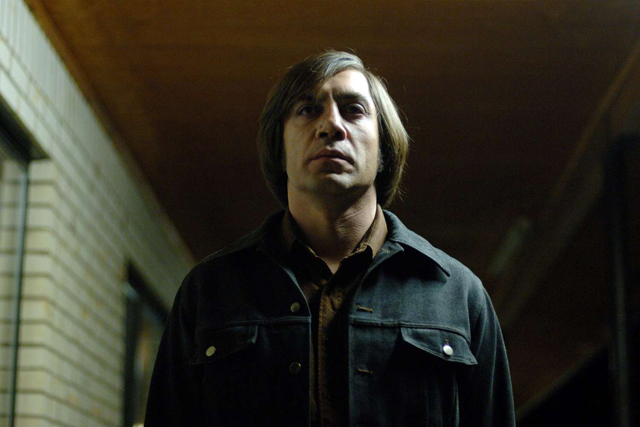
It’s no surprise that the performances throughout the movie are top notch. Josh Brolin had a breakout period in his career with both this and his Oscar nominated performance in Gus Van Sant’s Milk (2008) the following year. Long before he would join Marvel and bring the villain Thanos to life, he showed off with these films that he was a dramatic actor worthy of working with the best. In fact, he has become a favorite of the Coen brothers, appearing later in their films True Grit (2010) and Hail Caesar! (2016), the latter as the lead actor. Here he does a great job of showing Llewelyn Moss, a morally conflicted man who gets himself way in over his head due to his own greedy ambitions. Tommy Lee Jones of course delivers a knockout performance as Ed Tom Bell, the one pure soul who remains steady in a world that has long abandoned him. And of course Javier Bardem in an absolutely iconic villainous role as Anton Chigurh. The great testament about his performance is that he still manages to be terrifying even while having a ridiculous bowl style haircut on his head, something that Bardem even joked about during his Oscar acceptance speech. Even beyond that iconic gas station moment, his whole performance is chilling to watch. It’s the way that he plays Chigurh as this almost robotic like killing machine; like the Terminator if he were flesh and bone. A lot of the aura off his performance just come from watching him so effortlessly perform his job without distraction. It makes him both fascinating and terrifying at the same time. One other major thing of note in the movie is the absolutely stunning cinematography by frequent Coen brothers collaborator Roger Deakins. Deakins does such a brilliant job of capturing the sweltering conditions of these hot Texas desert locations. It’s the nighttime scenes where he especially excels, because his stark contrast between stark fluorescent and neon lighting and dark shadow in between give you a sense of the still oppressive heat that stick around even after the sun has gone down. Deakins also does a brilliant job of capturing the vastness of the empty West Texas vistas. Deakins, despite having many previous nominations, would sadly still have to wait for his Oscar, as There Will Be Blood’s Robert Elswit took a well-deserved award home that year, but No Country for Old Men was yet another reminder that he is indeed one of the greatest cinematographers of all time.
When it comes to Best Picture winners in the Criterion Collection, you know that the home video presentation was going to be done with a great amount of care. Given that this movie is just under 20 years old, Criterion had a good source to draw from in their transfer. A new 4K scan of the original 35mm negative was used to creative this digital master, with Roger Deakins supervising the final grading and processing. What results is a director and cinematographer approved transfer of the movie that is honestly the best that it has ever looked outside of the cinema. Free of blemishes and imperfections, this is a very clean and clear image that makes the overall movie look amazing in 4K viewing. You would probably find it hard to believe that this a film reaching it’s 20th year, because it looks like it could’ve been shot just last week. The movie still holds up visually, which is typical of most Coen brothers films which often have a timelessness to their movie that help them stay relevant after many years. The film also gets a magnificent restoration of the original 5.1 soundtrack. It’s not a dynamic film in the sound department, given that so much of the movie’s tension is built through it’s use of silence, but whenever that silence is broken, it sounds amazing on any system. That gas station scene in particular makes great use of subtle sound, especially with the desert wind howling just outside and even the slight rustle of a candy wrapper standing out. All of it comes across with crystal clarity. The film was given a Dolby Vision certified presentation, so the dynamic range in color really pops off the screen if you watch it on a 4K television set equipped with HDR. It’s a wonderful transfer for a film that isn’t even the flashiest of movies that the Coen brothers have ever. Imagine what Criterion could do with a movie splashed in color like The Big Lebowski. For a movie that has the esteem of Oscar behind it, the Criterion Collection certainly does not disappoint, and the movie gets the treatment it deserves under their label on a visual and audio level.
Given the Coen Brothers aversion to doing interviews about their movies, it’s not surprising that their presence on the bonus features for this Criterion edition of their movie is pretty sparse. Even still, they did manage to do a special sit down interview just for Criterion, with author Megan Abbott moderating. The interview becomes more of a discussion about the movie and how it relates to Cormac McCarthy’s novel, but the brothers do discuss how they approached their adaptation of the novel. In particular, they point out how seriously they took finding the right locations for the movie that fit with the vision of the bleak Texas desert setting that Cormac described in his book. Another new documentary on the Criterion set is a conversation between Roger Deakins and associate producer David Diliberto, also hosted by Megan Abbott. Their discussion covers a lot more ground about the on the set work that went into the making of the movie. They talk about all the motels and cattle farms they came across during the making of this movie, searching for the right locations that would fit the story they were telling. Much of the remaining material on the set are archival bonus features that were found on previous home video releases of the movie from Miramax. One of the more interesting bonuses found here is a behind the scenes documentary made by Josh Brolin himself. In it, he gets clips of interviews from his fellow co-stars as well as the Coens themselves, all discussing what it’s like making the movie as it’s being made. A more standard Making of documentary from Miramax is also available on the set, as well as promotional interviews with Brolin, Tommy Lee Jones, Javier Bardem and Kelly Macdonald. Another documentary has cast and crew discussing what it is like working with the Coen Brothers, which offers a nice portrait of the elusive duo from both long time collaborators and newcomers alike. Another short documentary called “Diary of a Country Sheriff” delves deeper into the pivotal character of Ed Tom Bell, and his symbolic place within the story. Tommy Lee Jones particularly shares his own thoughts about the character and how he approached bringing him to life through his performance. Lastly the film’s theatrical trailer can also be found as a bonus feature. Like always, Criterion gives you a full package worth of bonus features, especially with a movie of this award winning pedigree.
It was an extraordinarily competitive year at the Oscars in 2007, with three certifiable masterpieces at the top; No Country For Old Men, There Will be Blood, and Michael Clayton in the running for Best Picture. Personally, I would’ve gone with There Will Be Blood personally, just because it was my favorite movie of that year and one of my favorites of all time. But, there’s no denying that the Coen Brothers were deserving and long overdue for attention from the Oscars. They helped to define cinematic art through the 90’s and 2000’s, including delivering Oscar winning movies like Fargo in the process. They were too good not to get their due recognition from the Academy, and No Country for Old Men was the movie that came at the right time to capitalize off of that goodwill built up over the years. Paul Thomas Anderson, who got overlooked that same year, in a way had the same outcome happen for him in the last year as he finally got his long overdue Oscar win for One Battle After Another (2025). But, what is more important is whether or not your movie stands the test of time beyond it’s win at the Oscars, and No Country For Old Men is one of those timeless movies that still feels just as fresh and relevant as it has ever been now almost 20 years later. Javier Bardem’s chilling, Oscar-winning performance as Anton Chigurh is still as iconic as ever and the character has risen to be considered in the annals of the greatest cinematic villains of all time for most people. The movie also helped to propel Josh Brolin into another stage of his career as a serious actor and leading man. But what is special about this movie is that it stands alone even among Coen Brother movies. Not even in their body of work does a movie like it exist, except maybe their adaptation of True Grit, and that is a more traditional Western than this one. The movie they made right after this was the darkly comic Burn After Reading (2008), which is a huge tonal shift for the Coens after the bleak No Country. It shows that the Coens were never filmmakers inclined to rest on their laurels and continue to follow Oscar glory. They made movies that appealed to them just as much as they would to their audience, and that’s why their filmography is so wild and varied. Criterion did justice to this iconic piece in their body of work, and hopefully the Coens will allow even more of their movies to become part of the Collection. This is no coin toss, it’s a certifiable win for any collector of classics from the Criterion library.
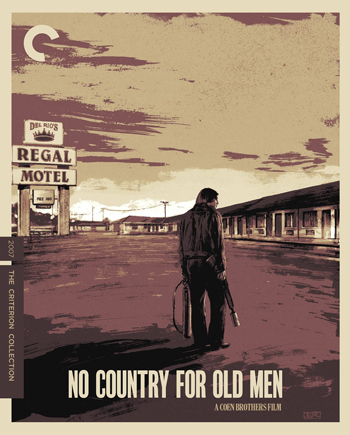
https://www.criterion.com/films/29429-no-country-for-old-men